Showing posts with label Yemen. Show all posts

Wednesday, September 4, 2019

US, UK and France May be Complicit in War Crimes in Yemen


UN Report


Global Research, September 04, 2019

JURIST 3 September 2019

A UN panel reported Tuesday that the US, UK and French governments may be complicit in war crimes for their assistance to the Saudi-led coalition that is attacking and starving civilians in Yemen as a military tactic.
The panel’s report, drawn from interviews with more than 600 victims and witnesses involved with the half-decade long violence in Yemen, describes a pattern of human rights abuses. These include indiscriminate bombing of civilian targets, shelling non-military targets and intentionally impeding international aid including food from reaching civilians. In a press release accompanying the report, the panel stated that “the governments of Yemen and the United Arab Emirates and Saudi Arabia, as well as the Houthis and affiliated popular committees have enjoyed a pervasive lack of accountability for violations of international humanitarian and human rights law.” In addition, the panel referred a list of more than a 160 people considered “main actors” who are believed to have intimate involvement with the ongoing war crimes to UN human rights chief Michelle Bachelet for further inspection. The report called on the international community to monitor the situation in Yemen more closely and ensure protection and justice for the people of Yemen.
In addition, the panel said that it was imperative for “other States to refrain from providing arms that could be used in the conflict,” alluding to the governments of Britain, France and the US. All three countries continue to sell weapons to Saudi Arabia that have been used in the violence. The US Congress passed a bill in July prohibiting the sale of weapons to Saudi Arabia that would be used in Yemen, but President Donald Trump vetoed the measure. A British court recently held that UK arms sales were unlawful because the British ministers failed to take into account the civilian damage that the weapons could cause.
*
Note to readers: please click the share buttons above or below. Forward this article to your email lists. Crosspost on your blog site, internet forums. etc.
Featured image is from edgarwinkler / Pixabay


https://www.globalresearch.ca/un-us-uk-france-complicit-war-crimes-yemen/5688071

JUST NEWS published this article following the Creative Commons rule. If you don't want your article to appear in this blog email me and I will remove it asap.

Saturday, August 31, 2019

Video: Yemen’s Houthis Carry Out Drone Strike on Saudi Capital


Global Research, August 31, 2019
South Front 29 August 2019

The Ansar Allah movement carried out a new series of strikes on Saudi Arabia in the framework of their operations to oppose the Kingdom-led intervention of Yemen.
On August 25, Yemeni forces fired 10 short-range ballistic missiles at military sites in the Jizan International Airport in their “biggest” attack with such missiles on targets inside Saudi Arabia. Yemen’s al-Masirah TV reported that the missiles targeted the hangars of Saudi warplanes and Apache choppers as well as some military sites in the area.
On the same day, Ansar Allah launched a new “ballistic missile,” dubbed Nakal, at a gathering of the Saudi military in the Kingdom’s province of Najran.  Brig. Gen. Yahya Sari, a spokesman for Ansar Allah-led forces, said that the new missile stuck its target, killing and injuring “dozens” of coalition personnel.
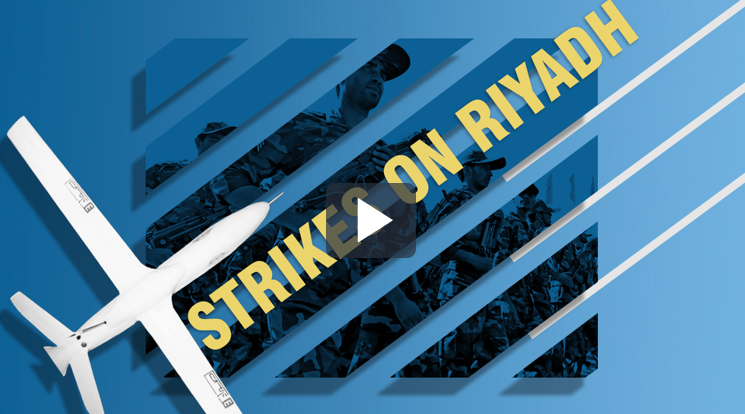
On August 26, Ansar Allah, for the first time, used a squadron of its new Sammad-3 to strike an “important military target” in the Saudi capital of Riyadh.  Brig. Gen. Sari said that the drones struck the designated target with great precision emphasizing that the strikes were the answer to the Saudi aggression against Yemen.
Later, a Qassem medium-range ballistic missile hit positions of Saudi-backed forces in the Saqam area of Narjan Province.
On August 27, Qasef-2K loitering munitions targeted Saudi Arabia’s King Khalid Air Base in the province of Asir.
All these developments came amid continued border clashes between Ansar Allah fighters and Saudi-led forces. Ansar Allah regularly releases videos showing large equipment losses of coalition-backed troops in the area.
Taking into account a recent rift between Saudi-backed and UAE-backed forces in southern Yemen, it appears that the coalition is steadily losing more and more ground in the war-torn country and , that the war is moving to southern Saudi Arabia.
*
Note to readers: please click the share buttons above or below. Forward this article to your email lists. Crosspost on your blog site, internet forums. etc.
We call upon Global Research readers to support South Front in its endeavors.
If you’re able, and if you like our content and approach, please support the project. Our work wouldn’t be possible without your help: PayPal: southfront@list.ru or via: http://southfront.org/donate/ or via: https://www.patreon.com/southfront


https://www.globalresearch.ca/video-yemen-houthis-drone-strike-saudi-capital/5687702


JUST NEWS published this article following the Creative Commons rule. If you don't want your article to appear in this blog email me and I will remove it asap.

Saturday, August 17, 2019

South Yemen Is Already Functionally Independent Even if It’s Not Recognized as Such


Global Research, August 16, 2019

The Southern Transitional Council’s liberation of the former South Yemeni capital of Aden from the Saudi-backed Islah Islamists has restored the independence of the Old Cold War-era country.
STC vs. Islah
It was bound to happen sooner than later, but the Southern Transitional Council (STC) once again liberated the former South Yemeni capital of Aden from the Saudi-backed Islah Islamists and Hadi’s forces for the second time since January 2018, though this time they’re not willing to return to the status quo ante bellum but are  bargaining hard for the coalition’s recognition of their functional independence. The group’s UK-based spokesman Saleh Alnoud told Reuters that “giving up control of Aden is not on the table at the moment” and that it “would be a very good start if Islah was removed from the whole of the south and allow southerners to govern themselves.” The UAE-backed STC blame the Saudi-backed Islah Islamists for complicity in the Ansar Allah’s recent missile strike in Aden that further fractured the already divided coalition and provoked the separatists to forcefully evict their “frenemies” from the seaside city.
Secularism vs. Islamism
It should be noted that the STC is a secular organization that has an entirely different worldview than Islah, which explains the never-ending tension between them since the GCC-organized coalition unnaturally brought these ideologically contradictory groups together in the shared short-term interest of stopping the Ansar Allah’s rapid advance southward and pushing them as far back north as possible. The war has since crawled to a stalemate and become the world’s worst humanitarian crisis as the majority of the country’s population risks starvation and disease in the mostly blockaded northern part of the state under the control of the Ansar Allah, which explains why these “uneasy allies” began scheming and ultimately turning their guns on one another. The UAE’s large-scale military drawdown last month created fears of a power vacuum that in turn triggered a security dilemma between the STC and Islah, after which the latter allegedly conspired with the Ansar Allah during this month’s missile strike in Aden and thus caused the STC to react as they did out of self-defense.
Iranian Intrigue
Being once again in control of Aden but with the STC this time unwilling to cede power except potentially to the allied Security Belt Forces (SBF) or Aden Police (according to Alnoud in the previously cited interview), the tipping point might have finally been passed whereby the coalition is forced by necessity to recognize South Yemen’s functional independence if it hopes to continue the war. The UAE has already begun its “face-saving” withdrawal from the conflict, but Saudi Arabia is left in a situation that’s increasingly gone from bad to worse seemingly without any real exit strategy in mind, so it might at the very least seriously consider the STC’s suggestion that Islah be removed from all of South Yemen. The STC doesn’t just oppose Islah’s worldview, but is extremely suspicious of their connections to the Muslim Brotherhood, which some observers believe that it’s actually an offshoot of. Furthermore, it should be pointed out that Iran interestingly was opposed to the US’ designation of the Muslim Brotherhood as a terrorist organization despite many of its affiliates fighting against the Islamic Republic’s forces in Syria over nearly the past decade of that proxy conflict.
Time To Act
With the Ansar Allah being politically supported by Iran and Islah being suspected of indirect connections to it, the STC might have felt like a conspiracy was brewing that could end its separatist plans one way or another in the future, hence the pressing need to remove this threat from the territory of their formerly independent state as soon as possible before the situation got out of control. Coalition leader Saudi Arabia evidently doesn’t see things that way since it’s sponsoring the Islah Islamists, but those two parties might one day split from one another if either of them comes to think that the strategic utility of their partnership has eventually expired, which wouldn’t be all too surprising in a dirty war that’s already seen so many dramatic twists and turns since it first began. Sensing that its narrow window of opportunity might soon be shut, the STC made their move after being backstabbed by Islah, though they’re thus far resisting the pressure of so-called “hardliners” within their ranks to immediately declare independence in order to proverbially “go by the book” and try to get as much international support as possible first.
The Six Steps Towards Independence
In practical terms, this means being recognized by the UN as a legitimate party to the conflict and thus being assured a role in the ongoing negotiations to end it, after which they can then proceed according to the phased plan that the author suggested in his December 2017 policy proposal about how “South Yemen Will Regain Independence If It Follows These Six Steps“, beginning with an unofficial independence referendum and ending with becoming a crucial node along the New Silk Road. A “federal” transitional period of an undetermined length might be required beforehand, however, whereby the formerly independent countries of North and South Yemen consolidate their state institutions with assistance from the international community as they prepare for the formal restoration of their former sovereignty. The main problem, however, is that the Ansar Allah — despite previously favoring a “federal” solution as recently as last December — might not go along with it since they were advised by the Ayatollah earlier this week to “strongly resist” what he called the “plot” to divide Yemen and should instead endorse “a unified, coherent Yemen with sovereign integrity”.
Concluding Thoughts
Saudi Arabia, the Ansar Allah, and Iran all share one goal in common and that’s to prevent the restoration of South Yemen’s statehood, but none of them are in a position to stop the seemingly inevitable and can only realistically slow it down if anything after all that just recently transpired. If all armed parties and their supporters abroad (both military and political) truly want to end the war, then the only pragmatic solution available is to recognize the STC as a legitimate party to the conflict and begin the process of “federalizing” the country into its two former constituent parts prior to officially “re-partitioning” it following referenda in each region. The strategic dynamics are such that South Yemen’s impending independence appears to be inevitable, especially if the UN incorporates them into the fledgling peace talks as an equal member. That still has yet to happen, however, and might not occur right away, so expectations should be tempered when talking about how long this entire process might take. Even so, the STC remains committed to using the interim period to consolidate its state institutions and prepare for the day when it finally declares outright independence.
*
Note to readers: please click the share buttons above or below. Forward this article to your email lists. Crosspost on your blog site, internet forums. etc.
This article was originally published on OneWorld Global Think Tank.
Andrew Korybko is an American Moscow-based political analyst specializing in the relationship between the US strategy in Afro-Eurasia, China’s One Belt One Road global vision of New Silk Road connectivity, and Hybrid Warfare. He is a frequent contributor to Global Research.
Featured image is from Yemen Press


https://www.globalresearch.ca/south-yemen-functionally-independent-not-recognized/5686573

JUST NEWS published this article following the Creative Commons rule. If you don't want your article to appear in this blog email me and I will remove it asap.
Friday, August 2, 2019

UAE Withdrawal from Yemen. Turning Point. Did the Ansar Allah Just Win the Yemeni War?


Global Research, August 02, 2019

The announcement that the UAE is in the process of a large-scale military drawdown in Yemen has been met with rapturous applause by the Ansar Allah’s supporters who believe that this unofficially acknowledges their victory in the conflict, but these celebrations are premature because the vast majority of the country’s territory still remains outside of the armed group’s grasp even if most of its people reside in their region, and the most politically realistic solution to the war entails the institutionalization of the state’s deep divisions via the implementation of a “federal” model that de-facto restores the Old Cold War-era independence of North and South Yemen. 
A Turning Point 
Decision makers the world over are talking about the implications of the large-scale military drawdown that the UAE recently announced is presently underway in Yemen, with the prevailing notion being that this unofficially acknowledges the Ansar Allah’s (“Houthis'”) victory in the conflict. It’s true that this development is very significant for the armed group because it all but precludes the commencement of any more offensives against the territory under its control, which could potentially lead to the stabilization of the front lines and the beginning of a global aid campaign to relieve the suffering that millions of people are experiencing in what has previously been recognized as the world’s worst humanitarian crisis. In fact, the UAE probably wouldn’t have done this had they and their Saudi allies succeeded in taking the strategic Ansar Allah-held port of Hodeidah, the failure of which set into motion the subsequent events that led to its decision to withdraw most of its forces from Yemen.
The Ansar Allah And The STC
The Ansar Allah might have begun as a rural peripheral rebellion among the religious minorities of Yemen’s northern mountainous region but it’s since evolved into a much more inclusive movement that convincingly has the trappings of a national liberation one, especially after allying with the Yemeni Army in seeking the expulsion of all foreign forces from the country. By comparison, the “internationally recognized” government of President Hadi enjoys close to no domestic support whatsoever and has basically functioned as little more than an excuse to justify the Saudi-led coalition’s military intervention against the Ansar Allah. The supposed bastion of its support, the southern port of Aden, is more under the control of the Southern Resistance Forces (SRF, the armed wing of the Southern Transitional Council [STC]) that want to restore the Old Cold War-era independence of South Yemen than it is Hadi’s, which in and of itself hints at the most politically realistic outcome of this conflict in the wake of the UAE’s withdrawal.
“Federalization”
With the Ansar Allah in control of the most demographically and economically significant portions of the former nation of North Yemen (officially the “Yemen Arab Republic” from 1962-1990) and the STC wielding UAE-backed sovereignty over South Yemen (officially the “People’s Democratic Republic of Yemen” from 1967-1990), the quickest way to end the war would be to institutionalize Yemen’s already existing military and political divisions via the implementation of a “federal” model that de-facto recognizes this state of affairs since neither side has the wherewithal to surmount the stalemate that’s set in. That scenario, however, is far from the “victory” that the Ansar Allah originally hoped to achieve even though it satisfies most of what the STC and its Emirati patron want, all of which would nevertheless further complicate Saudi Arabia’s security situation along its southern border if it turns out that the Kingdom doesn’t have anything to show for its costly campaign other than the Ansar Allah’s “autonomy” over North Yemen and its “little brother’s” (UAE) new proxy state in the south.
A “Compromised” Victory
Ending the kinetic (military) phase of this conflict could be considered a humanitarian victory but that doesn’t change the fact that no side apart from the STC will probably be able to claim a political one. Saudi Arabia and the UAE failed to destroy the Ansar Allah despite their technical military superiority and the devastating war of attrition that they waged, which speaks to the armed group’s tactical finesse and the support that they have from a significant share of the population in the areas under their control. The Ansar Allah, for its part, failed to take full control of the country, especially the former lands of South Yemen whose people have long resented what they claim is the North’s unfair dominance of their homeland after the 1990 unification and especially following the end of the brief 1994 civil war to reverse it. Even so, the vast majority of Yemen’s population resides in the areas that they administer, so it could be argued that they nevertheless succeeded in their quest to become the most important political actor in the country.
The Saudis’ “Short End Of The Stick”
This in turn has enabled the Ansar Allah to claim that they’re the ones who truly represent the Yemeni government and not Hadi, whose forces don’t even have much sway in the same city that they’re formally based in when compared to the STC’s much greater strength and grassroots popularity there. The Saudi-led war was launched to keep Yemen united under the authority of Riyadh’s proxy leader but ironically led to the country’s de-facto division along most of its pre-1990 Old Cold War-era borders without the Kingdom retaining any “sphere of influence” whatsoever over its territory, instead becoming strategically dependent on its “little brother” (whose leader, MBZ, curiously mentors Saudi Arabia’s de-facto leader MBS) to remain relevant in South Yemen. Saudi Arabia certainly got the proverbial short end of the stick after spending hundreds of billions of dollars on the war and receiving nothing in return for its “investment”, not even an enhanced security environment after the Ansar Allah’s military capabilities evolved and it now regularly bombs Saudi territory.
“Little Brother” Upstages “Big Brother” 
The UAE, however, at least has something to show for its involvement in this campaign after obtaining several strategic regional bases throughout the course of the conflict and emerging as a power broker in the Horn of Africa. Moreover, Abu Dhabi also gained priceless experience managing mercenary groups and training local forces while Riyadh’s contribution to the war remained largely relegated to the air and never really took any serious form on the ground. As such, it can be said that Saudi Arabia — either out of an “abundance of caution” to avoid casualties, incompetence, and/or an outright fear of the Ansar Allah — squandered what could have otherwise been a valuable opportunity” to train its military forces in the field while the UAE took full advantage of this and will likely apply what it learned in forthcoming conflicts (which will probably be waged indirectly through the many mercenary formations that it’s since assembled). Interestingly, the “little brother” has upstaged the “big brother” and their relationship with one another will probably never be the same again.
Concluding Thoughts
Bearing in mind all that was touched upon in this analysis, one can say that while every other participant in the war achieved some (Ansar Allah, UAE) or practically all (STC) of its objectives, the Saudis didn’t succeed with anything other than preventing the Ansar Allah’s full takeover of Yemen. The Kingdom’s security situation is worse than when the conflict began and it no longer has any direct influence in its neighbor, instead having to rely on its “little brother” to maintain its presence in parts of South Yemen. Without the UAE doing the “heavy lifting”, it’s all but inevitable that Saudi Arabia will scramble for a “face-saving” exit from the war as well since it’s proven itself unable to alter the dynamics in is favor on its own, especially when most of what it’s been doing is bombing Yemen and never really fighting on the ground and holding territory like its allies have. Even though the Ansar Allah can’t be said to have won the civil-international Yemeni War since it doesn’t control the entire country, it didn’t lose it either, with that ignoble distinction being the Saudis’ alone.
*
Note to readers: please click the share buttons above or below. Forward this article to your email lists. Crosspost on your blog site, internet forums. etc.
Andrew Korybko is an American Moscow-based political analyst specializing in the relationship between the US strategy in Afro-Eurasia, China’s One Belt One Road global vision of New Silk Road connectivity, and Hybrid Warfare. He is a frequent contributor to Global Research.
Featured image is by Felton Davis | CC BY 2.0

https://www.globalresearch.ca/did-ansar-allah-really-just-win-yemeni-war/5685403

JUST NEWS published this article following the Creative Commons rule. If you don't want your article to appear in this blog email me and I will remove it asap.

Wednesday, July 31, 2019

As US Beefs Up Military Presence in the Gulf, Yemen’s Houthis Turn to Russia for Support


Global Research, July 31, 2019
MintPress News 26 July 2019

Houthi attempts to engage the UN to broker a peaceful solution to the war on Yemen have stalled. Now, out of options, the movement may have found a willing partner in Moscow.
***
Yemen’s Houthi movement has reacted with concern to an announcement by Washington that the U.S. is pursuing an increased military presence in the Persian Gulf. U.S. Central Command announced Operation Sentinel on July 19, claiming that a multinational maritime effort is needed to promote “maritime stability, ensure safe passage, and de-escalate tensions in international waters throughout the Bab el-Mandeb Strait, the Arabian [Persian] Gulf, Strait of Hormuz, and the Gulf of Oman.”
The Houthis’ Supreme Political Council, the highest political authority in Sana`a, held an emergency meeting on Monday to discuss the developments. After the meeting Houthi officials released a statement denouncing Operation Sentinel, saying that Yemen is keen on the security of the Red Sea and that any escalation by Coalition countries, including the United States, would be met with a response. The statement went on to say:
What makes waterways safe is an end to the war on Yemen, a lifting of the siege on the country and the end to [th Saudi-led Coalition] restricting access to food and commercial vessels in Yemeni ports, especially the port of Hodeida, not the presence of multinational forces there.”
Houthi officials also weighed in on the arrival of U.S. troops in Saudi Arabia as a part of a broader tranche of forces sent to the Gulf region over the past two months following increased tensions between Washington and Tehran. Mohammed Abdulsalam, the spokesman of Houthis and one of the most important decision-makers within the movement, told al-Mayadeen TV that the arrival of 500 U.S. troops to Saudi Arabia is “not welcome in the region.”
On Monday, Abdulsalam ridiculed Saudi Arabia’s celebration of the arrival of the U.S. troops, pointing to the Kingdom’s relying on U.S. and British protection while at the same time not knowing how to extricate itself from Yemen.
“On one side, there are the Saudis seeking protection from others and on the other side, we have Yemen facing those superpowers with strength, rigidity and wisdom,” Abudlsalam said in a Facebook post.
Abdulsalam also said that the deployment of U.S. troops to the Kingdom was aimed at boosting the morale of Saudi Arabia in the face of Yemen’s ballistic missile and drone attacks.
Abudlsalam’s comments were made during an official visit to Moscow, where a Houthi delegation was visiting at the invitation of the Russian government. The July 24 meeting with Russian Deputy Foreign Minister to the Middle East and North Africa Mikhail Bogdanov was held to discuss, among other things, U.S. military presence in the Gulf. Abdulsalam claimed during the meeting that U.S. and Western visions for a solution to the conflict in Yemen would be unsuccessful, telling his Russian counterpart that there won’t be security and safety in the region without an end to the aggression against Yemen. He went on to say that,
“we [Houthis] have common interests with the Russians regarding peace in the region.”
Both Bogdanov and Abdulsalam expressed commitment to abiding by the UN-brokered Stockholm Agreement, which calls for a ceasefire in the Hodeida port in western Yemen. The Houthis also expressed support for Russia’s policy vision for security in the Gulf, which was presented by Bogdanov on Tuesday.
While Russian efforts may not necessarily produce peace in Yemen, they may give the Saudi-led Coalition a chance to see that all options for diplomacy have been fully explored. They will also provide the United Arab Emirates (UAE) — which recently pulled out a significant portion of their military forces from Yemen, amidst fears of Houthi retaliatory attacks on Dubai — a chance to jump on the Russian bandwagon. Saudi Arabia, which has made little progress in its more than four-year-long adventure in Yemen, could also use Russian efforts as a face-saving opportunity, according to Yemeni diplomats who spoke to MintPress.
According to well-informed sources in the Houthi movement, Russia is pushing hard to play a role in bringing an end to the war on Yemen, and Russian and Houthi interests are becoming more aligned, including opposition to an increased U.S. military presence in the region. Houthi officials are also hoping that Russia will use its position in the UN Security Council to veto resolutions adversely affecting the interests of Yemen. One Houthi official, who asked to remain anonymous because of the sensitivity of the issue, even told MintPress that Russia played a role in the recent withdrawal of the UAE forces from Yemen.
“No subordination to Iran”
Mehdi Al-Mashat, the Head of the Houthi Supreme Political Council, told delegates from the International Crisis Group on Wednesday that the Houthis are ready to stop drones and ballistic attacks on Saudi Arabia if the Kingdom stops its attacks on Yemen. He also expressed readiness to engage in dialogue with Saudi officials to “achieve a just peace for all,” but warned that the “U.S. must know Yemen is a country which has sovereignty and is not subject to anyone.”
Regarding Iran, Al-Mashat told members of the International Crisis Group, a Brussels-based NGO that works to resolve violent conflicts around the world, “with regard to the false claims that we are followers of Iran, which the Coalition countries know to be false, we confirm that there is no subordination to Iran.” Tehran’s support for the Houthis is limited to political, diplomatic and media support and the country’s influence in Yemen is marginal at best.
For its part, the United Nations says the years-long war in Yemen can be stopped and is eminently resolvable if the warring sides commit to the UN-brokered Stockholm peace agreement reached in Sweden late last year. Under the agreement, both the Houthis and Coalition forces agreed to withdraw their troops from the Yemeni ports of Hodeida, Salif, and Ras Issa, and to allow the deployment of UN monitors.
The UN Special Envoy for Yemen Martin Griffiths said on Tuesday,
“I believe that this war in Yemen is eminently resolvable, both parties continue to insist that they want a political solution and the military solution is not available, they remain committed to the Stockholm agreement in all its different aspects.”
UAE “not leaving Yemen”
While the Houthis have had some success in forcing a dialogue with Coalition leaders through the United Nations, Russia, and various NGOs, it appears that their celebration over the recent announcement that the UAE is withdrawing its troops from Yemen may have been premature. In the Houthis’ first official statement since the UAE announced it was withdrawing its troops from Yemen, Houthi spokesman Mohammed Abdulsalam said on Wednesday that “the UAE has not withdrawn any its soldiers from Yemen, and instead has redeployed its forces from a number of areas in Yemen, including battlefields in Hodeida and Marib province in eastern Yemen.” Abdulsalam went on to encourage UAE leaders to pull out of Yemen, saying “the UAE getting out of Yemen is positive and natural and we encourage its leaders to do so.”
The UAE Minister of State for Foreign Affairs Anwar Mohammed Gargash, in an opinion piece published in The Washington Post on Monday, confirmed the UAE was not leaving Yemen, saying:
“Just to be clear, the UAE and the rest of the Coalition are not leaving Yemen.”
He added,
“While we will operate differently, our military presence will remain. In accordance with international law, we will continue to advise and assist local Yemen forces — referring to the myriad UAE-funded Yemeni rebel groups including the Shaban elite forces, the Mahri elite forces, and the Security Belt.
According to Mohammed Abdulsalam, the seemingly contradictory statement coming from the UAE may be a result of Saudi pressure.
Meanwhile, Turkey’s state news agency Anadolu, citing a spokesman for the UAE allies, reported on Wednesday that the Sudanese armed forces had partially withdrawn from parts of Yemen following the withdrawal of UAE troops from the same areas. Yemeni armed forces will replace the Sudanese troops around Hodeida, a Yemeni source told Anadolu.
The UAE and Sudan, parts of a Saudi-led military coalition, have been active members in the brutal Saudi-led Coalition’s war on Yemen since it began in 2015, which the United Nations says has produced the world’s worst humanitarian crisis, with millions on the brink of starvation.
*
Note to readers: please click the share buttons above or below. Forward this article to your email lists. Crosspost on your blog site, internet forums. etc.
Ahmed AbdulKareem is a Yemeni journalist. He covers the war in Yemen for MintPress News as well as local Yemeni media.


https://www.globalresearch.ca/us-beefs-up-military-presence-gulf-yemen-houthis-turn-russia-support/5685195

JUST NEWS published this article following the Creative Commons rule. If you don't want your article to appear in this blog email me and I will remove it asap.