Showing posts with label History. Show all posts

Wednesday, September 11, 2019

We are all hostages of 9/11


After years of reporting on the Great War on Terror, many questions behind the US attacks remain unresolved

By Pepe Escobar

September 11, 2019 "Information Clearing House" - Afghanistan was bombed and invaded because of 9/11. I was there from the start, even before 9/11. On August 20, 2001, I interviewed commander Ahmad Shah Massoud, the “Lion of the Panjshir,” who told me about an “unholy alliance” of the Taliban, al-Qaeda and the ISI (Pakistani intel).
Back in Peshawar, I learned that something really big was coming: my article was published by Asia Times on August 30. Commander Massoud was killed on September 9: I received a terse email from a Panjshir source, only stating, “the commander has been shot.” Two days later, 9/11 happened.
And yet, the day before, none other than Osama bin Laden, in person, was in a Pakistani hospital in Rawalpindi, receiving treatment, as CBS reported. Bin Laden was proclaimed the perpetrator already at 11am on 9/11 – with no investigation whatsoever. It should have been not exactly hard to locate him in Pakistan and “bring him to justice.”
In December 2001 I was in Tora Bora tracking bin Laden – under B-52 bombers and side by side with Pashtun mujahideen. Later, in 2011, I would revisit the day bin Laden vanished forever.
One year after 9/11, I was back in Afghanistan for an in-depth investigation of the killing of Massoud. By then it was possible to establish a Saudi connection: the letter of introduction for Massoud’s killers, who posed as journalists, was facilitated by commander Sayyaf, a Saudi asset.
For three years my life revolved around the Global War on Terror; most of the time I lived literally on the road, in Afghanistan, Pakistan, Iran, Iraq, the Persian Gulf and Brussels. At the start of ‘Shock and Awe’ on Iraq, in March 2003, Asia Times published my in-depth investigation of which neo-cons concocted the war on Iraq.
In 2004, roving across the US, I re-traced the Taliban’s trip to Texas, and how a top priority, since the Clinton years all the way to the neo-cons, was about what I had baptized as “Pipelineistan” – in this case how to build the Turkmenistan-Afghanistan-Pakistan-India (TAPI) gas pipeline, bypassing Iran and Russia, and extending US control of Central and South Asia.
Later on, I delved into the hard questions the 9/11 Commission never asked, and how Bush’s 2004 reelection campaign was totally conditioned by and dependent on 9/11.
Michael Ruppert, a CIA whistleblower, who may – or may not – have committed suicide in 2014, was a top 9/11 analyst. We exchanged a lot of information, and always emphasized the same points: Afghanistan was all about (existent) heroin and (non-existent) pipelines.

Now, President Trump may have identified a possible Afghan deal – which the Taliban, who control two-thirds of the country, are bound to refuse, as it allows withdrawal of only 5,000 out of 13,000 US troops. Moreover, the US ‘Deep State’ is absolutely against any deal, as well as India and the rickety government in Kabul.In 2011, the late, great Bob Parry would debunk more Afghanistan lies. And in 2017, I would detail a top reason why the US will never leave Afghanistan: the heroin rat line.
But Pakistan and China are in favor, especially because Beijing plans to incorporate Kabul into the China-Pakistan Economic Corridor and have Afghanistan admitted as a member of the Shanghai Cooperation Organization, thus attaching the Hindu Kush and the Khyber Pass to the ongoing Eurasia integration process.

Praying for a Pearl

Eighteen years after the game-changing fact, we all remain hostages of 9/11. US neocons, gathered at the Project for the New American Century, had been praying for a “Pearl Harbor” to reorient US foreign policy since 1997. Their prayers were answered beyond their wildest dreams.
Already in The Grand Chessboard, also published in 1997, former National Security Adviser and Trilateral Commission co-founder Zbigniew Brzezinski, nominally not a neocon, had pointed out that the American public “supported America’s engagement in World War II largely because of the shock effect of the Japanese attack on Pearl Harbor.”
So, Brzezinski added, America “may find it more difficult to fashion a consensus on foreign policy issues, except in the circumstance of a truly massive and widely perceived direct external threat.”
As an attack on the homeland, 9/11 generated the Global War on Terror, launched at 11pm on the same day, initially christened “The Long War” by the Pentagon, later sanitized as Overseas Contingency Operations by the Obama administration. This cost trillions of dollars, killed over half a million people and branched out into illegal wars against seven Muslim nations – all justified on “humanitarian grounds” and allegedly supported by the “international community.”
Year after year, 9/11 is essentially a You Have The Right to Accept Only The Official Version ritual ceremony, even as widespread evidence suggests the US government knew 9/11 would happen and did not stop it.
Three days after 9/11, the Frankfurter Allgemeine Zeitung reported that in June 2001, German intelligence warned the CIA that Middle East terrorists were “planning to hijack commercial aircraft to use as weapons to attack important symbols of American and Israeli culture.”
In August 2001, President Putin ordered Russian intel to tell the US government “in the strongest possible terms” of imminent attacks on airports and government buildings, MSNBC revealed in an interview with Putin that was broadcast on September 15 that year.
No US government agency has released any information on who used foreknowledge of 9/11 in the financial markets. The US Congress did not even raise the issue. In Germany, investigative financial journalist Lars Schall has been working for years on a massive study detailing to a great extent insider trading before 9/11.

While NORAD sleeps

Discrediting the official, immutable 9/11 narrative remains the ultimate taboo. Hundreds of architects and engineers engaged in meticulous technical debunking of all aspects of 9/11’s official story are summarily dismissed as “conspiracy theorists.”
In contrast, skepticism rooted in Greek and Latin tradition came up with arguably the best documentary on 9/11: Zero, an Italian production. Just as arguably the most stimulating book on 9/11 is also Italian: The Myth of September 11, by Roberto Quaglia, which offers a delicately nuanced narrative of 9/11 as a myth structured as a movie. The book became a huge hit in Eastern Europe.
Serious questions suggest quite plausible suspects to be investigated regarding 9/11, far more than 19 Arabs with box cutters. Ten years ago, in Asia Times, I asked 50 questions, some of them extremely detailed, about 9/11. After reader demand and suggestions, I added 20 more. None of these questions were convincingly addressed – not to mention answered – by the official narrative.
World public opinion is directed to believe that on the morning of 9/11 four airliners, presumably hijacked by 19 Arabs with box cutters, traveled undisturbed – for two hours – across the most controlled airspace on the planet, which is supervised by the most devastating military apparatus ever.
American Airlines Flight 11 deviated from its path at 8.13am and crashed into the first World Trade Center tower at 8.57am. Only at 8.46am did NORAD – the North American Aerospace Defense Command – order that two intercepting F-15s take off from Otis military base.
By a curious coincidence a Pentagon war game was in effect on the morning of 9/11 – so air-controllers’ radars may have registered only ‘ghost signals’ of nonexistent aircraft simulating an air attack. Well, it was much more complicated than that, as demonstrated by professional pilots.

‘Angel was next’

World public opinion is also directed to believe that a Boeing 757 – with a wingspan of 38 meters – managed to penetrate the Pentagon through a six-meter-wide hole and at the height of the first floor. A Boeing 757 with landing gear is 13 meters high. Airliners electronically refuse to crash – so it’s quite a feat to convince one to fly five to 10 meters above the ground, landing gear on, at a lightning speed of 800 kilometers an hour.
According to the official narrative, the Boeing 757 literally pulverized itself. Yet even after pulverization, it managed to perforate six walls of three rings of the Pentagon, leaving a two-meter wide hole in the last wall but only slightly damaging the second and third rings. The official narrative is that the hole was caused by the plane’s nose – still quite hard even after pulverization. Yet the rest of the plane – a mass of 100 tons traveling at 800 kilometers an hour – miraculously stopped at the first ring.
All that happened under the stewardship of one Hani Hanjour, who three weeks before had been judged by his flight instructors to be incapable of piloting a Cessna. Hanjour, nonetheless, managed to accomplish an ultra-fast spiral descent at 270 degrees, aligning at a maximum 10 meters above ground, minutely calibrating the trajectory, and keeping a cruise speed of roughly 800 kilometers an hour.
At 9.37am, Hanjour hit precisely the Pentagon’s budget analysts’ office, where everyone was busy working on the mysterious disappearance of no less than $2.3 trillion that Defense Secretary Donald “Known Unknowns” Rumsfeld, in a press conference the day before, said could not be tracked. So, it’s not only Boeings that get pulverized inside the Pentagon.
World public opinion is also directed to believe that Newtonian physics was suspended as a special bonus for WTC 1 and 2 on 9/11 (not to mention WTC 7, which was not even hit by any plane). The slower WTC tower took 10 seconds to fall 411 meters, starting from immobility. So it fell at 148 kilometers an hour. Considering the initial acceleration time, it was a free fall, not the least impeded by 47 massive, vertical steel beams that composed the tower’s structural heart.
World public opinion is also directed to believe that United Airlines Flight 93 – 150 tons of aircraft with 45 people, 200 seats, luggage, a wingspan of 38 meters – crashed in a field in Pennsylvania and also literally pulverized itself, totally disappearing inside a hole six meters by three meters wide and only two meters deep.
Suddenly, Air Force One was “the only plane in the sky.” Colonel Mark Tillman, who was on board, recalled: “We get this report that there’s a call saying ‘Angel’ was next. No one really knows now where the comment came from – it got mistranslated or garbled amid the White House, the Situation Room, the radio operators. ‘Angel’ was our code name. The fact that they knew about ‘Angel,’ well, you had to be in the inner circle.”
This means that 19 Arabs with box cutters, and most of all their handlers, surely must have been “in the inner circle.” Inevitably, this was never fully investigated.
Already in 1997, Brzezinski had warned, “it is imperative that no Eurasian challenger emerges capable of dominating Eurasia and thus of also challenging America.”
In the end, much to the despair of US neocons, all the combined sound and fury of 9/11 and the Global War on Terror/Overseas Contingency Operations, in less than two decades, ended up metastasized into not only a challenger but a Russia-China strategic partnership. This is the real “enemy” – not al-Qaeda, a flimsy figment of the CIA’s imagination, rehabilitated and sanitized as “moderate rebels” in Syria.
Pepe Escobar is correspondent-at-large at Asia Times. His latest book is 2030. Follow him on Facebook.
==See Also==
Veterans Reach Their Tipping Point Against Our Post-9/11 Wars; Solid majorities of veterans believe Iraq and Afghanistan were not worth fighting. It's time to heed their counsel.

Meg Hutchinson - Song for Jeffrey Lucey


http://www.informationclearinghouse.info/52245.htm


JUST NEWS published this article following the Creative Commons rule. If you don't want your article to appear in this blog email me and I will remove it asap.

Thursday, September 5, 2019

The Amazon Fire Crisis Has Been 500 Years in the Making – as Brazil’s Indigenous People Know Only Too Well


Global Research, September 05, 2019
The Conversation 4 September 2019


São Paulo – the largest city in the Americas – was recently plunged into darkness in the middle of the day due to smoke from the Amazon rainforest burning more than 2,700km (1,700 miles) away.
These fires have brought global attention to the forests of South America, but the crisis surrounding them has deep roots. To understand what is happening in the Amazon today, it’s necessary to understand how deeply exploitation of the forest, and the Indigenous peoples who live within it, are ingrained in the global economy.
The first Portuguese explorers arrived in Brazil on April 22 1500. The region didn’t at first appear to offer the gold or silver that was to make Central America a tempting target for colonisers, but it did present a more obvious asset: vast forests with a seemingly inexhaustible supply of timber.
The region’s Brasilwood trees produced a valuable red dye, and with the colour red in fashion in the French court, Brazil’s forests quickly became a target for profit-minded Europeans. Brasilwood was so prevalent before colonisation that it lent its name to the country. But after centuries of overharvesting, these trees are now a highly endangered species.
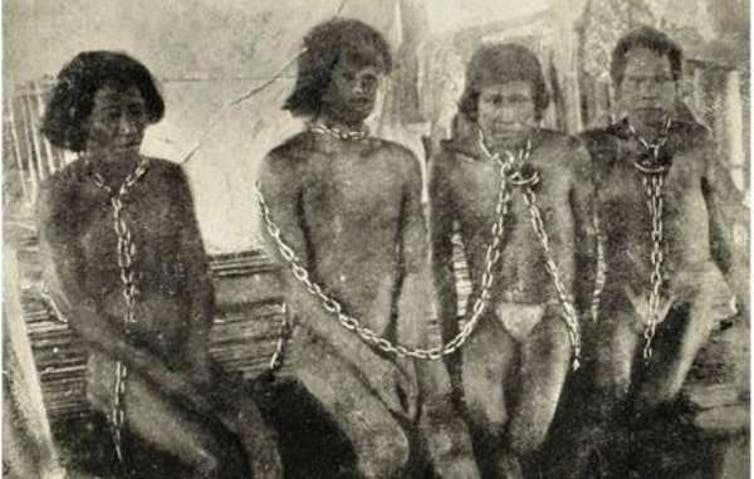
Indigenous peoples were initially incentivised to help harvest timber in exchange for European goods. But eventually the native peoples were enslaved and made to destroy the forests which had provided the wood for their homes and the game and plants for their diet.
Once cleared of trees, land was turned into plantations to grow labour-hungry cash crops such as sugar, encouraging the enslavement of yet more Indigenous people. When they proved too few in number, vast numbers of people were taken from Africa and forced into slavery alongside them.
Global economy, local cost
The Mata Atlântica, a vast tropical forest which stretched down the east coast of the country and well into its interior, was an obvious target for the seafaring colonisers, who needed to ensure the materials they harvested could be easily transported to overseas markets.
But the environmental cost of this process was massive. As much as 92% of the Mata Atlântica has been destroyed over the past 500 years, erasing the places in which hundreds of distinct cultures evolved over the preceding millennia. Vast numbers of species disappeared along with it.
Indigenous people in the Peruvian Amazon were enslaved by rubber barons into the 20th century. Walter Hardenberg/Wikipedia
In the 19th century, the British cleared yet more forest to establish rubber plantations. Despite officially being keen to encourage the abolition of slavery, the British-owned Peruvian Amazon Company violently forced Indigenous people into servitude. The anthropologist Wade Davis would later comment that
The horrendous atrocities that were unleashed on the Indian people of the Amazon during the height of the rubber boom were like nothing that had been seen since the first days of the Spanish Conquest.
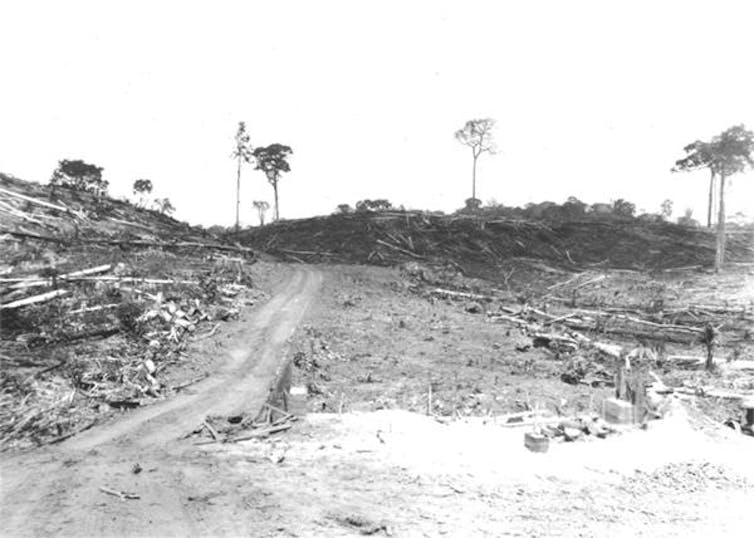
The American industrialist Henry Ford founded a rubber-producing town deep in the Amazon rainforest in 1928. He hoped to “develop that wonderful and fertile land” to produce the rubber his company needed for car tires, valves and gaskets. Fordlândia, as it became known, was abandoned in 1934.
Fordlândia required the Ford Motor Company to ‘develop’ significant areas of rainforest. The Henry Ford Collection
By the middle of the 20th century, the size of the Indigenous population first encountered by the Portuguese had shrunk by 80-90%. Meanwhile, the global demand for beef accelerated the destruction of South American forests to free up new grazing land.
Global brands, such as McDonalds, have been linked with Brazilian beef, half of which is produced on lands which were once rainforest. Just as demand for sugar and rubber fuelled historic slavery, the global appetite for beef drives deforestation and displaces Indigenous people today.
New frontiers
The current crisis in the Amazon began with illegal gold miners, loggers, and farmers setting fires to clear lands for new enterprises. This process has been promoted and celebrated by the government of Jair Bolsonaroand the country’s powerful agribusiness sector. Already dislocated people face an increasingly grave situation. This is especially true for uncontacted groups who’ve yet to cultivate biological resistance to the diseases which outsiders can introduce, or develop the cultural experience necessary to navigate today’s complex political landscape.
Members of the Kaingang, a people displaced by the destruction of the Mata Atlântica. Their name can be translated as ‘owners of the forest’. Darren ReidAuthor provided
Many of Brazil’s Indigenous cultures are completely oriented around their forests. In the modern era, their belief systems endure in groups such as the Kaingang, a part of the Gê peoples who occupied the southern parts of the Amazon rainforest and lived throughout the Mata Atlântica. They must actively nurture and protect these beliefs in the face of tremendous outside pressure.
Unlike in the US, dense forests and unmapped locations, not to mention uncontacted peoples, ensure continuity between the earliest days of European colonisation and modern Brazil.
Indigenous peoples have shown remarkable strength and resilience against more than 500 years of colonialist attack. But they remain vulnerable to an insatiable global economy which profits from the destruction of South American forests and the people who live within them. The recent fires are simply the most recent chapter in a much longer story.
*
Note to readers: please click the share buttons above or below. Forward this article to your email lists. Crosspost on your blog site, internet forums. etc.
 is a Senior Lecturer, American History and Popular Culture, Coventry University
Featured image is from End of the American Dream


JUST NEWS published this article following the Creative Commons rule. If you don't want your article to appear in this blog email me and I will remove it asap.
Wednesday, September 4, 2019

Fear and Loathing Under Modi’s Second Term


Experts debate whether India is being Pakistanized, while protest against the BJP’s corporate and religious pandering spreads


Global Research, September 04, 2019

The Pakistani feminist poet Fahmida Riaz, who moved to India from Pakistan in the 1980s to escape that country’s Islamic fundamentalist military dictatorship, only to encounter growing Hindu funda- mentalism in her new home, captured the experience in a poem (translated and abridged) that has become more prescient over time:
You turned out to be just like us, Equally stupid, wallowing in the past… Your demon of religion dances like a clown,
Whatever you do will be upside down You too will sit deep in thought
Who is Hindu, who is not…
Pakistan was carved out of India in 1947 as a state for Muslims while India remained secular. But since 2014, under the rule of Prime Minister Narendra Modi and his Hindu supremacist Bharatiya Janata Party (BJP), the country has become increasingly dominated by religious fundamentalism that is tolerated and openly encouraged by the government. Mob lynching of Muslims and other minorities (80% of Indians are Hindu and 14% are Muslim) is common.
An election in the spring, which many expected to chip away at Modi’s support, in the end produced an even stronger second majority for the BJP, giving the extreme nationalist party 302 out of 542 seats in parliament compared to 282 seats in the 2014 election. The main opposition Congress Party got only 53 seats.
Modi won at the polls in May despite a weakening economy marked by plummeting investment, record unemployment, a crisis in agriculture and a looming environmental disaster, which will see 21 Indian cities run out of water in 2020, affecting 600 million people. Modi’s two main fiscal initiatives in his first term — demonetization and the introduction of a goods and services tax (GST) — were also badly received. Taking 86% of banknotes out of circulation caused massive losses to poor people, damaged economic growth and failed to remove illicit money from the economy as planned. The complexity of the GST led many small businesses to lay off staff.
But such problems were likely far from the minds of hundreds of millions of Modi’s supporters, who are attracted “not through concrete economic policies but through the politics of emotion — negative emotion such as fear, anger, hatred for the neighbour, for minorities and women,” according to Nikita Sud, associate professor of development studies at Oxford University and author of the 2012 book Liberalisation, Hindu Nationalism and the State (Oxford University Press). “During the campaign, the economy was barely mentioned, nor was the agricultural crisis. Modi’s campaign focused mainly on the threat of terrorism and national security and promoted the fear that if you do not elect us, terrorism will increase.”
Modi’s election campaign was helped greatly by the February 14 suicide attack in Kashmir. The Pakistan-based Islamist militant group Jaish-e-Mohammed Isa claimed responsibility for the incident, which killed 40 soldiers and shocked India. The BJP had lost elections in three key states in November 2018 and was leak- ing support to the Congress Party. The killing of Indian soldiers and India’s retaliatory airstrikes into Pakistan reversed this political situation and ensured the BJP a majority.
As I’ve written in the Monitor before (“Modi and the criminalization of Indi- an politics,” September/October 2014), Modi’s hostility toward India’s Muslim population is well-known. In a sworn statement to India’s Supreme Court in 2011, a former senior police chief alleged Modi had “allowed” a bloody religious riot in Gujarat in 2002 when he was chief minister of the state, to let Hindus “vent their anger,” an accusation Modi denies. At least 1,000 people were killed in the mob violence, most of them Muslims.
Sud tells me that Modi and the BJP’s subversion of the media would have played a role in their second election victory. “[P]articular corporate houses close to the Modi government control large parts of the media, which ensures that economic matters that the government has failed at, such as demonetization, are not brought up,” she says.
“There is a similarity in the politics of India and Pakistan now,” she continues, echoing the poet Riaz. “[T]his othering of minorities, blasphemy accusations, sedition charges, and patriotism constantly being stressed. These are the similarities, but the big difference is that the Indian army does not have the kind of power that the Pakistan army does to totally dominate the country.”
Sud says it’s ironic how Modi is using hatred of Pakistan to make India more like Pakistan.
Mujibur Rehman, author of the 2018 book Saffron Power: Reflections on Indian Politics (Routledge) and an assistant professor of politics at Jamia Millia Islamia University in India’s capital city of New Delhi, explains that
“the majority of Indian media appears to be compromised and work as the Modi government’s wing of information and broadcasting.”
If Indian voters gave Modi one more chance, he adds, it was “because they did not find his opponents credible.”
Modi’s main opponent was and is Rahul Gandhi, scion of the Gandhi family that has dominated Indian politics and the Congress Party since India’s independence in 1947. Gandhi’s electoral strategy was to attack Modi for being corrupt, but this had little effect coming from a party with its own history of graft in power. The election result has reduced Congress to its weakest point ever; the party is close to being wiped out in northern India.
“There are some similarities in the ways things are un- folding in India and Pakistan,” says Rehman. “But I would not say India is becoming like Pakistan. Similarities are in the domain of minority rights, religious freedom; we do see lots of violations in India in recent years, which resembles Pakistan’s state of affairs.
“But India still has its constitution and there are dis- senting voices and political forces. Also, India is nowhere close to a situation where we could see [as in Pakistan] the overthrow of its democratically elected regime. I do not see any possibility of a military or dictator takeover of the Pakistan kind in India. India is still a democracy, but a democracy can also see violations, massive violations, which is what we are witnessing.”
The dramatic rise in mob lynching of Muslims, Dalits (also known as “untouchables,” the lowest caste in the Hindu caste system) and other non-Hindus are an example of the violations Rehman is talking about. Alarmed and in response to the violence, 49 Indian celebrities sent an open letter to Prime Minister Modi on July 23 condemning “a definite decline in the percentage of convictions” against hate crimes since his government first took office.
The letter points out that 254 religious identity–based hate crimes were reported between January 1, 2009 and October 29, 2018 “where at least 91 persons were killed and 579 were injured.” Muslims were the victims in 62% of cases and Christians in 2%, according to the Citizen’s Religious Hate-Crime Watch.
“About 90 per cent of these attacks were reported after May 2014 when your government assumed power nationally,” the celebrities write.
Kapil Komireddi, author of the 2019 book Malevolent Republic: A Short History of the New India (Hurst), has written that Modi’s second term “will take India to a dark place,” and that his party “has unleashed forces that are irreversibly transforming the country,” with Indian democracy “now the chief enabler of Hindu extremism.” In the Guardian (U.K.), Komireddi claimed shortly before the May elections that the normally incorruptible India election commission “functioned during this vote as an arm of Modi’s BJP, too timid even to issue perfunctory censures of the prime minister’s egregious use of religious sloganeering.” According to the writer, India’s military has been politicized, “and the judiciary plunged into the most existential threat to its independence since 1975, when Indira Gandhi suspended the constitution and ruled as a dictator for 21 months.”
Indian and foreign corporations have praised the BJP’s economic and state reforms, which are redistributing wealth upwards. At a cost of 500 billion rupees (about $9.5 billion), the Indian election this year was the most expensive in the country’s — and world — history, topping the 2016 U.S. election by half a billion dollars. Much of this was financed by electoral bonds bought by corporations, with 84% of the money going to the BJP.
“The entire election process has been corporatized and the corporate sector is very much funding political parties,” says Sud, a sign of fascism “which is very worrying.”
Indian activist Xavier Dias, who has worked in support of the rights of Adivasi [Indigenous] communities in Jharkhand state for 45 years, tells me that the “fascist new liberalization” of India is being resisted on a significant scale.
“Despite a very heavy powerful state, in every corner of India the resistance movements are growing. The working class through their unions are on strike all over the country, resisting privatization and regressive changes in labour laws. Farmers are resisting also and demanding more help from the government. Women in villages are up in arms and Adivasis now too are better organized,” he says.
“But the damage to the country is so deep and wide- spread that even if the BJP is defeated, India will take at least 20 years to recover from the damage. The soul of India is drenched in blood.”
*
Note to readers: please click the share buttons below. Forward this article to your email lists. Crosspost on your blog site, internet forums. etc.
This article was originally published on the Canadian Centre for Policy Alternatives (page 44).
Asad Ismi is an award-winning writer and radio documentary-maker. He covers international politics for the Canadian Centre for Policy Alternatives Monitor (CCPA Monitor), Canada’s biggest leftist magazine (by circulation) where this article was originally published. Asad has written on the politics of 64 countries and is a regular contributer to Global Research. For his publications visit www.asadismi.info.  He is a frequent contributor to Global Research.


https://www.globalresearch.ca/fear-loathing-under-modi-second-term/5688053


JUST NEWS published this article following the Creative Commons rule. If you don't want your article to appear in this blog email me and I will remove it asap.
Monday, August 26, 2019

Fire and the “Changing Narrative” Thing


Global Research, August 26, 2019

Changing narratives is a new buzz term. I even heard a Distinguished Professor say he can change the narrative about himself. He can’t change it much. Narratives are intellectual, depending on concepts that depend on societies. They are ultimately conservative.
This was known in early Buddhism. The Buddha said emotional is the highest form of wisdom, ahead of rationalization, which depends on traditions. He didn’t say “narrative change” is useless. But the merely intellectual is the status quo, fundamentally.
Toni Morrison referred to the story beneath the story. James Baldwin called it a burning fire. In a letter to Angela Davis, awaiting trial, he wrote:
“we have been told nothing but lies, lies about ourselves and our kinsmen and our past, and about love, life, and death”.
In other words, everything.
Baldwin discovered what “history had made of him”. It happened when he was jailed in Paris with North Africans. He learned he was distinct, not for being black, but for being powerful. Despised in the US, he was a product of US power: a “bastard of the west”. In a new biography, Living in Fire,[i] Bill V. Mullen says Baldwin should be “understood the way we understand Fanon, García Marquez, Assata Shakur”: They wrote outside the US, aware of imperialism: what history has made of us. They knew the fire.
The point is hard, for some. In Young Castro,[ii] Harvard University Senior Lecturer, Jonathen Hansen, offers a sympathetic portrait of Fidel Castro with no such awareness. He mentions the struggle for independence but doesn’t explain how and why the “impossible” gripped whole generations.
In Náhuatl culture, of Middle America, fire images refer to truth. You get it by burning up, metaphorically. Volcanic images run through centuries-long traditions from which Castro emerged.
Hansen leaves that out. It’s like writing a biography of Stephen Hawking and leaving out collapsing stars and imaginary time. We wouldn’t have had Hawking without Hubble, Lemaitre, and Einstein, and Castro couldn’t be who he was without Varela, Bolívar, Luz, and Cespedes. He said it repeatedly.  Yet Hansen writes about Castro without mentioning any of them. They knew about fire. Hansen doesn’t.
Arguably, the most notable “narrative change” in the Americas was by José Martí, 19th century Cuban independence leader. He changed the narrative of US supremacy.  Cuban scholar Juan Marinello says one of the great puzzles about Cuba, for its enemies (and some sympathizers), is how ideas have survived. It’s because they weren’t “mere thinking”, as Einstein put it.
Latin America had no “cultural passport”, no identity.[iii] It had resisted Spanish colonialism for hundreds of years, but the models were English, French or US. Martí was the first, arguably, to set out an idea of Latin Americanness. He said, famously, that ideas are stronger weapons than ones of steel. But Martí’s ideas weren’t just ideas. He proposed “una cultura nueva” (new way of living).[iv]
It wasn’t about naming identities and giving some priority. Martí did what Baldwin intended: challenged the terms of daily life: “love, life and death”. In 1961, Baldwin said “the only hope for this country …. [is] to undermine the standards by which the middle-class American lives”.  The bridge uniting black people, he wrote, is suffering. He articulated that suffering drawing on his own lived reality.
But Baldwin gets fitted into a contradictory narrative: identity politics. Mullin wonders whether Baldwin at the end of his life recognized black lesbians as political agents or whether he still saw black men as agents of change. It seems a silly question, given what we learn about Baldwin in Mullin’s book. Baldwin expressed suffering within the community he knew. He thereby moved his readers to understanding human suffering, the place from which we know other people as people.
For instance, Palestinians.  Baldwin learned, early on, from a “radical, white female mentor” that white people didn’t act as they did because they were white but for other reasons. Trying to know those reasons “burned at the core of his political education”. It made him an internationalist.
As a result, Baldwin discovered “something of the universal and inevitable human ferment which explodes into what is called a revolution”. It’s not narrative. It’s not identity.
In Report to Greco, describing his life-changing reaction to the 10th anniversary of the Russian Revolution, Nikos Kazantzakis writes that
“Beyond all reasoning, beyond learned bickering … higher than programs, higher than leaders, higher than Russia … [was a] lightening flash [that]  illuminated their minds … All men are brothers!”
It’s connection. Kazantzakis says the “lightening flash” happened as “boundaries were crumbling away, [and] names, countries and races were vanishing”. Perhaps it sounds cliché, but it makes a philosophical point. Before identity, and naming, is connection. It explains narrative change, when it counts.
Closing the new documentary on her life, Toni Morrison describes how, in an art exhibit, she looks through a mirror and sees someone approaching. She raises her hand to the glass and an unknown figure meets her hand on the other side. Morrison says, “I didn’t need to know her name or who she was, or anything about her.” The connection was enough.
Imperialism’s narratives are about names: “people” and “non-people”. The “non-people” are somehow not like us and our self-image requires knowing them as such. Martí called it “historical logic”, as did Fanon. Hansen plays right into it, assuming about Castro what would never be assumed about Hawking: that his actions are explained by his idiosyncrasies not by a mind rooted in a history moving forward.
He doesn’t know that Castro, like Morrison, can be a “friend of my mind” because he expressed what Martí called “energía original”, and Baldwin called “dignity”. Whatever the name, it must first be felt, like the Náhuatl fire and sun imagery that drove Martí, personally first, and then intellectually.
*
Note to readers: please click the share buttons above or below. Forward this article to your email lists. Crosspost on your blog site, internet forums. etc.
Susan Babbitt is author of Humanism and Embodiment (Bloomsbury 2014). She is a frequent contributor to Global Research.
Notes
[i] Pluto Press, 2019. See review forthcoming at https://www.nyjournalofbooks.com/
[iii] Noel Salomón “José Martí y la toma de conciencia latinoamericana” Anuario del Centro de estudios martianos (4 1972)
[iv] Pedro Pablo Rodríguez, Los dos Américas, 5


https://www.globalresearch.ca/fire-changing-narrative-thing/5687179


JUST NEWS published this article following the Creative Commons rule. If you don't want your article to appear in this blog email me and I will remove it asap.