Showing posts with label Latin America & Caribbean. Show all posts

Thursday, September 5, 2019

The Amazon Fire Crisis Has Been 500 Years in the Making – as Brazil’s Indigenous People Know Only Too Well


Global Research, September 05, 2019
The Conversation 4 September 2019


São Paulo – the largest city in the Americas – was recently plunged into darkness in the middle of the day due to smoke from the Amazon rainforest burning more than 2,700km (1,700 miles) away.
These fires have brought global attention to the forests of South America, but the crisis surrounding them has deep roots. To understand what is happening in the Amazon today, it’s necessary to understand how deeply exploitation of the forest, and the Indigenous peoples who live within it, are ingrained in the global economy.
The first Portuguese explorers arrived in Brazil on April 22 1500. The region didn’t at first appear to offer the gold or silver that was to make Central America a tempting target for colonisers, but it did present a more obvious asset: vast forests with a seemingly inexhaustible supply of timber.
The region’s Brasilwood trees produced a valuable red dye, and with the colour red in fashion in the French court, Brazil’s forests quickly became a target for profit-minded Europeans. Brasilwood was so prevalent before colonisation that it lent its name to the country. But after centuries of overharvesting, these trees are now a highly endangered species.
Indigenous peoples were initially incentivised to help harvest timber in exchange for European goods. But eventually the native peoples were enslaved and made to destroy the forests which had provided the wood for their homes and the game and plants for their diet.
Once cleared of trees, land was turned into plantations to grow labour-hungry cash crops such as sugar, encouraging the enslavement of yet more Indigenous people. When they proved too few in number, vast numbers of people were taken from Africa and forced into slavery alongside them.
Global economy, local cost
The Mata Atlântica, a vast tropical forest which stretched down the east coast of the country and well into its interior, was an obvious target for the seafaring colonisers, who needed to ensure the materials they harvested could be easily transported to overseas markets.
But the environmental cost of this process was massive. As much as 92% of the Mata Atlântica has been destroyed over the past 500 years, erasing the places in which hundreds of distinct cultures evolved over the preceding millennia. Vast numbers of species disappeared along with it.
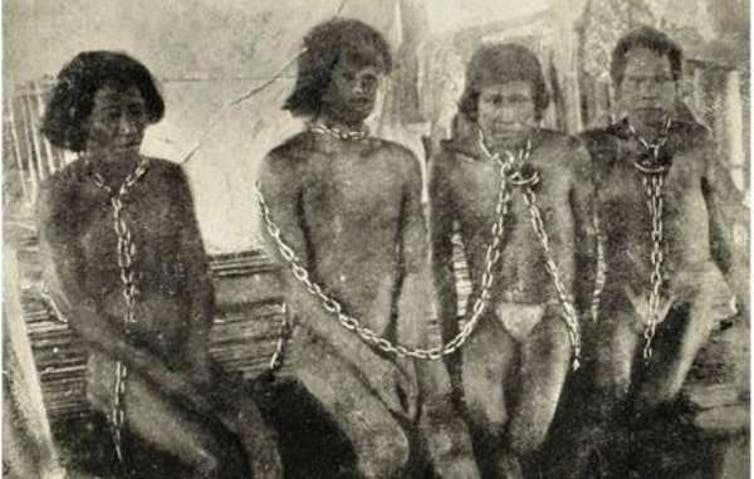
Indigenous people in the Peruvian Amazon were enslaved by rubber barons into the 20th century. Walter Hardenberg/Wikipedia
In the 19th century, the British cleared yet more forest to establish rubber plantations. Despite officially being keen to encourage the abolition of slavery, the British-owned Peruvian Amazon Company violently forced Indigenous people into servitude. The anthropologist Wade Davis would later comment that
The horrendous atrocities that were unleashed on the Indian people of the Amazon during the height of the rubber boom were like nothing that had been seen since the first days of the Spanish Conquest.
The American industrialist Henry Ford founded a rubber-producing town deep in the Amazon rainforest in 1928. He hoped to “develop that wonderful and fertile land” to produce the rubber his company needed for car tires, valves and gaskets. Fordlândia, as it became known, was abandoned in 1934.
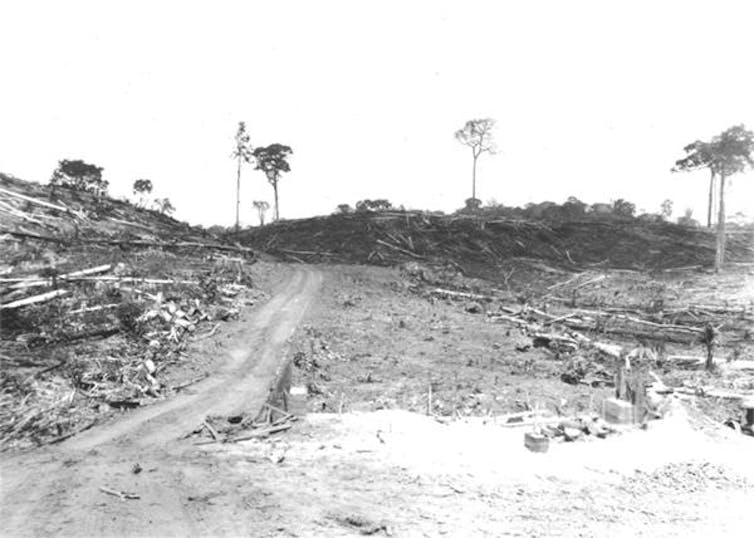
Fordlândia required the Ford Motor Company to ‘develop’ significant areas of rainforest. The Henry Ford Collection
By the middle of the 20th century, the size of the Indigenous population first encountered by the Portuguese had shrunk by 80-90%. Meanwhile, the global demand for beef accelerated the destruction of South American forests to free up new grazing land.
Global brands, such as McDonalds, have been linked with Brazilian beef, half of which is produced on lands which were once rainforest. Just as demand for sugar and rubber fuelled historic slavery, the global appetite for beef drives deforestation and displaces Indigenous people today.
New frontiers
The current crisis in the Amazon began with illegal gold miners, loggers, and farmers setting fires to clear lands for new enterprises. This process has been promoted and celebrated by the government of Jair Bolsonaroand the country’s powerful agribusiness sector. Already dislocated people face an increasingly grave situation. This is especially true for uncontacted groups who’ve yet to cultivate biological resistance to the diseases which outsiders can introduce, or develop the cultural experience necessary to navigate today’s complex political landscape.
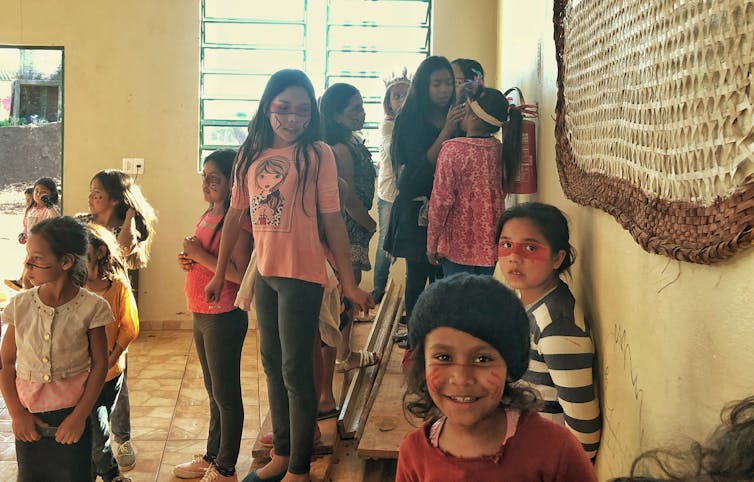
Members of the Kaingang, a people displaced by the destruction of the Mata Atlântica. Their name can be translated as ‘owners of the forest’. Darren ReidAuthor provided
Many of Brazil’s Indigenous cultures are completely oriented around their forests. In the modern era, their belief systems endure in groups such as the Kaingang, a part of the Gê peoples who occupied the southern parts of the Amazon rainforest and lived throughout the Mata Atlântica. They must actively nurture and protect these beliefs in the face of tremendous outside pressure.
Unlike in the US, dense forests and unmapped locations, not to mention uncontacted peoples, ensure continuity between the earliest days of European colonisation and modern Brazil.
Indigenous peoples have shown remarkable strength and resilience against more than 500 years of colonialist attack. But they remain vulnerable to an insatiable global economy which profits from the destruction of South American forests and the people who live within them. The recent fires are simply the most recent chapter in a much longer story.
*
Note to readers: please click the share buttons above or below. Forward this article to your email lists. Crosspost on your blog site, internet forums. etc.
 is a Senior Lecturer, American History and Popular Culture, Coventry University
Featured image is from End of the American Dream


JUST NEWS published this article following the Creative Commons rule. If you don't want your article to appear in this blog email me and I will remove it asap.

Monday, August 26, 2019

Fire and the “Changing Narrative” Thing


Global Research, August 26, 2019

Changing narratives is a new buzz term. I even heard a Distinguished Professor say he can change the narrative about himself. He can’t change it much. Narratives are intellectual, depending on concepts that depend on societies. They are ultimately conservative.
This was known in early Buddhism. The Buddha said emotional is the highest form of wisdom, ahead of rationalization, which depends on traditions. He didn’t say “narrative change” is useless. But the merely intellectual is the status quo, fundamentally.
Toni Morrison referred to the story beneath the story. James Baldwin called it a burning fire. In a letter to Angela Davis, awaiting trial, he wrote:
“we have been told nothing but lies, lies about ourselves and our kinsmen and our past, and about love, life, and death”.
In other words, everything.
Baldwin discovered what “history had made of him”. It happened when he was jailed in Paris with North Africans. He learned he was distinct, not for being black, but for being powerful. Despised in the US, he was a product of US power: a “bastard of the west”. In a new biography, Living in Fire,[i] Bill V. Mullen says Baldwin should be “understood the way we understand Fanon, García Marquez, Assata Shakur”: They wrote outside the US, aware of imperialism: what history has made of us. They knew the fire.
The point is hard, for some. In Young Castro,[ii] Harvard University Senior Lecturer, Jonathen Hansen, offers a sympathetic portrait of Fidel Castro with no such awareness. He mentions the struggle for independence but doesn’t explain how and why the “impossible” gripped whole generations.
In Náhuatl culture, of Middle America, fire images refer to truth. You get it by burning up, metaphorically. Volcanic images run through centuries-long traditions from which Castro emerged.
Hansen leaves that out. It’s like writing a biography of Stephen Hawking and leaving out collapsing stars and imaginary time. We wouldn’t have had Hawking without Hubble, Lemaitre, and Einstein, and Castro couldn’t be who he was without Varela, Bolívar, Luz, and Cespedes. He said it repeatedly.  Yet Hansen writes about Castro without mentioning any of them. They knew about fire. Hansen doesn’t.
Arguably, the most notable “narrative change” in the Americas was by José Martí, 19th century Cuban independence leader. He changed the narrative of US supremacy.  Cuban scholar Juan Marinello says one of the great puzzles about Cuba, for its enemies (and some sympathizers), is how ideas have survived. It’s because they weren’t “mere thinking”, as Einstein put it.
Latin America had no “cultural passport”, no identity.[iii] It had resisted Spanish colonialism for hundreds of years, but the models were English, French or US. Martí was the first, arguably, to set out an idea of Latin Americanness. He said, famously, that ideas are stronger weapons than ones of steel. But Martí’s ideas weren’t just ideas. He proposed “una cultura nueva” (new way of living).[iv]
It wasn’t about naming identities and giving some priority. Martí did what Baldwin intended: challenged the terms of daily life: “love, life and death”. In 1961, Baldwin said “the only hope for this country …. [is] to undermine the standards by which the middle-class American lives”.  The bridge uniting black people, he wrote, is suffering. He articulated that suffering drawing on his own lived reality.
But Baldwin gets fitted into a contradictory narrative: identity politics. Mullin wonders whether Baldwin at the end of his life recognized black lesbians as political agents or whether he still saw black men as agents of change. It seems a silly question, given what we learn about Baldwin in Mullin’s book. Baldwin expressed suffering within the community he knew. He thereby moved his readers to understanding human suffering, the place from which we know other people as people.
For instance, Palestinians.  Baldwin learned, early on, from a “radical, white female mentor” that white people didn’t act as they did because they were white but for other reasons. Trying to know those reasons “burned at the core of his political education”. It made him an internationalist.
As a result, Baldwin discovered “something of the universal and inevitable human ferment which explodes into what is called a revolution”. It’s not narrative. It’s not identity.
In Report to Greco, describing his life-changing reaction to the 10th anniversary of the Russian Revolution, Nikos Kazantzakis writes that
“Beyond all reasoning, beyond learned bickering … higher than programs, higher than leaders, higher than Russia … [was a] lightening flash [that]  illuminated their minds … All men are brothers!”
It’s connection. Kazantzakis says the “lightening flash” happened as “boundaries were crumbling away, [and] names, countries and races were vanishing”. Perhaps it sounds cliché, but it makes a philosophical point. Before identity, and naming, is connection. It explains narrative change, when it counts.
Closing the new documentary on her life, Toni Morrison describes how, in an art exhibit, she looks through a mirror and sees someone approaching. She raises her hand to the glass and an unknown figure meets her hand on the other side. Morrison says, “I didn’t need to know her name or who she was, or anything about her.” The connection was enough.
Imperialism’s narratives are about names: “people” and “non-people”. The “non-people” are somehow not like us and our self-image requires knowing them as such. Martí called it “historical logic”, as did Fanon. Hansen plays right into it, assuming about Castro what would never be assumed about Hawking: that his actions are explained by his idiosyncrasies not by a mind rooted in a history moving forward.
He doesn’t know that Castro, like Morrison, can be a “friend of my mind” because he expressed what Martí called “energía original”, and Baldwin called “dignity”. Whatever the name, it must first be felt, like the Náhuatl fire and sun imagery that drove Martí, personally first, and then intellectually.
*
Note to readers: please click the share buttons above or below. Forward this article to your email lists. Crosspost on your blog site, internet forums. etc.
Susan Babbitt is author of Humanism and Embodiment (Bloomsbury 2014). She is a frequent contributor to Global Research.
Notes
[i] Pluto Press, 2019. See review forthcoming at https://www.nyjournalofbooks.com/
[iii] Noel Salomón “José Martí y la toma de conciencia latinoamericana” Anuario del Centro de estudios martianos (4 1972)
[iv] Pedro Pablo Rodríguez, Los dos Américas, 5


https://www.globalresearch.ca/fire-changing-narrative-thing/5687179


JUST NEWS published this article following the Creative Commons rule. If you don't want your article to appear in this blog email me and I will remove it asap.

Wednesday, August 21, 2019

Half a Billion Bees Drop Dead in Brazil Amid Jump in Pesticide Use


Global Research, August 21, 2019

Zero Hedge 19 August 2019


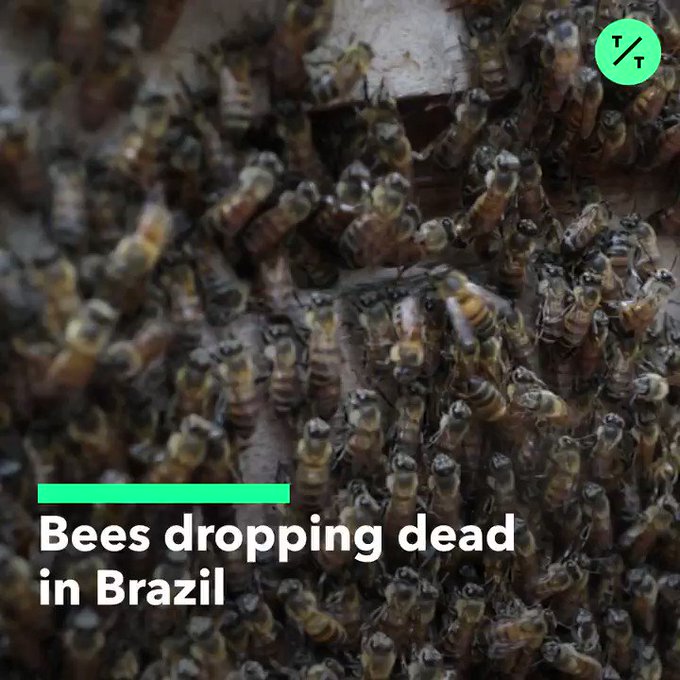
Bee apocalypse has unfolded in four of Brazil’s southern states in 1Q19. More than half a billion bees died earlier this year, in a short period, experts are suggesting that pesticides are likely to be blamed, reported Bloomberg.
.
.
.
.
Around half a billion bees dropped dead in 4 of Brazil’s southern states in the first few months of this year. Samples showed most of the dead had been poisoned with Fipronil, a insecticide proscribed in the EU, classified as a possible human carcinogen by the U.S. EPA (thread)
133 people are talking about this
Most of the dead bees had traces of Fipronil, an insecticide classified by the European Union and the US Environmental Protection Agency as a human carcinogen.
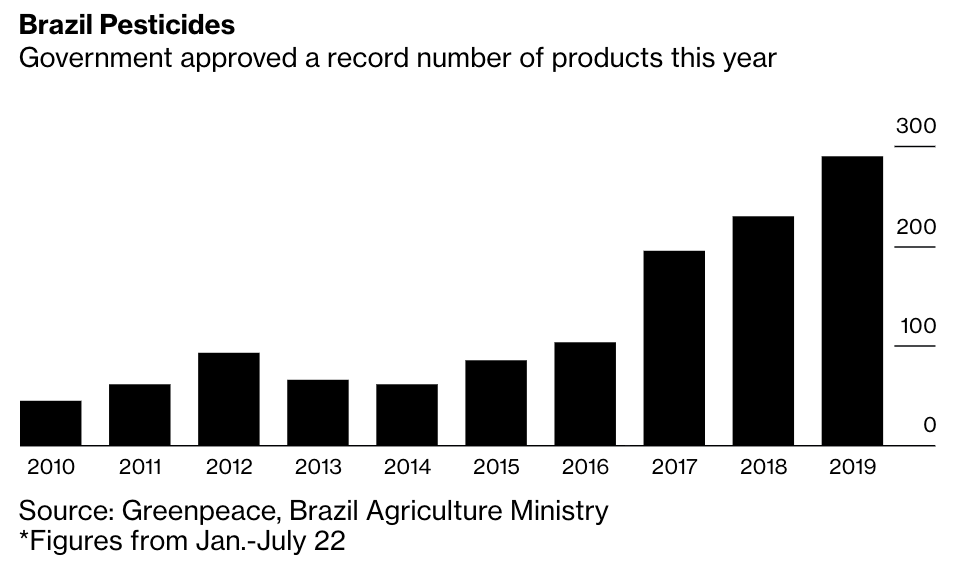
Since President Jair Bolsonaro took control in January, the Ministry of Agriculture has approved sales of a record 290 pesticides, up 27% YoY for the same period. There’s also a bill sitting in Congress that would dramatically decrease pesticide standards.
Brazilian companies such as Cropchem and Ouro Fino, as well as major international firms including Syngenta, Monsanto, BASF and Sumitomo,  have recently won new pesticide registrations.
Data from the United Nations discovered Brazil’s pesticide use jumped 770% from 1990 to 2016.
Brazil’s health watchdog Anvisa recently published a food-safety report which found 20% of samples contained pesticide residues above government accepted levels.
Bloomberg noted that Anvisa’s test didn’t even include glyphosate, one of Brazil’s best-selling pesticide, which is outlawed in at least a dozen countries around the world.
“The death of all these bees is a sign that we’re being poisoned,” said Carlos Alberto Bastos, president of the Apiculturist Association of Brazil’s Federal District.
At least 18% of Brazil’s economy is agriculture. And it makes sense why President Bolsonaro is relaxing pesticide rules; he’s trying to spark an economic boom by deregulating chemical standards for farmers.
“This is your government,” Bolsonaro told legislators from the agriculture caucus, and his administration has even allowed farmers this year to use whatever pesticides they want.
Greenpeace said 40% of Brazil’s pesticides are “highly or extreme highly toxic,” and 32% of them aren’t allowed in the European Union.
Marina Lacorte, a coordinator at Greenpeace Brazil, told Bloomberg that new approvals for pesticides are being rushed through without proper examination from experts.
“There isn’t another explanation for it, other than politics,” she said.
Making farmers great again was a campaign commitment for Bolsonaro. He even told farmers that he was going to ease pesticide restrictions.
Andreza Martinez, manager for regulation at Sindiveg, a group representing pesticide producers, told Bloomberg about half of the new approvals are ingredients, not final products. This is due to insects developing resistance to legacy formulas.
“It brings more tools to farmers, but that doesn’t mean an increase in the use of products in the field,” she said.
The increased, and sometimes untested chemicals, however, alarms toxicologists.
“The higher the number of products, the lower our chances of safety, because you can’t control them all,” said Silvia Cazenave, a professor of toxicology at the Catholic Pontifical University of Campinas.
It’s not just the bees who are being poisoned — it’s also humans, the health ministry said. More than 15,000 cases of agricultural pesticide were seen in 2018, a likely underreported figure.
President Trump has also been approving new pesticides that are dangerous to bees.
new report showed US beekeepers lost 40% of their colonies in the past year, raising fresh concerns that pesticides are poisoning farmlands.
Making farmers great again not just in Brazil but also in the US could be an uphill battle, as the unintended consequences of deregulating pesticides have led to a global bee apocalypse.
*
Note to readers: please click the share buttons above or below. Forward this article to your email lists. Crosspost on your blog site, internet forums. etc.
Featured image is from the author


https://www.globalresearch.ca/half-billion-bees-drop-dead-brazil-pesticide-use/5686822


JUST NEWS published this article following the Creative Commons rule. If you don't want your article to appear in this blog email me and I will remove it asap.