Showing posts with label Brazil. Show all posts

Thursday, September 5, 2019

The Amazon Fire Crisis Has Been 500 Years in the Making – as Brazil’s Indigenous People Know Only Too Well


Global Research, September 05, 2019
The Conversation 4 September 2019


São Paulo – the largest city in the Americas – was recently plunged into darkness in the middle of the day due to smoke from the Amazon rainforest burning more than 2,700km (1,700 miles) away.
These fires have brought global attention to the forests of South America, but the crisis surrounding them has deep roots. To understand what is happening in the Amazon today, it’s necessary to understand how deeply exploitation of the forest, and the Indigenous peoples who live within it, are ingrained in the global economy.
The first Portuguese explorers arrived in Brazil on April 22 1500. The region didn’t at first appear to offer the gold or silver that was to make Central America a tempting target for colonisers, but it did present a more obvious asset: vast forests with a seemingly inexhaustible supply of timber.
The region’s Brasilwood trees produced a valuable red dye, and with the colour red in fashion in the French court, Brazil’s forests quickly became a target for profit-minded Europeans. Brasilwood was so prevalent before colonisation that it lent its name to the country. But after centuries of overharvesting, these trees are now a highly endangered species.
Indigenous peoples were initially incentivised to help harvest timber in exchange for European goods. But eventually the native peoples were enslaved and made to destroy the forests which had provided the wood for their homes and the game and plants for their diet.
Once cleared of trees, land was turned into plantations to grow labour-hungry cash crops such as sugar, encouraging the enslavement of yet more Indigenous people. When they proved too few in number, vast numbers of people were taken from Africa and forced into slavery alongside them.
Global economy, local cost
The Mata Atlântica, a vast tropical forest which stretched down the east coast of the country and well into its interior, was an obvious target for the seafaring colonisers, who needed to ensure the materials they harvested could be easily transported to overseas markets.
But the environmental cost of this process was massive. As much as 92% of the Mata Atlântica has been destroyed over the past 500 years, erasing the places in which hundreds of distinct cultures evolved over the preceding millennia. Vast numbers of species disappeared along with it.
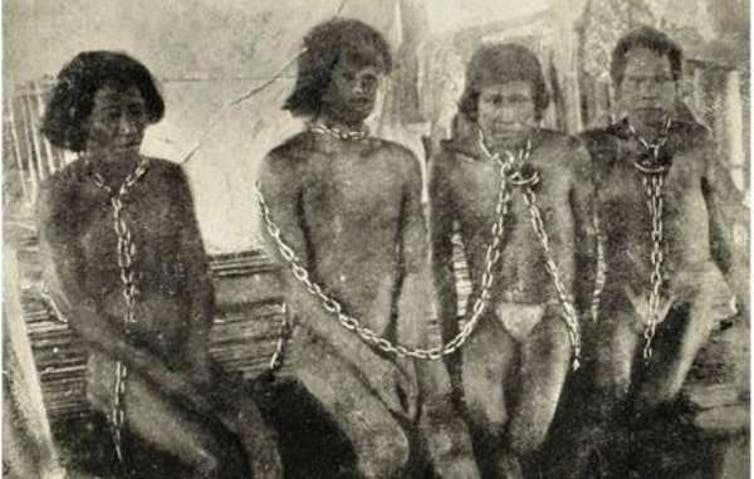
Indigenous people in the Peruvian Amazon were enslaved by rubber barons into the 20th century. Walter Hardenberg/Wikipedia
In the 19th century, the British cleared yet more forest to establish rubber plantations. Despite officially being keen to encourage the abolition of slavery, the British-owned Peruvian Amazon Company violently forced Indigenous people into servitude. The anthropologist Wade Davis would later comment that
The horrendous atrocities that were unleashed on the Indian people of the Amazon during the height of the rubber boom were like nothing that had been seen since the first days of the Spanish Conquest.
The American industrialist Henry Ford founded a rubber-producing town deep in the Amazon rainforest in 1928. He hoped to “develop that wonderful and fertile land” to produce the rubber his company needed for car tires, valves and gaskets. Fordlândia, as it became known, was abandoned in 1934.
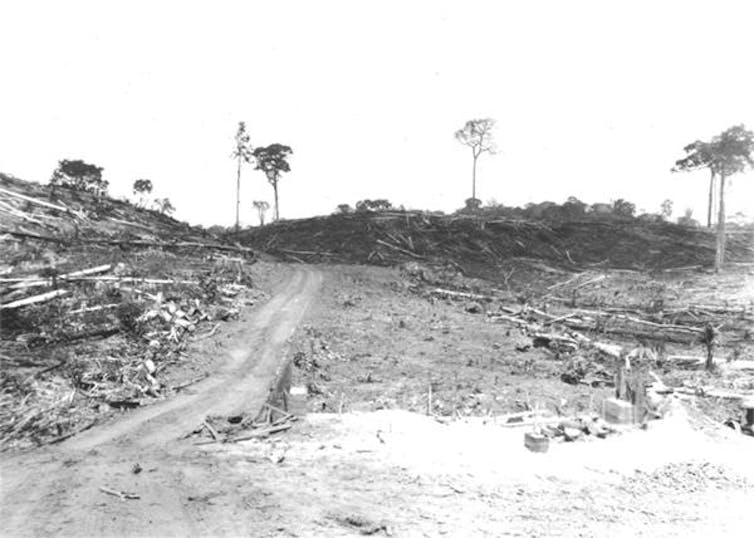
Fordlândia required the Ford Motor Company to ‘develop’ significant areas of rainforest. The Henry Ford Collection
By the middle of the 20th century, the size of the Indigenous population first encountered by the Portuguese had shrunk by 80-90%. Meanwhile, the global demand for beef accelerated the destruction of South American forests to free up new grazing land.
Global brands, such as McDonalds, have been linked with Brazilian beef, half of which is produced on lands which were once rainforest. Just as demand for sugar and rubber fuelled historic slavery, the global appetite for beef drives deforestation and displaces Indigenous people today.
New frontiers
The current crisis in the Amazon began with illegal gold miners, loggers, and farmers setting fires to clear lands for new enterprises. This process has been promoted and celebrated by the government of Jair Bolsonaroand the country’s powerful agribusiness sector. Already dislocated people face an increasingly grave situation. This is especially true for uncontacted groups who’ve yet to cultivate biological resistance to the diseases which outsiders can introduce, or develop the cultural experience necessary to navigate today’s complex political landscape.
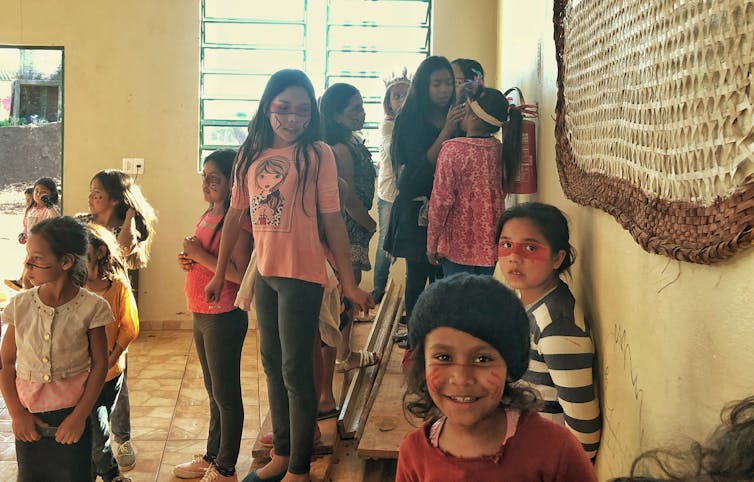
Members of the Kaingang, a people displaced by the destruction of the Mata Atlântica. Their name can be translated as ‘owners of the forest’. Darren ReidAuthor provided
Many of Brazil’s Indigenous cultures are completely oriented around their forests. In the modern era, their belief systems endure in groups such as the Kaingang, a part of the Gê peoples who occupied the southern parts of the Amazon rainforest and lived throughout the Mata Atlântica. They must actively nurture and protect these beliefs in the face of tremendous outside pressure.
Unlike in the US, dense forests and unmapped locations, not to mention uncontacted peoples, ensure continuity between the earliest days of European colonisation and modern Brazil.
Indigenous peoples have shown remarkable strength and resilience against more than 500 years of colonialist attack. But they remain vulnerable to an insatiable global economy which profits from the destruction of South American forests and the people who live within them. The recent fires are simply the most recent chapter in a much longer story.
*
Note to readers: please click the share buttons above or below. Forward this article to your email lists. Crosspost on your blog site, internet forums. etc.
 is a Senior Lecturer, American History and Popular Culture, Coventry University
Featured image is from End of the American Dream


JUST NEWS published this article following the Creative Commons rule. If you don't want your article to appear in this blog email me and I will remove it asap.

Friday, August 23, 2019

The “Lungs of the Earth” Are Literally Being Burned Away as Unprecedented Wildfires Absolutely Ravage Our Planet


Global Research, August 23, 2019

End of the American Dream 21 August 2019

We have never seen anything quite like this.  This week the skies above Brazil’s largest city turned black in the middle of the afternoon due to the massive wildfires that are currently raging in that country.  But the wildfires aren’t actually happening anywhere near São Paulo.  In fact, the smoke that turned the skies black actually came from fires that were happening more than 1,000 miles away.  Can you imagine how powerful the fires have to be in order to do that?  And it isn’t just Brazil – right now horrific fires are scorching vast stretches of our planet from South America all the way up to the Arctic.  Some of the fires are producing so much smoke that you can actually see it from space.  And in the process, irreversible damage is being done to our ecosystems.
I know that this number is hard to believe, but there have been more than 72,000 wildfires in Brazil so far in 2019, and most of those fires are happening in the Amazon rainforest.  I understand that many of you may not care what happens in Brazil, but you should.  Approximately 60 percent of the entire Amazon rainforest is in Brazilian territory, and that rainforest produces approximately 20 percent of all the oxygen in our atmosphere.  So essentially the “lungs of the Earth” are being burned away right in front of our eyes
The fires are burning at the highest rate since the country’s space research center, the National Institute for Space Research (known by the abbreviation INPE), began tracking them in 2013, the center said Tuesday.
There have been 72,843 fires in Brazil this year, with more than half in the Amazon region, INPE said. That’s more than an 80% increase compared with the same period last year.
The Amazon is often referred to as the planet’s lungs, producing 20% of the oxygen in the Earth’s atmosphere.
Every minute of every single day, an average of 1½ soccer fields of Amazon rainforest are being wiped out.  This is an ongoing crisis that hasn’t been getting nearly the attention that it deserves in the United States.
But when the skies above Sao Paulo suddenly turned completely black at three in the afternoon on Monday, that set off a social media frenzy
São Paulo’s skies were blackened for roughly an hour at around 3 p.m. Monday due to raging fires throughout the region and weather conditions that pushed particulate matter over the city, setting off intense speculation on social networks about the reason why the day was seemingly transformed into night.
Videos and images posted by local residents depicted disturbing scenes of pedestrians walking under black skies and cars driving in the mid-afternoon with their headlights on as the continued fires throughout the Amazon rainforest drove the hashtags #PrayforAmazonia and #PrayforAmazonas to worldwide viral status.
Sadly, these fires are not going to end any time soon.  It is being reported that more than 9,000 fires are raging at the moment, and it is being estimated that 640 million acres have been affected by those fires.
Yes, you read that number correctly.
640 million acres.
Meanwhile, 50 large wildfires are burning in a dozen U.S. states right now.  The worst fires are happening in Alaska, where “more than 400,000 acres are currently burning”
Multiple fires are burning near the state’s biggest city, and firefighters have called in assistance from the Lower 48. More than 400,000 acres are currently burning, and one of the biggest concerns is the McKinley Fire, which has destroyed at least 50 structures about 100 miles north of Anchorage. Officials with the Matanuska-Susitna Borough declared a state of emergency, and firefighters hoped that calmer weather predicted for Wednesday could permit evacuees to return.
When I think of Alaska, I think of a place that is bitterly cold.  But apparently it is hot enough this year for wildfires to sweep across hundreds of thousands of acres.
And we are also witnessing highly unusual wildfires in the Arctic in 2019…
The Arctic as a whole has seen unusually high wildfire activity this summer, Parrington said, including areas such as Greenland that typically don’t see fires. One estimate found that the amount of carbon dioxide emitted from fires burning within the Arctic Circle in in June 2019 was greater than all of the CO2 released in the same month from 2010 through to 2018 put together.
To me, it is very strange to be talking about “wildfires in the Arctic”, but we have entered a period of time when our entire definition of “normal” is going to change.  Last winter we experienced one of the coldest winters in ages, during the first half of this year the middle of the U.S. experienced unprecedented rainfall and flooding, and now we are being told that last month was the hottest July ever recorded
The average global temperature in July was 1.71 degrees F above the 20th-century average of 60.4 degrees, making it the hottest July in the 140-year record, according to scientists at NOAA’s National Centers for Environmental Information.
The previous hottest month on record was July 2016. Nine of the 10 hottest recorded Julys have occurred since 2005; the last five years have ranked as the five hottest. Last month was also the 43rd consecutive July and 415th consecutive month with above-average global temperatures.
Unfortunately, many believe that this is just the beginning.  Global weather patterns are going haywire, and so the extremes that we have seen so far may just be the tip of the iceberg.
The environment that we depend upon for life every moment of every day is being shaken, and many are deeply alarmed about what is happening to the Earth.  Each day it is being destroyed a little bit more, and the clock is ticking…
*
Note to readers: please click the share buttons above or below. Forward this article to your email lists. Crosspost on your blog site, internet forums. etc.
Michael Snyder is a nationally-syndicated writer, media personality and political activist. He is the author of four books including Get Prepared NowThe Beginning Of The End and Living A Life That Really Matters. His articles are originally published on The Economic Collapse BlogEnd Of The American Dream and The Most Important News.
Featured image is from End of the American Dream


https://www.globalresearch.ca/unprecedented-wildfires-absolutely-ravage-planet/5687028


JUST NEWS published this article following the Creative Commons rule. If you don't want your article to appear in this blog email me and I will remove it asap.

How Jair Bolsonaro Emboldened Brazilian Agribusiness to Torch the Amazon & Attack Indigenous People


Democracy Now!
World leaders are calling for the protection of the Amazon, which produces about 20% of the oxygen on the planet.
Andrew Miller, advocacy director for the conservation organization Amazon Watch, says the fires are worse now than in previous years as a direct result of far-right Brazilian President Jair Bolsonaro’s policies, which encourage exploitation of the Amazon for mining, logging and agricultural activity. “The people who feel the impacts directly are local indigenous communities,” Miller says.
Posted August 23, 2019

This article was originally published by "Democracy Now!" -

==See Also==


http://www.informationclearinghouse.info/52151.htm


JUST NEWS published this article following the Creative Commons rule. If you don't want your article to appear in this blog email me and I will remove it asap.

Friday, August 9, 2019

Bolsonaro’s War on the Amazon: Mass Mining Invasion of Yanomami Lands in Brazil Threatens Their Survival


Global Research, August 09, 2019


Acting in response to public statements from the President of Brazil, Jair Bolsonaro, on the need to open up indigenous lands in the Amazon Basin to extractive industries, an estimated 20,000 illegal miners are reported to have invaded the lands of the Yanomami peoples in Brazil. Although the 9.7 million hectare area was established as an Indigenous Park in 1992, meaning it could only be exploited for mining subject to special decisions in the national legislature, over the past 20 years it has been repeatedly threatened by mining invasions which have caused epidemics and violent clashes.
Concerns have also been raised about copycat invasions of Yanomami lands across the border in Venezuela, where the Government of President Maduro has announced plans for a Mining Arc embracing the whole of the south of the country. Currently, owing to a nation-wide gasoline shortage, illegal mining in the Upper Orinoco and Caura rivers in Venezuela have been scaled back.
The American Association of Anthropologists has also appealed to human rights organisations to demand the protection of the Yanomami’s rights.
*
Note to readers: please click the share buttons above or below. Forward this article to your email lists. Crosspost on your blog site, internet forums. etc.
Featured image is from Forest Peoples Programme


https://www.globalresearch.ca/bolsonaros-war-on-the-amazon-mass-mining-invasion-of-yanomami-lands-in-brazil-threatens-their-survival/5686008

JUST NEWS published this article following the Creative Commons rule. If you don't want your article to appear in this blog email me and I will remove it asap.

Wednesday, August 7, 2019

Future of Amazon Deforestation Data in Doubt as Research Head Sacked by Bolsonaro


Global Research, August 07, 2019

Mongabay 5 August 2019

After a month of intensifying criticism from far-right President Jair Bolsonaro concerning data revealing a spike in deforestation in the Brazilian Amazon over recent months, the Brazilian President has fired the head of the government agency in charge of tracking forest loss, raising concerns over the future of an institution recognized nationally and internationally for its cutting-edge satellite-imaging and monitoring program.
On August 2, Bolsonaro fired the head of the Brazilian National Institute of Space Research (INPE), Ricardo Magnus Osório Galvão. The announcement was made by Galvão himself after a meeting with the Minister of Science, Technology, Innovation and Communication, Marcos Pontes.
Image on the right: Physicist Ricardo Magnus Osório Galvão, former head of the Brazilian National Institute of Space Research (INPE). Image courtesy of Giro720 CC BY-SA 4.0.
“I will be fired… The way I reacted to the president[‘s accusations of data inaccuracy and data manipulation] has created an embarrassment that is untenable,” Galvão told journalists in Brasília.
In July, INPE issued an alert identifying deforestation and degradation totaling some 2,072 square kilometers (800 square miles) in June for Legal Amazonia — a federal designation that includes all or parts of nine Brazilian states — as detected by DETER, the institute’s real-time detection system. INPE noted that DETER alerts should not be used as exacting measures of deforestation rates compared year-to-year; rather the figures aim to support surveillance and enforcement.
However, a 2018-2019 month-to-month comparison does show a drastic uptick in deforestation. According to DETER, Brazil’s Amazonian deforestation in June 2019 was 88 percent greater than for the same month in 2018, while deforestation in the first half of July was 68 percent above that for the entire month of July 2018.
INPE is not scheduled to post its detailed 2019 annual deforestation analysis (conducted between August and July by its PRODES satellite monitoring system) until later this year. PRODES determines annual deforestation using NASA Landsat satellite imaging. Data gathered from August 2017 to July 2018 detected an increase in deforestation of 7,536 square kilometers (2,910 square miles) in Legal Amazonia, which represented an increase of 8.5 percent compared to 2017, measured from August 2016 to July 2017, when an area of 6,947 square kilometers (2,682 square miles) was cleared.
Experts recently contacted by Mongabay endorsed INPE’s cutting-edge satellite-imaging used to track forest loss and dismissed the Bolsonaro administration’s accusations of data manipulation. The government has offered no significant evidenceto back up its charges that INPE data is inaccurate.
Beyond challenging INPE data, Bolsonaro has also criticized the way INPE works, claiming that he should have been notified before monthly deforestation statistics were released. The day before Galvão’s firing, Bolsonaro accused him of working in conspiracy with “an NGO.” The administration has repeatedly accused international nonprofits working in the Brazilian Amazon of having undue influence over Brazil’s national environmental policies — including NGO participation in the implementation of the Amazon Fund, long seen as a fairly successful initiative for curbing Amazon deforestation.
“If all this devastation you accuse us of doing, and that has already been done in the past, [were true] the Amazon would have been extinct,” said Bolsonaro in a press conference on August 1 when he dismissed INPE’s figures. “I am convinced that INPE’s data is [a] liar.… In our feeling, this is not consistent with reality. It even looks like he’s [Galvão’s] on duty of an NGO,” he added.
Worrying future
Galvão’s removal triggered an outcry from scientists, NGOs, federal prosecutors and INPE officials.
“Bolsonaro knows that his government is primarily responsible for the current scenario of destruction of the Amazon. The dismissal of INPE’s head is just an act of revenge against those who show the truth,” said Márcio Astrini, public policy coordinator at Greenpeace Brasil, in a statement.
“The new government has been implementing in the country an anti-environmental project, which scrap[s] the State’s ability to combat deforestation and favor[s] those who commit environmental crime. And now, when it comes to facing the consequences of his decisions, he [the president] tries to hide the truth shamefully and blame others,” Astrini added.
Bolsonaro’s cabinet did not comment on Galvão’s removal. Instead, it forwarded a statement from the Ministry of Science, Technology, Innovation and Communication that confirmed the dismissal, thanked Galvão for his work and stated that the choice of a new head will be made based on “the necessary merit [required for] the position.”
Two INPE officials who talked to Mongabay under condition of anonymity expressed “serious concerns” not only about who will next head the institution, but also about the future of INPE’s decades-long monitoring system.
“I’m very concerned about the future. I worry greatly about ensuring that the systems will keep working as they are, with transparency… I hope the government won’t stop our work,” the INPE official told Mongabay.
“Galvão’s dismissal was shocking to us. It’s scary to have a president who discredits a scientific institution that has its work recognized worldwide, simply due to his political interests… It is a complete disrespect to people who are dedicated to science, education, culture. We are being scolded. The scientists are scared,” a second INPE official said.
According to this official, the government’s attacks against INPE seem a strategy to discredit the institution in order to pave the way to set up a private system to monitor the country’s deforestation. In March, the Folha de S.Paulo newspaper reported that Environment Minister Ricardo Salles was preparing an alternative private system to that employed by INPE, at a cost of at least $8.5 million, using satellite imagery to be provided by Planet, a U.S.-based company. According to the newspaper, INPE currently pays some $150,000 annually for NASA Landsat satellite imagery that it uses to assess PRODES annual deforestation rates, while DETER alerts use images from CBERS, Sino-Brazilian satellites, which are free.
Galvão’s removal and his replacement have yet to be published in the country’s official gazette, Diário Oficial da União. In an interview with Radio Eldorado on August 5, Pontes said that INPE’s new head will be announced by August 6. According to the minister, an Air Force officer and a PhD researcher with deforestation expertise top the list.
*
Note to readers: please click the share buttons above or below. Forward this article to your email lists. Crosspost on your blog site, internet forums. etc.
Featured image: Deforestation in the Brazilian Amazon in Rondônia state. This 2016 satellite image shows the smoke from fires which are typically set to clear rainforest in preparation for grazing and farming. Image courtesy of Planet Labs, Inc CC BY-SA 4.0.

https://www.globalresearch.ca/future-amazon-deforestation-data-doubt-research-head-sacked/5685832


JUST NEWS published this article following the Creative Commons rule. If you don't want your article to appear in this blog email me and I will remove it asap.