Showing posts with label Afghanistan. Show all posts

Friday, September 6, 2019

A US-Taliban Peace Deal Would Redefine the Regional Balance of Power


Global Research, September 06, 2019

The tentative peace deal that the US is negotiating with the Taliban would redefine the regional balance of power if it’s officially promulgated, thus continuing the ongoing trend of Great Power realignment in Eurasia.
It’s been widely reported that the tentative peace deal that the US is negotiating with the Taliban will see the removal of 5,000 American troops from Afghanistan and the closure of five military bases (at least in the first phase) in exchange for the armed group (formally recognized as terrorists by Russia and many other countries) promising not to allow their territory to be used by international terrorists such as Daesh. Should this pact be officially promulgated, then it would redefine the regional balance of power and continue the ongoing trend of Great Power realignment in Eurasia. Before analyzing the implications of this possible move, it must first be pointed out that there’s supposedly significant opposition to the agreement within the American government itself, with Time reporting that Pompeo refused to sign it because of concerns that he has that it would legitimize the Taliban as a US-recognized political force in the country despite the organization declining to bestow the same recognition on the Kabul government that they’ve sworn to overthrow.
It’s unclear whether Pompeo’s concerns are sincere or if they’re just self-interested political positioning ahead of his possible candidacy in the 2024 elections in the event that the full US military withdrawal that it’ll likely eventually lead to is as destabilizing for Afghanistan as Obama’s one from Iraq was and he wants to distance himself from it in advance. Another detail that deserves mentioning is that former Secretary of Defense Mattis recently revealed in his memoirs that he regards Pakistan as the “most dangerous country” in the world, even though the global pivot state greatly facilitated the progress that’s been made thus far on brokering peace in Afghanistan and its leader was warmly received by Trump over the summer. The US’ “deep state” divisions had previously been between its diplomatic and military wings yet now it appears as though they’re on the same page in opposition to the President’s peace push, but Trump’s “going rogue” to get it done anyhow, likely emboldened per his style to think that he must be doing something right if he’s received this much pushback.
If Trump signs the deal and it expectedly receives important endorsements from regional powers like Russia, China, Pakistan, and Iran (all of which and others the Taliban expect to serve as “international witnesses” to the accord), then he can have the “face-saving” pretext necessary to withdraw his troops even further and pass his decision off as a necessary one in the interests of peace, which he hopes will help him extricate his country from this ultra-expensive but ultimately failed campaign and therefore possible win re-election next year. He’s also on record as saying that more immediate stakeholders such as India, Pakistan, Russia, Afghanistan (meant in this context to be the Kabul government), Iran, Iraq, and Turkey will probably have to intervene in the US’ wake in order to ensure that Daesh doesn’t take advantage of the situation, which can be interpreted either as a pragmatic admission of America’s defeat in this seemingly never-ending war or a Machiavellian maneuver to embroil his rivals in this quagmire.
Whatever his true intentions may be, going forward with the tentative Taliban peace deal would radically change the regional balance of power. The armed group would likely take over Kabul sooner than leader and officially return to power, thus reducing the effectiveness of India’s exploitation of the country as a springboard for carrying out its Hybrid War on CPEC and therefore enabling Pakistan to concentrate more of its military-strategic focus on defending its eastern border. Nevertheless, Indian influence might not be totally removed from Afghanistan in the scenario of a Taliban takeover because Russia has some sway over the group after hosting it for peace talks several times and its Foreign Minister recently said that Moscow is closely coordinating with its new global partners in New Delhi on this matter, so its possible that they might join forces to dangle the carrot of sustainable economic development through an eastern branch of their jointly pioneered North-South Transport Corridor (NSTC) in order to retain some Indian influence in the country.
India brazenly defied the US’ CAATSA sanctions threats this week by agreeing to jointly producemilitary equipment with Russia on top of proceeding apace with its deal to purchase the S-400s, and the Vladivostok-Chennai Maritime Corridor that they’re creating will have serious security implications for China if it’s accompanied by a forthcoming logistics pact that sees the Indian navy regularly patrolling this future trade route that traverses through the South China Sea and up China’s eastern coast. While Russia and India maintain that their bilateral relations aren’t aimed against any third parties, it might have been the case that their game-changing moves were predicated on the belief that it’s necessary to preemptively “balance” the predictable expansion of Chinese-Pakistani influence in Afghanistan following the eventual American withdrawal that would thus secure CPEC and correspondingly place India at a major strategic disadvantage given its refusal to accept the Belt & Road Initiative‘s (BRI) flagship project due to its maximalist approach towards the Kashmir Conflict.
As the cliched saying goes, “every action has an equal and opposite reaction”, and Russia’s “proactive balancing” with India against China and Pakistan is no different, likely resulting in the counter-response of China doubling down on its commitment to CPEC and Pakistan opening the doors for its partner to “counter-balance” India in Afghanistan as well. In addition, the US might interestingly gravitate closer to Pakistan too out of desire to “balance” the de-facto Russian-Indian alliance after New Delhi defied Washington’s CAATSA sanctions threats, which could curiously put the US and China on the same page regarding the need to support the global pivot state. The world’s superpowers might thus be in tacit agreement over this geostrategic necessity even if they remain at odds over their so-called “trade war“, but should their economic disagreements eventually be overcome, then it can’t be discounted that they might even coordinate their efforts in this respect. As such, it’s clear that the regional balance of power will definitely be redefined if the US-Taliban peace deal succeeds.
*
Note to readers: please click the share buttons above or below. Forward this article to your email lists. Crosspost on your blog site, internet forums. etc.
This article was originally published on OneWorld.
Andrew Korybko is an American Moscow-based political analyst specializing in the relationship between the US strategy in Afro-Eurasia, China’s One Belt One Road global vision of New Silk Road connectivity, and Hybrid Warfare. He is a frequent contributor to Global Research.
Featured image is from OneWorld


https://www.globalresearch.ca/taliban-peace-deal-would-redefine-regional-balance-power/5688277


JUST NEWS published this article following the Creative Commons rule. If you don't want your article to appear in this blog email me and I will remove it asap.

Wednesday, July 24, 2019

Trump’s Demented Foreign Policy: How to Kill Ten Million Afghans and Not Win…


Global Research, July 24, 2019

23 July 2019

“We’re like policemen. We’re not fighting a war. If we wanted to fight a war in Afghanistan and win it, I could win that war in a week. But I don’t want to kill 10 million people. Afghanistan could be wiped off the face of the Earth. I don’t want to go that route.”
Even considering the rolling annals of demented Trumpism, bolstered every single day by a torrent of outrageous tweets and quotes, what you’ve just read is simply astonishing. Here we have the President of the United States asserting that,
1) The US is not fighting a war in Afghanistan;
2) If the US wanted a war, the President would win it in a week;
3) He would kill 10 million people – although he doesn’t want it;
4) “Afghanistan” as a whole, for no meaningful reason, could be wiped off the face of the Earth.
Trump said all of the above while sitting alongside Pakistani prime minister Imran Khan – who, in a deft move, is trying to appease the White House even as he carefully positions Pakistan as a solid node of Eurasia integration alongside Russia, China and Iran.
When Trump says the US is not fighting a war in Afghanistan, he’s on to something, although it’s doubtful that Team Trump have told the boss that the real game in town, from the beginning, is the CIA heroin rat line.
It’s also doubtful Trump would ask for input from his hated predecessor Barack Obama. Obama may not have killed 10 million people, but the forces under his command did kill scores of Afghans, including countless civilians. And still Obama did not “win” – much less “in a week.”
Barack Obama did entertain the notion of “winning” the war in Afghanistan. After deliberating in solitary confinement for 11 hours, as legend goes, he “methodically” settled for a two-step surge, 21,000 troops plus 30,000. Obama believed the war on Afghanistan was a noble crusade and during his presidential campaign in 2008 always defined it as “the right war.”
Obama defended his surge on humanitarian imperialist grounds: “For the Afghan people, the return of Taliban rule would condemn their country to brutal governance, international isolation, a paralyzed economy and the denial of basic human rights to the Afghan people, especially women and girls.” The New York Times and the Washington Post applauded.
But, Kabul, we have a problem. Afghanistan, bombed and invaded under the Cheney regime, was never a “right” or “just” war. There was never any established Taliban connection to 9/11. Plotting and financing for 9/11 involved Saudis and cells in Germany, Pakistan and the UAE. Mullah Omar never dispatched any “terra-rists” on one-way tickets to America.
Nevertheless, the Taliban leadership in Kandahar did agree to a deal – brokered by Moscow – to surrender Osama bin Laden, who, without even the hint of an investigation, was proclaimed the evil 9/11 culprit only a few hours after the collapse of the Twin Towers. The Cheney regime rejected the Taliban offer, as well as a subsequent one, to hand over Osama to a Muslim nation for trial. The Cheney regime only wanted an extradition to the US.

The SCO steps in

With puppet Hamid Karzai barely reigning in Kabul, and the neocons already focused on their real target, Iraq, the occupation of Afghanistan was handed over to NATO. This had already been decided even before 9/11, at the G8 in Genoa in July, when it became clear Washington had a plan to strike Afghanistan by October. The Cheney regime badly needed a beachhead in the intersection of Central Asia and South Asia not only to monitor Russia and China but also to coordinate a drive to take over Central Asia’s massive gas wealth.
Notoriously fickle history in the Hindu Kush ruled otherwise. Incrementally, the Taliban started to get their mojo back throughout the 2010s, to the point that now they control as much as half of the country.
Even that fountain of vanity General David Petraeus – who had crafted the (failed) Iraq surge – always knew the Afghan war was un-winnable. Disgraced General Stanley McChrystal at least was more surgical: “We’ve shot an amazing number of people and killed a number, and to my knowledge, none has proven to have been a real threat.”
Still, certified fun and games were assured by stuff such as Lockheed Martin’s high mobility artillery rocket system laying waste to Pashtun villages and devastating wedding ceremonies. Pentagon propaganda about “low collateral damage” never disguised the absence of real, actionable intel on the ground.
Seymour Hersh argued that Obama’s version of the killing of Osama bin Laden in May 2011 was an elaborate work of fiction – subsequently duly enshrined by Hollywood. One year later, Obama’s surge still had 88,000 soldiers in Afghanistan plus nearly 118,000 contractors. The surge then died a slow, ignominious death.
Anyone remotely familiar with the fractious geopolitics at the intersection of Central and South Asia knows that, for the US military-industrial-security complex, to withdraw from Afghanistan is anathema. Trump may be emitting some noise – but that’s just noise. Bagram air base is an invaluable asset in the Empire of Bases to monitor the evolving Russia-China strategic partnership.
The only feasible solution for Afghanistan is a pan-Eurasia mechanism being advanced by the Shanghai Cooperation Organization, with Russia and China at the helm, India and Pakistan as full members and Iran and Afghanistan as observers. Afghanistan will then be fully integrated as a node of the New Silk Roads, or Belt and Road Initiative, as part of the China-Pakistan Economic Corridor as well as the Indian mini-Silk Road through Afghanistan towards Central Asia starting from the Iranian port of Chabahar.
This is what all major Eurasia players want. This is how you “win” a war. And this is how you don’t need to kill 10 million people.
This article was originally published by the Asian Times


https://www.globalresearch.ca/trumps-demented-foreign-policy-how-to-kill-ten-million-afghans-and-not-win/5684477

JUST NEWS published this article following the Creative Commons rule. If you don't want your article to appear in this blog email me and I will remove it asap.
Wednesday, June 5, 2019

How US “Good Guys” Wiped Out an Afghan Family


Global Research, June 05, 2019


It was 4am when Masih Ur-Rahman Mubarez’s wife Amina called, an unusually early time for their daily chat. When he picked up the phone, he could hear the panic in her voice.
Amina was calling from the Afghan province of Wardak, where she brought up their children while he worked over the border in Iran to support them. She told him that soldiers were raiding their village. Some of them were speaking English. Amina was told to turn off her phone but Masih asked her not to – how would he know they were ok?
The call ended with Masih saying he would call again when things had calmed. But at 9am, when he dialled his wife’s number, her phone was off. He tried again at 9.30am. Still off. Through the whole of that day and the next, he repeatedly called. But Amina’s phone remained off.
It took another day for him to the learn the truth. Relatives avoided his calls or gave vague replies to his questions, until finally his brother broke the news. “He tried to avoid telling me the whole story, but I insisted that he tell me the truth,” Masih recalled in a wavering voice. “He told me to have patience in God – no one is left.”
Image on the right: Masih spent months working alongside journalists to prove who had killed his family
An airstrike on Masih’s house had killed his wife and all his seven children, alongside four young cousins. His youngest child was just four years old.
In the following weeks, as grief consumed Masih, so did an intense need for answers. Who had killed his family and why?
His journey to find out would last more than eight months, pit him against military and government officials, and see him face obfuscation and denials. It would lead him to work alongside the Bureau and journalists from The New York Times, putting together a puzzle piece by piece. Ultimately it would lead to one definitive conclusion – the US military had dropped the fatal bomb.
His story is one window into the struggles faced by families across Afghanistan every day. Airstrikes are raining down on the country, with US and Afghan operations now killing more civilians than the insurgency for the first time in a decade. But getting confirmation of who has carried out a fatal strike is often impossible. An apology, or any form of public accountability, is even harder to obtain.
The US denied repeatedly that it had bombed Masih’s house, or even that any airstrike in his area had taken place. But using satellite imagery, photos and open source content, we proved that denial false. Following our investigation, the military has now admitted that it did conduct a strike in that location, but it still denies it resulted in civilian deaths.
A happy life destroyed
“Prior to my house being bombed, I had a normal life. I was married, had four daughters and three sons,” Masih told our reporter in Kabul. “Our life was full of love.”
Masih was the headteacher in a local school run by a Swedish organisation before financial issues forced him to seek employment in construction in Iran in 2014. He still reminisces about his days in the village of Mullah Hafiz, where he split his time between farming, teaching and his children. “We were so happy,” he says.
Exactly what happened on the day of the strike is not clear. Villagers say that overnight on September 22 2018, bombs were dropped in Mullah Hafiz, which lies in a Taliban-controlled area. The same night, they said, soldiers carried out a raid on the village as part of an operation on a Taliban prison, which was about 200 metres away from Masih’s house. One of the villagers said Taliban fighters had fired on the soldiers from some civilian homes.
A cousin of Masih’s told us he and and other male relatives were taken away and detained, alongside some other villagers. At some point the next morning, a strike hit Masih’s house. When his relatives returned, they found the building flattened. In the rubble were the bodies of Amina, the seven children and their four cousins, they say.
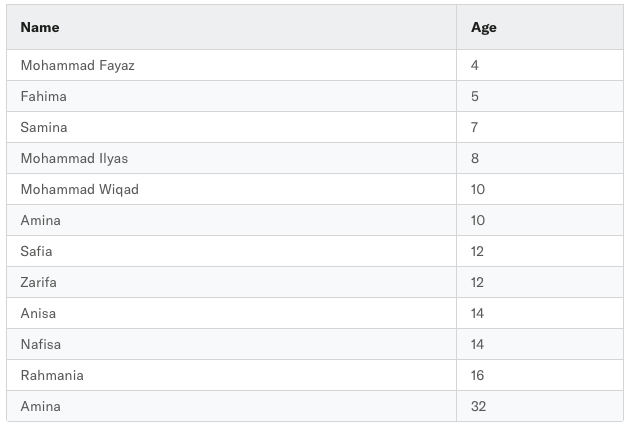
Masih’s children were aged between four and 14 years old; his wife Amina was 32. The cousins, all girls, were aged from 10 to 16.
Clockwise from top left: Masih’s children Mohammad Elyas (8), Mohammad Wiqad (10), Fahim (5), Samina (7) and Mohammad Fayaz (4) all died in the strike, alongside their two elder sisters, Anisa (14), and Safia (12), and their mother Amina (32). (Fahim appears in both photos in the bottom row)Photo supplied by family. We do not have photos of the teenage girls or Masih’s wife Amina
The full list of those who died in the strike
On finding out his family had been killed, Masih returned immediately to Afghanistan. The return journey was tough – having been working illegally in construction in Iran he says he had to hand himself to the Iranian police and wait for deportation. It took him three days to get back to his village. It was then that he began hunting for the truth.
Masih claims government officials acknowledged in private that his family died. However while both the Afghan Ministry of Defence and the provincial police publicly announced in the days following the attack that an operation on a Taliban prison had killed large numbers of Taliban fighters, they did not acknowledge that any civilians died in a strike.
“I have repeatedly told them that it was my children, that it was my wife, that it was my cousins, that they were all civilians and that my house was destroyed,” Masih said. “When they say that they have bombed a [Taliban] prison, they have absolutely not done that.”
Journalists investigate
As Masih was investigating, so was the Bureau. We had independently heard of a strike that had killed multiple children in Mullah Hafiz on September 23, and were trying to establish who had carried it out.
The Bureau has been recording strikes in Afghanistan for over four years. Getting to the bottom of what has happened is often difficult. The attacks mostly take place in remote areas under Taliban control. They are often not reported by local media and neither the US nor the Afghan military is fully transparent.
We faced all these same barriers with this strike. But this time, over the course of several months, working with Afghan reporters on the ground and the Visual Investigations unit of The New York Times, we were able to prove that the US was responsible for a strike which killed multiple children.
Our first step was to contact both the Afghan and the US militaries.
Officials in the Afghan Ministry of Defence told us no one was available for comment.
When we went to the US military, we were met with contradictory statements. Its story changed repeatedly as our reporting developed and the New York Times got involved.
A US spokesperson first stated in October that there were “no connections” between their actions and the allegations of civilian casualties in Mullah Hafiz. In a later email in February, they claimed to have no record at all of a strike in the district on September 23.
In a Pentagon report released this month the strike on Masih’s house was not included in a list of confirmed civilian casualties.
Finally, as we prepared to go to press earlier this week, they admitted they had bombed Masih’s house. Days later, there was yet another statement. American soldiers had reported being fired on from the house, they said, and a strike had been carried out “in self-defence.” But they did not kill Masih’s family, they said.
The military has not told us what information it used to reach its conclusion. It is not uncommon for the US to rely, for the most part, on pre-strike and post-strike footage filmed by aircraft to investigate claims that an air attack has harmed civilians. But when a strike hits a building, as in the case of Masih’s home, it can be difficult to tell what’s under the rubble.
Crucial evidence
Masih wanted the world to know what had happened. Interviews he did with Afghan media led us to contact him, and in April we were able to meet him in Kabul. By this time, he had been knocking on doors for months in search for answers. He had carefully collected evidence he hoped would shine a light on what happened that day.
Some of this helped our investigation. First we needed to do the basics – to verify that a strike had hit his house. We had to do this without visiting the village, because it was not safe for reporters to go to the Taliban-controlled area. From metadata contained in photos supplied by Masih, we were able to obtain the coordinates of his home. We used these to get satellite images which showed the house had been attacked, with the damage consistent with a strike. A team from the Bureau and the The New York Times’ Visual Investigations unit also reviewed photos of Masih’s children’s graves and found satellite images of the burial site. Both the damage to the house and the burial site are only visible in satellite images after September 23.
Crucially, we also were given photos of weapon fragments said to be found at the site of the strike. While most were nondescript, a few pieces had distinctive markings. On one piece we could see what is known as a “CAGE code” – this is a unique identifier given to companies which supply government or defence agencies. This code linked the fragment to a US-based company called Woodward, that makes components for a missile kit known as a JDAM. These enable bombs to be guided by GPS.
Weapons experts then reviewed the photos, and saw something else – the distinctive pattern of four bolts on a tail fin that identified it as part of a JDAM.
We trawled defence and aviation news archives and found the Afghan military did not have capability to use JDAMs. The only other military carrying out strikes in Afghanistan is America’s.
We asked the weapons experts which military could have dropped the bomb and they confirmed what we had learned – only the US military has the capability to use JDAMs in Afghanistan.
The weapon fragments said to be found in the rubble from the strike on Masih’s house Via Masih
A close-up of the tail fin with distinctive arrangement of four bolts that indicated it was from a JDAM Via Masih
After four and a half years of recording civilian casualties from strikes in Afghanistan, we were finally able to say for certain who pushed the button on one.
Answering the why
While we believe our investigation answers the who, the why is less clear.
The US’s final statement – that they dropped a bomb on the house after American soldiers reported being fired on – tallies in part with one villager who said the soldiers were shot at from civilian homes. However two others say everything was quiet in the area by the time the strike happened.
Perhaps a clue lies in the location of the house, which was set apart from the rest of the village, very close to a Taliban prison. We know an operation on the prison was carried out, with villagers claiming that a number of security force members being held inside were rescued during the raid. It’s possible that Masih’s house was hit by accident.
This panorama shows how close the two buildings were:
Panorama of the outskirts of Mullah Hafiz, showing the Taliban prison on the left and Masih’s family home on the right Photo sent via Masih
Without full military transparency, these questions will remain unanswered. And whatever the reason for the attack, the US still claims it did not kill any civilians.
Soaring civilian deaths
Our investigation raises serious questions about US military accountability.
Last year, the UN found that US military operations in Afghanistan killed and injured 632 civilians – more than double the year before. The US military has admitted to just over 20 percent of that figure. The reason for the discrepancy, says the US, is that they have access to intelligence such as drone footage which shows that “what often looks like civilian harm from US actions was actually a result of other causes.”
In its first statement back in October, the US spokesperson had warned us: “It isn’t uncommon for insurgents to use these accusations to drive a wedge between the military and the population. As Secretary Mattis has said: ‘We do everything humanly possible consistent with military necessity, taking many chances to avoid civilian casualties at all costs.
“’We’re not perfect guys, but we are the good guys. And so we’re doing what we can.’”
There have been calls for change, even from the Pentagon itself. It released a report in February highlighting concerns about how the US military investigates and responds to civilian casualties. The military was sometimes seen as “restrictive” in how it assessed allegations of civilian harm received from organisations like the Bureau or NGOs, it said.
The report also found that different regional military commands had different processes for reviewing civilian casualties. The US is now developing the first military-wide policy on civilian casualties, which has sparked hopes that things may improve.
For Masih, the pursuit of justice continues. The little money the family managed to save as a result of his work in Iran is now being used for this battle.
“We have a saying; staying silent against injustice is a crime, therefore I will spread my voice throughout the world,” Masih said. “I will talk to everyone, everywhere. I will not stay silent.
“But this is Afghanistan. If someone hears us, or not, we will still raise our voice.”
Additional reporting by Abbie Cheeseman and Ahmed Mengli. This investigation was a partnership between the Bureau of Investigative Journalism and The New York Times’ Visual Investigations team.
To see the video of this story, click here.
*
Note to readers: please click the share buttons above or below. Forward this article to your email lists. Crosspost on your blog site, internet forums. etc.
All images in this article are from TBIJ unless otherwise stated


https://www.globalresearch.ca/how-us-good-guys-wiped-out-afghan-family/5679645


JUST NEWS published this article following the Creative Commons rule. If you don't want your article to appear in this blog email me and I will remove it asap.

Saturday, March 16, 2019

US-Taliban Talks: Real or Illusory Progress? Afghanistan’s Multibillion Dollar Mineral Wealth


Global Research, March 15, 2019

US Afghan aggression and occupation of parts of the country remain largely unchanged after over 17 years.
Afghanistan reflects what CIA officials once called Vietnam – “the grand illusion of the American cause,” a conflict impossible to win. Yet it persists with no prospect for meaningful resolution.
US Lt. Colonel Daniel Davis earlier assessed conditions in the country after touring occupied areas for weeks, speaking to commanders, lower-ranking soldiers, Afghan security officials, civilians, and village elders.
He minced no words saying
“(h)ow many more men must die in support of a mission that is not succeeding,” adding:
“Senior ranking US military leaders have so distorted the truth when communicating with the US Congress and American people in regards to conditions on the ground in Afghanistan that the truth has become unrecognizable.”
“This deception has damaged America’s credibility among both our allies and enemies, severely limiting our ability to reach a political solution to the war in Afghanistan.”
Wherever he went,
“the tactical situation was bad to abysmal…witness(ing) the absence of success on virtually every level” – things perhaps worse now than earlier, the nation and its people devastated by endless US war.
The US came to stay, not leave, permanent occupation planned, wanting the country’s resources plundered.
They include barite, chromite, coal, cobalt, copper, gold, iron ore, lead, enormous amounts of highly-valued lithium and other rare earth metals vital for high tech products, natural gas, oil, precious and semi-precious stones, potash, salt, sulfur, talc, zinc, among other minerals.
They represent potentially trillions of dollars of economic value, a treasure Washington has no intention of relinquishing. US policymakers also aim to traverse the country with oil and gas pipelines.
Its territory is used as part of a greater plan to encircle Russia and China. Taliban forces control half or more of the country. US-controlled puppet rule was installed in Kabul – figures Taliban officials won’t talk to because of their illegitimacy.
Afghanistan is the world’s largest opium producer, used for heroin production. What the Taliban eradicated pre-9/11, the US restored.
It’s a bonanza for money-laundering Western banks, the CIA relying on drugs trafficking as a revenue source, and other organized crime, tens of billions of dollars annually at stake – why the US is complicit in what’s going on at the highest official levels.
Trump regime envoy for talks with Taliban officials Zalmay Khalilzad formerly was Bush/Cheney’s ambassador to occupied Afghanistan and Iraq, later their UN envoy, a hardcore neocon extremist, supporting Washington’s imperial agenda, hostile to peace, equity and justice.
On February 25, so-called peace talks between Taliban officials and Khalilzad began in Qatar. There’s virtually no chance of anything from them benefitting long-suffering Afghans if any agreement if struck.
Nor is there any prospect for Washington admitting defeat and exiting the country altogether – similar to its humiliating April 1975 Vietnam withdrawal.
It was the longest US war in modern times until naked aggression in Afghanistan was launched in October 2017, weeks post-9/11, plans for attacking the nation prepared months in advance. All wars require extensive planning.
Whatever the US may agree on in the days and weeks ahead with the Taliban won’t be worth the paper it’s written on, a nation repeatedly breaching deals – most recently the JCPOA Iran nuclear agreement.
Two summits with North Korea failed over unacceptable demands made in return for hollow promises.
That said, here’s where things stand on Wednesday, according to Khalilzad and the Taliban. Via Twitter, the Trump regime envoy said the following:
“Peace requires agreement on four issues: counter-terrorism assurances, troop withdrawal, intra-Afghan dialogue, and a comprehensive ceasefire.
We “agreed in principle on…four elements. We’re now agreed in draft (form) on the first two.”
A Taliban spokesman said progress was made on withdrawing all foreign forces from Afghanistan, short of setting a timeline, as well as agreeing on  US-sought assurances on the future of security in the country if Pentagon and allied troops pull out.
The NYT published a Reuters report, saying the US wants assurances from the Taliban “not (to) allow militant groups (ISIS, al-Qaeda, etc.) to use Afghanistan to stage attacks.”
The Washington Post published an AP News report, saying both “sides have reached a draft agreement on the withdrawal of US troops,” along with the Taliban agreeing not to let territory it controls become “a haven for terrorists (ISIS, al-Qaeda, etc.).
NBC News said the US got a commitment from the Taliban “to cut all ties (sic) with al-Qaeda or other terrorist groups” its leadership opposes.
The US supports these jihadists, using them a proxy forces in its war theaters, including in Afghanistan against the Taliban. Its leadership wants them eliminated from the country.
Notably, no breakthroughs were achieved on any issues – nor is it likely in further talks whatever possible accommodations both sides may agree on in principle.
Republicans and undemocratic Dems intend permanent occupation of Afghanistan. Anything agreed to otherwise on paper is virtually certain to be breached by US officials.
Taliban authorities are savvy, knowing the hazards of dealing with imperial Washington. They likely hope for anything positive from talks – well aware that US officials can never be trusted.
*
Note to readers: please click the share buttons below. Forward this article to your email lists. Crosspost on your blog site, internet forums. etc.
Award-winning author Stephen Lendman lives in Chicago. He can be reached at lendmanstephen@sbcglobal.net. He is a Research Associate of the Centre for Research on Globalization (CRG)
His new book as editor and contributor is titled “Flashpoint in Ukraine: US Drive for Hegemony Risks WW III.”
Visit his blog site at sjlendman.blogspot.com.


https://www.globalresearch.ca/ustaliban-talks-real-illusory-progress/5671454

JUST NEWS published this article following the Creative Commons rule. If you don't want your article to appear in this blog email me and I will remove it asap.