Showing posts with label Women's Rights. Show all posts

Monday, February 25, 2019

Further Reflections on Women’s Suffrage and African Emancipation


From the antebellum period through the Civil War and Jim Crow the issues of gender and race were interwoven


Global Research, February 25, 2019


A cursory re-examination of the early years of what became known as the women’s suffrage movement and abolitionism represented the embryonic phases of self-organization and mass struggle politics within United States society.
As we pointed out in an earlier essay, the campaigns aimed at winning the right of women to exercise the franchise emerged directly from the demands for the outlawing of African enslavement.
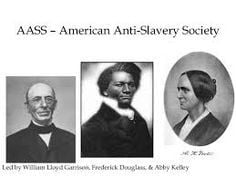
William Lloyd Garrison as leader of the American Anti-slavery Society (AASS) provided an opportunity for both free African men and women to enhance their avenues of expression in work related to the achievement of ending involuntary servitude. The Philadelphia Female Anti-slavery Society (PFASS) and its national component of the Anti-slavery Convention of American Women during the 1830s attracted people of both African and European descent creating the conditions for the early calls for full equality eventually leading to the demands for universal suffrage.
None of these efforts would have been possible absent of the flight and rebellion taking place among the enslaved African people. By the early 19th century concerns about the untenable nature of the Atlantic Slave Trade and its containment of the impacted populations created the material basis for the stiffening of repressive measures aimed at controlling the African people residing in the U.S.
Although there was a gradual reversal of the legalization of slavery and the limited enfranchisement of African people in the Northeastern states after the War of Independence from Britain, the rapid expansion of slave labor production occurred during the opening decades of the 19th century after the invention of the cotton gin in 1793, prompting the large-scale European settlement of South. Rebellions and rumors of unrest in Richmond (VA) in 1800, Charleston (SC) 1822 and the South Hampton County (VA) uprising led by Nat Turner in 1831, fueled the notions of the potential for a collapse of the slave system through violent upheaval.
The Haitian Revolution from 1791 to 1804 and the founding of the Black Republic born in the military defeat of French empire on Hispaniola Island actually worsened the conditions for enslaved Africans on the plantations of the South during subsequent decades. By the 1830s and 1840s the demand for cotton continued to rise in order to supply the textile industries of the North and in England.
Seneca Falls, Women’s Suffrage and the Intervention of Frederick Douglass
Organizers of the Seneca Falls, New York July 19-20, 1848 convention through writings and speeches have placed this event as the genesis of women’s suffrage claims. However, these demands had been raised before in other fora including the Liberty Party platforms earlier in the same year (June 14-15) by presidential candidate Gerrit Smith and within the work of previously organized female societies opposed to slavery. Ernestine Rose delivered addresses as early as 1846 in support of abolition and universal suffrage. (See this and this)
Many of the concerns which were initially addressed at Seneca Falls were related to the right of property ownership, inheritance and marital status. Even leading women activists were unsure about the timeliness of demands for universal suffrage.
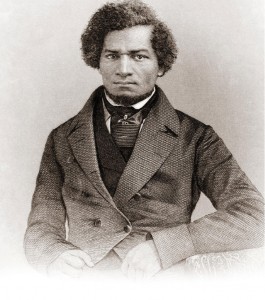
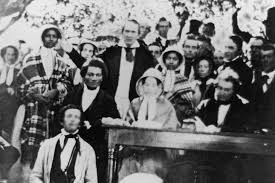
In fact it was Frederick Douglass (image on the right), the publisher of the North Star, a leading abolitionist, who spoke to the delegates on the second day of the Convention urging the gathering to pass a resolution calling for the right of women to vote. Douglass, said to have been the only Black person and one of very few men in attendance, rose militantly to pronounce:
“If there is any argument to be made, it must be made by opponents, not by the friends of woman suffrage. Let those who want argument examine the ground upon which they base their claim to the right to vote. They will find that there is not one reason, not one consideration, which they can urge in support of man’s claim to vote, which does not equally support the right of woman to vote.” (See this)
Yet Maria Stewart of Boston had written and spoken publically as early as 1831 on the need to end African enslavement as well as advocating equality for women. Stewart published in the Liberator newspaper initiated by Garrison, and beginning in 1832, delivered at least four lectures on the horrors of slavery along with the need for women’s emancipation. It is important to acknowledge that Stewart is often referred to as the first woman to speak in public settings where audiences were composed of diverse genders.
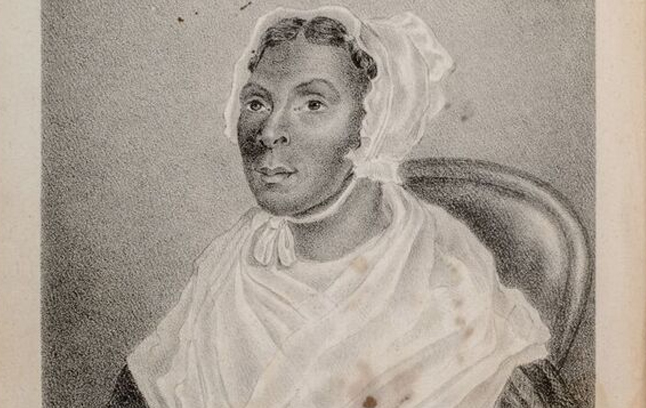
Speculation is that Stewart spoke within the same mode as other 19th century African women preachers such as Jarena Lee (image on the left) and Julia Foote. Lee preached after much struggle and opposition in the African Methodist Episcopal Church (AME) founded by Richard and Sara Allen in 1794 in Philadelphia. Foote was ordained as the first woman deacon in the African Methodist Zion Church (AMEZ) and would later become a well-known evangelist associated with the spiritualist tradition which reached fruition in the early 20th century.
The Women History Blog notes that:
“Maria Stewart’s essays and speeches presented original ideas that were to become central to the struggles for African American freedom, human rights and women’s rights. In this she was a clear forerunner to Frederick Douglass, Sojourner Truth and generations of the most influential African American activists and political thinkers. Many of her ideas were so far ahead of their time that they remain relevant more than 180 years later.” (See this)
Another notable personality of the era was born into slavery in the early 1820s in Dorchester County, Maryland. Harriet Tubman ran away from her master to become a leader in the Underground Railroad. She liberated many Africans from bondage and would later serve as a member of the Union Army in the Civil War where she provided intelligence on the locations of plantations.
Divisions Intensify After the Civil War
Tubman later worked with Elizabeth Cady Stanton and Susan B. Anthony after the Civil War in efforts aimed at acquiring women’s suffrage. These efforts linking African emancipation and women’s rights would be strained over events surrounding the enactment of 14th and 15th Amendments to the Constitution.
A leading section of the women’s movement led by Stanton and Anthony opposed the passage and ratification of the 15th Amendment which was purportedly drafted to guarantee the right to the franchise for African American males formerly enslaved in the Confederate states. This disagreement prompted the split within the American Equal Rights Association (AERA) founded in 1866 with the stated purpose of winning civil rights for African Americans and women of all races. The AERA would collapse by 1870 resulting in the advent of two rival women’s suffrage organizations.
Even Douglass’ alliance with Stanton and Anthony would be strained during this period as one historical source describes how:
“After only three years, the AERA dissolved over heated fights about whether to support the 15th Amendment, with which Black men won the right to vote (in the South, this victory would be short-lived). At a pivotal convention in May 1869, Douglass argued that the AERA should support the amendment while continuing to fight for women’s suffrage. Stanton not only disagreed, she gave an address filled with racist stereotypes about the male immigrants and male former slaves whom the amendment would enfranchise.” (See this)
This fragile victory gained through the passage of the 15th Amendment would be liquidated through the withdrawal of federal troops from the former Confederate states, the passage of Jim Crow legislation by southern state governments instituting peonage for African American farmers and the widespread usage of racial terror by white supremacist groups such as the Ku Klux Klan.  Lynch law became the order of the closing decades of the 19th century.
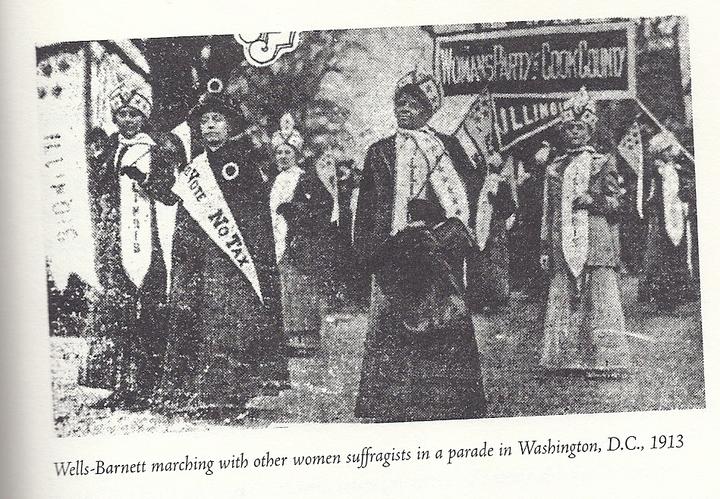
Ida B. Wells-Barnett, an educator, journalist and political organizer was driven out of Memphis after her militant opposition to the 1892 triple lynching of three African American men by leading white officials and businessmen in the city. Launching an international campaign against racist mob violence and state approved repression, Wells-Barnett would also become a leading force in the African American women’s club movement of 1890s and early 1900s.
After relocating in Chicago, Wells-Barnett was a key figure in the struggle for full political rights through the founding of the Alpha Suffrage Club in 1913. Despite here valiant efforts, members of the renewed white-dominated women’s movement sought to segregate her along with dozens of other African Americans at a demonstration for voting rights in Washington, D.C.
An account of this episode says:
“In March 1913, Wells-Barnett traveled to the first suffrage parade in Washington D.C., an event organized by the National American Woman Suffrage Association. On the day of the parade, Wells-Barnett and sixty other Black women arrived to march with the Illinois delegation, but were immediately advised, as women of color, to march in the back, so as to not to upset the Southern delegates. Wells-Barnett refused, arguing: ‘Either I go with you or not at all. I am not taking this stand because I personally wish for recognition. I am doing it for the future benefit of my whole race.’ She initially left the scene, therefore convincing the crowd that she was complying with the request. However, she quickly returned and marched alongside her own Illinois delegation, supported by her white co-suffragists Belle Squires and Virginia Brooks. This event received massive newspaper coverage and shed light on the reality for African-American participation in politics.” (See this)
Lessons for the 21stCentury Struggles Related to Gender Equality and Anti-Racism
Over a century later these unresolved contradictions remain a serious impediment to inter-racial political unity aimed at the realization of full equality and self-determination for women and the oppressed nations in the U.S. Gaining the right to the franchise through the 15th (1870) and 19th Amendments (1920) was the result of decades of tireless work and sacrifice.
During the mid-20th century, the passage of the 1964 Civil Rights Act prohibiting discrimination based on race, religion, gender and national origins was the direct outgrowth of mass initiatives and legal challenges. The following year, the 1965 Voting Rights Act empowered the federal government once again to exercise its authority to guarantee universal suffrage. Moreover, the international pressures from the world socialist movement and the national liberation struggles were an important element in the transformation of the superstructure of U.S. political culture.
Nevertheless, the existence of these civil rights cannot be guaranteed under a capitalist system which is committed to the reversal of every gain won by popular movements. This historical reality requires the building of independent revolutionary organizations based within the working class and the masses of oppressed peoples.
The acquisition of sustainable guarantees for democratic rights and self-determination cannot be secured by the two existing ruling class oriented political parties. A party of the working class and nationally oppressed must come into existence which can speak in the name of those who have been the victims of the centuries-long class domination and economic exploitation.
*
Note to readers: please click the share buttons below. Forward this article to your email lists. Crosspost on your blog site, internet forums. etc.
Abayomi Azikiwe is the editor of Pan-African News Wire. He is a frequent contributor to Global Research.
All images in this article are from the author


https://www.globalresearch.ca/further-reflections-on-womens-suffrage-and-african-emancipation/5669635


JUST NEWS published this article following the Creative Commons rule. If you don't want your article to appear in this blog email me and I will remove it asap.

Women’s Suffrage and African Emancipation During the 19th Century


From Seneca Falls to the Civil War and Reconstruction the struggle for national liberation and gender equality took center stage


Global Research, February 25, 2019


Since the mid-19th century there has been a periodic interrelationship between the movements for African emancipation and women’s liberation.
Of course these convergences have not been without serious contradictions particularly in light of the historic racial and class divisions which became characteristic of United States society as a whole.
Quite similar to aspects of the labor movement which sought to exclude African people from whatever advancements were made in regard to better salaries and working conditions, some sections of the white-dominated women’s suffrage movement sought to align themselves on the basis of race while relegating African American women and men to the doldrums of lower caste status through a permanent state of second-class citizenship.
The Declaration of Independence of 1776 proclaimed that “all men were created equal” therefore excluding women. African people were not considered full human beings and consequently unworthy of equal treatment before the law, let alone the right to self-determination and independence from national oppression.
Ironically in many ways, the origins of the women’s suffrage movement were spawned by abolitionism, the struggle to eliminate the legal basis for the enslavement of African people. Nonetheless, the question as to whether European American women were prepared to take a principled stand against racism and in favor of the liberation of African people remained elusive.
During the 1830s, the abolitionist movement in the U.S. included the pivotal participation of women who often campaigned against slavery. At this time even white women were considered subordinate to their men and were even prohibited from speaking publically.
In 1833, the Philadelphia Female Anti-slavery Society (PFASS) was formed with the participation of both African and European American women.  The organization was established because the American Anti-slavery Society (AASS) led by William Lloyd Garrison did not allow women to hold full membership. (See this)
Anti-Slavery Society of the 19th Century
American Anti-Slavery Society
Although it appears as if the majority of members of the PFASS were white, Black women played an important role in creating the organization and shaping its political character which was oftentimes more militant than other anti-slavery efforts. Free African women such as Margaretta Forten, Grace Bustill Douglass and Amy Hester Reckless were involved in not only petitioning and speaking out against the horrors of African enslavement. They also assisted in the founding of the Female Literary Society (FLS) which emphasized education, the archiving of literature and mutual aid for escaped slaves. (See this)
These events among women in various states of the Northeast, South and Midwest regions of the country created the conditions for the convening of the First Anti-slavery Convention of American Women in May of 1837. The gathering was attended by 175 delegates representing twenty different female anti-slavery groupings from ten states. Many of these women had origins in the Quaker faith where elements of the religious grouping had opposed slavery. (See this)
A European American woman Mary S. Parker served as the President of the gathering. Other leading women who attended the Convention went on to be prominent members of the Women’s suffrage movement. These included Lucretia Mott, Angelina Emily Grimke, Sarah Moore Grimke and Lydia Maria Child. The delegates spanned from Free African women to the wives and daughters of slaveholders, as well as participants from working class and poor backgrounds.  The meeting was the first to discuss in detail both the abolition of African enslavement along with the rights of women.
After a series of gatherings of the Anti-slavery Convention of American Women and its male counterpart, the British abolitionist movement called for the holding of a World Anti-slavery Convention in June of 1840 in London. Differences emerged over whether women would be able to participate fully in the meeting. Even within the U.S. abolitionist movement divisions between Garrison, who was in favor of women’s participation, and the more conservative Arthur Tappan, in opposition, arose. (See this)
Yet several prominent women in the abolitionist movement in the U.S. attended. The first day of the Convention was pre-occupied with the question of whether women could speak at the gathering. Eventually it was decided that women would not be allowed to speak or vote while they were relegated to a separate section of the hall. The aftermath of the London Convention would prompt figures such as Lucretia Mott and Elizabeth Cady Stanton to work towards the convening of women’s rights conferences.
Women’s Suffrage, African American Enfranchisement and the 15th Amendment
By 1848, some of these women had come together for what is considered in the official historiography as the first gender equality conference in Seneca Falls, New York. Nonetheless, there were other major events which preceded and followed the Seneca Falls gathering. (See this)
After the Civil War (1861-1865) there was a major rift in the women’s movement with the formation of two separate organizations, the National Woman Suffrage Association (NWSA) and the American Woman Suffrage Association (AWSA) both founded in 1869. These two groups emerged after a split in the American Equal Rights Association (AERA) over the question of whether to support the 15th Amendment to the Constitution ostensibly guaranteeing the right to vote for African American men, while denying access to women of any race. (See this)
The NWSA, largely led by Elizabeth Cady Stanton and Susan Anthony, refused to support the 15th Amendment if another measure was not introduced and approved guaranteeing suffrage for women. Opposition to the 15th Amendment led Stanton and Anthony to seek support from the previously pro-slavery Democratic Party. In Kansas during a campaign to secure women’s suffrage, they coalesced with George Francis Train a railroad magnate who spoke openly about his believes that African Americans were inferior, saying that it would be an outrage for Blacks to gain the franchise prior to European American women. Train would finance some of the work of Stanton and Anthony during the late 1860s and early 1870s causing much consternation among African Americans and supporters of the 15th Amendment.
Its rival the AWSA included both women and men within its ranks. The founders were activists such asLucy Stone and Josephine St. Pierre Ruffin, an African American woman intellectual from Boston. AWSA advanced the notion that if African American men were granted due process and the right to the ballot it would open the way for universal suffrage.
After the passage and ratification of the 15th Amendment in 1869-1870, African American men were able to hold public office in greater numbers. However, after the Hayes-Tillman Compromise of 1876, federal support for Reconstruction was ended. In the successive decades of the 19th century, African Americans were systematically driven from public office while segregation laws were enshrined in state constitutions amid the rise of lynching and other forms of racialized terror. (See this)
This rift in the European American women’s movement would remain until the conclusion of the 19th century when there was a renewed thrust towards universal suffrage resulting in the merging of the two factions creating the National American Woman Suffrage Association (NAWSA). Voting rights were granted to women in several states prior to the passage and ratification of the 19th Amendment in 1920.
The Legacy of Gender Equality and African American Liberation in the 20th Century
Despite the passage of the 15th and 19th Amendments to the Constitution, most African Americans living in the South were still denied the right to vote. In addition, to the denial of the franchise, Jim Crow laws remained largely in effect until the passage of the 1964 Civil Rights Act, which outlawed discrimination based on race, gender, religion and national origin.
Racist violence was rampant in the North, South and other regions of the U.S. It would take a series of legal challenges and a mass movement to win equal rights for African Americans by the conclusion of the 1960s. The 1965 Voting Rights Act provided opportunities for African Americans to vote in the South leading to the increase in the number of Black elected officials throughout the country.
After the advent of the African American led Civil Rights and Black Power campaigns between the 1950s through the 1970s, the women’s movement experienced a revival. However, divisions remained over race and class with white women advancing in some sectors of the labor market due to the continuing national oppression of African Americans and other people of color.
Lessons from the 19th century anti-slavery and women’s movements portend much for the ongoing problems of race and gender in the present period. Until the basis for inequality is eliminated these contradictions can easily be utilized by the capitalist ruling class in the U.S. as a mechanism to foster divisions among the working class and nationally oppressed.

*
Note to readers: please click the share buttons below. Forward this article to your email lists. Crosspost on your blog site, internet forums. etc.
Abayomi Azikiwe is the editor of Pan-African News Wire. He is a frequent contributor to Global Research.
All images in this article are from the author


https://www.globalresearch.ca/womens-suffrage-and-african-emancipation-during-the-19th-century/5669554


JUST NEWS published this article following the Creative Commons rule. If you don't want your article to appear in this blog email me and I will remove it asap.
Wednesday, September 26, 2018

How Many More Women Are There?


Global Research, September 26, 2018


How many more women await our discovery?
My question is not related to ongoing exposés of sexual abuse suffered by women under a culture of male privilege and dominance– the culture known by the trope #MeToo. What concerns me here is a seemingly unrelated silence and need for exposure, namely accomplishments of women scientists. This too is being newly addressed, although desultorily. 
Like millions of others I was alerted to the history of women in science after viewing Hidden Figures. This celebrated film features three African American women working in the 1950s U.S. space program. It’s based on the book by Margot Lee Shetterly, herself African American whose parents and neighbors were professionals working in the time and place of that story. So compelling were Shetterly’s revelations, the film was completed just two years after the book’s release.  While this film is making a profound social impact, to grasp the full context of African American scientists and women in general in the U.S. government’s pioneering space projects, read Shetterly’s full account. Book or film, Hidden Figures will propel more African Americans into the sciences while it impresses on all women the need for us to step out of the margins and into the center of public life.      
Human Computers of NASA (Source: margotleeshetterly.com)
Another ‘hidden figure’ is revealed with the recent award of the Breakthrough Prize in Fundamental Physics to British physicist Jocelyn Bell Burnell. Had the monetary award not been $3. million, her story likely wouldn’t be featured in a major U.S. newspaper. (See this)  Nevertheless the article is an opportunity to learn, once again, how a brilliant student of physics, somehow, despite adversarial male and institutional attitudes, managed what many of us cannot: she remained at work, applied her genius and pursued her irrepressible love of science. Burnell persisted despite her Cambridge supervisor, not Burnell, winning a Nobel Prize for his research on pulsars, a discovery she had made. That interview provides an all too common narrative of how modesty allowed Burnell to demure to male colleagues, and be upstaged by her professor. In this account we hear more about her modesty than her professional history and ongoing work at Oxford. 
This review regrettably includes a flawed note on other ‘hidden figures’. It mentions the white scientist Rosalind Franklin and the celebrated film, but fails to name mathematicians Dorothy Vaughan and Katherine Johnson and engineer Mary Jackson featured there. When will we learn to know, repeat and apply these women’s names? Dorothy Vaughan; Katherine Johnson, Mary Jackson; Dorothy Vaughan, Katherine Johnson, Mary Jackson; Dorothy Vaughan, Katherine Johnson, Mary Jackson. And add Margot Lee Shetterly to that deserving list.
Not long after perusing Shetterly’s highly readable and conscientiously researched book, browsing in my local library, I (by chance?) came across The Other Einstein. It’s an historical novel based on credible rumors regarding Mileva Marić-Einstein, a mathematician herself and first wife of the famous physicist. In The Other Einstein, published in 2016, author Marie Benedict explores rumors of a woman whom history not only marginalizes; it denies her any credit as a working scientist. 
A promising student of physics in Zurich, was a close companion of Albert Einstein in university, a member of his circle of aspiring scientists, and mother of his children. Benedict presents a story of Marić that’s debated by others; that is: she was Albert’s indispensable intellectual collaborator and contributor to his research reports—a tantalizing issue which physicist and writer Dennis Overbyementions in his 2000 Einstein in Love, but leaves undeveloped (see this)    deserving of equal credit for his (sic) discovery of relativity. (Did he assign his Nobel prize money to Marić-Einstein as recompense for denying scholarly accreditation to her?) Benedict explores this possibility, offering a convincing portrayal of how Einstein may have exploited Marić’s brilliance and her trust in him, removing her name from publications of their shared scientific discoveries. (A very serious charge which must be thoroughly explored.)
Albert Einstein is so lionized a figure that it will take much more research to clarify Marić-Einstein’s real role in the history of physics. But the accounts by Overbye and Benedict are a start, just as Shetterly’s work is an essential opening act on women in U.S. pioneering research (see this).
Women everywhere struggle on mightily. In small snips we cut away the deep roots of misogyny in every culture. While progress is slow at the legal level, headway is being made by the slogging research work by our writers. Doubtless many more histories await our attention and when we uncover them we will find how many more predecessors broke barriers long before this modern era. Knowing women’s early scientific work, even absent of fanfare or awards, is still empowering to this and future generations.  
*
Note to readers: please click the share buttons above. Forward this article to your email lists. Crosspost on your blog site, internet forums. etc.
This article was originally published on the author’s webpage: www.radiotahrir.org.
Aziz is a veteran anthropologist and radio journalist, also author of Heir to A Silent Song: Two Rebel Women of Nepal, published by Tribhuvan University, Nepal, and available through Barnes and Noble in the USA. She is a frequent contributor to Global Research and Asia-Pacific Research.
Featured image: Mileva Marić-Einstein (Source: Wikimedia Commons)


https://www.globalresearch.ca/how-many-more-women-are-there/5655187

JUST NEWS published this article following the Creative Commons rule. If you don't want your article to appear in this blog email me and I will remove it asap.