Showing posts with label Pepe Escobar. Show all posts

Sunday, May 19, 2019

‘Clash of civilizations’ or crisis of civilization?


The outlook of current Western leaders suggests that humanity will be hard pressed to survive the 21st century
By Pepe Escobar
May 19, 2019 "Information Clearing House" -  Talk about a graphic display of soft power: Beijing this week hosted the Conference on Dialogue of Asian Civilizations
Organized under the direct supervision of President Xi Jinping it  took place amid an “Asian Culture Carnival.”  Sure, there were dubious, kitschy and syrupy overtones, but what really mattered was what Xi himself had to say to China and all of Asia.
In his keynote speech, the Chinese leader essentially stressed that one civilization forcing itself upon another is “foolish” and “disastrous.” In Xi’s concept of a dialogue of civilizations, he referred to the New Silk Roads, or Belt and Road Initiative (BRI), as programs that “have expanded the channels for communication exchanges.”
Xi’s composure and rationality present a stark, contrasting message to US President Donald Trump’s “Make America Great Again” campaign.

West vs East and South

Compare and contrast Xi’s comments with what happened at a security forum in Washington just over two weeks earlier. Then, a bureaucrat by the name of Kiron Skinner, the State Department’s policy planning director, characterized US-China rivalry as a “clash of civilizations,” and “a fight with a really different civilization and ideology the US hasn’t had before.”
And it got worse. This civilization was “not Caucasian” – a not so subtle 21st century resurrection of the “Yellow Peril.” (Let us recall: The “not Caucasian” Japan of World War II was the original “Yellow Peril.”) 

Huntington’s pseudo-theory, coming from someone who did not know much about the multi-polar complexity of Asia, not to mention African and South American cultures, was mercilessly debunked across vast swathes of the global South.  
In fact, Huntington did not even come up with the original, flawed concept. That was the work of Anglo-American historian and commentator Bernard Lewis, who passes for a Middle East guru in the US.Divide and rule, spiced with racism, accounts for the toxic mix that has been embedded in the hegemonic US  narrative for decades now. The mix harks back to Samuel Huntington’s The Clash of Civilizations and the Remaking of World Order, published in 1996.

Divide, rule, conquer

As Alastair Crooke, the founder of the Conflicts Forum, has outlinedLewis consistently preached divide and rule, tinged with racism, in Islamic states. He was a fervent proponent of regime change in Iran and his recipe for dealing with Arabs was “to hit them between the eyes with a big stick” because, in his world view, the only thing they respect is power.
Crooke reminds us that since the 1960s, Lewis has been a master at spotting vulnerabilities in “religious, class and ethnic differences as the means to bring an end to Middle Eastern states.” Lewis is a hero across a certain spectrum – a spectrum that includes former US Vice President Dick Cheney and US Secretary of State Mike Pompeo.
Now, we live in the era of “Lewis redux.” Given that the Islamic world is  largely subdued, in torpor or in turmoil, the clash of civilizations basically applies, on a downsized scale, to containing or destroying Shi’ite Iran.
Meanwhile the real clash – as the State Department insists – is with China.
Huntington, the sub-Lewis, did not include Russia among “The West.” The revisionist State Department does. Otherwise how could “Nixon in reverse”be justified? (“Nixon in reverse,” let us remember, is the Kissingerian recommendation to President Donald Trump: Apply divide and rule between Russia and China – but this time seducing Russia.)
A revisionist Pentagon also came up with the “Indo-Pacific” concept. The only justification for the amalgam is that these two zones should conduct a foreign policy subjected to American hegemony.
The logic is always divide and rule and clash of civilizations – divisions provoking chaos all across Eurasia. 
But this strategy is being applied against the background of a crucial historical juncture: The era when BRI is being configured as the road map for progressive Eurasian integration.

Quo vadis, humanity?

It’s not hard to detect the faintest of smiles on the faces of Chinese strategists as they survey “The Big Picture” from the vantage point of 5,000 years of civilization. The Christian West as the unique road map to deliver humanity from evil – in fact, the foundation of Pax Americana – is regarded as an amusing fiction at best.
That fiction is now looking downright dangerous, wallowing in exceptionalism and demonization of “The Other” in myriad forms. The Other – from the Islamic Republic of Iran to atheist China, not to mention “autocratic” Russia – automatically qualifies as a manifestation of “evil.”
China, by contrast, is polytheist, pluralist, multi-polar – embracing Confucianism, Buddhism, Taoism. That is mirrored by the current drive towards a multi-polar world-system. What matters is unity in multiplicity – as Xi stressed in his keynote speech. In it, we find China and Persia, two ancient civilizations – not by accident linked by the Ancient Silk Road – thinking alike.
Then there’s the appalling state of the planet, which dwarfs the current appalling spectacle of political madness. UCLA geographer and global best-selling author Jared Diamond is not being terribly precise, but he estimates there’s a 49% chance “that the world as we know it will collapse by about 2050.”
As encapsulated by author Nafeez Ahmad: “Over the last 500 years or so, humanity has erected an ‘endless growth’ civilization premised on a particular patchwork of ideological worldviews, ethical values, political and economic structures, and personal behaviors. This is a paradigm that elevates the vision of human beings as disconnected, atomistic, competing material units, which seek to maximize their own material consumption as the principal mechanism for self-gratification.”
What we’re living now is not a clash of civilizations; it’s a crisis of civilization.
If the paradigm under which most of humanity barely survives is not changed – and there’s precious little evidence it will – there won’t be any civilizations left to clash.
Pepe Escobar is correspondent-at-large at Asia Times. His latest book is 2030. Follow him on Facebook.

This article was originally published by "Asia Times"-

http://www.informationclearinghouse.info/51638.htm

JUST NEWS published this article following the Creative Commons rule. If you don't want your article to appear in this blog email me and I will remove it asap.

Monday, April 1, 2019

Empire of Chaos in Hybrid War Overdrive


Global Research, April 01, 2019

Consortiumnews 24 March 2019


The Trump administration’s foreign policy may be easily deconstructed as a crossover between The Sopranos and late-night comedy, writes Pepe Escobar.
***
Is this the Age of Anxiety? The Age of Stupidity? The Age of Hybrid War? Or all of the above?
As right populism learns to use algorithms, artificial intelligence (AI) and media convergence, the Empire of Chaos, in parallel, is unleashing all-out hybrid and semiotic war.
Dick Cheney’s Global War on Terror (GWOT) is back, metastasized as a hybrid mongrel.
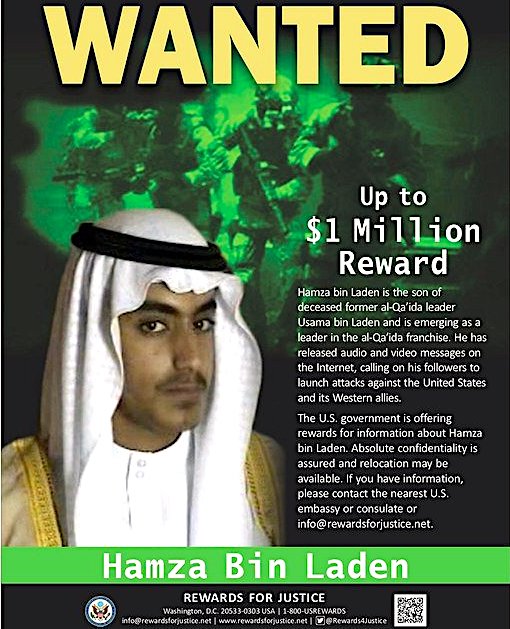
But GWOT would not be GWOT without a Wild West scarecrow. Enter Hamza bin Laden, son of Osama. On the same day the State Department announced a $1 million bounty on his head, the so- called “UN Security Council IS and Al-Qaeda Sanctions Committee” declared Hamza the next al-Qaeda leader.
Since January 2017, Hamza has been a Specially Designated Global Terrorist by the State Department – on par with his deceased Dad, back in the early 2000s. The Beltway intel community “believes”Hamza resides “in the Afghanistan-Pakistan region.”
Remember these are the same people who “believed” former Taliban leader Mullah Omar resided in Quetta, Baluchistan, when in fact he was safely ensconced only a few miles away from a massive U.S. military base in Zabul, Afghanistan.
Considering that Jabhat al-Nusra, or al-Qaeda in Syria, for all practical purposes, was defined as no more than “moderate rebels” by the Beltway intel community, it’s safe to infer that new scarecrow Hamza is also a “moderate”. And yet he’s more dangerous than vanished fake Caliph Abu Baqr al-Baghdadi. Talk about a masterful example of culture jamming.
Show Me The Big Picture
A hefty case can be made that the Empire of Chaos currently has no allies; it’s essentially surrounded by an assortment of vassals, puppets and comprador 5th columnist elites professing varied degrees of – sometimes reluctant – obedience.
The Trump administration’s foreign policy may be easily deconstructed as a crossover between The Sopranos and late-night comedy – as in the whole episode of designating State Department/CIA regime change, lab experiment Random Dude as President of Venezuela. Legendary cultural critic Walter Benjamin would have called it “the aestheticization of politics,” (turning politics into art), as he did about the Nazis, but this time it’s the Looney Tunes version.
To add to the conceptual confusion, despite countless “an offer you can’t refuse” antics unleashed by psychopaths of the John Bolton and Mike Pompeo variety, there’s this startling nugget. Former Iranian diplomat Amir Moussavi has revealed that Trump himself demanded to visit Tehran, and was duly rebuffed.
“Two European states, two Arab countries and one Southeast Asian state” were mediating a series of messages relayed by Trump and his son-in-law Jared “of Arabia” Kushner, according to Moussavi.
Is there a method to this madness? An attempt at a Grand Narrative would go something like this: ISIS/Daesh may have been sidelined – for now; they are not useful anymore, so the U.S. must fight the larger “evil”: Tehran. GWOT has been revived, and though Hamza bin Laden has been designated the new Caliph, GWOT has shifted to Iran.
When we mix this with the recent India-Pakistan scuffle, a wider message emerges. There was absolutely no interest by Prime Minister Imran Kahn, the Pakistani Army and the Pakistani intelligence, ISI, to launch an attack on India in Kashmir. Pakistan was about to run out of money and about to be bolstered by the U.S., via Saudi Arabia with $20 billion and an IMF loan.
At the same time, there were two almost simultaneous terrorist attacks launched from Pakistan – against Iran and against India in mid-February. There’s no smoking gun yet, but these attacks may have been manipulated by a foreign intelligence agency. The Cui Bono riddle is which state would profit immensely from a war between Pakistan and Iran and/or a war between Pakistan and India.
The bottom line: hiding in the shadow of plausible deniability – according to which what we understand as reality is nothing but pure perception – the Empire of Chaos will resort to the chaos of no-holds-barred hybrid war to avoid “losing” the Eurasian heartland.
Show Me How Many Hybrid Plans You Got
What applies to the heartland of course also applies to the backyard.
The case of Venezuela shows that the “all options on the table” scenario has been de facto aborted by Russia, outlined in an astonishing briefing by Maria Zakharova, spokeswoman of the Russian Foreign Ministry, and then subsequently detailed by Russian Foreign Minister Sergey Lavrov.
Meeting with Chinese Foreign Minister Wang Yi and Indian Foreign Minister Sushma Swaraj at a crucial RIC (part of BRICS) summit in China,Lavrov said,
“Russia keeps a close eye on brazen US attempts to create an artificial pretext for a military intervention in Venezuela… The actual implementation of these threats is pulling in military equipment and training [US] Special Forces.”
Lavrov explained how Washington was engaged in acquiring mortars and portable air defense systems “in an East European country, and mov(ing) them closer to Venezuela by an airline of a regime that is… rather absolutely obedient to Washington in the post-Soviet space.”
The U.S. attempt at regime change in Venezuela has been so far unsuccessful in several ways. Plan A – a classic color revolution -has miserably failed, in part because of a lack of decent local intelligence. Plan B was a soft version of humanitarian imperialism, with a resuscitation of the nefarious, Libya-tested responsibility to protect (R2P); it also failed, especially when the American tale that the Venezuelan government burnt humanitarian aid trucks at the border with Colombia was a lie, exposed by The New York Times, no less.
Plan C was a classic Hybrid War technique: a cyberattack, replete with a revival of Nitro Zeus, which shut down 80 percent of Venezuela’s electricity.
That plan had already been exposed by WikiLeaks, via a 2010 memo by a U.S.-funded, Belgrade-based color revolution scam that helped train self-proclaimed “President” Random Dude, when he was just known as Juan Guaidó. The leaked memo said that attacking the Venezuelan power grid would be a “watershed event” that “would likely have the impact of galvanizing public unrest in a way that no opposition group could ever hope to generate.”
But even that was not enough.
That leaves Plan D – which is essentially to try to starve the Venezuelan population to death via viciously lethal additional sanctions. Sanctioned Syria and sanctioned Iran didn’t collapse. Even boasting myriad comprador elites aggregated in the Lima group, exceptionalists may have to come to grips with the fact that deploying the Monroe doctrine essentially to contain China’s influence in the young 21st century is no “cakewalk.”
Plan E—for extreme—would be U.S. military action, which Bolton won’t take off the table.
Show Me the Way to the Next War Game
So where do all these myriad weaponizations of chaos theory leave us? Nowhere, if they don’t follow the money. Local comprador elites must be lavishly rewarded, otherwise you’re stuck in hybrid swamp territory. That was the case in Brazil – and that’s why the most sophisticated hybrid war case history so far has been a success.
In 2013, Edward Snowden and WikiLeaks revealed how the NSA was spying on Brazilian energy giant Petrobras and the Dilma Rousseff government beginning in 2010. Afterwards, a complex, rolling judicial-business-political-financial-media coup ended up reaching its two main objectives; in 2016, with the impeachment of Rousseff, and in 2018, with Lula thrown in jail.
Now comes arguably the juiciest piece of the puzzle. Petrobras was supposed to pay $853 million to the U.S. Department of Justice for not going to trial for crimes it was being accused of in America. But then a dodgy deal was struck according to which the fine will be transferred to a Brazilian fund as long as Petrobras commits to relay confidential information about its businesses to the United States government.
Hybrid war against BRICS member Brazil worked like a charm, but trying it against nuclear superpower Russia is a completely different ball game. U.S. analysts, in another case of culture jamming, even accuse Russia itself of deploying hybrid war – a concept actually invented in the U.S. within a counter-terrorism context; applied during the occupation of Iraq and later metastasized across the color revolution spectrum; and featuring, among others, in an article co-authored by former Pentagon head James “Mad Dog” Mattis in 2005 when he was a mere lieutenant general.
At a recent conference about Russia’s military strategy, Chief of General Staff Gen. Valery Gerasimov stressed that the Russian armed forces must increase both their “classic” and “asymmetrical” potential. In the U.S. this is interpreted as subversion/propaganda hybrid war techniques as applied in Ukraine and in the largely debunked Russia-gate. Instead, Russian strategists refer to these techniques as “complex approach” and “new generation war”.
Santa Monica’s RAND Corporation still sticks to good ol’ hot war scenarios. They have been holding “Red on Blue” war games simulations since 1952 – modeling how the proverbial “existential threats” could use asymmetric strategies. The latest Red on Blue was not exactly swell. RAND analyst David Ochmanek famously said that with Blue representing the current U.S. military potential and Red representing Russia-China in a conventional war, “Blue gets its ass handed to it.”
None of this will convince Empire of Chaos functionary Gen. Joseph Dunford, chairman of the Joint Chiefs of Staff, who recently told a Senate Armed Services Committee that the Pentagon will continue to refuse a “no first use” nuclear strategy. Aspiring Dr. Strangeloves actually believe the U.S. can start a nuclear war and get away with it.
Talk about the Age of Hybrid Stupidity going out with a bang.
*
Note to readers: please click the share buttons below. Forward this article to your email lists. Crosspost on your blog site, internet forums. etc.
Pepe Escobar, a veteran Brazilian journalist, is the correspondent-at-large for Hong Kong-based Asia Times. His latest book is “2030.” Follow him on Facebook.


https://www.globalresearch.ca/empire-of-chaos-in-hybrid-war-overdrive/5673307

JUST NEWS published this article following the Creative Commons rule. If you don't want your article to appear in this blog email me and I will remove it asap.
Sunday, August 16, 2015

Pipelineistan — the Iran-Pak-China Connection


By Pepe Escobar

August 15, 2015 "Information Clearing House" - "Asia Times" - Iranian Foreign Minister Javad Zarif has just been to Islamabad to talk serious business with Pakistani Prime Minister Nawaz Sharif. And the serious business had to be Pipelineistan – as in what next for the Iran-Pakistan (IP) gas pipeline.

Zarif essentially said that IP is a go – again – as soon as sanctions against Iran start to melt, by late 2015 or early 2016. Iran has already invested $2 billion in the Iranian stretch of IP, and China will finance the Pakistani stretch.

This is a major Pipelinestan gambit, as Asia Times has previously reported. And as a side note, as soon as IP goes online, all those years of incessant harassing by successive Bush and Obama administrations will finally come down to nought.

Even before Zarif hit Pakistan something serious was going on in … Karamay. You may have not heard of Karamay, but this town in Xinjiang is right at the center of the Eurasian action; it has just hosted the 2015 China-Pakistan Economic Corridor Forum.

As we all know, the China-Pakistan Economic Corridor (CPEC) is an absolutely key component, worth $46 billion, of the China-driven New Silk Roads. CPEC will link Kashgar in Xinjiang to the Arabian Sea port of Gwadar via highways (essentially an upgrade of the fabled Karakoram Highway), railways, industrial parks, fiber optic networks and – eventually – a pipeline.

And that pipeline will be no less than an extension up north of IP.

As part of CPEC, for instance, last month TBEA Xinjiang SunOasis — a Chinese company — finished the biggest solar power plant in Pakistan, for $215 million, in only three months.

At Karamay, China and Pakistan signed 20 CPEC-related cooperation agreements. They even issued a Karamay manifesto, stressing the political/economic importance of the Silk Road Economic Belt and the 21st-Century Maritime Silk Road. CPEC is the largest China-Pakistan joint project since the construction of the Karakoram highway in 1979. And CPEC is only one among six economic corridors to be developed as part of the New Silk Roads.

Yet the full impact of CPEC will only be noted by the next decade. That’s when the New Silk Road for the bulk of China’s energy imports from the Middle East will be cut short by no less than 12,000 kilometers.

Ashgabat wakes up

Meanwhile, Turkmengaz — Turkmenistan’s national gas company — has taken a 51% stake in a consortium still seeking to build the perennially troubled TAPI (Turkmenistan-Afghanistan-Pakistan-India) gas pipeline, a serious competitor to IP if it ever gets built.

That’s a game-changer because the Turkmen will now be in charge of the construction and operation of TAPI Ltd. The cost is a whopping $10 billion (IP will cost three times less); investment to the tune of $4 billion and $6 billion in debt.

Still it all comes back to the same problem; who wants to invest in a steel umbilical cord prone to all sorts of sabotage traversing a war zone — western Afghanistan all the way to Kandahar? In theory, “host countries” should be responsible for TAPI’s security; in the case of Afghanistan, that qualifies as black humor.

For the moment, Turkmengaz can only count on the Manila-based but Japan/US-controlled Asian Development Bank (ADB). That’s not much. The notoriously opaque regime in Ashgabat says it’s seeking other backers — but no one knows where and how.

TAPI is still a pipe dream. Pakistan and India are not seriously considering it viable even in the medium term. So it’s back to IP.

Even after sanctions are lifted, Iran will need to find an ocean of investment — at least $180 billion — to upgrade its energy infrastructure and be able to start exporting natural gas to Europe, in competition with Gazprom.

So Iran’s privileged Pipelineistan play for the near future will be Asia – from Southwest Asia (Iraq and Oman) to South Asia (Pakistan). With China ready to instantly capitalize on every surge of Iran’s natural gas production.


Copyright 2015 Asia Times Holdings Limited, a duly registered Hong Kong company.


http://www.informationclearinghouse.info/article42632.htm

Counter Information published this article with the author's permission through a license from Creative Commons, respecting their freedom to publish elsewhere.