Showing posts with label The Balkans. Show all posts

Tuesday, June 25, 2019

The ICTY Srebrenica Trials: The Unseen Evidence


One of the key evidentiary issues that arose during several ICTY Srebrenica trials was the right of the accused to conduct an independent examination of the forensic evidence used against them. That right exists as a matter of course in all non-political criminal trials in all civilized legal jurisdictions. Specifically, that is the right of defendants to verify for purposes of their own exoneration as well as for the benefit of the court the alleged DNA identifications proferred by the Prosecution, which were supplied by the International Committee for Missing Persons (ICMP).
ICMP is an NGO founded in 1996 under the auspices of the US which until recently was operating out of the Bosnian city of Tuzla. The Hague Tribunal consistently refused to issue a subpoena to ICMP to produce its biological samples and make them available to defense forensic experts for independent analysis. Supposedly sovereign governments are subject to ICTY subpoenas and can be compelled to produce physical evidence (Serbia in numerous cases, Croatia in the Gotovina artillery records matter). But a private NGO such as ICMP is apparently above all that. The reason for its immunity is the status accorded to ICMP that can only be described as exterritorial,  effectively raising it to a level above that of sovereign governments.
The ICTY managed to create an impression that some 6,800 bodies recovered from mass graves around Srebrenica had been conclusively identified by means of a ‘breakthrough’ DNA technique devised by the body that carried out the forensic work, the International Commission for Missing Persons.  In fact, the primary DNA evidence was never shared with the ICTY.  The court was provided only with a report of the ICMP’s work and findings. The only information shared was in the form of computer printouts.  No details were given about the DNA methodology or the steps taken to prevent contamination (a major problem in DNA work).  Nor was evidence given by those who had themselves carried out the work.
It is a minimum requirement of all genuine systems of justice that accused persons and their defence teams should have access to all the evidence against them.  This allows defendants to have scientific evidence checked by their own experts so that prosecution experts can be cross- examined in depth and defence experts can be called to give their assessments of the evidence. This did not happen in any of the ICTY trials.  But in every instance the court chose to treat the DNA evidence as proven.
An independent paper published on this topic revealed that the ICMP had been granted unprecedented levels of immunity in separate agreements with the Council of Ministers of Bosnia and Herzegovina (1998) and the Government of Croatia (2002):
“The Headquarters agreement provides immunity for property, assets, and staff of the ICMP from “every form of legal and administrative process, except insofar as in any particular case the ICMP has expressly waived its immunity.”  It also provides for the inviolability and immunity of ICMP premises, property and assets from “search, requisition, confiscation, expropriation, and any other form of interference, whether by executive, judicial, administrative or legislative action.” Practically, this also meant that biological samples and profiles became the property of the ICMP as a means to protect witness information and data. Only the ICMP could decide on whether information was to be shared with authorities or not. Compliance with writs such as a subpoena compelling production of material or witness attendance to give evidence was subject to the ICMP waiving their immunity. In other words, the ICMP received diplomatic status as a technical and scientific human identification operation. For a DNA laboratory or human identification eort, this was unprecedented.“
There can be little doubt that no proper court of justice would have admitted the ICMP’s evidence on this basis.
But this was only one of the problems relating to the ICMP.  This organization was the unilateral creation of US President Bill Clinton in 1996 when it became clear that the first mass grave excavations carried out by the US organization, Physicians for Human Rights, had not delivered the expected results.  The mass graves identified by US intelligence, said by Madeleine Albright to contain thousands of bodies, were nothing of the kind.  The ICMP, billed as a new international organization, seemed to all intents to be the Muslim Commission for Missing Persons, an organization set up after Dayton by Bosnian Muslim leader Alija Izetbegovic, with an international supervisory board (always Chaired by an American) grafted on the top.  Bosnian Muslims always comprised more than 90% of the workforce of the ICMP.  Few would think it appropriate or acceptable for one warring faction to be used to investigate the actions of the other.
Second, the central premise underlying the ICMP’s mass grave investigations was a dubious theory conceived by the ICTY’s small investigation team.  The theory was that, unbeknown to anyone, the Bosnian Serbs had carried out a huge cover-up operation between August – November 1995 which had involved excavating the bodies of murdered Bosnian Muslims from their original graves, transporting them to other sites within the Srebrenica safe area and reburying them in the hope that they might not be discovered in the new graves.  On the face it, this theory was risible.  Excavating, transporting and reburying some 500 tons of human remains in mountainous territory at the end of a very hot summer was not something that could have been concealed from the many UN and intelligence personnel who remained in the area.  Nor could it have been concealed from the US satellites and geostationary drones which Madeleine Albright had very publicly told the UN on 10 July 1995 that the US “will be watching” for anything of the kind.  Nor would the exhausted Bosnian Serb army have found it at all easy to mount a covert operation of this kind, especially as they were desperately short of petrol.
A further compelling reason for suspicion was that, having achieved very few identifications in the first four years or so after the end of the Bosnian war, the ICMP suddenly began to make identifications at a rate never seen before or since.  This was surprising for several reasons, not least the fact that, as there had been no population records for the wartime population of Srebrenica, the ICMP could only use the unscientific lists created when the Bosnian Muslim government urged people to come forward to report relatives missing.  Since many Bosnian Muslims had been moved around throughout the war, few families would have had definite knowledge that their relatives had been in Srebrenica.
Finally, there has always been a problem about the numbers claimed to have been killed at Srebrenica.  The Bosnian government had given a Srebrenica population figure of 42,000 to the UN as the basis for food supplies into the safe area.  Such figures are invariably an overestimate. The consensus of the aid agencies was around 38,000.   But the UN recorded 35,600 survivors of Srebrenica at Tuzla.  A further 2,000 or so of the Bosnian Muslim soldiers in Srebrenica were seen by UN personnel safely behind Muslim lines near Tuzla before they were secretly redeployed to other parts of Bosnia.  A further 750 Srebrenica survivors were recorded in Zepa, and around 1,000 escaped into Serbia.  If 6,800 were massacred in Srebrenica, there would have to have been more than 45,000 people there when it fell to the Bosnian Serbs – a far bigger figure than anyone had suggested.
In the investigation of Srebrenica, ICMP has functioned as an evidence gathering adjunct of the Tribunal. Why has it been exempted from the obligation to show to either the court or to the accused the physical evidence that its conclusions are allegedly based on? The attached ICMP Headquarters Agreement signed with Bosnia and Herzegovina contains the answer to that important question.
*
Note to readers: please click the share buttons above or below. Forward this article to your email lists. Crosspost on your blog site, internet forums. etc.
This article was originally published on Srebrenica Project.
Stephen Karganovic is president of “Srebrenica Historical Project,” an NGO registered in the Netherlands to investigate the factual matrix and background of events that took place in Srebrenica in July of 1995.


https://www.globalresearch.ca/the-icty-srebrenica-trials-the-unseen-evidence/5681681

JUST NEWS published this article following the Creative Commons rule. If you don't want your article to appear in this blog email me and I will remove it asap.

Thursday, May 30, 2019

Srebrenica and Jasenovac: The Genuine Difference Between a Phony and a Real Genocide


concerning Jasenovac. Jasenovac, for those who are unfamiliar with it, was a death camp in the Nazi satellite “Independent State of Croatia” during World War II, also known as the “Auschwitz of the Balkans.”  What is the link?
It is that while the massacre in Srebrenica, arising from the conflict which took place in the former Yugoslavia in the 1990s, was engineered primarily to serve political purposes, it also had another extremely important consequence. That was to shift attention away from the genocide in Jasenovac suffered by the Serbian, Jewish, and Roma people trapped during World War II in the “Independent State of Croatia”. One of the chief impacts of Srebrenica was to diminish the magnitude and horror of Jasenovac by imputing to the Serbs an invented crime of genocidal proportions, allegedly committed by them during the Bosnian war.
Now, if one is looking for a mirror-image Jasenovac analogue for the iniquitous use of Srebrenica that was just mentioned, here it is.   Jasenovac, and more broadly the heinous atrocities committed by the Croatian Ustashe during World War Two, were a key factor in London’s otherwise inexplicable switch from supporting their faithful ally General Mihailovich to installing the internationalist  Josip Broz Tito, a person of obscure origin and equally obscure allegiances, as the post-war ruler of Yugoslavia. The British, and the Western alliance as a whole, critically needed the mass influence of the Roman Catholic Church for the anticipated post-war mobilization against the Left, and the perceived threat of the victorious and strengthened Soviet Union in particular. A Roman Catholic Church untainted by association with fascism and the genocidal atrocities committed by its followers in the heart of Europe was a sine qua non for that operation. Mihailovich’s victory assuredly would have led to exposure of this nefarious link and instant discreditation of the Vatican, on a scale that would dwarf the current scandals and would have rendered it useless as a moral authority in the projected crusade against communism. The patriot Mihailovich therefore had to be jettisoned and ideological chameleon Tito elevated in his place. It could safely be assumed that under Tito’s rule Jasenovac and all its implications would be swept under the rug, which is exactly what happened.
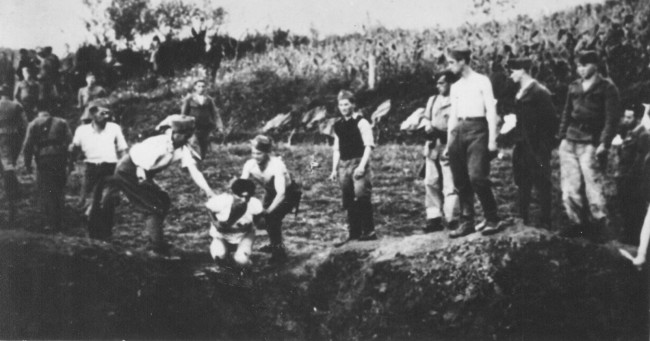
Image result for jasenovac auschwitz of the balkans
Ustasha Fascists conduct an execution at the Jasenovac camp. (Source: Wikipedia)
Srebrenica has been aggressively promoted as a meme suggesting Serb guilt for the commission of genocide, although the factual circumstances of this event, which our NGO has thoroughly researched and established, unequivocally refute that. On the other hand, while Jasenovac fully satisfies Convention on Genocide criteria for finding genocide, that event is being systematically underplayed in such a manner that knowledge about it is suppressed and respect for hundreds of thousands of its victims is scant.
What follows is a brief comparative analysis of these two events in order to demonstrate how a misleading narrative about a politically contrived genocide has obscured a genuine genocide and largely impeded proper respect for its victims.
Srebrenica fully fits in with the contemporary pattern of false flag operations where the actor who actually commits the crime skilfully shifts the responsibility onto the designated fall guy. The latter’s role is to be saddled with the blame, he is subjected to a brutal campaign of vilification, and ultimately takes the assigned political and moral punishment. Sounds familiar, doesn’t it?
To this day we do not have an official and reliable Srebrenica death toll. As judge Jean-Claude Antonetti pointed out in his dissenting opinion in the Tolimir case, after more than twenty years of “investigating” the Hague Tribunal has no clue of who conceived and ordered the crime. Srebrenica is plagued with uncertainties and deliberate obfuscations. The only items in the dubious Srebrenica narrative alleged to be unquestionable certainties are the two memes of “genocide” and “8,000 executed men and boys.” A powerful special interest propaganda machine has skillfully and perfidiously injected them into the mass subconscious.
The mechanism is driven by three fundamental political objectives. That agenda is behind the staging of Srebrenica killings and then utilizing their propaganda effects for base purposes. The first objective was to create a significant enough, inflatable and statistically elastic, mass slaughter incident, seemingly attributable to the Serbs, in July of 1995. That was on the eve of Operation Storm, set to be executed in the Krajina in August of 1995, using NATO logistics and Croatian ground forces. As Peter Galbraith, US ambassador to Zagreb at the time, freely admitted in 2012,
“without Srebrenica there would have been no Operation Storm.”
That strongly suggests, at a minimum, that the former might have been conceived and carried out to provide cover for the latter.
Another important secondary role of Srebrenica has been to serve as a symbolic construct, a nation building identity tool for cementing Bosnian Muslim ethnicity. The third and perhaps most momentous of the uses of Srebrenica – as Diana Johnstone would put it – is to serve as the underpinning for the lethal “Right to Protect” interventionist doctrine. It was constructed supposedly to ensure that there would be “no more Srebrenicas.” However, in practice this predatory doctrine has led to the pitiless destruction of several defenseless countries and the violent loss so far of at least two million innocent, mostly Muslim lives. R2P was designed to ensure hegemonic global control, not to prevent Srebrenica-style slaughter.
What follows is a quick overview of Srebrenica facts before I return to Jasenovac. The Srebrenica narrative is fraught with glaring anomalies which have gone largely unaddressed and unexamined critically.
1. On July 11, 1995, Srebrenica passed under the control of the Army of the Serb Republic. The Dutch battalion was also there, but it did nothing, acting mainly in an observer capacity.
2. After gaining control of Srebrenica, the Serbian Army evacuated to Muslim-held territory about 20,000 Muslims from Srebrenica – women, children, and elderly – who had gathered at the UN base in Potočari. The International Red Cross was present.
3. Simultaneously, men of military age, soldiers of the 28th Division of the Bosnian Muslim army, numbering between 12,000 and 15,000, well-armed and in a combative mood literally until the day before, suddenly and inexplicably lost their will to fight. Instead of putting up an active defense in a situation where they had a 3 to 1 numerical advantage over the Serb attackers and where the rugged configuration of the landscape clearly favored them, they conducted a risky breakout manoeuvre out of Srebrenica enclave toward Tuzla, on the other side of the front-line. The 60-kilometre-long corridor they had to traverse through Serb territory had been prior to that heavily mined and the retreating column also encountered numerous ambushes set up by the Serbian army. The 28th Division suffered its most massive casualties as a result of combat with the Zvornik Brigade of the Bosnian Serb Army, leaving between 4,000 and 5,000 dead. However, the 28th Division column was a legitimate military target, as admitted by the Prosecution of the Hague Tribunal, and therefore no one was ever charged or convicted by the Tribunal for causing it casualties. In the end, part of the retreating column were killed in combat, part reached Muslim lines in Tuzla, and part surrendered. It is important to point out that the remains of the majority of the putative “genocide victims” were found in the proximity of sites where there had been clashes between the Muslim column and the Serbian forces.
4. Of those who were taken prisoner, some were transferred to prisoner of war camps and some, apparently the majority unfortunately, were executed. A prominent role in the executions was played by the mysterious 10th Sabotage Detachment, an oddly multinational unit within the Bosnian Serb Army in the midst of an ethnic conflict, set up in 1994 for no apparent purpose and with no fixed position within the Serbian Army’s order of battle. The Detachment’s only significant operation turned out to be precisely the execution of Srebrenica prisoners in July of 1995. The famous “star witness” Dražen Erdemović, a condottiere of Croat ethnicity who fought in all three armies during the Bosnian conflict, and who ultimately became the Hague Tribunal’s sole witness to the executions after making a convenient plea bargain with the prosecution, was a member of that unit. What makes Erdemović exceptional is that he is simultaneously the Tribunal’s only witness and also an avowed perpetrator of genocide. He is also the beneficiary of an extraordinarily mild 3-year prison term for such a grave crime.
As debunked in detail by Bulgarian analyst Germinal Civikov, Erdemović testified contradictorily and unconvincingly that, during a five-hour period, he and seven other detachment colleagues executed 1,200 prisoners bussed in (he could not state even the approximate number of busses) to a field near a place called Branjevo. According to him, they shot the prisoners in groups of 10, which makes 120 groups and given his time frame leaves an improbable 2,5 minutes per group. During that time, the prisoners were walked a distance of 100 to 200 meters from the vehicles to the field of execution, they were searched and their personal documents and valuables were removed, the executions were carried out, and finally the victims were checked for any survivors, who were administered the coup de grace before bringing in the next group. All that in 2,5 minutes. According to Civikov this is a highly unlikely scenario, but the Hague Tribunal had no problems with it, and this scenario is incorporated lock-stock-and-barrel in all its Srebrenica judgments.
An oddity of this story is that Tribunal forensic experts, who in 1996 searched the site indicated by Erdemović, instead of 1,200 found the remains of 127 victims, of whom 70 had ligatures suggesting execution, a 90% reduction of Erdemović’s claimed total. Another oddity, if one wishes to view it as such, is the fact that the Hague Tribunal never sought nor indicted, much less questioned, Erdemović’s colleagues in the commission of the crime, Franc Kos, Stanko Kojić, Vlastimir Golijan to name some, whom Erdemović had identified at his first appearance in the Hague in 1996 and whose whereabouts was not a secret. Erdemović was never asked who issued the execution order. At present, he is living as a protected witness of the Hague Tribunal in an unidentified country and with a changed identity.
5. Thus, and this is another remarkable oddity of Srebrenica that the public are mostly unaware of, during a quarter of a century since the first Srebrenica indictment the Tribunal has managed to condemn to an insignificant sentence only one perpetrator of the alleged genocide – Dražen Erdemović. Every other Srebrenica defendant was found guilty and sentenced not for directly executing prisoners but based on concepts of “command responsibility” or “joint criminal enterprise”. The question of who ordered the physical liquidation of the prisoners remains glaringly unanswered to the present day.
6. Equally significant, most Hague Tribunal verdicts point to different figures, ranging from 4,970 to about 8,000, as the alleged number of “genocide victims.” Key facts are systematically brushed aside, such as that all those figures necessarily include combat casualties from the retreating 28th Division column, as mentioned previously, as well individuals who died or were killed in other ways in the Srebrenica enclave over the preceding three-year period. Thus, neither the Tribunal nor any other authority has to this day established even the approximate number of actual “genocide victims.”
7. The forensic picture of Srebrenica raises additional scepticism about the official Srebrenica narrative. We have analyzed every single one of the 3,568 autopsy reports and established that they contain the remains of 1,923 individuals based on the most reliable indicator, the number of paired femur bones. Based on the Prosecution’s own autopsy reports, of that number 650 were killed by shrapnel, mines, and grenades, which excludes the possibility of execution but is unquestionably consistent with combat. But the main point is that the total of 1,923 exhumed bodies represents all human losses in the Srebrenica enclave during the conflict, from 1992 to 1995.
8. When talking about Srebrenica, it is important to reiterate that without the “genocide” allegedly committed there and the hypocritically asserted obligation to “prevent another Srebrenica,” there would be no right-to-protect “humanitarian intervention” doctrine. That doctrine is increasingly becoming the principal raison d’etre of NATO and its excuse for the destruction of sovereign governments in different parts of the world under the guise of benevolence. Yet – and this is another Srebrenica oddity for you to chew on – at the Dayton peace conference in November 1995, four months after the event, not a word was spoken about “Srebrenica genocide” or the mass execution of prisoners. Does anyone seriously think that Alija Izetbegović would have refrained from extracting maximum political advantage in the negotiations by using the Srebrenica card if he had had any solid evidence of genocide to show?  There is, in fact, much evidence to suggest that Srebrenica was initially a false flag improvised to provide media and political cover for the huge crimes committed by Croats and their NATO backers against the Serbian population of Krajina in Operation Storm, which followed shortly thereafter. Srebrenica’s potential as a tool to be used for other purposes was grasped only gradually, and later. The “genocide” refrain was introduced only in 1997 at an international conference in Sarajevo, including the “8,000 men and boys” meme. The right-to-protect use of Srebrenica came several years after that, around the time of the Kosovo war.
So much for an essential overview of Srebrenica. Now to return to Jasenovac.
The bodies of prisoners executed by the Ustaše in Jasenovac (Source: Wikimedia Commons)
There is an immense contrast between Srebrenica and Jasenovac. Jasenovac was not a false flag operation but an openly conducted, ideologically inspired extermination site, which functioned publicly and in accordance with the laws and political goals of the satellite, pro-Nazi Croatian wartime state. All the resources of the Croat state were consciously mobilized and intensely focused to make Jasenovac possible as the country’s premier mass killing field and slaughterhouse. That is not to neglect, of course, thousands of Serbian villages and other less well-known spots where the relentless extermination program, which shall forever blacken the name of that unhappy land, was being implemented.
There is an important question about Jasenovac to which so far no one has been able to provide a coherent answer. It must be raised. For the last twenty or so years vast treasure has been channelled into Srebrenica mass grave exhumations to forensically document inflated prisoner of war execution figures. As pointed out, best efforts and unhindered access notwithstanding, Srebrenica exhumations have been an embarrassing flop. Just slightly over 1,000 human remains have been uncovered in a condition or with a pattern of injury suggesting execution, far short of the target figure of 8,000.
For Jasenovac we have a multitude of independent reports, many from shocked but victim-hostile, perpetrator-friendly German sources, about the massiveness and depravity of crimes that were committed there. They run not into thousands, but into the hundreds of thousands. So here is the question.
For three years during the conflict in the nineties, the site of the main Jasenovac camp on Croatian territory was under the control of Serbian forces. During that time, not the slightest effort was made by local Serbs or their authorities to exhume any of the Jasenovac killing sites and to forensically document what was bulldozed over and hidden underneath the earth’s surface. Why?
Bundesarchiv Bild 183-N0827-318, KZ Auschwitz, Ankunft ungarischer Juden.jpg
Jews on selection ramp at Auschwitz, May 1944 (Source: Wikimedia Commons)
Assuming that the exigencies of war might have prevented them from taking these reasonable steps at that time, there is a follow-up question. The war has been over for a quarter of a century. But the Jasenovac death camp extended over to the other bank of the Sava River, which is now fully under the control of the Republic of Srpska. The Gradina camp of the Jasenovac complex is beyond the reach of Croatian authorities and they cannot tamper with or misrepresent the evidence that lies just under the surface of the earth there. That is all the more important since historians and survivors are unanimous that most of the mass killings associated with Jasenovac actually occurred on the Gradina side of the Sava River.
For two decades the authorities of the Republic of Srpska have tolerated tendentious  exhumations around Srebrenica, on their territory, designed to document a phony genocide and saddle them and their people with responsibility for it. Every year with great fanfare Republic of Srpska officials come to  Gradina to collect political points by commemorating the horrors of Jasenovac, but they do it risk-free, while remaining on the earth’s surface. When will they send a team of forensic experts with shovels to start digging and to check and document what lies underneath the surface?
In today’s brutal, neo-fascist world expecting risky behaviour from politicians is unrealistic. But there is a moral obligation to pop the question: Why hasn’t the government of the Republic of Srpska done the natural thing to document the scope of the real genocide that not too long ago was inflicted upon its people and took place on its territory? Why has it failed to do even the minimum to collect the tangible evidence fully within its reach to settle once and for all the demeaning and cynical Croatian numbers game about the victims of Jasenovac?
I am ready to take my shovel and start digging. Who will join me?
*
Note to readers: please click the share buttons above or below. Forward this article to your email lists. Crosspost on your blog site, internet forums. etc.
This article was originally published on Srebrenica Project.
Stephen Karganovic is president of “Srebrenica Historical Project,” an NGO registered in the Netherlands to investigate the factual matrix and background of events that took place in Srebrenica in July of 1995.


https://www.globalresearch.ca/srebrenica-jasenovac-difference-between-phony-real-genocide/5678995


JUST NEWS published this article following the Creative Commons rule. If you don't want your article to appear in this blog email me and I will remove it asap.
Thursday, March 28, 2019

Never to Forget: 1999 – NATO’s War on Yugoslavia. The 2019 Belgrade Declaration


Global Research, March 28, 2019

On the occasion of 20th anniversary of the aggression of NATO Alliance against Serbia (the Federal Republic of Yugoslavia, the FRY), on 22nd and 23rd March 2019 Belgrade was the venue of the International Conference under slogan NEVER TO FORGET, and title “Peace and Progress instead of Wars and Poverty”. The organisers of the Conference are the Belgrade Forum for the World of Equals, the Federation of Associations of Veterans of the National Liberation War of Serbia, the Serbian Generals and Admirals Club, the Society of the Serbian Hosts, in cooperation with the World Peace Council. Besides the participants from Serbia, the Conference was attended by more than 200 distinguished guests from some 35 countries from all over the world, whom the organisers welcomed and expressed sincerest gratitude for their solidarity, support and huge humanitarian relief during one of the most challenging periods in the recent history of Serbia and the Serbian nation.
The program of activities marking this anniversary was dedicated to preserving the lasting memory and paying tribute to the military and the police personnel who made the ultimate sacrifice in the defence of their country against the aggression, as well as to the civilian victims including the very young, the very old, and the ailing victims killed during this 78-day aggression by NATO.
The participants have unanimously condemned NATO aggression, affirming that in its essence it was an illegal, invading and criminal war against a peaceful sovereign European country, waged without the UN Security Council mandate and under brute violation of the United Nations Charter, the OSCE Helsinki Final (1975) and the basic principles of international law.
By attacking Serbia (the FRY), the leading Western powers championed by the USA had exposed the freedom-loving and justness-oriented Serbian people to anguish, devastation, and lasting suffering for the sake of attaining their imperialistic geopolitical aims for control of natural and energy resources, the road of transport and the sphere of influence. This was neither ‘a small war’ nor ‘a humanitarian intervention’, but rather a war of underlying geopolitical goals for the long-term deployment of the US troops in the Balkans, for the establishment of case precedent for future aggressions, and for the toppling of legitimate governments, all within the Eastbound Expansion Strategy and the overall goal of setting the global dominance. The history will note the fact that, back in 1999, blindly following alien geopolitical interests, Europe fought itself.
The Balkan is today more unstable. Europe is even more divided. Europe’s backtracking to itself requires some soul-searching, courage and the vision, including confession that the attack against Serbia (the FRY) in 1999 was a colossal historical error.
The aggression’s masterminds and executors should be held responsible for their crimes. The aggression killed some 4,000 persons (including 79 children), whereas additional 6,500 people were seriously wounded. Direct material damage amounted to US 100 billion. It was stressed that NATO and its members participating in the aggression had duty to compensate the war damages to Serbia.
The participants of the Conference were informed about the findings of scientific and expert analyses conducted so far, all confirming that the use of ammunition filled with depleted uranium, and of graphite and cluster bombs and other inflammable and toxic means of warfare, have resulted in high levels of the long-term environmental pollution and the massive-scale endangering of the Serbian citizens. They welcomed the establishment of special bodies of both the national Assembly and of the Government of Serbia tasked with determining the consequences of NATO aggression reflected on the health of population and the safety of environment, and expressed support to the work of those bodies.
The forcible and unlawful tearing Kosovo and Metohija off Serbia continues, through the constant pressuring of Serbia to formally acknowledge the splitting off of a part of territory of its State. Participants of the Conference underscored that a forcible taking of Kosovo and Metohija apart from Serbia would become a precedent which, in turn, would inevitably pave the way for drawing the new borders in the Balkans and the creation of the so-called Greater Albania at the expense of territories of the states of Serbia, North Macedonia, Greece, and Montenegro, what must not be permitted.
NATO aggression against Serbia (the FRY) was a direct and simultaneous attack on the peace and security system in Europe and in the world, which has been constructed on the outcome of the Second World War. As conclusively demonstrated by the subsequent interventions of the USA and its allies (Afghanistan, Iraq, Libya, Mali, Syria, etc.), this aggression has served as case-precedent and template to globalize the interventionism, a manual on how to utilize terrorism and separatism to carry out the Western powers’ plans of conquest, in order to forcibly topple ‘unsuitable’ regimes and impose geopolitical interests of the West, notably, of the USA.
NATO aggression against Serbia (the FRY), an act of most blatant violation of fundamental principles of the international law, is unjustifiable; aggressor’s responsibility cannot be diminished by hypocritical attempts to transfer responsibility onto Serbia or her that-time state leadership. This NATO aggression made history as an indicator of moral and civilisation decline that, twenty years on, the governments of the leading aggressor countries have neither been pardoned, nor gotten to learn the right lesson from.
Participants of the Conference expressed their strong support to, and solidarity with efforts Serbia invests in remedying the grave and lasting consequences of the aggression and to her striving to prevent the continuation of NATO aggression by other means. They explicitly supported Serbia’s efforts to preserve own sovereignty and territorial integrity and her contribution to resolve the future status of Kosovo and Metohija, which will be in line with international law and Resolution 1244 of the UN Security Council. They denounced the policy of coercion, pressures, and unilateral steps.
The aggressors’ responsibility for the committed crimes and the inflicted damage cannot be either justified or diminished. Serbia is entitled to seek indemnification, and legal and criminal culpability of NATO leaders and the responsible members. Demand was made to immediately prosecute all those responsible for the crimes against the Serbian nation, and in particular for the case of illicit trafficking in human organs harvested from the abducted Serbs, in accordance with the Report of Disk Marty and relevant decision of the Parliamentary Assembly of the Council of Europe..
The aggression of 1999 against Serbia (the Federal Republic of Yugoslavia) and its other more recent military interventions have transformed NATO into an openly offensive military alliance, which is responsible for the present-day Balkans and Europe being more discordant and volatile, for militarization of Europe and of international relations, for reaching the lowest point of distrust and confrontation since the Cold War, and for the thoroughly shaken the global security order.
NATO is but a tool of the military industry complex and the largest capital domination, rather than a tool of peace, peoples’ needs, and progress. This is why NATO, a Cold War relic, should be dissolved and foreign military camps abolished, including military base Bondsteele in the Serbian Province of Kosovo and Metohija.
Participants of the Conference held that the world was going through period of growing distrust, tensions, and threats of new interventions and conflicts. The root causes are the aggressiveness of NATO and of alienated power centres, whose interests benefit from violations of fundamental principles of the international law, escalation of threats, renewed arms race, and militarization of international relations.
The participants have condemned all method of abuse of international institutions such as: United Nations, OSCE, UNESCO, WTO and others, demanding their improvement and strengthening, not weakening and bypassed.
The policy of domination based on military might, typical of unipolar world order, was rejected as unacceptable because being founded on privileges and self-proclaimed excellence and not on equality of all countries and nations. Multi-polarisation excludes dominance and opens window for democratisation of international affairs. The Conference sent an appeal to all peaceful forces in the world to join forces in the struggle for the observance of the international law as based on the UN Charter, for reinforced role of the United Nations and other universal international organisations.
Participants of the Conference unanimously demanded to urgently put an end to a new arms race and violation of relevant international agreements, and to redirect the funds from the military budgets into the domains of economic development, improving quality of people’s life, and eliminating the disheartening developmental and social divergences. They expressed profound concern provoked by unilateral USA withdrawalof the valid international agreements particularly of Intermediate range Nuclear Force Treaty (INF). They demanded for full respect of the existing agreements, and renewal of negotiations on stopping arm race, particularly nuclear. They demand full withdrawal of the US tactical nuclear weapons and missile defense assets from Europe that are worsening of the security on the European continent.
It was held that the imperialism system with its insatiable greed for someone else’s wealth, and unipolar order based on the strategy of exceptionality, dominance and NATO interventionism, are the key sources of instability, distrust, and conflicts. Peace, stability, democracy, inclusive progress, require radical changes in global relations, observance of sovereign equality, non-interference, multiculturalism, common interests, and exclusion of any egotism, protectionism, and privileges.
A statement was made that the imperialistic system, with its inherent insatiable greediness for other nations’ riches, and the unipolar order based on the strategy of exceptionalism and dominance, and NATO interventionism, are the key sources of instability, distrust, and conflicts. Peace, democracy, and progress require radical changed in global relations, observance of sovereign equality, non-interference, and multiculturalism. Stability, peace, and inclusive progress require observance of common interests, partnership, and exclusion of any egotism, protectionism, and privileges. Policy of confrontation, interventionism, and interference in the internal affairs, prompted by the military industry complex and big financial capital must give way to dialogue, partnership, observance of the basic norms of international law and international order, which are based on the common interests and mutual respect.
Participants of the Conference committed to peaceful political solution of all international problems, under observance of principles of international law, the UN Charter, and the decisions of the UN Security Council.
Belgrade, 23th March 2019.
*
Note to readers: please click the share buttons below. Forward this article to your email lists. Crosspost on your blog site, internet forums. etc.


https://www.globalresearch.ca/never-to-forget-1999-natos-war-on-yugoslavia-the-2019-belgrade-declaration/5672932

JUST NEWS published this article following the Creative Commons rule. If you don't want your article to appear in this blog email me and I will remove it asap.