Showing posts with label Morocco. Show all posts

Tuesday, July 30, 2019

“Without Health, We Have Nothing”: The Need for Comprehensive Sustainable Development


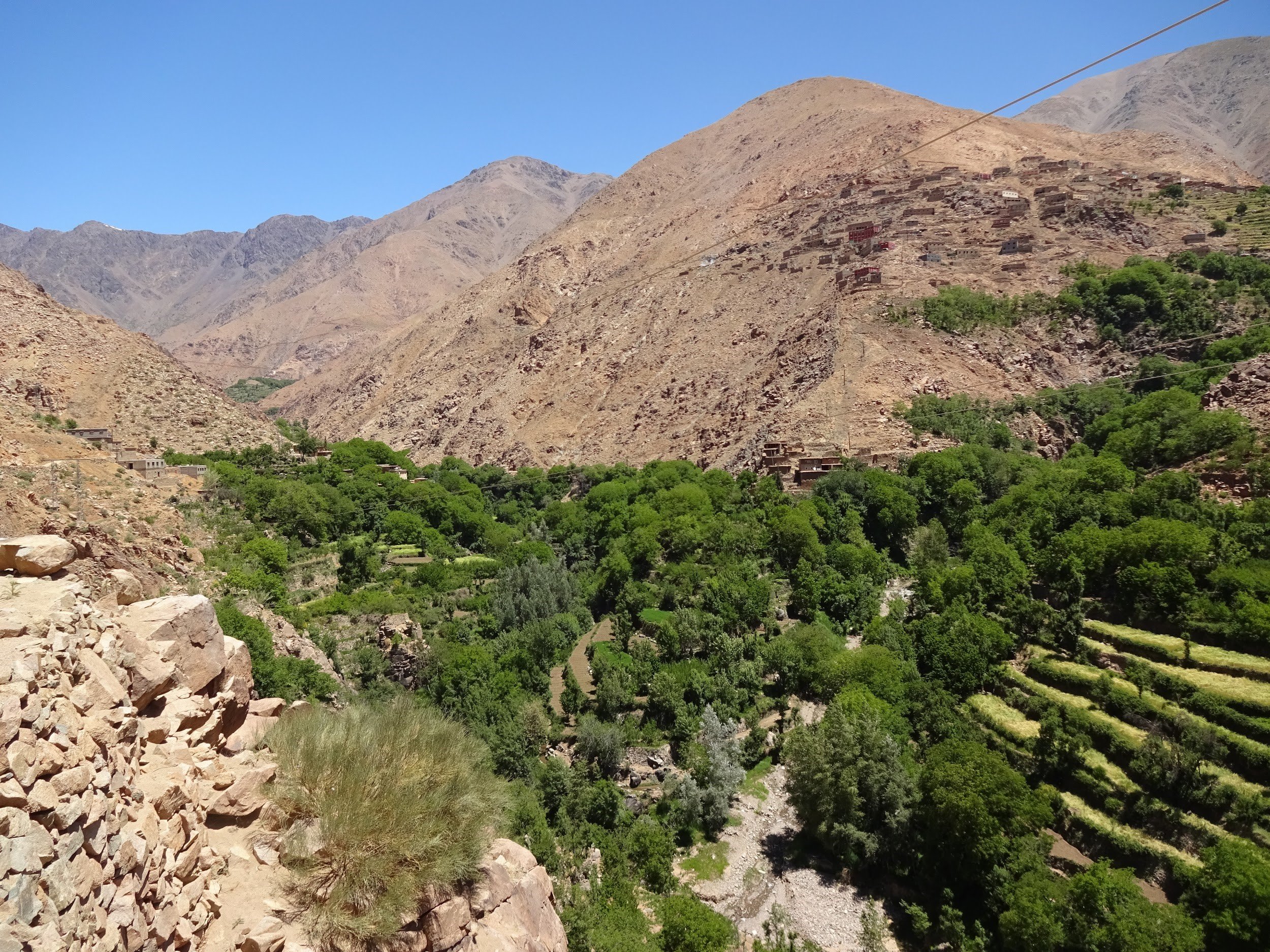
Small Village in Morocco's High Atlas Mountains


Global Research, July 30, 2019

After a windy uphill journey to Aguerzran, a small village nestled within the High Atlas Mountains, we reached the building where we would be conducting workshops. The small rectangular building, painted in sun-faded pink and green, overlooked the lush valley. My colleague explained to the group, over thirty women of varying ages, the purpose of our visit: to conduct both a cooperative building workshop and a women’s health discussion. As we waited for women to fill up the desks of the primary school, I asked the women why they felt health was important to them.
“Without health, we have nothing,” one woman proclaimed. The conversation naturally continued, as every woman reiterated the same sentiment.
Within minutes, the mood within the room shifted. One woman, a matriarch in the village, spoke through tears about challenges her community faces in accessing healthcare. Aware of her heart disease, she was unable to leave the village to take any action towards treatment. With merely one ambulance in the municipality, it is both physically and financially inaccessible. Aguerzran’s nearest health clinic is located in the Imlil Souk L’Aarba, three hours away by foot. Workshop handouts and diagrams originally brought to discuss nutrition, exercise, and hygiene were important, but not adequate.
The problem does not lie in the do’s and don’ts of health. The issue lies in addressing economic stability, education systems, the built environment, and community context; all of which are social and structural determinants surrounding health in Aguerzran.
Three months prior to our visit, the women went through an empowerment workshop conducted by the High Atlas Foundation. The workshop aims to cultivate visions women have for themselves within different spheres of personal development including money, spirituality, emotions, and the body. During our visit, facilitators conducted follow up interviews with the women to track their progress in actualizing their goals. The women expressed feeling more confident, advocative, and self-aware. Yet, their perception of taking care of their personal health and well-being was defined simply by “working hard.”
Measured by means such as healthy lives, education, and standard of living, Morocco ranks 123rd on the United Nations Human Development Index out of 189 countries. Although this indicator is widely used to gauge the country’s progress, it may not capture severe regional disparities and inter-sectional inequalities. Nearly forty percent of Morocco’s population is rural, and women make up half of the population. With the implementation of Moudawana, the Moroccan family code, and the National Initiative for Human Development, Morocco has made strides towards improving social and economic development. However, empowerment is not the only means to development; and improved health is more than a result of development.
Health, empowerment, and development have a symbiotic relationship. Significant strides in development should be holistic, and include the reduction of health inequalities in order to achieve sustainable change. Morocco faces the double burden of communicable and increasing non-communicable disease. A 2015 study published in BMC Cancer found that rural Moroccan women are at higher risk of late diagnosis for breast cancer, the most common cancer among Moroccan women. Illnesses such as tuberculosis are also often detected at late stages in rural communities. According to the World Health Organization, non-communicable diseases such as diabetes and cardiovascular disease make up nearly seventy-five percent of all deaths in Morocco. Coupled with inaccessibility to clinical care and monitoring, rural communities are increasingly susceptible to undetected chronic diseases. This epidemiological shift is indicative of unresolved structural inequalities that exacerbate rates of non-communicable diseases.
Physically and figuratively on the margins, rural women face a two-fold disadvantage. Weaker education systems in rural communities do not address health education, and weaker health systems can prevent women pursuing their education. Additionally, physical distance from health centers is discouraging and compromises safety. Women in Aguerzran expressed that heavy lifting and labor causes intense aches and pains. If left unaddressed, these pains can increase the risk of serious injury, halting their ability to work. Addressing the mutual relationship between these determinants will lead to better long-term health and equity outcomes for rural women and their communities.
When in Aguerzran, Marrakech, or anywhere in between, the crucial role of women in their communities and families is undeniable. The migration of rural men into cities has increased women’s agricultural labor and domestic care responsibilities, occupying a rural woman’s ability to give attention to her own health. As epicenters for their families, evidence suggests that the educational success and overall well-being of children is positively correlated with educational attainment and health of their mothers.
Fostering comprehensive women’s empowerment not only encourages internal progress but also paves the way for better future generations and communities. Empowering rural women through health provides the foundation for improved human capital, capacity building, and better long-term economic outcomes through participation in activities such as cooperatives.
Talking to the women in Aguerzran brought forth the importance of including health in an empowerment context. Since health seems to truly be everything for these women, it should also be an integral part of empowerment and development methodologies. Just as empowerment programs may inform women of their societal rights, the right to health should also be progressively achieved through increased data, awareness, and advocacy. Not prioritizing the wellbeing of the most vulnerable populations will prevent sustainable development from becoming a reality.
*
Note to readers: please click the share buttons above or below. Forward this article to your email lists. Crosspost on your blog site, internet forums. etc.
Fariha Mujeebuddin (fam9ab@virginia.edu) is a student at the University of Virginia studying Economics and Global Public Health, and an Intern for the High Atlas Foundation where this article was originally published.
Featured image: Two girls run down the road that leads from Aguerzran village to Souk L’Arbaa.  (Photo by Fariha Mujeebuddin, July 2019)


https://www.globalresearch.ca/without-health-we-have-nothing-need-comprehensive-sustainable-development/5685018


JUST NEWS published this article following the Creative Commons rule. If you don't want your article to appear in this blog email me and I will remove it asap.

Friday, February 8, 2019

The People of Morocco’s High Atlas: Civil Society’s Role in Achieving the “Sustainable Development Goals” (SDG)


Global Research, February 09, 2019

Life and death for whole communities hang in the balance of achieving the 17 Sustainable Development Goals (SDGs) that include eliminating poverty, conserving forests, and addressing climate change, passed by the United Nations unanimously in 2015. Take for example, the Indigenous Amazigh people who live in the mountains around Marrakech. They are representative of people who need to be served first by sustainable development.
The High Atlas Amazigh people experience hard lives in small villages. Most work as day laborers and agriculturalists with barely enough income to support their families and heat their homes. Education is a major concern, but is hard to attain for a number of reasons. Sometimes families cannot afford the subsequent costs of backpacks and books, even when the school is open and free. The challenge is especially difficult for girls, because, as one person explained, “How can fathers let their girls study if it is dark when they must travel?” The effect of incomplete education is profound, and when we asked one 62-year-old man what he thought the greatest threats to the future were for his community, he did not have confidence in his own experiences, noting, “What can I say? I am not read [educated].”
Through a partnership of the University of Central Florida (Orlando), The Hollings Center for International Dialogue (Washington D.C. and Istanbul), and the High Atlas Foundation (Marrakech), we recently conducted field work in the High Atlas Mountains, speaking with the people there who poured their hearts out to us.
The most consistent message we heard from the people of the High Atlas was that the future hinges on water. One group told us that when things are good, it is because the rain is abundant and on time; things are very hard otherwise. They are worried that climate change will affect if the rains come, or that the rain will not “come in its time.” They have good reason to worry because climate change is expected to decrease precipitation significantly, reducing streams, lakes, and groundwater.
Drought is a constant worry. The World Bank estimates that 37 percent of the population works in agriculture, meanwhile production of cereal crops varies wildly due to annual variation of precipitation– and 2018 was thankfully a bountiful year. Climate change will make the people of the High Atlas Mountains much more vulnerable while they are already living on the edge of survival. In one area, this change in precipitation timing and amount was already noticeable, resulting in a significant loss of fruit trees. In that same area, we were told that there is fear that there will be no water in twenty years, and that for these people who are deeply connected to the land, there will be “no alternatives.”
The High Atlas people are in an extremely vulnerable position. One group noted that they are so desperate for basic resources that they burn plastic trash to heat their water. Worse, they believe they have been left behind by society and that “the people of the mountains do not matter.” They feel that Moroccan society is deeply unfair—there is no help for the sick, little support for education, little defense against the cold, and that, for some, corruption is the greatest threat to a sustainable future.
Consequently, civil society has an important role in achieving the SDGs. The High Atlas Foundation has been working to help people in this region to organize themselves into collectives that decide both what the collective wants, and pathways to achieve those goals. Women have organized into co-ops that they own and they collect dividends from their products together. People in one coop lobbied the 2015 Conference of Parties climate meeting in Marrakech. Men’s associations have developed tree nurseries that not only produce income, but which protect whole watersheds – and therefore some water for the future. They are also participating in carbon sequestration markets. In this regard, the Marrakech Regional Department of Water and Forest provides them carob trees and the authorization to plant these trees on the mountains surrounding their villages.
However, perhaps the most important element of these collectives is that they give each person in them a voice. Leaders of these collectives have formal rights to approach the regional governments about their needs, and this voice would not be heard at all without the formal collective organization. These organizations cannot replace government services, but they do add capacity to the community.
Not only do these collectives lend people some influence over their current and their children’s lives, they love each other and they are not struggling alone. We witnessed profound solidarity. Repeatedly, the collectives told us “We love each other, we are one family,” “We are like one,” “We help each other,” and the conviction that “I will be with you.”The world is decidedly on an unsustainable path, so If we are going to meet SDGs, all the people like the people of the High Atlas Mountains must matter and their voice deserves to be heard.
*
Note to readers: please click the share buttons below. Forward this article to your email lists. Crosspost on your blog site, internet forums. etc.
Peter J. Jacques is a Professor of Political Science at the University of Central Florida in Orlando, USA.
Featured image: Above, Amazigh women in a village with an association that cultivates an olive tree nursery. Photo credit: Peter J. Jacques


https://www.globalresearch.ca/the-people-of-moroccos-high-atlas-civil-societys-role-in-achieving-the-sustainable-development-goals-sdg/5667928


JUST NEWS published this article following the Creative Commons rule. If you don't want your article to appear in this blog email me and I will remove it asap.

Wednesday, October 10, 2018

Effective Practices to Sustain Development in Morocco


Global Research, October 10, 2018


Natural landscapes are declining worldwide. Approximately 30 percent of the world’s natural forests are expected to be lost by the end of this century. Further, 25 percent of all land on earth is currently under threat of desertification, resulting in severe soil erosion and falls in productivity, food security, and biodiversity. Morocco is no exception. Over 90 percent of Morocco’s historical forest cover has already been decimated due to the combined effect of overexploitation, overgrazing, and worsening climate. The disastrous extent of Morocco’s environmental degradation poses a major threat to the country’s flora and fauna. According to the IUCN Red List, over 223 plant and animal species in Morocco are endangered. In addition, severe erosion, water run-off, floods, and soil depletion are critical concerns for human well-being, particularly in the Atlas communities who depend on natural resources and are marginalized with most experiencing systemic poverty.
Under these highly stressful conditions, conservation inherently remains a development issue and their combined mitigation has become an important political objective. As a result, a wide range of projects that provide communities with control over their natural resources and promote socioeconomic benefits were established. However, tackling environmental and societal issues at once can be challenging and many projects have failed to achieve both their conservation and development goals. Identifying a set of effective practices and sharing lessons learned is therefore crucial to successfully conserve natural landscapes and alleviate poverty.
To enable an understanding of effective practices, a Moroccan pro-poor agroforestry program was assessed using a new methodology that allowed the analysis of the linkage between conservation management, community interventions, and their influence on both development outcomes and biodiversity improvements. The evaluation of this program implemented by the High Atlas Foundation (HAF), a Moroccan-United States nonprofit organization, was carried out by this author, an independent primary investigator from April to September 2018. The study involved a desk-based review of relevant documents, 34 interviews, and six focus groups with seven staff members and 26 beneficiaries. The data were then analyzed and organized into an assessment booklet. This booklet was used by a group of independent professionals, who scored the performance of the program, determined successful practices as well as gaps, and gave recommendations for further improvement.
The assessment revealed that HAF in Morocco showcases exemplary, highly effective practices and, thus, can serve as a model project that should be lauded internationally. Since 2003, HAF has planted 3.6 million seeds and trees with a remarkable increase in 2018, enabled through establishing four new nurseries in partnership with Morocco’s High Commission of Water and Forests and Ecosia, a social business based in Berlin. Through the distribution of fruit trees, the foundation facilitates the transition from subsistence barley and corn cultivation to surplus organic fruit tree farming. This helps preserve the natural environment by reducing soil erosion and flooding and increasing soil quality and plant regeneration, which is highly relevant for villages that face serious and at times dangerous levels of mountain erosion and desertification, exacerbated by farming of staples and cattle herding. One farmer observed: “Before when we just grew barley and corn, the soil lost quality fast and erosion took our land. Now the trees prevent this from happening. We also have more bees because bees love the flowers.”
Fruit tree plantations in the Tifnoute Valley, High Atlas Mountains.
Furthermore, the foundation was able to impact approximately 10,000 households by increasing their agricultural skills and income. In the Tifnoute Valley of the Taroudant province, for example, the foundation distributed between 10 and 100 cherry trees per farmer. They now generate $21 to $105 from each cherry tree, depending on the water availability, harshness of winters, production rates of previous years, and other factors. On average, this is ten times as much as farmers were able to earn from barley and corn. One farmer stated:
“Before we grew trees, we had to work hard to grow corn and barley. If I counted everything together and sold all the barley and corn without keeping anything for myself, I only gained $53 a year. A few years after the foundation gave me trees I was able to sell the fruits for $528 to $1,055 depending on how much my trees produced. With the income generated, I improved my family’s life.”
In addition, the increased income enabled communities to reinvest their profits in further communal ventures like school infrastructure, health care, or youth enterprises.
Key to this success is the foundation’s holistic strategy to meaningful community engagement. Through utilizing the participatory approach, the foundation involves communities in every step of the program, entrusts them with the authority to make decisions, and increases their capacity to be agents of change. This secures early community buy-in, prevents programs from being driven by external interests, and guarantees the program is designed with a thorough understanding of local context. Furthermore, through women empowerment workshops, skills-building, literacy classes, and other community-determined initiatives such as improving school infrastructure and enriching education, HAF addresses poverty from all angles. Thereby HAF acknowledges that poverty can manifest not only through shortfalls of income and food but also through a lack of access to education, equality, empowerment, and opportunity. One woman said:
This tree and plant nursery changed our lives. Before the nursery we were just at home. Now with the help of the foundation we are able to work in the nursery, learn new skills, earn our own money, and help to provide for our families. This makes our life so much easier and men are starting to respect us. We are very proud of what we do even when we encounter problems. We learned how to face the problems together, search for solutions, and keep going.
The ongoing deterioration of landscapes and the significant dependency of rural poor on natural resources illustrate the need to considerably change conservation thinking. The High Atlas Foundation proves that meaningful community engagement through participatory methods is essential to sustainable, long-term success. A farmer concluded, “I have great expectations for the future. The trees we planted will be good for the environment, prevent soil erosion, and the project will benefit the communities and the associations in this area.” Therefore, community engagement should never be an afterthought or rhetorical, but should be fundamentally integrated into every conservation and development project. By sharing their lessons learned and effective practices, the High Atlas Foundation offers excellent potential for informing the global conservation and development community of how to develop impactful and beneficial programs.
*
Note to readers: please click the share buttons above. Forward this article to your email lists. Crosspost on your blog site, internet forums. etc.
Kerstin Opfer holds a Master in Conservation and Rural Development at the Durrell Institute for Conservation and Ecology, University of Kent, and has traveled, worked, and lived in Morocco for over four years.


https://www.globalresearch.ca/effective-practices-to-sustain-development-in-morocco/5656649


JUST NEWS published this article following the Creative Commons rule. If you don't want your article to appear in this blog email me and I will remove it asap.