Showing posts with label Militarization and WMD. Show all posts

Sunday, September 8, 2019

Strangelove Redux: US Experts Propose Having Artificial Intelligence (AI) Control Nuclear Weapons


Global Research, September 08, 2019


Hypersonic missiles, stealthy cruise missiles, and weaponized artificial intelligence have so reduced the amount of time that decision makers in the United States would theoretically have to respond to a nuclear attack that, two military experts say, it’s time for a new US nuclear command, control, and communications system. Their solution? Give artificial intelligence control over the launch button.
In an article in War on the Rocks titled, ominously, “America Needs a ‘Dead Hand,’” US deterrence experts Adam Lowther and Curtis McGiffin propose a nuclear command, control, and communications setup with some eerie similarities to the Soviet system referenced in the title to their piece. The Dead Hand was a semiautomated system developed to launch the Soviet Union’s nuclear arsenal under certain conditions, including, particularly, the loss of national leaders who could do so on their own. Given the increasing time pressure Lowther and McGiffin say US nuclear decision makers are under,
“[I]t may be necessary to develop a system based on artificial intelligence, with predetermined response decisions, that detects, decides, and directs strategic forces with such speed that the attack-time compression challenge does not place the United States in an impossible position.”
In case handing over the control of nuclear weapons to HAL 9000 sounds risky, the authors also put forward a few other solutions to the nuclear time-pressure problem: Bolster the United States’ ability to respond to a nuclear attack after the fact, that is, ensure a so-called second-strike capability; adopt a willingness to pre-emptively attack other countries based on warnings that they are preparing to attack the United States; or destabilize the country’s adversaries by fielding nukes near their borders, the idea here being that such a move would bring countries to the arms control negotiating table.
Still, the authors clearly appear to favor an artificial intelligence-based solution.
“Nuclear deterrence creates stability and depends on an adversary’s perception that it cannot destroy the United States with a surprise attack, prevent a guaranteed retaliatory strike, or prevent the United States from effectively commanding and controlling its nuclear forces,” they write. “That perception begins with an assured ability to detect, decide, and direct a second strike. In this area, the balance is shifting away from the United States.”
History is replete with instances in which it seems, in retrospect, that nuclear war could have started were it not for some flesh-and-blood human refusing to begin Armageddon. Perhaps the most famous such hero was Stanislav Petrov, a Soviet lieutenant colonel, who was the officer on duty in charge of the Soviet Union’s missile-launch detection system when it registered five inbound missiles on Sept. 26, 1983. Petrov decided the signal was in error and reported it as a false alarm. It was. Whether an artificial intelligence would have reached the same decision is, at the least, uncertain.
One of the risks of incorporating more artificial intelligence into the nuclear command, control, and communications system involves the phenomenon known as automation bias. Studies have shown that people will trust what an automated system is telling them. In one study, pilots who told researchers that they wouldn’t trust an automated system that reported an engine fire unless there was corroborating evidence nonetheless did just that in simulations. (Furthermore, they told experimenters that there had in fact been corroborating information, when there hadn’t.)
University of Pennsylvania political science professor and Bulletin columnist Michael Horowitz, who researches military innovation, counts automation bias as a strike against building an artificial intelligence-based nuclear command, control, and communications system.
“A risk in a world of automation bias is that the Petrov of the future doesn’t use his judgment,” he says, “or that there is no Petrov.”
The algorithms that power artificial intelligence-systems are usually trained on huge datasets which simply don’t exist when it comes to nuclear weapons launches.
“There have not been nuclear missile attacks, country against country. And so, training an algorithm for early warning means that you’re relying entirely on simulated data,” Horowitz says. “I would say, based on the state-of-the-art in the development of algorithms, that generates some risks.”
Mostly, Horowitz thinks the United States wouldn’t develop an artificial intelligence-based command, control, and communications system because, even if there may be less time to react to an attack in this era than in earlier decades, the government is confident in the military’s second-strike capability.
“As long as you have secure-second strike capabilities, you can probably absorb some of these variations in speed, because you always have the ability to retaliate,” he says.
Lowther and McGiffin point out that a second strike means there’s already been a first strike somewhere.
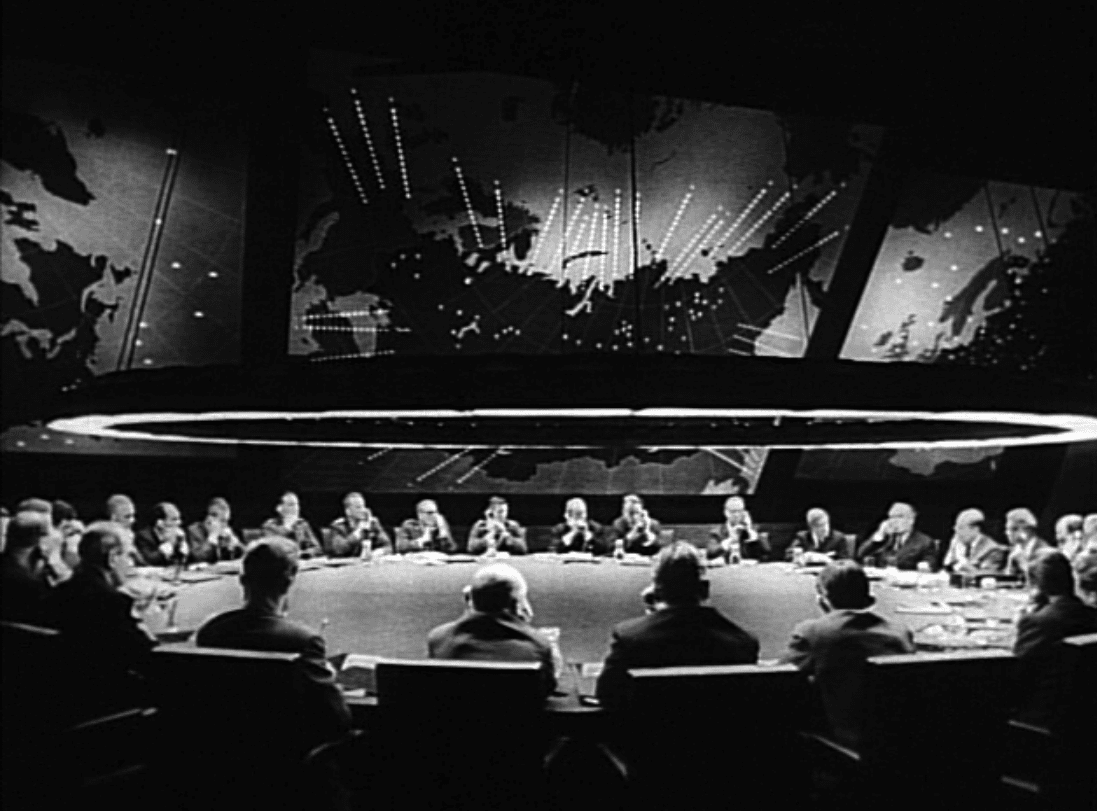
The "Doomsday Machine" in the movie Dr. Strangelove shares some similarities with a system the Soviet Union actually set up. Photo via Wikimedia Commons. Public Domain.
The “Doomsday Machine” in the movie Dr. Strangelove shares some similarities with a system the Soviet Union actually set up. Photo via Wikimedia Commons. Public Domain.
There is some precedent for the system proposed by the War on the Rocksauthors, who have served in government or in the military in nuclear-weapons-related capacities. In the fictional world of Hollywood, that precedent was established in Stanley Kubrick’s nuclear satire Dr. Strangelove and called the “Doomsday Machine,” which author Eric Schlosser described this way for The New Yorker:
“The device would trigger itself, automatically, if the Soviet Union were attacked with nuclear weapons. It was meant to be the ultimate deterrent, a threat to destroy the world in order to prevent an American nuclear strike. But the failure of the Soviets to tell the United States about the contraption defeats its purpose and, at the end of the film, inadvertently causes a nuclear Armageddon. ‘The whole point of the Doomsday Machine is lost,’ Dr. Strangelove, the President’s science adviser, explains to the Soviet Ambassador, ‘if you keep it a secret!’”
About two decades later, satire became closer to reality with the advent of the Soviet Union’s semiautomated Dead Hand system, formally known as Perimeter. When that system perceived that the Soviet military hierarchy no longer existed and detected signs of a nuclear explosion, three officers deep in a bunker were to launch small command rockets that would fly across the country initiating the launch of all of the Soviet Union’s remaining missiles, in a sort of revenge-from-the-grave move. The system was intended to enhance deterrence. Some reports suggest it is still in place.
The possibility that taking humans out of the loop might lead to an accidental launch and unintended nuclear war is a main element in US Naval War College Prof. Tom Nichols’ harsh characterization of the Dead Hand system in a 2014 article in The National Interest: “Turns out the Soviet high command, in its pathetic and paranoid last years, was just that crazy.”
But Lowther and McGiffin say a hypothetical US system would be different than Dead Hand because “the system itself would determine the response based on its own assessment of the inbound threat.“ That is to say, the US system would be better, because it wouldn’t necessarily wait for a nuclear detonation to launch a US attack.
*
Note to readers: please click the share buttons above or below. Forward this article to your email lists. Crosspost on your blog site, internet forums. etc.
Featured image: A US missile test. Photo via Wikimedia Commons. Public Domain.


https://www.globalresearch.ca/strangelove-redux-us-experts-propose-having-artificial-intelligence-ai-control-nuclear-weapons/5688448


JUST NEWS published this article following the Creative Commons rule. If you don't want your article to appear in this blog email me and I will remove it asap.

Sunday, August 25, 2019

US Missile Test, UN Security Council Face Off: China-Russia v. US


Global Research, August 25, 2019

At the request of Russia and China, a Thursday Security Council session was held on the Trump regime’s development of short-and-intermediate-range missiles prohibited by the landmark 1987 INF Treaty.
The key pillar of arms control (and earlier ones) are gone because the US unilaterally abandoned its obligations based on Big Lies — the INF pullout announced in February, formal withdrawal occurring on August 2.
Russia and China correctly warned that the White House move threatens international peace and security — what’s true about Washington’s geopolitical agenda overall under both extremist wings of its war party.
Ahead of Thursday’s SC session, Russian Foreign Ministry spokeswoman Maria Zakharova said the following:
“The (meeting) was based on the plans announced by the US, which concern the deployment of intermediate-range missiles to the Asia-Pacific region” close to China and North Korea, adding:
“Clearly, it is only the first step, and in the future, the US may deploy such weapons to other regions of the world, including Europe” near Russia’s border — heightening world tensions more than already.
On August 18, the US war department said the Pentagon “conducted a flight test of a conventionally-configured ground-launched cruise missile at San Nicolas Island, California” — banned by the INF Treaty it failed to explain, adding:
“The test missile exited its ground mobile launcher and accurately impacted its target after more than 500 kilometers of flight.”
“Data collected and lessons learned from this test will inform the (war department’s) development of future intermediate-range capabilities.”
During Thursday’s SC session, acting Trump regime envoy Jonathan Cohen repeated long ago debunked Big Lies about Russian INF violations that didn’t occur.
Moscow invited international inspections of missiles objected to by the US. They never took place because Trump regime hardliners pressured their NATO counterparts not to accept the offer.
Sergey Lavrov earlier explained that US INF Treaty violations began 20 years ago under the Clinton co-presidency and continued under Bush/Cheney, Obama and Trump.
Not a shred of credible evidence suggests Russian noncompliance, just the opposite. False accusations are all about giving the US an unjustifiable pretext to abandon its international obligations — what it does time and again.
Trump regime withdrawal from the INF Treaty was planned long before announced last February.
The pullout is all about leaving the US unrestrained to develop and deploy short-and-intermediate-range/nuclear-capable cruise and ballistic missiles close to the borders of its adversaries — notably Russia, China, North Korea, Venezuela and Iran.
During Thursday’s Security Council session, China slammed the Trump regime’s unilateral INF Treaty pullout, its UN envoy Zhang Jun saying the following:
Since agreed on by Soviet Russia and the US in 1987 until abandoned by the White House this month,
“the treaty effectively mitigated the arms race on intermediate-range missiles between the US and USSR in Europe and helped to enhance strategic mutual trust between major powers, ease international relations and advance nuclear disarmament process.”
The above is a true statement – polar opposite the litany of Big Lies recited by the Trump regime’s envoy — typical of how the US operates on the world stage, why it can never be trusted by other nations, allies and adversaries alike.
China: Russia and the US “should have properly handled differences over treaty compliance through dialogue and consultation to earnestly safeguard the effectiveness of the treaty.”
Trump regime hardliners ruled it out so the Pentagon can go its own way unconstrained by international laws, norms, standards, and agreements with other countries.
Unilaterally withdrawing from the INF Treaty “will have a far-reaching negative impact on global strategic balance and stability, regional security in Europe and Asia as well as international arms control regime,” China stressed.
When China, Russia, and other nations call on the US to exercise restraint and observe its international obligations, it falls on deaf ears in Washington virtually always.
Beijing has “no interest (in) and will not be part of…so-called arms control negotiations with the” with the US, its envoy stressed, adding:
“(A)ll its land-based intermediate range missiles are deployed within (its) territory…for defense purposes only and pose no threat to any country.”
China and Russia prioritize world peace and cooperative relations with other countries — at war with none.
The US under both wings of its war party seeks dominion over planet earth, its resources and populations — waging endless preemptive wars of aggression in multiple theaters against nonbelligerent nations threatening no one.
Russia’s deputy UN envoy Dmitry Polyanskiy stressed the importance of the INF Treaty now gone.
After observing its treaty obligations “for a while,” compliance became “inconvenient” for the US side, “believ(ing) in (its) exceptionalism,” said Polyanskiy, adding:
The US is “determined to impose inequitable unilateral schemes of international relations on others” — breaching its international obligations unaccountably.
Putin said Russia won’t breach INF Treaty provisions except in response to US violations — clearly what happened.
Abandonment of arms control treaties “leaves no instrument in the world to curtail the arms race,” Putin stressed.
New START is next on the Trump regime’s chopping block for elimination when expires in February 2021 if DJT is still in power.
Bolton said extending it is unlikely. Putin said no Trump regime official “is willing to talk about (extending New START) with us.”
Agreed to by the US and Russia in April 2010, it succeeded START I (1991) and the 2002 Strategic Offensive Reductions Treaty (SORT).
New START limits deployment of strategic nuclear warheads to 1,550, a major reduction from earlier levels, a verification regime agreed on to assure both sides comply with their obligations.
Russia: The US “had been persistently and deliberately violating the INF Treaty for a long time,” pullout intended long before announced.
“(L)ast December, Russia proposed a General Assembly draft resolution in support for the INF Treaty.”
EU/NATO countries, in cahoots with the US, rejected the idea, going along with the Trump regime’s abandonment of the INF Treaty by not allying with Russia to save it.
Moscow warned that the treaty’s demise would “lead to a new nuclear arms race,” missiles with these weapons targeting European cities because leaders of these countries failed to act responsibly.
Congressional budgeting for INF banned missiles was in place “long before this treaty was sentenced to death. And, as always, Russia is to blame,” its UN envoy stressed.
Abandonment of the rule of law and international obligations by the US left the world a far more dangerous place than during the Cold War.
It’s highlighted by the Trump regime’s war secretary Mark Esper, saying the Pentagon is preparing for “high-intensity conflicts against competitors such as Russia and China” — clearly Iran as well.
The Bulletin of the Atomic Scientists’ Doomsday Clock stands at two minutes to midnight, moved there in January 2018.
The nuclear arms race launched by the Trump regime may get it moved closer to doomsday in the weeks or months ahead.
A Final Comment
On Friday, Vladimir Putin ordered Russia’s Defense Ministry to respond appropriately to threats posed by the Trump regime’s INF Treaty pullout, its August 18 missile test prohibited by treaty, likely more of the same to come, and deployment of these missiles, stressing:
“We have repeatedly pointed out that the deployment of such launchers by the US at its missile defense base in Romania, and their expected deployment in Poland in the near future are a direct and flagrant violation of the treaty on medium and short-range missiles,” adding:
“The US side stubbornly denied this, claiming that land-based MK-41s were supposedly unable to launch sea-based Tomahawk cruise missiles.”
“Now, the fact of their violation is out in the open and impossible to dispute. They themselves have spoken about it.”
Russia will do whatever it considers necessary to defend its security from a clear threat posed by the US. China will act the same way. So will Iran.
*
Note to readers: please click the share buttons below. Forward this article to your email lists. Crosspost on your blog site, internet forums. etc.
Award-winning author Stephen Lendman lives in Chicago. He can be reached at lendmanstephen@sbcglobal.net. He is a Research Associate of the Centre for Research on Globalization (CRG)
His new book as editor and contributor is titled “Flashpoint in Ukraine: US Drive for Hegemony Risks WW III.”
Visit his blog site at sjlendman.blogspot.com.
Featured image is from InfoRos


https://www.globalresearch.ca/us-missile-test-un-security-council-face-off-china-russia-v-us/5687073


JUST NEWS published this article following the Creative Commons rule. If you don't want your article to appear in this blog email me and I will remove it asap.

Monday, August 19, 2019

Fire on US Military Contracted Plane at Shannon Airport Raises Serious Questions


Global Research, August 19, 2019

Shannonwatch 16 August 2019

Shannonwatch are calling for an immediate review of the safety standards applied to US military and military contracted planes at Shannon Airport. A fire on an Omni Air International troop carrier brought the airport to a standstill on Thursday August 15th. This once again highlights the dangers posed by daily military traffic at a civilian airport like Shannon.
The troop carrier, which is reported to be carrying approximately 150 troops, was on its way to the Middle East. It had arrived earlier from Tinker Air Force Base, Oklahoma USA.
“We know that it’s standard practice for the troops on these planes to have their weapons with them,” said John Lannon of Shannonwatch. “But what we don’t know, because the Irish government refuses to conduct proper inspections of US military planes at Shannon, is whether or not there were munitions on board.”
Edward Horgan of Veterans for Peace said
“It appears there was a significant fire on the undercarriage of the aircraft as it was taking off, and that this required the airport fire brigade to use flame retardant foam to extinguish the fire. The flame retardant foams used at US military bases around the world have been causing very serious pollution. Are similar polluting fire-fighting foams being used at Shannon as part of the US military business?”
It was reported in July that Shannon was the first airport in the country to take delivery of new High Reach fire tenders.
“Is this another example of US military dictating practice at Shannon to counteract the risk posed by their use of the airport?” asked Mr Horgan.
According to data gathered by Shannonwatch, the military contracted plane on which the fire broke out has, over the past week, been at Biggs Air Force Base in Texas, Shaw Air Force Base in South Carolina, as well as US Air Bases in Japan (Yokota) and South Korea (Osan). It has also travelled to the Al Udeid Air Base in Qatar, via Kuwait. As well as being a US base, Al Udeid also houses the Qatari Air Force that has been part of the Saudi-led military offensive in Yemen. This has left millions of people facing famine since 2016.
Close to 3 million US troops have gone through Shannon Airport since 2001. Troop carriers continue to land and take off from Shannon on a daily basis.
In addition to the US troop carrier flights, aircraft operated directly by the US Air Force and Navy also land at Shannon. The Irish government has admitted that there are weapons on board the troop carriers. But they claim that the other US military aircraft are carrying no arms, ammunition or explosives and are not part of military exercises or operations.
“This is utterly incredible,” said John Lannon. “It is normal procedure for crews of US military aircraft to carry personal weapons, and since thousands of these have been refuelled at Shannon since 2001 it is inconceivable that there wasn’t a single weapon on even one of them. We therefore find it impossible to believe any “assurances” about the US military use of Shannon.”
“Given the regularity of US military aircraft at Shannon, incidents like the fire on Thursday morning are potential disaster waiting to happen.” said Edward Horgan. “Furthermore, the presence of hundreds of US military personnel presents major security risks for everyone using or working at the airport.”
The use of Shannon Airport is also in contravention of Ireland’s stated policy of neutrality.
“The use of Shannon to directly support US unjustified wars in the Middle East, including wars crimes committed by some of the US military and their allies is unjustified and unacceptable,” said Edward Horgan of Veterans for Peace.
According to an RTÉ TG4 Exit Poll after the May elections, 82% of those polled said Ireland should remain a neutral country in all aspects.
Roger Cole, Chair of the Peace and Neutrality Alliance (PANA), said
“The danger to Shannon Airport and the passengers posed by US military planes that carry military equipment to the perpetual wars of the US have been highlighted by Shannonwatch and PANA. PANA once more calls upon the immediate termination of the use of Shannon Airport by US troops”.
“More important than anything however, is the Irish Government should stop collaborating with the US in killing hundreds of thousands of men, women and children,” he added.
Shannonwatch reiterate their calls for an end to all US military use of Shannon Airport, in the interests of local safety and global stability.
*
Note to readers: please click the share buttons above or below. Forward this article to your email lists. Crosspost on your blog site, internet forums. etc.


https://www.globalresearch.ca/us-military-contracted-plane-shannon-airport-raises-serious-questions/5686652

JUST NEWS published this article following the Creative Commons rule. If you don't want your article to appear in this blog email me and I will remove it asap.

Tuesday, July 23, 2019

International Laws Governing the Use of Nuclear Weapons in Outer Space Expiring in 2021


What's next for the 8 countries (Pakistan, Russia, China, US, France, UK, North Korea, India) with nuclear capabilities


Global Research, July 23, 2019

In recent rhetoric about a treaty between Russia and Pakistan to not be the first to deploy weapons in space, citing “The use of force against space-based objects, the development and deployment of Anti Ballistic Missile systems and their integration into space assets have added worrying dimensions to the issues relating to Outer Space” the two countries voiced concerns about International Law allowing control of space and space assets.
Which is exactly what the Trump Space force intends to do, as explained in an excerpt from The United States Space Force, AMI special issue (Vol. 18 N.66), which states their directive,
“Currently, outer space is protected under International Law…..By 2020, new national laws will be in place to manage the governance, services and support the functions of the space force. Where they conflict with international codes, the latter will have to be modified to adjust to new realities.” 
There are currently five agreements from as far back as 1967 (Treaty for the prevention of Outer Space) thru the United Nations Office of Outer Space Affairs, due to expire as soon 2021.  With 8 current nuclear-powered countries posturing for global economic alliances and control over space-based assets and, the creation of new international laws will be the cornerstone that shapes the future of civilization.
Currently, thirteen countries already have capability to launch into space and leaders like China, Russia, India, Japan, and US are expanding space exploration and manufacturing at an unprecedented rate.
With the escalation of trade tensions, bilateral agreements and pacific-asia trade alliances the topic at the G20 summit, countries like India and the US have directed their officials to meet and resolve trade disputes between the two countries.  Russia’s nuclear weapon stockpile now exceeds the US and China is aggressively developing its next generation of nuclear weapons, conducting an average of five tests a month to simulate nuclear blasts, as stated in the South China Morning Post.
In Vienna Austria, plans are underway for World Space Forum 2019 where new International Laws concerning space will likely headline the various discussions such as this one.
The various factors of access to space, space technology data and facilities, and the importance of joining a global effort in the development of the entire space arena for the benefit of humanity“, is the title for one of the many meetings taking place under the umbrella “Space-4 All” co organized by the European Space Agency and The United Nations Office for Outer Space Affairs (UNOOSA). In addition to the eight nuclear armed countries, NATO member nuclear weapons sharing states include (Belgium, Germany, Italy, the Netherlands, Turkey), with Australia the next likely nuclear armed country to join in, as reported recently by the Bangcock Post.
In the meantime, a Treaty to Ban Space-Based Weapons developed and previously ratified by China and Russia back in the 1970s already exists and could set the stage for International Cooperation in space says Peace in Space activist, Dr. Carol Rosin.
“This treaty could be a milestone of diplomacy for us to end the war mentality and evolve into a peaceful, sovereign space-faring society.” Because, she adds “Once we get to space, we all Earthlings.”
*
Note to readers: please click the share buttons above or below. Forward this article to your email lists. Crosspost on your blog site, internet forums. etc.
D.A. West has a Masters in International Business from DePaul University in the US. She works as an editor and writer, currently living in Tokyo, Japan. Her background is in advances in nanoscience, astrophysics, everything “Space-related” and the implications to an evolving society.


https://www.globalresearch.ca/international-laws-governing-use-nuclear-weapons-outer-space-expiring-2021/5684386


JUST NEWS published this article following the Creative Commons rule. If you don't want your article to appear in this blog email me and I will remove it asap.