Showing posts with label Libya. Show all posts

Friday, August 16, 2019

What happened when she ‘supported’ Libya? Chinese media roasts Hillary Clinton over Hong Kong


Hillary Clinton © REUTERS/Clodagh Kilcoyne ; fighting in southern Tripoli, Libya June 22, 2019. © REUTERS/Yosri al-Jamal
A newspaper operated by China’s Communist Party pulled no punches on Hillary Clinton’s support for Hong Kong protesters, noting her role in past foreign policy debacles ranging from the Iraq War to US intervention in Libya.

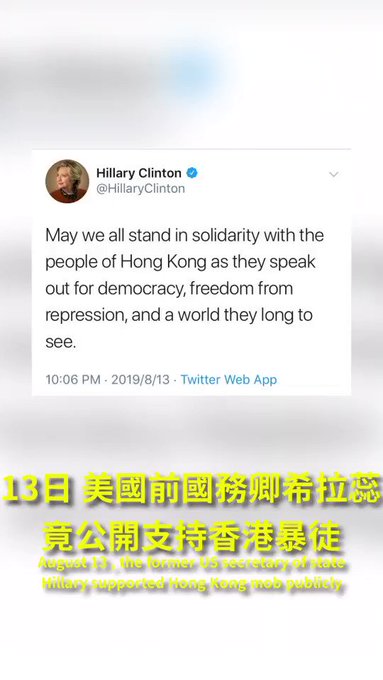
“@HillaryClinton has called for support of the rioters in Hong Kong. Let’s see what happened when she ‘supported’ Syria, Libya, Yemen, Iraq,” the People’s Daily tweeted.
The accompanying video shows clips of Hillary Clinton throughout her tumultuous political career, advocating for wars and foreign policy positions that have led to the deaths of hundreds of thousands of people across the Middle East and North Africa.
The video ends with a photograph of a US Consulate official meeting with Hong Kong activists, and video footage showing demonstrators waving American flags. Washington is now attempting to “intervene” in Hong Kong, the video claims.
Earlier this week, Clinton urged the world to “stand in solidarity” with the Hong Kong protesters as they “speak out for democracy.”
ALSO ON RT.COMHong Kong in US’ crosshairs? No matter where there’s revolution, we’re there, Ron Paul says
Beijing has repeatedly accused Washington of playing an active role in demonstrations that have rocked Hong Kong since March. On Thursday, China’s Foreign Ministry office in Hong Kong accused the US of “conspiring with radical criminal elements and are insanely involved in anti-Chinese criminal cases” in the semi-autonomous territory.


https://www.rt.com/news/466629-china-mocks-hillary-clinton/

JUST NEWS published this article following the Creative Commons rule. If you don't want your article to appear in this blog email me and I will remove it asap.

Friday, August 2, 2019

The Retainer Solution: The European Union, Libya and Irregular Migration


Global Research, August 02, 2019

There is a venom in international refugee policy that refuses to go away: officials charged with their tasks, passing on their labours to those who might see the UN Refugee Convention as empty wording, rather than strict injunction carved upon stone.  They have all become manifest in the policy of deferral: humanitarian problems are for others to solve.  We will simply supply monetary assistance, the machinery, the means; the recipients, like time honoured servants, will do the rest.  
The European Union, and some of its members, have their own idea of a glorified servant minding their business in North Africa.  The EU Emergency Trust Fund for Africa is the pot of gold; the recipient is Libya, an important “transit country for migrants heading to Europe.”  Such a status makes Libya the main point of outsourced obligations associated with human traffic.  Using Libya supposedly achieves the objectives of the Joint Communication ‘Managing flows, saving lives’ (never pass up the chance to use weasel words) and the Malta Declaration.
In responding to the regional refugee crisis, the EU mires itself in the wording of bureaucracy, machine language meant to be inoffensive.  The first phase of the “Support to Integrated border and migration management in Libya” sounds like an allocation of mild tasks, a simple case of proper filing.  In summary,
it “aims to strengthen the capacity of relevant Libyan authorities in the areas of border and migration management, including border control and surveillance, addressing smuggling and trafficking of human beings, search and rescue at sea and in the desert.” 
A casual takeaway from this is that the EU is not merely being responsible but caring, assisting a country to, in turn assist migrants and refugees from making rash decisions, saving them when needed, and protecting them when required.  
According to its unconvincing brief,
“the EUTF for Africa pays particular attention to protection and assistance to migrants and their host communities in the country in order to increase their resilience.” 
In arid language, there is lip-service paid to “support a migrant management and asylum in Libya that is consistent with the main international standards and human rights.”
Such documents conceal the appallingly dire situation of Libya as the sponsored defender of Europe against irregular arrivals.  Money sent is not necessarily money well spent.  Detention centres have become concentrations of corrupted desperation, its residents exploited, tormented and kidnapped.   
Accounts of torture in such camps have made their way to Human Rights Watch and Amnesty International.  In July 2018, Human Rights Watch paid a visit to four detention centres in Tripoli, Misrata and Zuwara.  The organisation found “inhumane conditions that included severe overcrowding, unsanitary conditions, poor quality food and water that has led to malnutrition, lack of adequate healthcare, and disturbing accounts of violence by guards, including beatings, whippings, and the use of electric shocks.” 
The EUTF for Africa lacks human context; dull, bloodless policy accounts make little mention of cutthroat militias jousting for authority and the absence of coherent, stable governance.  In May, the UN High Commissioner for Refugees spokesperson Charlie Yaxley claimed that the
UNHCR was “in a race against time to urgently move refugees and migrants out of detention centres to safety, and we urge the international community to come forward with offers of evacuation.”  
Such races have tended to be lost, and rather badly at that.  The militias are on the move, and one war lord eager to make an impression is Khalifa Haftar.  On July 3, some fifty people perished in an airstrike when two missiles hit a detention centre in Tripoli hosting 610 individuals.  The finger pointing, even as the centre continued to burn, was quick, with blame duly allocated: Italy’s interior minister Matteo Salvini, and Libya’s UN-recognised and misnamed Government of National Accord (GNA) saw the hand of Haftar’s Libyan National Army.  The intended target, according to LNP general Khaled el-Mahjoub, had been the militia camp located in the Tajoura neighbourhood.   
Salvini, for good measure, also saw another culprit in the undergrowth of responsibility. While the rest of the EU could not shy away from this “criminal attack”, France would prove an exception, given their “economic and commercial reasons” for supporting “an attack on civilian targets.”  Salvini is right, up to a point: France has an interest in supporting Haftar, given its interest in the eastern Libyan oilfields which he controls.  The EU continues to speak in harshly different voices, none of them particularly humanitarian.   
The UN special envoy for Libya, Ghassan Salamé suggested that the strike “clearly could constitute a war crime” having killed people “whose dire conditions forced them to be in that shelter.”  The envoy’s formulation was striking: it was not the fault of GNA authorities who had detained migrants near a military depot; nor did the EU harbour any responsibility for having ensured the conditions of “managed” traffic flow that had led to the creation of detention centres.    
The debate that followed was all a matter of logistical semantics; the camps proved to be, yet again, areas of mortal danger and hardly up to the modest standards of the EU’s refugee policy. To add to the prospects of future butchery, 95 more people have been added to the Tajoura centre.  The cruel business has resumed. 
*
Note to readers: please click the share buttons above or below. Forward this article to your email lists. Crosspost on your blog site, internet forums. etc. 
Dr. Binoy Kampmark was a Commonwealth Scholar at Selwyn College, Cambridge.  He lectures at RMIT University, Melbourne. He is a frequent contributor to Global Research and Asia-Pacific Research. Email: bkampmark@gmail.com
Featured image is from TruePublica

https://www.globalresearch.ca/european-union-libya-irregular-migration/5685406

JUST NEWS published this article following the Creative Commons rule. If you don't want your article to appear in this blog email me and I will remove it asap.
Monday, May 6, 2019

How the West's war in Libya has spurred terrorism in 14 countries


The true extent of the fall-out from the Libya war is remarkable: it has spurred terrorism in Europe, Syria, North Africa and sub-Saharan Africa
By Mark Curtis

May 06, 2019 "Information Clearing House" -  Eight years on from Nato's war in Libya in 2011, as the country enters a new phase in its conflict, I have taken stock of the number of countries to which terrorism has spread as a direct product of that war.
The number is at least 14. The legacy of David Cameron's, Nicolas Sarkozy's and Barack Obama's overthrow of Libyan leader Muammar Gaddafi has been gruesomely felt by Europeans and Africans.
Yet holding these leaders accountable for their decision to go to war is as distant as ever.

Ungoverned space

The 2011 conflict, in which Nato worked alongside Islamist forces on the ground to remove Gaddafi, produced an ungoverned space in Libya and a country awash with weapons, ideal for terrorist groups to thrive.
But it was Syria that suffered first.
After civil war broke out there in early 2011, at the same time as in Libya, the latter became a facilitation and training hub for around 3,000 fighters on their way to Syria, many of whom joined al-Qaeda affiliate, Jabhat al-Nusra and the Islamic State-affiliated Katibat al-Battar al-Libi (KBL), which was founded by militants from Libya.
In Libya itself, a rebranding of existing al-Qaeda-linked groups in the north-eastern area of Derna produced Islamic State's first official branch in the country in mid-2014, incorporating members of the KBL.
During 2015, IS Libya conducted car bombings and beheadings and established territorial control and governance over parts of Derna and Benghazi in the east and Sabratha in the west. It also became the sole governing body in the north-central city of Sirte, with as many as 5,000 fighters occupying the city.
By late 2016, IS in Libya was forced out of these areas, largely due to US air strikes, but withdrew to the desert areas south of Sirte, continuing low-level attacks.
In the last two years, the group has re-emerged as a formidable insurgent force and is again waging high-profile attacks on state institutions and conducting regular hit-and-run operations in the southwestern desert.

Terror in Europe
Last September, UN Special Representative to Libya Ghassan Salame told the UN Security Council that the IS "presence and operations in Libya are only spreading".
After the fall of Gaddafi, IS Libya established training camps near Sabratha which are linked to a series of terrorist attacks and plots.
"Most of the blood spilled in Europe in the more spectacular attacks, using guns and bombs, really all began at the time when Katibat al-Battar went back to Libya," Cameron Colquhoun, a former counterterrorism analyst for Britain's Government Communications Headquarters, told The New York Times.
"That is where the threat trajectory to Europe began - when these men returned to Libya and had breathing space."
Salman Abedi, who blew up 22 people at a pop concert in Manchester in 2017, met with members of the Katibat al-Battar al-Libi, a faction of IS, several times in Sabratha, where he was probably trained.
Other members of the KBL were Abdelhamid Abaaoud, the ringleader of the 2015 Paris attacks on the Bataclan nightclub and sports stadium, which killed 130 people, and the militants involved in the Verviers plot to attack Belgium in 2015.
The perpetrator of the 2016 Berlin truck attack, which left 12 people dead, also had contacts with Libyans linked to IS.
So too in Italy, where terrorist activity has been linked to IS Libya, with several individuals based in Italy involved in the attack on the Bardo museum in Tunis in 2015, which killed 22 people.

Libya's neighbours

Tunisia suffered its deadliest terrorist attack in 2015 when a 23-year-old Tunisian armed with a machine gun mowed down 38 tourists, mainly Britons, at a beach hotel in the resort of Port El Kantaoui.
The perpetrator was reportedly an adherent of IS and, like Salman Abedi, had been trained in the camp complex at Sabratha from where the attack was staged.
Libya's eastern neighbour, Egypt, has also been struck by terrorism emanating from the country. IS officials in Libya have been linked to, and may have directed, the activities of Wilayat Sinai, the terrorist group formerly known as Ansar Bayt al-Maqdis, which has carried out several deadly attacks in Egypt.
After the fall of Gaddafi, the Western Desert became a corridor for the smuggling of weapons and operatives on their way to the Sinai.
Egypt conducted air strikes against militant camps in Libya in 2015, 2016 and again in 2017, the latter following the killing of 29 Coptic Christians near Cairo.

Into the Sahel

But Libya has also become a hub for jihadist networks stretching south into the Sahel. Libya's 2011 uprising opened a flow of weapons into northern Mali, which helped revive an ethno-tribal conflict that had been brewing since the 1960s.
By 2012, local allies of Al-Qaeda in the Islamic Maghreb (AQIM) had taken control of day-to-day governance in the northern Mali towns of Gao, Kidal and Timbuktu.
After France intervened in Mali, the ongoing lack of governance in Libya precipitated several groups to relocate their operational centres to Libya, including both AQIM and its offshoot, Al-Mourabitoun, from where these groups could acquire weapons more easily.
With Libya as its rear base, Al-Mourabitoun under its leader Mokhtar Belmokhtar was behind the attack on the Amenas hydrocarbon complex in eastern Algeria in January 2013, which left 40 foreign workers dead; the gun attack on the Radisson Blu hotel in Bamako, Mali in November 2015, which killed 22 people; and for the attack on Hotel Splendid in Ouagadougou, Burkina Faso, which killed 20 people in January 2016.
Al-Mourabitoun has also attacked a military academy and French-owned uranium mine in Niger.

Disastrous foreign policy

The fall-out from Libya spreads even wider, however. By 2016, US officials reported signs that Nigeria's Boko Haram jihadists, responsible for numerous gruesome attacks and kidnappings, were sending fighters to join IS in Libya, and that there was increased cooperation between the two groups.
The International Crisis Group notes that it was the arrival of weapons and expertise from Libya and the Sahel that enabled Boko Haram to fashion the insurgency that plagues north-western Nigeria today.
There have even been claims that Boko Haram answers to IS commanders in Libya.
In addition to these 14 countries, fighters from several other states have joined IS militants in Libya in recent years. Indeed, it is estimated that almost 80 percent of IS membership in Libya is non-Libyan, including from countries such as Kenya, Chad, Senegal and Sudan.
These foreign fighters are potentially available to return to their own countries after receiving training.
The true extent of the fall-out from the Libya war is remarkable: it has spurred terrorism in Europe, Syria, North Africa and sub-Saharan Africa. Islamic State, although now nearly defeated in Syria and Iraq, is far from dead.
Indeed, while Western leaders seek to defeat terrorism militarily in some places, their disastrous foreign policy choices have stimulated it in others.
Mark Curtis is a historian and analyst of UK foreign policy and international development and the author of six books, the latest being an updated edition of Secret Affairs: Britain’s Collusion with Radical Islam.

This article was originally published by "MEE" -  


JUST NEWS published this article following the Creative Commons rule. If you don't want your article to appear in this blog email me and I will remove it asap.

Sunday, April 21, 2019

Failed States and Militias: General Khalifa Haftar Moves on Tripoli


Global Research, April 21, 2019


The richly disastrous mess that is Libya has been moving into another phase of inspired aggression at the hands of General Khalifa Haftar.  As he does, UN-backed Prime Minister Fayez Al-Sarraj is anxious.  For some three weeks, the General’s eastern forces, known as the Libyan National Army (LNA) have been edging towards the capital of the fractured state in a hope to remove the “remaining terrorist groups” in the region.
The government of national accord (GNA) is not getting the voices of support in foreign capitals it might have once enjoyed.  In early April, Al-Sarraj was keen to stress his view on how Libya would return to a state of strife-free normalcy. “We will not give up our principles and peaceful solutions to reach a civil state, to ensure that totalitarian rule or militarisation of the state will not return.”
Much stock was placed in having a national dialogue that would lead to “the unification of institutions and the holding of right presidential and parliamentary constitutional elections to allow people to have their say.”
General Haftar, veteran of the Libyan war in Chad during the 1970s and 1980s and touted past collaborator with the CIA, has preferred to spoil the party with his own effort to besiege the capital, despite efforts on the part of Western diplomats to discourage him.  His argument in attacking Tripoli since the chaos of 2011 has been directed at the feeble efforts of Libya’s interim figures, whom he accuses of being oblivious to the Islamist militia problem.  His response to the militia problem has been to create his own ragtag grouping of militias.  It takes one to get rid of one.
Al-Sarraj is doing everything he can to assure that his forces will play by the rules of international humanitarian law, hoping that this will keep him in the good books and add him to others.  A counter-offensive has begun, and clashes have been reported in Wadi Rabea, Airport Road, Ain Zara and Khalit Al-Furjan.
As the recognised government struggles, old formulae of accusations and suspicions are also playing out.  Al-Sarraj and his colleagues are convinced the general is getting support from external sources, though their finger pointing is somewhat awry.  Of little doubt is the assistance Haftar is receiving from the United Arab Emirates and Egypt, which have done their bit to add some polish in terms of equipment to the LNA.
Russia is keen that Haftar not receive all the blame for the new round of spoliation; the United States seemed confused on the matter in the UN Security Council, though President Donald Trump has done much to confuse the issue.  (Previously, US Secretary of State Mike Pompeo had called on Haftar to halt his attack.)  In conversations with Haftar, Trump seemed to give his nod of approval to the efforts on the part of the LNA leader to restore order.  In a phone call, Trump “recognised Field Marshal Haftar’s significant role in fighting terrorism and securing Libya’s oil resources, and the two discussed a shared vision for Libya’s transition to a stable, democratic political system.”
With the regime in Tripoli isolated, the Libyan Interior Minister, Fathi Bashagha, has led the recriminations.  France, despite having supplied six patrol boats to Al-Sarraj’s forces as early as February, not to mention training for the presidential guard, has been singled out as arch villain. The interior ministry has suspended “all relations between the ministry and the French side… due to the position of the French government in support of the criminal Haftar.”
European politicians are observing the latest round of violence with concern less for the humanitarian consequences to Libya than the clouded security picture that will follow.
“If the war persists,” warns former Italian Interior Minister Marco Minitti, “all those fleeing the clashes will turn into refugees per the international conventions, thus bringing among them foreign fighters from Syria and Iraq who usually use chaos to transport from one place to another.”
How inconsiderate of them.
The French response has been one of shrugged shoulders, and some regret.  But the final picture here is one of typical, undermining indifference. It was France who, helped by the United Kingdom and the United States, led the campaign to oust Muammar Qaddafi with catastrophic consequences for a state that has ceased to be.
Since 2011, to call Libya a functioning political entity has been a charade of grotesque proportion assisted by forced theatre on the diplomatic stage.  The post-2014 civil war in the aftermath of the ejection of the internationally acknowledged Libyan parliament by forces working with the Libyan Muslim Brotherhood, has seen continuing, crippling conflict.  What is distinctly not a charade are the deaths and refugees that are growing in number, meaning that this failed state is on track to become the next blood soaked Syria.
*
Note to readers: please click the share buttons below. Forward this article to your email lists. Crosspost on your blog site, internet forums. etc.
Dr. Binoy Kampmark was a Commonwealth Scholar at Selwyn College, Cambridge.  He lectures at RMIT University, Melbourne.  He is a frequent contributor to Global Research and Asia-Pacific Research. Email: bkampmark@gmail.com


https://www.globalresearch.ca/general-khalifa-haftar-moves-tripoli/5675137


JUST NEWS published this article following the Creative Commons rule. If you don't want your article to appear in this blog email me and I will remove it asap.

Saturday, April 20, 2019

Libya - U.S. Reveals Support For Hafter's Side


By Moon Of Alabama
April 19, 2019 "Inf
ormation Clearing House" - The Libyan National Army (LNA) troops of General Hafter attack the militias which support the UN recognized government in Tripoli from the south. The LNA still lacks forces for a larger break through. Several objects at the front changed hands several times. There are bloody skirmishes but no big fights. Those are still to come.


Map by South Front - bigger
Some people doubt that Hafter can be successful:
Analysts believe that Haftar over-estimates the strength of his LNA.They say the controversial field marshal, who backs an administration rival to the GNA based in eastern Libya, was counting on a quick collapse of Tripoli militias.
But pro-GNA reinforcements from around Tripoli rushed to assist in driving back his forces.
It was never clear if Hafter really hoped that a lightning attack on Tripoli would achieve a fast victory, or if his sudden move was intended to rally support from outside. He is now certainly getting such support and that will be to his decisive advantage in the longer play.

Hafter has open support from France, the UAE, Saudi Arabia, Egypt and Russia. The Trump administration is not interested to step into the mess. Hafter is an old CIA asset and if he takes control there is a good chance that the U.S. will have influence over him. As long as Libyan oil flows and keeps the global oil price down Trump will be happy. Russia is trying to stay in the background to not give the anti-Russian forces in Washington an excuse to intervene.As we described it:
The Muslim Brothers, supported by Turkey and Qatar, are still in play in Misrata but have otherwise lost their influence on the ground.
Since then the Wall Street Journal reported that Saudi Arabia pledged tens of millions of dollars to support Hafter's move on Tripoli. During the last week Hafter visited President Sisi of Egypt.

Europe is disunited over the issue. Italy wants to keep its influence in its former colony Libya and its historical position in the Libyan oil industry. It is also concerned about a new wave of refugees. It supports the government in Tripoli. France is supporting Hafter with an eye on taking over some oil business. It is also concerned about Islamist activities in former French colonies west and south of Libya. With Italy and France in a clinch, the European Union only issued a weak statement that called for a stop of fighting without naming any side.

Concern over the militias which support the Tripoli government increased too. They not as harmless as many seem to have thought:
A week after an aspiring strongman launched a surprise attack on the Libyan capital, an assortment of criminal gangs and extremists are rushing into the fight against him, raising new questions for the United States and other Western powers that have condemned his attack.
...
But an increasingly unsavory cast has joined the coalition against him, including a group closely tied to a militia sanctioned as a terrorist organization by the United States and the United Nations; an extremist warlord sanctioned for undermining Libya’s stability; and other militia leaders sanctioned for migrant trafficking. That mix so alarms Western powers that some may deem General Hifter the lesser evil.
Yesterday the U.S., which had said little when Hafter launched his assault on Tripoli, came out of the closet:
The United States and Russia both said Thursday they could not support a United Nations Security Council resolution calling for a cease-fire in Libya at this time, diplomats said, as mortar bombs crashed down on a suburb of the Libyan capital, Tripoli.Russia objects to the British-drafted resolution blaming eastern Libyan commander Khalifa Haftar for the latest flare-up in violence when his Libyan National Army (LNA) advanced to the outskirts of Tripoli earlier this month, diplomats said.
The United States gave no reason for its position on the draft resolution ...
Today we learn that Trump spoke with Hafter several days ago:
President Donald Trump spoke on Monday with a Libyan strongman whose forces are advancing on the nation’s capital, the White House said, in a move that may undermine support for the country’s internationally recognized government.
...
Trump discussed “ongoing counterterrorism efforts and the need to achieve peace and stability in Libya” with Haftar, White House Deputy Press Secretary Hogan Gidley said in a statement. Gidley called Haftar by the title “field marshal.”“The president recognized Field Marshal Haftar’s significant role in fighting terrorism and securing Libya’s oil resources, and the two discussed a shared vision for Libya’s transition to a stable, democratic political system,” Gidley said.
The key point for Trump is the oil price. His administration put sanctions on sales of Iranian and Venezuelan oil. Since the beginning of the year crude oil prices rallied from the low $50 per barrel to over $70 per barrel. Trump plans to reduce waivers he gave to some of the countries that continue to buy Iranian oil. That would further decrease Iran's output. Any additional disruption of Libya's oil production would increase the oil price and harm the U.S. economy. It would thereby make Trump's plan for total sanctions on Iranian oil impossible.

Hafter controls most of Libya's oil supplies. With open backing from the U.S., Russia and France, support from the military in Egypt, and with enough Saudi cash to finance his army, he surely has all the needed support to sustain a longer fight.

His next move will likely be against the small air force the Misrata gangs assembled. The U.S. might give him a helping hand in that. Hafter could then close down the airspace for flights from Turkey and Qatar. That would cut into the resupply Misrata and Tripoli need for a longer fight.
Those who say that "there is no military solution" to the situation in Libya will likely be proven wrong. Hafter has all he needs to win the fight.
This article was originally published by "Moon Of Alabama" -

==See Also==


Trump recognises Haftar's 'significant role in terror fight': Anger in Libya's Tripoli after US president speaks with the renegade commander leading an offensive to seize the city.

http://www.informationclearinghouse.info/51466.htm


JUST NEWS published this article following the Creative Commons rule. If you don't want your article to appear in this blog email me and I will remove it asap.

Saturday, April 13, 2019

Saudi Arabia funded Libya rebels push toward capital: Report


Libyan Marshal Khalifa Haftar, chief of the so-called Libyan National Army, leaves the main building of Russia's Foreign Ministry after a meeting with Russian Minister of Foreign Affairs in Moscow on November 29, 2016. (AFP photo)


Libyan rebel commander General Khalifa Haftar has been directly supported by Saudi Arabia in his new campaign to seize control of the capital Tripoli, a new report has shown.
The Wall Street Journal said Haftar, who leads the so-called Libyan National Army, had been ensured of massive funds from Saudi Arabia during a trip to the kingdom before he started his push to seize control of Tripoli on April 4.
The report cited sources close to the Saudi government as saying that senior officials in Riyadh, including Saudi's intelligence chief and interior minister, had offered tens of millions to Haftar to pay for his bloody operation.
They said Haftar accepted the offer which could guarantee the support of tribal leaders and enable him to recruit and pay fighters.
“We were quite generous,” said an advisor to the Saudi government, according to the WSJ.
The newspaper also confirmed that Haftar had met Saudi Crown Prince Mohammed bin Salman during his visit to the kingdom.
The revelations comes against the backdrop of previous reports showing that Saudi Arabia, along with the United Arab Emirates and Egypt, have been assisting Haftar and a rebel administration based in east of the country in their efforts to oppose an internationally-backed government in Tripoli.
“Haftar would not be a player today without the foreign support he has received ... The last few months, pretty much everyone jumped on the Haftar train,” said  Wolfram Lacher, a Libya expert at the German Institute for International and Security Affairs, in comment provided to the WSJ.
Libya has been beset by violence since the overthrow of long-time dictator Muammar Ghaddafi in 2011 which came through an intervention by the NATO military alliance.
A patchwork of militant groups based in east of the country have resisted United Nations efforts to establish a government of national unity.

The United States and major powers in Europe have expressed their support for the Tripoli-based government while they have also received and met Haftar on several occasions.
https://www.presstv.com/Detail/2019/04/13/593362/Libya-Haftar-Tripoli-operation-Saudi-support

JUST NEWS published this article following the Creative Commons rule. If you don't want your article to appear in this blog email me and I will remove it asap.