Global Research, July 16, 2019
As America fumbles around for a way out of “forever wars,” can we draw inspiration from an alternative vision that once was mainstream?
Following twenty years of decay, US foreign policy has spun out of control since Donald Trump’s ascension to the presidency. It appears that the traditional post-war US foreign policy goals of free trade, collective security and foreign aid, meant to cement worldwide US geopolitical and economic dominance, have crumbled and the crude pursuit of raw economic power has become the primary game in town.
Washington insiders dismiss Trump as a comic, even pathetic, figure. They are vaguely amused by how one moment the world is teetering on the brink of catastrophe, and the next a sudden breakthrough brings us back from the precipice. But the dangerous truth is that Trump’s reality TV style has ushered in a complete breakdown of the rules of diplomacy and the end of a balance between the executive, judicial and legislative branches of government. Whatever constraints on the raw exercise of executive power that may have existed have gone by the wayside. We face the real possibility of a complete collapse of governance that, in an age of hypersonic missiles, could result in nuclear war in less than an hour.
Hard-line ideologues John Bolton and Mike Pompeo have swept away all remnants of multilateralism, and commitment to international treaties and organizations, making the United States simultaneously the world’s most militarily aggressive country, with hundreds of military bases on all continents and engaged in numerous wars, and at the same time a profoundly isolated country, the leadership of which has little understanding of anything other than their own aggrandizement.
Although the Democrats present a different vision of social welfare at home, “progressives” like Bernie Sanders and Alexandria Ocasio Cortez have done virtually nothing to stop the frightening increases in military spending. They buy into the campaigns to demonize Russia and China which are part of a build up for war. The Democratic and Republican parties are unable to offer anything but an ever-expanding military. And although the Democrats sometimes say something about US interventionism, they then attack Trump from the right on North Korea, suggesting that the egregious lack of diplomatic relations with that country should continue on to the end of time. That bankrupt Democratic response has given Trump’s overtures to North Korea, which serve as a political ploy rather than real diplomacy, greater legitimacy than they deserve.
Nor are the think tanks that spread across Washington DC capable of offering an alternative to the forever wars in the Middle East and South Asia. And they have embraced the catastrophic new Pentagon policy of preparing for large-scale military conflict with China and/or Russia— casting diplomacy and dialogue aside.
So great is the general alienation from this insane foreign policy that the establishment has rushed in to offer an alternative in the form of the
Quincy Institute for Responsible Statecraft. This big-budget think tank advertises a new foreign policy that promotes “a decent respect for the rights and dignity of humankind” and does not deploy the military “in a costly, counterproductive, and indiscriminate manner, normalizing war and treating armed dominance as an end in itself.”
Could it be that, at last, a voice will be heard that does not scream out for war as a “one size fits all” solution to economic and social problems, at home and abroad?
Sadly, a closer examination reveals that once again we are being offered a false choice. The Quincy Institute is backed by two multi-billionaires who are expert puppet masters at home and abroad. One isGeorge Soros, who has supported various “progressive” identity politics campaigns at home and abroad, but makes his billions through currency manipulation, repackaging privatization, which fuels governmental corruption, as the route to “freedom and democracy.” Although the media suggests that Soros’ alliance with the “conservative” contributor Charles Koch, is an odd coupling, they have plenty in common. Koch has also been engaged in big-budget political fights to promote climate change denial through a network of NGOs run out of empty offices within the beltway, and around the world.
Thus the “new vision” of the Quincy Institute is entirely bought and paid for by key players in the domination of American foreign policy by the super-rich focused on wealth extraction abroad and the promotion of political conflicts for profit.
As things now stand there is no one set to lead Washington D.C. in the right direction. Yet there are traditions in American foreign policy that can nourish and inspire us.
There was a moment after the Second World War, before the “Washington consensus” was formed, when the mandate of the United Nations and the US dominated World Bank to eliminate poverty was real, and not a public relations ploy, when there were major political figures who argued that the United States should be committed to global peace and mutually beneficial cooperation between nations with differing political and economic systems.
In the immediate post-war period there were a significant number of Americans who saw the Soviet Union as a partner in the battle against fascism, and for universal equality. The Progressive Party and Communist Party USA played a significant role in the political debate in Washington D.C. and championed “peaceful co-existence” as a counterweight to the divisive “Cold War” policies pushed by mainstream Republicans and Democrats.
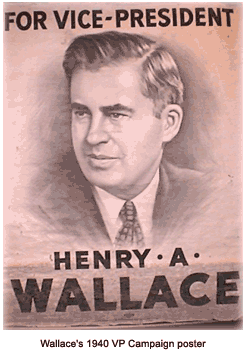
The highest profile figure who articulated an alternative vision for American foreign policy was the politician Henry Wallace, who served as vice president under Franklin D. Roosevelt from 1940-1944 and ran for president in 1948 as the candidate of the Progressive Party.
Although Wallace’s campaign is separated from us by seventy years, his vision for the United States is still there in American’s political DNA. Rather than compromise and accept “progressive” Democrats like Bernie Sanders and Elizabeth Warren, who allude to the great progressive tradition but do not seriously question the military-industrial congressional complex, let alone the corporate and financial interests backing perpetual wars, we must put forth a project to fundamentally transform America’s approach to foreign affairs. It has been done before.
Wallace’s vision for American Foreign Policy
Tremendous efforts have been made to airbrush Henry A. Wallace out of American history, as he was the champion of a left-wing internationalism and egalitarianism that was made political anathema during the Cold War.
As Secretary of Agriculture under Roosevelt, Wallace made the elimination of poverty and a long-term scientific approach to farming, rather than the stock market and corporate profits, his chief concern. After he became vice president in 1940, as Roosevelt was increasingly ill, Wallace promoted a new vision for America’s role in the world that suggested that rather than playing catch up with the imperial powers, the United States should work with partners to establish a new world order that eliminated militarism, colonialism and imperialism.
Wallace gave a speech in 1942 that declared a “Century of the Common Man.” He described a post-war world that offered “freedom from want,” a new order in which ordinary citizens, rather than the rich and powerful, would play a decisive role in politics.
That speech made direct analogy between the Second World War and the Civil War, suggesting that the Second World War was being fought to end economic slavery and to create a more equal society. Wallace demanded that the imperialist powers like Britain and France give up their colonies at the end of the war.
Wallace supported a partnership between the United States and the nations of Latin America. His 1943 tour of the region included unprecedented efforts to engage with ordinary citizens and his thoughtful speeches in Spanish laid out plans for an age of mutual respect and cooperation.
Most significantly, Wallace recognized the contribution of the Soviet Union to the defeat of fascism and envisioned a post-war order in which Washington and Moscow would cooperate to create a better world for ordinary people. That perspective led Harry Truman, following his ascension to the presidency after FDR’s death, to dismiss Wallace as Secretary of Commerce for his efforts to engage the Soviet Union.
Wallace found his own voice in the Progressive Party. No longer weighed down by the Southern segregationists of the Democratic Party he further developed the “New Bill of Rights” first put forth by FDR in his 1944 State of the Union Address, which declared that the “political rights” guaranteed by the Constitution were “inadequate to assure us equality in the pursuit of happiness” because they did not address structural inequalities of the economy. Wallace fleshed out this platform, demanding full employment, adequate food, clothing and leisure time, farmers’ rights to a fair income, freedom from unfair competition
and monopolies and the right to adequate housing, medical care, social security and education for all Americans.
In diplomacy, Wallace imagined a multi-polar world founded on the United Nations Charter with a focus on peaceful cooperation. In contrast, in 1941 Henry Luce, publisher of Time Magazine, had called for an ‘American century,’ suggesting that victory in war would allow the United States to “exert upon the world the full impact of our influence, for such purposes as we see fit and by such means as we see fit.”
Wallace responded to Luce with a demand to create a world in which “no nation will have the God-given right to exploit other nations. Older nations will have the privilege to help younger nations get started on the path to industrialization, but there must be neither military nor economic imperialism.” Wallace took the New Deal global. His foreign policy was to be based on non-interference in the internal affairs of other countries and mutual respect for each other’s territorial integrity and sovereignty.
Wallace was replaced by Truman as VP for FDR’s fourth term in office. If Wallace had been the VP in 1944 and 2nd in line to the presidency, the course of American foreign policy might have followed a quite different path than it eventually did. He was immensely popular and had he assumed the presidency would have carried on the New Deal tradition both domestically and internationally. He would not have assumed that the Soviet Union and the Chinese Communist Party were threats, but rather partners in creating a world order founded on economic justice.
Sadly, since then, despite occasional efforts to head in a new direction, the core constituency for US foreign policy has been corporations, rather than the “common man” either in the United States, or the other nations of the world, and United States foreign relations have been dominated by interference in the political affairs of other nations. As a result the military was transformed from an “arsenal for democracy” during the Second World War into a defender of privilege at home and abroad afterwards.
Foreign aid for Wallace was not a tool to foster economic dominance as it was to become, but rather “economic assistance without political conditions to further the independent economic development of the Latin American and Caribbean countries.” He held high “the principle of self-determination for the peoples of Africa, Asia, the West Indies, and other colonial areas.” He saw the key policy for the United States to be based on “the principles of non-interference in the internal affairs of other nations and acceptance of the right of peoples to choose their own form of government and economic system.”
But the United States was ultimately seduced by the glory of taking over the British imperial mantle. The Progressive Party and the American Communist Party were subject to unrelenting attacks as US politicians increasingly used Roosevelt’s anti-fascist rhetoric to justify blatantly imperialist coups and colonial wars in East Asia, Iran, Central America, Africa, and later in Vietnam, in such a hypocritical manner that the scope for political debate became so circumscribed and delimited as to drive many self-respecting intellectuals out of the political mainstream.
What does Wallace mean for us today?
We find ourselves today facing political dangers equivalent to those faced by Wallace in 1941, with the rise of fascistic forces, at home and abroad, combined with a continued drive to make the military the primary engine for endless growth. We see dissentious politicians like Bernie Sanders and Elizabeth Warren trying to channel progressivism into a soft neo-liberalism, but refusing to address the contradiction between their ideals of social and economic justice and the reality that a coterie of international investment bankers, and a class of corporatist and financial billionaires, dominate the US economy and pursue an agenda of war preparations and global hegemony for their own narrow pecuniary interests.
“Progressive” icons like Sanders and Warren seem incapable of even questioning why the US has over 700 military bases around the world and uses the tax dollars of working class Americans to promote a petroleum economy that benefits US oligarchs and their allies in Israel and Saudi Arabia, let alone calling for the troops to be brought home.
Under successive administrations, culminating with the Trump presidency, the US ruling elite labels all nations capable of opposing them, such as Russia, Iran and China, as authoritarian, a new buzzword similar to the one-size-fits-all label of communist used to dismiss domestic and foreign critics during the Cold War.
All the progressives in the Democratic Party accept this argument and are incapable of presenting a vision of a United States which spends its resources to promote peace, rather than war. Nor can they question the assumption that the stock market is essential to the US economy, and that growth is the primary indicator of national well-being, let alone point out how military spending underlies both.
Wallace’s legacy suggests that it is possible to put forth a vision of an honest internationalism in US foreign policy that is in essence American. His approach was proactive not reactive. It would go far beyond anything Democrats propose today, who can only suggest that the United States should not start an unprovoked war with Iran or North Korea, but who embrace sanctions and propagandist reports that demonize those countries.
Rather than ridiculing Trump’s overtures to North Korea, they should go further to reduce tensions between the North and the South by pushing for the eventual withdrawal of troops from South Korea and Japan (a position fully in line with Wallace and many other politicians of that age).
Rather than demonizing and isolating Russia (as a means to score political points against Trump), progressives should call for a real détente, that recognizes Russia’s core interests, proposes that NATO withdraw troops from Russia’s borders, ends sanctions and reintegrates Russia into the greater European economy. They could even call for an end to NATO and the perpetuation of the dangerous global rift between East and West that it perpetuates.
Rather than attempt to thwart China’s rise, and attack Trump for not punishing it enough, progressives should seek to create new synergies between China and the US economically, politically and socioculturally.
Is China a future enemy, or a model for the road not taken?
Central to the rhetoric of the Democratic Party and the progressives within it, is the alleged China threat. They attack President Trump from the right, demanding that he properly punish China for its supposed trade violations which are the inevitable product of a maturing economy. They interfere in China’s internal affairs by weaponizing “human rights” in order to stigmatize and demonize it, although China does not reciprocate by focusing on the multitude of human rights violations in the US. They are all on board with treating China as a military threat even though it is the United States that continually invades one country after another. The People’s Republic of China has not had a single military conflict since a short border war with Vietnam in 1979 that did not question the legitimacy of the Vietnamese to self-determination.
What we see in the criticism of China by the Republicans and Democrats is “psychological projection,” a process whereby one’s own unethical actions and behaviors are projected onto another as a means of displacing anxiety about misdeeds that they themselves refuse to consciously address.
It seems that we excuse our own transgressions as policy “mistakes” or faulty execution, absolving ourselves of the responsibility for millions of deaths, countless injuries, the destruction of whole nations, and the creation of millions of refugees resulting from preemptive war and “humanitarian intervention,” but we only hold accountable other nations for their slightest transgressions against the “international rule of law” that the US interprets for the entire world. The dictum has become what is best for the US is best for the world.
China has been singled out as the bête noire of our geopolitical nightmares upon which are projected the authoritarianism and military aggression which the United States is actually carrying out at home and around the world. The reason is simple: the People’s Republic of China is not simply an economic or technological competitor, but much more seriously offers an alternative paradigm in international relations that draws into question US prerogatives. China represents for the Washington establishment the “path not taken” that was offered by Wallace at the end of World War II.
Chinese foreign policy programs like the Belt and Road Initiative (BRI) are interpreted as an existential threat to the status quo because the United States is slipping rapidly into imperial collapse and can no longer rally its economic and military might to cover up its lack of legitimacy.
While the United States builds real concentration camps aimed at specific minorities (whether the internment camps for indigenous Americans fleeing from failed nations of Central America or the privatized prison industrial system of mass incarceration which puts people of color back into slavery), American newspapers are filled with hyperbolic articles about Chinese vocational camps for Uyghurs, replete with unverified hearsay accounts of abuses which pale in comparison to the real abuses suffered by millions in the outposts of Gulag Americana.
In contrast to the US policy of perpetual war and “destroying nations in order to save them,” China’s BRI proposes an open plan for development that is not grounded in the models of French and British imperialism. It has proposed global infrastructure and science projects that include participants from nations in Africa, Asia, South and Central America previously ignored by American and European elites—much as Wallace proposed an equal engagement with Latin America. When offering developmental aid and investment China does not demand that free market principles be adopted or that the public sector be privatized and opened up for global investment banks to ravish.
China’s campaign for a “Community of Common Destiny” launched in 2017 harkens back to the roots of the United Nations as an institution for cooperation based on the principles of peace and mutual development along the lines of Wallace’s vision.
Interestingly, the Chinese economy today resembles that of the United States in 1948 more than the bloated and privatized beast that the US has since become. China encourages market relations, entrepreneurship and private initiative, but insists on strict government regulation of finance and keeps other critical fields like energy, transportation and communications under carefully regulated public monopolies.
The United States should be emulating China, its Belt and Road Initiative and Community of Common Destiny, as a means of revitalizing its political culture and kicking its addiction to a neo-colonial concept of economic development and growth. Rather than relying on militarization and its attendant wars to spark the economy, progressives should demand that the US work in conjunction with nations such as China and Russia in building a sustainable future rather than creating one failed state after another. Learning from China does not mean “eating with chopsticks.” It means returning to our New Deal roots not only domestically but overseas as well.
Conclusion
Compared with the original progressives of 1948, today’s crop sound more like the cold warrior Harry S Truman. We have to face the fact that the abandonment of the New Deal foreign policy and the choice of perpetual war as stimulus is what has brought us to the brink of economic and political disaster. The policy of “Guns and Butter” that worked in 1950s-70s has been downsized to “Guns without Butter” from the 1980s onward as the military has only increased its grip on our society.
Although the names may have changed, the strategy of domestic retrenchment, foreign intervention, anti-communism (now anti-authoritarianism) and global hegemony have held sway ever since.
Ironically, the principles of non-intervention, the promotion of mutually beneficial economic relations and the right of each nation to choose their own form of government and economic system espoused by the Progressive Party in 1948 was then enunciated at the Bandung Conference of Non-Aligned Nations in 1955 and has gone on to be the policy of the People’s Republic of China, and other nations that seek an alternative to the prevailing G-7 world order.
Unfortunately, the current progressives have eschewed that legacy, opting rather to sugarcoat neo-liberal policies like weaponized “human rights” policy and the practice of “humanitarian intervention.”
The concern with “human rights,” “development aid” and “humanitarianism” articulated in earnest in the 1940s has become a total travesty. The only political rights the US promotes are those of the compradores vying for power and fortune in countries the US hopes to control.
By contrast, the human rights that Wallace spoke of, peace, security, health care, education and economic development, are given short shrift, if they are considered at all. US promotion of human rights today is a code word for destabilization operations in countries it has targeted for regime change. More often than not, US “humanitarian intervention” in places like Libya or Syria has led to humanitarian catastrophes, the creation of failed states and millions of displaced people and refugees.
We have to ask whether those carrying the debased label of “progressive” today, like Bernie Sanders or Elizabeth Warren, would be any better than Hillary Clinton if they were elected.
Absolutely not!
They are just the same old neo-liberal human rights warriors who march to the orders of the corporate elite. You can put lipstick on a pig but it is still a pig. As inspiring as their speeches may sound to the uninformed, they are quick to defame, and to conspire against, any country that even hints at a new global consensus based on equality and mutual benefit.
Although Trump’s bluff and bluster will not save the US from catastrophe, he has inadvertently opened the door for a fundamental reassessment of US foreign affairs and its destructive contradictions.
We can revive the true progressive creed of Henry Wallace, that advocated for “the principles of non-interference in the internal affairs of other nations and acceptance of the right of peoples to choose their own form of government and economic system.” Then, and only then, does the US have a chance to create a more peaceful and more secure world which is dedicated, in word and in deed, to creating the conditions for all its people to thrive and prosper.
Following Wallace’s legacy, we must demand that our government end its imperialist policies of regime change, militarism and economic warfare in a definitive manner. Only then will we be able to work together with China, and other nations, to build a better world.
*
Note to readers: please click the share buttons above or below. Forward this article to your email lists. Crosspost on your blog site, internet forums. etc.
Dennis Etler holds a doctorate in anthropology from the University of California, Berkley. He conducted archaeological and anthropological research in China throughout the 1980s and 1990s and taught at the college and university level for over 35 years.
The original source of this article is Global Research
https://www.globalresearch.ca/henry-wallaces-internationalism-path-american-foreign-policy-could-have-taken-still-can/5683683
JUST NEWS published this article following the Creative Commons rule. If you don't want your article to appear in this blog email me and I will remove it asap.