Showing posts with label Drone War. Show all posts

Monday, June 10, 2019

The Danger of Armed Drones: Targeted Killings


Global Research, June 10, 2019


The use of armed drones is presented as a ‘risk-free’ solution to security problems. Through using remotely-controlled aircraft to take out bad guys far away from our shores, we are told, we are keeping the public as well as our armed forces safe. The reality, however, is that drones are liable to increase insecurity, not reduce it.
Lowering the threshold for the use of force
Politicians know that the public do not like to see young men and women sent overseas to fight in wars which often have remote and unclear aims.  Potential TV footage of grieving families awaiting funeral corteges has been a definite restraint on political leaders weighing up the option of military intervention. Take away that potential political cost, however, by using unmanned systems, and it makes it much easier – perhaps too easy –  for politicians to opt for a quick, short-term ‘fix’ of ‘taking out the bad guys’ rather than engaging in the often difficult and long-term work of solving the root causes of conflicts through diplomatic and political means.
Transferring the risk and cost of war from soldiers to civilians
Keeping ‘our boys’ safe through using remotely-controlled drones to launch air strikes comes at a price. Without ‘boots on the ground’ air strikes are inherently more dangerous for civilians on the ground. Despite claims of the defence industry and advocates of drone warfare, it is simply not possible to know precisely what is happening on the ground from thousands of miles away.  While the UK claims, for example, that only one civilian was killed in the thousands of British air and drone strikes in Iraq and Syria, journalist and casualty recording organisations have reported thousands of deaths in Coalition airstrikes.
It is also hard not to connect the awful terrorist attacks that have taken place here in the UK and in Europe to these military interventions. While the public as well as senior military and security officials understand that there is a clear link between military intervention and terror attacks at home, politicians continue to baulk at the connection. The reality though, as Air Marshall Greg Bagwell argued told us
“When you have an asymmetric advantage, enemies seek to find a way around it, and that is what terrorism is.  There is a danger that you shift the way an enemy target you and looks for vulnerabilities, and that is where we find ourselves.”
Expanding the use of ‘targeted killing’
Perhaps the most controversial aspect of armed drones has been their use by the United States, Israel and the UK for targeted killing.  Legal scholars define targeted killing as the deliberate, premeditated killing of selected individuals by a state who are not in their custody.  Where International Humanitarian Law (the Laws of War) applies, targeted killing of combatants may be legal. Outside of IHL situations, International Human Rights Law applies and lethal force may only be used when absolutely necessary to save human life that is in imminent danger.  This does not appear to be the case for many of the drone targeted killing that have been carried out, for example, by the US in Pakistan and Yemen.
While some argue that it is the policy of targeted killing that is wrong, not the weapon used to carry out it out, it is very difficult to imagine that the wholesale expansion of targeted killing would have occurred without the technology.  In the UK, campaigners have long been calling on the government to set out its policy on the use of armed drones outside a situation of armed conflict, something the government has so far refused to do.
Enabling video-game warfare
Separate, but connected to the idea that drones lower the threshold for using lethal forces is the notion, as Philip Alston the former Special Rapporteur on extra judicial killing, put it of the ‘PlayStation mentality’.  Alston and others suggest that the vast physical distance between those operating armed drones and the target makes that act of killing much easier. The physical distance induces a kind of psychological ‘distancing’.
There are strong objections to this notion, particular by those involved. Drone pilots, it is argued, are highly trained professionals that are able to distinguish between a video games and real life. Furthermore, it is widely reported that some drone pilots are suffering from post-traumatic stress from having to see the results of their strikes, hardly an indication of detachment.  On the other hand, there is some evidence for a ‘PlayStation’ mentality. In 2010 an Afghan convoy of vehicles was hit by an US airstrike involving drones in which 23 civilians were killed. A subsequent USAF investigation found that the Predator crew wanted to attack and “ignored or downplayed” evidence suggesting the convoy was not a hostile target.  Elsewhere, in Dr Peter Lee’s recent book, Reaper Force, containing detailed interviews with British RAF Reaper crews, several talked about missions where they became fixated on a target and were ready to strike despite the presence of civilians. Only direct intervention from others meant the strikes did not take place.
Seducing us with the myth of ‘precision’
Drones permit, we are told, pin-point accurate air strikes that kill the target while leaving the innocent untouched. Drone advocates seduce us with the notion that we can achieve control over the chaos of war through technology.  The reality is that there is no such thing as a guaranteed accurate airstrike  While laser-guided weapons are without doubt much more accurate than they were even 20 or 30 years ago, the myth of guaranteed precision is just that, a myth.  Even under test conditions, only 50% of weapons are expected to hit within their ‘circular error of probability’. Once the blast radius of weapons is taken into account and indeed how such systems can be affected by things such as the weather, it is clear that ‘precision’ cannot by any means be assured.
Politicians and defence officials too have been seduced by the myth of precision war and are opening up areas that would previously been out of bounds – due to the presence of civilians – to air strikes.  Perhaps most telling, internal military data which counters the prevailing narrative that drones are better than traditional piloted aircraft is simply classified.
Ushering in permanent war
Perhaps the most dangerous aspect of the rise of remote, drone warfare is that it is ushering in a state of permanent/forever war.  With no (or very few) troops deployed on the ground and when air strikes can be carried out with impunity by drone operators who then commute home at the end of the day, there is little public or political pressure to bring interventions to an end.
Drones are enabling states to carry out attacks with seemingly little reference to international law norms. US law professor Rosa Brooks argued in a disturbing article in Foreign Policy that ‘there’s no such thing as peacetime’ anymore. “Since 9/11,” she writes “it has become virtually impossible to draw a clear distinction between war and not-war.” Rather than challenging the erosion of the boundaries between crucially distinct legal frameworks, Brooks argues that we must simply accept that “the Forever War is here to stay.” To do otherwise she maintains is “largely a waste of time and energy. “Wartime is the only time we have” she insists.
The slide towards forever war must be rejected and resisted. It is incumbent on us all, citizen, politician, military officer, to work towards global peace and security, not permanent warfare.
*
Note to readers: please click the share buttons above or below. Forward this article to your email lists. Crosspost on your blog site, internet forums. etc.
All images in this article are from Drone Wars


https://www.globalresearch.ca/danger-drones/5680089


JUST NEWS published this article following the Creative Commons rule. If you don't want your article to appear in this blog email me and I will remove it asap.

Tuesday, February 19, 2019

American-Style Drone Warfare and How and When Humans Count


Global Research, February 19, 2019

Bracing Views 6 February 2019


When do humans count in drone warfare, and when do they not?
I thought of this question as I read Christopher Fuller’s “See It/Shoot It: The Secret History of the CIA’s Lethal Drone Program.”  Revealingly, U.S. pilots and crews who operate these drones, such as Predators and Reapers, reject the terminology of “drones” and UAV (unmanned aerial vehicle) or UAS (unmanned aerial system).  They prefer the term RPA, or remotely piloted aircraft.  They want to be known as the essential humans in the loop, they want to stand out, they want to count for something, and in fact the Department of Defense at various times has suggested a new “drone medal” to recognize their service.
Whereas American pilots want to stand up and be recognized as the pilots of their “remote aircraft,” the Pentagon doesn’t want to think about the targets of these drones as human beings. Civilian casualties are grouped and shrouded under the term “collateral damage,” a nasty euphemism that combines a banking term (collateral) with the concept of damage that hints at reversibility and repair.  But collateral damage really means innocents blown up and blasted by missiles.  Shouldn’t these humans count?
Another term that Fuller discusses is “neutralization.”  The U.S. counterterrorism goal is to “neutralize” opponents, meaning, as Fuller notes, “killing, rendition, and imprisonment.”  Again, with a word like neutralization, we’re not encouraged to think of those being attacked as humans.  We’re just “neutralizing” a threat, right?  A terrorist, not a fellow human being.  Right?
Interestingly, the whole idea of terrorism is something they do, not us.  Why?  Because the U.S. defines terrorism as “premeditated, politically motivated violence perpetrated against noncombatant targets by subnational groups or clandestine agents.”  Note that word: subnational.  By this definition, nations do not commit terrorism, which is handy for the U.S., which presents its drone attacks as defensive or proactive or preemptive.
Finally, the Pentagon and the CIA are at pains to assert they take the utmost care in reducing “collateral damage” in their “neutralization” efforts.  Yet as Fuller notes in his book (page 214), “the U.S. government did not always know the identity or affiliations of those killed in its drone strikes.”
So who counts, and who doesn’t?  Whose humanity is to be celebrated (pilots of RPAs?), and whose humanity (innocent victims) is to be suppressed?
*
Note to readers: please click the share buttons below. Forward this article to your email lists. Crosspost on your blog site, internet forums. etc.
Featured image is from Bracing Views


https://www.globalresearch.ca/american-style-drone-warfare-and-how-and-when-humans-count/5669087


JUST NEWS published this article following the Creative Commons rule. If you don't want your article to appear in this blog email me and I will remove it asap.

Tuesday, February 12, 2019

Britain’s Air and Drone War in Syria


Latest Freedom of Information Release from Ministry of Defence (MoD)


Global Research, February 13, 2019

Drone Wars UK 11 February 2019


The rise in UK air and drone strikes in Syria since September 2018 has been laid bare in the MoD’s latest responses to a Drone Wars UK FoI request.
The number of British strikes in Syria per month rose to its highest ever amount (75) in December 2018.
.
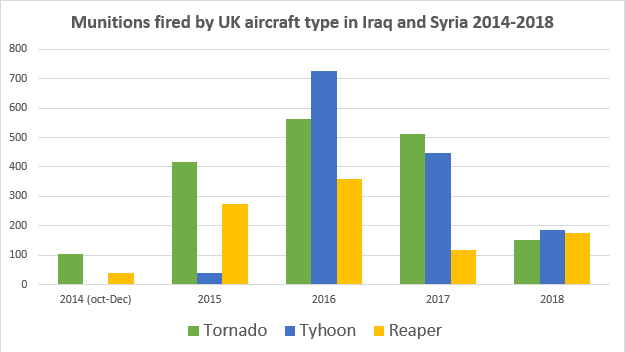
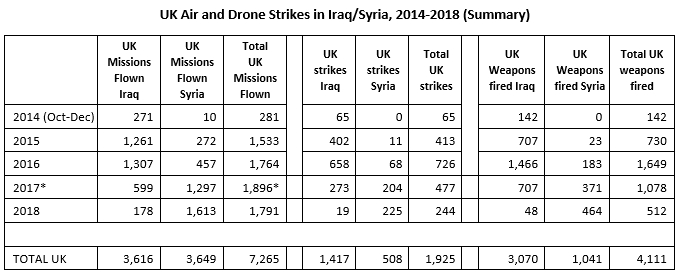
Overall, the UK launched 244 air and drone strikes in Iraq and Syria during 2018, firing 512 munitions. Between 2014 and the end of 2018, the UK has fired more than 4,100 missiles and bombs in a total of 1,925 strikes against ISIS in Iraq and Syria.  You can see the details on our stats page here.
In 2018, for the first time, more UK weapons were fired in Syria than in Iraq – in fact almost 10 times more (464 in Syria, 48 in Iraq).  While UK aircraft continue to fly in Iraq, 90% of UK missions occurred in Syria.
UK Reaper drones continued to operate in both Iraq and Syria during 2018, however there were no UK drone strikes in Iraq.  While the MoD continues to insist that its drones are primarily for intelligence and surveillance operations, Reapers fired more weapons in 2018 than the UK’s dedicated strike aircraft, the Tornado, and almost as many as Typhoons.  27% of UK strikes were carried out by drones during 2018. Overall, a quarter of all British air strikes against ISIS have been carried out by drones.
Although ISIS has been virtually defeated as a military force in Iraq and Syria, with its territory reduced to a few square miles in the Euphrates Valley (indeed this weekend the final battle is reported to have begun) UK Ministers and defence officials insists that UK strikes will continue until the group is absolutely and totally defeated. This though other nations are withdrawing their forces and senior UK commanders acknowledge that ISIS is no longer a credible military force.  While the UK’s Tornado’s have been withdrawn, UK drones and Typhoons will continue to launch strikes.  In the case of British Reaper drones, that’s approaching 12 years of continuously launching strikes.
*
Note to readers: please click the share buttons below. Forward this article to your email lists. Crosspost on your blog site, internet forums. etc.


https://www.globalresearch.ca/britains-air-and-drone-war-in-syria/5668351


JUST NEWS published this article following the Creative Commons rule. If you don't want your article to appear in this blog email me and I will remove it asap.

Monday, November 26, 2018

Drone Warfare: Should We Focus on Autonomous Weapons Or the Remote “Human Agencies” Directing Them?


Global Research, November 26, 2018
Drone Warfare 25 November 2018


In a Guardian article, Jamie Doward points out that though the government insists it “does not possess fully autonomous weapons and has no intention of developing them”, since 2015, the UK has declined to support proposals put forward at the UN to ban them.
Israel Defense summarises:
”The report maps out the agencies, laboratories, and contractors undertaking research into drones and autonomous weapon technology in support of the Ministry of Defence, examines the risks arising from the weaponization of such technologies, and assesses government policy in this area”.
“We have already seen the development of drones in Britain which have advanced autonomous capabilities, such as the Taranis stealth drone developed by BAE Systems, and the development of a truly autonomous lethal drone in the foreseeable future is now a real possibility,” Burt said.
A spokesman for the MoD said:
“There is no intent within the MOD to develop weapon systems that operate entirely without human input. Our weapons will always be under human control as an absolute guarantee of oversight, authority and accountability.”
The BBC reported in November that at least 6,660 Yemeni civilians have been killed and 10,560 injured in the fighting, according to the United Nations.
It is hard to imagine fully autonomous weapons inflicting much more death and destruction than current technology under human control.
*
Note to readers: please click the share buttons above. Forward this article to your email lists. Crosspost on your blog site, internet forums. etc.
Featured image is from Drone Warfare


https://www.globalresearch.ca/drone-warfare-should-we-focus-on-autonomous-weapons-or-the-remote-human-agencies-directing-them/5661040


JUST NEWS published this article following the Creative Commons rule. If you don't want your article to appear in this blog email me and I will remove it asap.
Friday, October 5, 2018

Imran Khan: “American Drone Strikes in Pakistan Must Stop. It’s Butchery, and the True Horror of It Is Hidden From the West”


Global Research, October 05, 2018

Drone Warfare 4 October 2018


Since 2004, the US government has attacked thousands of targets in tribal areas along the Afghan border in Northwest Pakistan. It used unmanned aerial vehicles operated by the US Air Force under the operational control of the CIA’s Special Activities Division. Attacks increased substantially under Bush’s successor, Nobel Peace Prize winner, Barack Obama.
A non-violent campaign in Pakistan against drone strikes by the Tehreek-e-Insaf party, led byImran Khan, involved blocking the route to pressure Washington to stop targeting armed groups in the region bordering Afghanistan. NATO supply containers to and from Afghanistan via Khyber Pakhtunkhwa were stopped at border points until US drone attacks stop and a formal apology was later given to the government for the killings in Pakistan. It ended in 2014.
Imran Khan attacks those countrymen who support NATO’s war on the Taliban:
*“They have absolutely no idea. They sit in the drawing room. They read the English-language newspapers, which bear very little resemblance to what is real Pakistan. I promise you, they would be lost in our villages . . .
Khan believes the US are responsible for the rise of the Pakistani Taliban, allies of the Afghan Taliban.
“We ended up sending our army into our tribal areas at the request of the Americans. And our areas got devastated. We had, more or less, a civil-war situation there. The aid was minuscule compared to the loss of billions and billions and the blood our country spilt.”
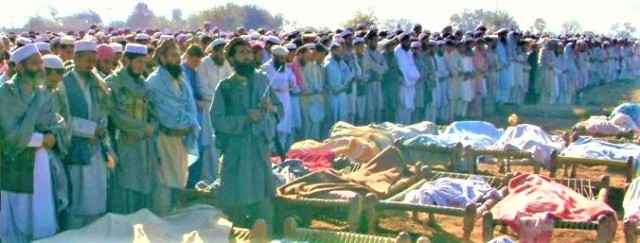
A leaked document confirmed that 81 civilians including children died in this 2006 CIA drone strike
He adheres to the Sufi tradition of egalitarianism and the acceptance of all creeds and beliefs in society and believes:
“All terrorism is politics. All this nonsense of religious terrorism. There’s no such thing as religious terrorism. It’s politics behind it. The political injustice. Perceived injustice is why people pick up arms — throughout history.”
*
Note to readers: please click the share buttons above. Forward this article to your email lists. Crosspost on your blog site, internet forums. etc.
Note
*Direct quotations from a hostile account in the Times
Images in this article are from Drone Warfare.


https://www.globalresearch.ca/imran-khan-american-drone-strikes-in-pakistan-must-stop-its-butchery-and-the-true-horror-of-it-is-hidden-from-the-west/5656223

JUST NEWS published this article following the Creative Commons rule. If you don't want your article to appear in this blog email me and I will remove it asap.