Showing posts with label Australia. Show all posts

Wednesday, August 21, 2019

Australian Investigative Journalist Exposes Mainstream Media Betrayal of Assange


Global Research, August 21, 2019

World Socialist Web Site 10 August 2019


At a Sydney “Politics in the Pub” meeting on Thursday night, award-winning Australian journalist Mark Davis revealed new first-hand information exposing the extent of the betrayal of Julian Assange by the Guardian and the New York Times, and refuting the lies both publications have used to smear the WikiLeaks founder.
Davis recounted his experiences documenting Assange’s life in the first half of 2010 for programs screened on the Australia’s Special Broadcasting Service (SBS). Using excerpts from the documentary “Inside WikiLeaks,” the journalist explained that he was present when WikiLeaks worked closely with media partners, including the Guardian and the New York Times, in the publication of the Afghan War logs.
The documents, leaked by the courageous whistleblower Chelsea Manning, comprised 90,000 incident and intelligence reports from the US military, between January 2004 and December 2009. They documented at least 200 civilian deaths at the hands of US and allied forces that had previously been hidden from the public, along with clear evidence of war crimes, including the existence of a secret “black unit” within the US military, tasked with carrying out illegal assassinations.
Davis said the assertions by Guardian journalists that Assange exhibited a callous attitude towards US informants and others who may have been harmed by the publication of the document were “lies.”
David Leigh and Nick Davies, senior Guardian journalists, who worked closely with Assange in the publication of the logs, have repeatedly claimed that Assange was indifferent to the consequences of the publication.
Their statements have played a key role in the attempts by the corporate media to smear Assange, and dovetail with US government claims that the 2010 publications “aided the enemy.” In reality, the US and Australian militaries have been compelled to admit that release of the Afghan war logs did not result in a single individual coming to physical harm.
Davis explained that he was present in “the bunker,” a room established by the Guardian to prepare the publication of the documents.
“Nick Davies made the most recurring, repetitive statement that Julian had a cavalier attitude to life. It’s a complete lie. If there was any cavalier attitude, it was the Guardian journalists. They had disdain for the impact of this material.”
The Guardian journalists, Davis added, had frequently engaged in “gallows humour,” but that Assange had not.
Significantly, Davis explained that despite the vast technical resources of the Guardian and the New York Times (NYT), it was left to Assange to personally redact the names of informants and other individuals from the war logs, less than three days before scheduled publication. Davis said Assange was compelled to work through an entire night, during which he removed some 10,000 names from the documents.
“Julian wanted to take the names out,” Davis said. “He asked for the releases to be delayed.” The request was rejected by the Guardian, “so Julian was left with the task of cleansing the documents. Julian removed 10,000 names by himself, not the Guardian.”
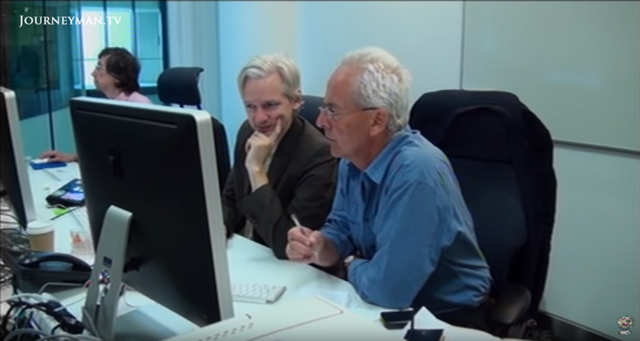
Assange in the Guardian “bunker” alongside Nick Davies [Credit: Journeyman Pictures, “Inside WikiLeaks”]
Davis refuted the attempts by the Guardian and the Times to downplay their central role in the publication of the leaks. He stated that the relationship between the corporate reporters and Assange was not that between journalists and their source. Rather, both outlets were intimately involved in preparing the publication of the documents.
This included, Davis said, the Guardian assigning a technical division to prepare the entire set of logs in a publishable and searchable format on the WikiLeaks website.
Davis explained that even in 2010, the Guardian and the NYT had employed “subterfuge” to shield them from any legal repercussions over the publication. Despite the explosive contents of the leaks, they had both insisted that WikiLeaks should publish first.
This, Davis stated, would allow them to claim that they were not primary publishers of the material, but were merely reporting material that had been released by WikiLeaks. This was the equivalent of the publications “pushing Julian out to walk the plank,” he said. “Julian’s in jail now because of that subterfuge.”
Tellingly, Davis stated that this plan was disrupted as a result of technical issues on the WikiLeaks website.
The Guardian and the Times nevertheless ran their scheduled stories, reporting on WikiLeaks’ supposed publication of the logs, despite the fact that they had not yet been placed on the WikiLeaks website. WikiLeaks published the documents two days after they had been reported by the corporate publications.
“WikiLeaks did not publish for two days,” Davis said. The Guardian and the Times had “reported a lie. They set Julian up from the start.”
Davis’s claim potentially has significant legal implications. The espionage charges, under which the Trump administration is seeking to extradite Assange to the US and prosecute him, include among their offenses WikiLeaks’ publication of the Afghan war logs.
Davis’ timeline, however, indicates that the Guardian and the New York Times were in fact the initial and primary publishers of the material. These publications, which are pillars of the media and political establishment, are “in the frame” for the supposed offenses that the Trump administration is seeking to prosecute Assange for. As Davis bluntly declared,
“If Julian’s in jail, they should be as well.”
Mary Kostakidis, a well-known Australian journalist and former SBS news anchor, who also spoke at the Sydney event, later tweeted on the significance of Davis’s revelation.
“Why aren’t the Guardian & NYT enjoined in the prosecution? The former used their technical resources to enable WikiLeaks online release, & the NYT published 2 days before WikiLeaks were able to go live with the docs due to a technical glitch,” she wrote.
In her address to “Politics in the Pub,” Kostakidis had declared:
“Julian is being destroyed for revealing war crimes. We need to stand up for his human rights.”
Kostakidis denounced successive Australian governments for refusing to take any action in defence of Assange, and condemned the establishment media for seeking to poison public opinion against him.
In response to a question from the audience about what could done, Professor Stuart Rees, a prominent fighter for civil liberties, who chaired the meeting, concluded that it was necessary to build a “mass movement in the streets” demanding freedom for Assange. This, he said, was the only way in which Australian politicians would be compelled to uphold their obligations to Assange as an Australian citizen and journalist by preventing his extradition to the US and securing his complete liberty.
*
Note to readers: please click the share buttons above or below. Forward this article to your email lists. Crosspost on your blog site, internet forums. etc.
Featured image: Mark Davis addressing Politics in the Pub meeting in Sydney (Source: WSWS)


https://www.globalresearch.ca/australian-investigative-journalist-exposes-guardiannew-york-times-betrayal-assange/5686660


JUST NEWS published this article following the Creative Commons rule. If you don't want your article to appear in this blog email me and I will remove it asap.

Tuesday, July 30, 2019

Militarising Australia: Talisman Sabre and the US Military Build Up


Global Research, July 30, 2019

Deemed the Expeditionary Advanced Base Operations strategy, the military method is a US Marine special, still spanking new, featuring “the amphibious landing of troops on islands for seizure and capture as part of a forward projection of sea and airpower aimed at the mainland.”
That particular description comes from Bevan Ramsden, an active member of the coordinating committee of IPAN, the Independent and Peaceful Australia Network.  IPAN has been decidedly concerned about what it sees, rightly, as an enthusiastic, boisterous build-up of US military forces primarily in the Northern Territory and ambling across the continent and along the shorelines.
The Australian Defence Department adds to Ramsden’s overview in a discussion of Talisman Sabre, a joint US-Australian military exercise conducted since 2007.
“TS19 will be the eighth iteration of the exercise and consists of a Field Training Exercise incorporating force preparation (logistic) activities, amphibious landings, land force manoeuvre, urban operations, air operations, maritime operations and Special Forces activities.”
On this occasion, Talisman Sabre had a new addition: Japan’s 1st Amphibious Rapid Deployment Regiment, which joined in beach landings alongside Australian, US and British forces on July 16.  Australian commander Major General Justin “Jake” Ellwood was notably impressed by the showing.  And a sight it proved to be: some 34,000 troops, 200 planes and 60 naval vessels.
What the Australian Defence Force cannot shy away from is that it remains, ultimately, an annex of the US military machine.  In a report from the Headquarters, Joint Operations Command (HQJOC) from April, an acknowledgement is made that TS19, “is focused on enhancing the readiness and interoperability of ADF Defence elements and exposing participants to a wide spectrum of military capabilities and training experiences.”  It is presumed, and never challenged, that such exercises are “in support of Australia’s national interests” begging the question whether any state should ever be so utterly interoperable with foreign military forces.
The US imperium was keen, using Australian facilities, to test the EABO in scenarios which envisage a concept of island seizure and, in the words of the official website of the US Marines, “distribute lethality by providing land-based options for increasing the number of sensors and shooters beyond the upper limit imposed by the quantity of seagoing platforms available.”  The integration of the Marines into the broader operations of the US Navy is an essential feature of this move.  This would, in turn, deny access to enemy vessels and aircraft, making the target of this clear: any power keen to challenge US power in the Pacific.  As James Lacey, who teaches at the Marine Corps War College suggests,
“the Marines will help ensure that the US Navy retains its freedom of manoeuvre throughout the Pacific, while curtailing China’s ability to get much beyond its littorals.”
What a lovely future confrontation this promises to be.
The TS19 show was also a display of military plumage and provocation. US Marine Colonel Matthew Sieber made the aim of it clear:
“to walk away having strengthened that relationship [between participants] and to demonstrate to our would-be partners or adversaries the strength of that alliance.”
The scale of TS19 has proven hefty, comprising whole swathes of the country.  An important feature of this is not to frighten the locals, who might be put off by the sheer scale of it all.  Do not, for instance, give the impression they are living under the cloud of occupation.
“Welcome,” comes the jolly opening to the Australian Defence Department’s information site, where “you will learn about TS19, the importance of the exercise to preparing out military, how we involve the community and protect the environment.”
The Defence Department leaves us this impression of movement and deployment across the country, and even then, struggles to make the monster innocuous:
“Large convoys will be on the roads from June to August 2019 and includes Australian, US and New Zealand military vehicles travelling from across Australia and converging at Rockhampton and Shoalwater Bay Area.”
To reassure environmental activists and residents, TS19 emphasises a lack of “live fire activities”, something seen as a marked improvement.  In other words, no underwater detonations or demolitions, naval gunnery and aerial bombardment; in place of that, dummy ammunition would be used, with added pyrotechnics to give effect.  But as Friends of the Earth Australia noted in May, this would not be the case at Shoalwater Bay, nor various lead-up or follow on activities.  These “are not assessed as part of Talisman Sabre because they fall outside of the official exercise dates.”  Hair splitting operatives will eventually get to you.
Even since Talisman Sabre became a regular feature of joint Australian-US operations, a nervousness among activist circles has grown.  What, for instance, are the neighbours to think about such displays of force?  The Chinese People’s Liberation Army, for instance, was very keen to monitor TS19 activities with a general intelligence vessel, known as the Type 815.  This was a repeat performance from 2017, when a Type 815 AGI also kept an eye on the Talisman Sabre exercises.
More broadly speaking, protests against the US military juggernaut Down Under remain skimpy, with efforts of resistance confined to conferences intended to raise awareness.  The latest word from Washington is a promise to build more than a quarter of a billion dollars-worth of naval facilities in Darwin and its environs, a move that delights more than alarms.  In 2015, for instance, a solitary stand was made by Justin Tutty off Lee Point, Darwin, a modest effort that led to his arrest.  Two other protestors made their way to the Shoalwater Bay live-firing range in a disruptive effort.  This year, IPAN intends holding a national public conference in Darwin from August 2 to 4 with the theme “Australia at the Crossroads: Time for an independent foreign policy.”  It promises few converts, given the continuing presence of the faithful at such gatherings.
More common, and creepily voyeuristic, is the spectator element of such exercises, the weak-at-the-knee individuals aroused by displays of power.  Ready your deckchairs and chilled chardonnay and observe the proceedings unfold.  That, at least, is how the owners of beach land at Stanage Bay, Ivonne and Fred Burns, saw it.  In the words of Ivonne Burns, “It’s incredible just to watch it all… to see it all happening before your eyes, in your own backyard.” Or not, if Washington’s adventurism gets out of hand, leaving Australia with more than just a bloody nose.
*
Note to readers: please click the share buttons above or below. Forward this article to your email lists. Crosspost on your blog site, internet forums. etc.
Dr. Binoy Kampmark was a Commonwealth Scholar at Selwyn College, Cambridge.  He lectures at RMIT University, Melbourne. He is a frequent contributor to Global Research and Asia-Pacific Research. Email: bkampmark@gmail.com
Featured image: An Australian M1 Abrams tank during Exercise Talisman Sabre 2015 (U.S. Army photo by Spc. Jordan Talbot)

https://www.globalresearch.ca/militarising-australia-talisman-sabre-us-military-build-up/5685028


JUST NEWS published this article following the Creative Commons rule. If you don't want your article to appear in this blog email me and I will remove it asap.

Tuesday, June 25, 2019

The Presence of Foreign Troops in Australia: The US Marines in Darwin


Global Research, June 25, 2019

Subordinates rarely have a good time of dictating matters to their superiors. In the webbed power relations that pass as realpolitik, Australia is the well behaved child in the front of the room, yearning to be caned and spoilt in equal measure.  Ever since Australia’s Prime Minister John Curtin cast his eye to Washington in an act of desperation during the Second World War, fearing defeat at the hands of the Japanese and British abandonment, the United States has maintained its role, a brute to be relied upon, even as it careers into the next disaster.  An underlying rationale since then has been dangerously simple: With the United States, right or wrong, sober or drunk.
An important element in the relationship has been the forced belief that the US has no bases in Australia, preferring the untidy ruse of rotation.  A base implies permanency, garrisons with darkened influences on the local populace, followed by the all-too-predictable requirement for courts martial.  A rotation on exercise suggests a casual visit and a bit of sunny fun.
The US armed forces, as Lieutenant Benjamin Franklin Pinkerton in Puccini’s Madama Butterfly, do this with callous freedom under the broader aegis of the alliance with Canberra, fucking the Oriental subject and departing, having impregnated the host, and propelling her to a despair that eventually kills.  The metaphor carries over for what sounds, promiscuously enough, a classic military strategy: rotation, not occupation; movement, not garrisoned entrenchment.  To that end, it follows that the US does not occupy Australia so much as penetrate it with convenience, use it, and discard if and when needed, all pimp, and occasionally reassuring plunderer.
In 2014, US President Barack Obama fluted his views about the Pacific and the future role of US forces on a visit to Australia, yet another notch on the belt of the imperium’s move into the Asia-Pacific.
“By the end of this decade, a majority of our Navy and Air Force fleets will be based out of the Pacific, because the United States is and always will be a Pacific power.”
In 2015, Admiral Jonathan Greenert did his little Pinkerton expedition to Darwin, hoping to find suitable environs to seed further.   The US, in his words, was “doing a study together with the Australian Defence Force (ADF) to see what might be feasible for naval co-operation in and around Australia which might include basing ships”.  (The horny Lothario must always sound cooperative and consultative.)
new port facility, planned to be situated at the Glyde Point area, has been one part of this potentially dubious harvest.  The intention here is to broaden the scope of naval operations, with the port intended for amphibious war ships, while providing comfort to the rotating marine force.  The Australian Defence Department, as is its wont, refuses to confirm this, telling the country’s national broadcaster that it had, at present “no plans for the development of a new naval facility in the Northern Territory.”  The evidence suggests otherwise, given the completion of the recent $40 million road to Gunn Point, near Glyde Point.  (The road to militarism tends to have good paving.)
A few mutterings are available from the Australian Defence Force.  A spokesman explained, noting additions to the infrastructure, that,
“The [fuel storage] facility will support training and enable enhance cooperation between the Australian Defence Force and the US Marine Corps and US Air Force.”
It has been a touch under a decade since US marines began arriving in Darwin, all part of the Obama administration’s desire to pivot the imperium. In 2018, Washington sent a contingent of 1,500 soldiers as part of the US-Australian force posture agreement, an understanding said to continue till 2040.  The national interest analysis of the agreement reads like an authorising document for occupation, however described.  Weasel assurances are present to give the reader the false impression of Australian independence; there would be, for instance, “respect for Australian sovereignty and the laws of Australia”, the need to agree to consultation “and affirms that the initiatives will occur at Australian facilities, consistent with our long-standing policy that there are no foreign military bases on Australian soil.”
Such a position did not fool Nick Deane of the Independent and Peaceful Australia Network, an organisation that continues to promote the dangers of a continuing US military presence on the continent.
“Having foreign troops on home territory creates a potential breach in any sovereign nation’s defence.  The first criterion of independence has to be the nation’s capacity to look after itself by conducting its own defence.”
The presence of foreign troops should only be countenanced in “the most extreme of situations”. Those had hardly presented themselves, despite the usual psychic pressings posed by a rejigged version of the Yellow Peril.
Groups such as IPAN, along with a few defence contrarians such as Mike Gilligan, argue that Australia simply does not need this added presence for peace of mind, being more than capable of dealing with its own security.
Australia’s problems have been amplified by another player in the crammed boudoir.  The People’s Republic of China is also sniffing, perusing and seeking a foothold.  Darwin’s port was leased to Landbridge Industry Australia, a subsidiary of Shandong Landbridge Group in 2015, which might have been regarded as more than just a tease. Such foreplay did not impress various critics at the time, including the then federal treasurer, Scott Morrison.
“They didn’t tell us about it!” he is noted to have said. “Which Australian city controversially leased their port to a Chinese company in 2015?”
Strategy wonks were baffled; this move on the part of the Northern Territory government did not tally.
It would be convenient to deem the Northern Territory government a convenient whipping boy in this whole business.  Australia, thus far, is proving an erratic courtesan on all fronts, happy to provide coal to Beijing in abundance with a certain amoral confidence but abstinent and circumspect on technology.  (Its directions to remain firm against Beijing from Washington regarding Huawei and 5G are clear enough.)
Canberra is also rebuffing various efforts being made by the PRC in the Pacific.  The Australian heart remains firmly, perhaps suicidally, in Washington’s embrace, but its politics remains scrambled.  Prime Minister Scott Morrison’s recent megaphone tour of the Solomon Islands was meant to be a signal to China that the Pacific remained Canberra’s neighbourhood watch zone and, by virtue of that, a US playground by proxy.  Pinkertonism is a hard thing to shake.
*
Note to readers: please click the share buttons above or below. Forward this article to your email lists. Crosspost on your blog site, internet forums. etc.
Dr. Binoy Kampmark was a Commonwealth Scholar at Selwyn College, Cambridge.  He lectures at RMIT University, Melbourne. He is a frequent contributor to Global Research and Asia-Pacific Research. Email: bkampmark@gmail.com


https://www.globalresearch.ca/pinkerton-effect-us-marines-darwin/5681643

JUST NEWS published this article following the Creative Commons rule. If you don't want your article to appear in this blog email me and I will remove it asap.

Friday, May 31, 2019

Australia’s Suspicion of China’s South Pacific Investments Is a Zero-sum Game


Global Research, May 31, 2019


The mainstream media revived its narrative of fear-mongering about China’s South Pacific investments during the Vanuatu Prime Minister’s visit to Beijing and ahead of the recently re-elected Australian Prime Minister Scott Morrison‘s trip to the Solomon Islands next week. 
There were very serious fake news claims being spread last year about China’s supposed plans to open up a naval base in Vanuatu, which served several interconnected strategic purposes by the irresponsible Australian media outlets that propagated them and continued to fan the flames of anti-Chinese fear-mongering to this day.
The first is that this false reporting attempted to rally the Australian public against what they were made to believe is a looming “yellow threat” in their neighborhood evocative of the one that they last faced in World War II from Imperial Japan, which in turn implied a subconscious sense of urgency in dealing with. The “solution,” as their government led them to believe, was to reaffirm their country’s commitment to the so-called “Quad” that also includes the United States, Japan and India and continue participating in provocative military exercises in the South China Sea.
Furthermore, this massive perception management operation occurred in the run-up to the APEC Summit in nearby Papua New Guinea in last year where Chinese President Xi Jinping was the guest of honor. U.S. Vice President Mike Pence exploited the occasion to criticize China, reinforce the false notions about its regional intentions, and then announce that the U.S. will begin paying more attention to this part of the world. As a result of the anti-Chinese fear-mongering, Australia passed a “foreign agents” law in June 2018 that many observers believe was modeled off of the American one and aimed against Beijing.
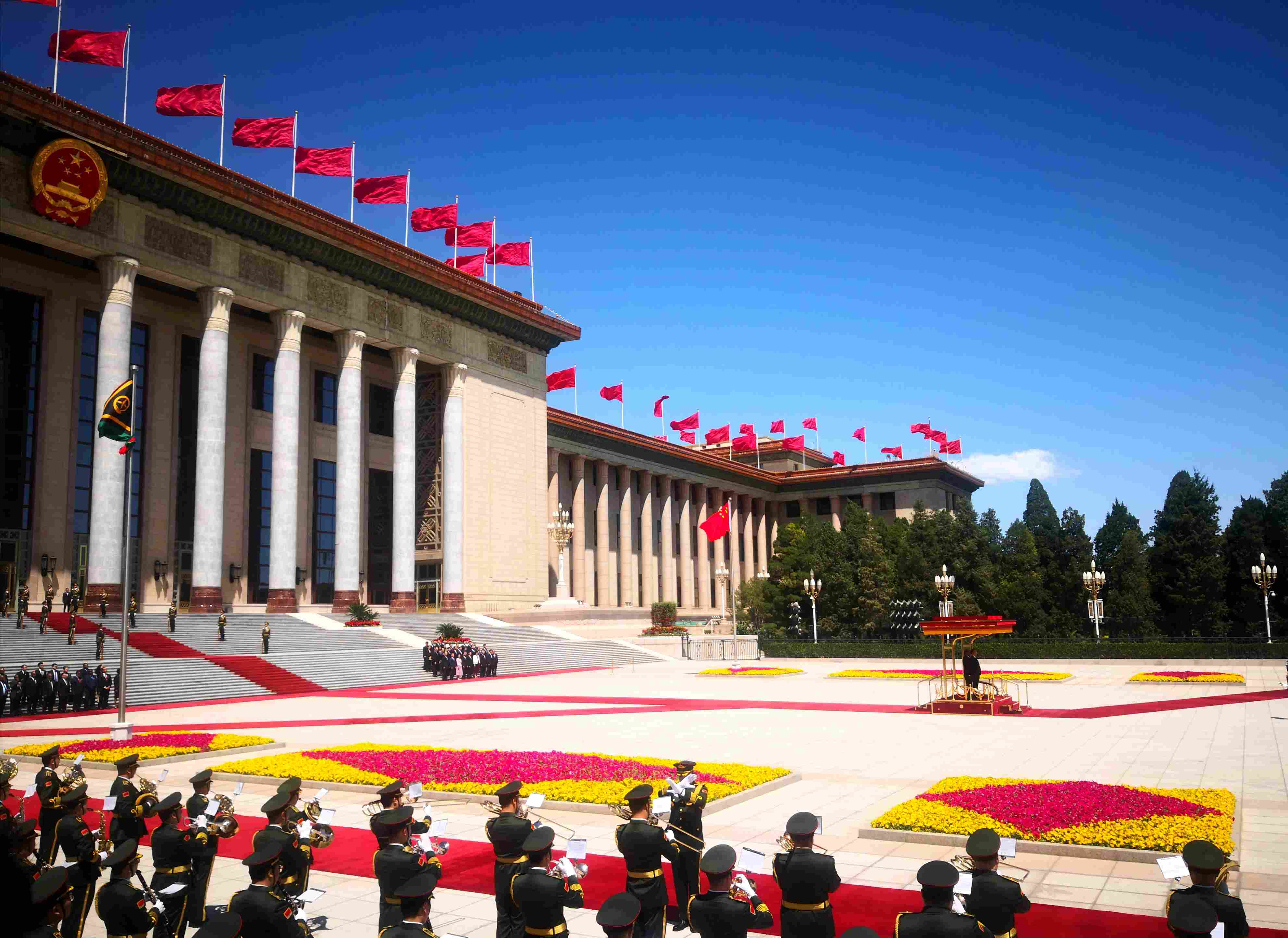
Chinese Premier Li Keqiang holds a welcoming ceremony for Vanuatuan Prime Minister Charlot Salwai at the Great Hall of the People before their talks in Beijing, May 27, 2019. /CGTN Photo
After a brief hiatus during the election season, Australian media is at it once again by framing Prime Minister Morrison’s upcoming visit to the Solomon Islands in the zero-sum perspective of “containing” China. This was the dog whistle for the country’s mainstream media partners all across the world to revive this narrative as well, which is important being brought back to life just a month before the G20 Summit in Japan. An obvious pattern seems to be emerging, and it’s that the so-called “China threat” to the South Pacific is brought up ahead of significant summits in the Asia-Pacific region.
The problem with this “reporting” isn’t just that it’s an inaccurate portrayal of reality, but that it actually does a disservice to the countries propagating it by overlooking their own regional policy shortcomings that created the opportunity for China’s robust outreaches to the South Pacific.
Australia, as the historic hegemon in this space, has long neglected the many underdeveloped and extremely impoverished nations around its maritime periphery, leaving their basic humanitarian and infrastructural needs unmet and therefore causing them to look elsewhere for support. It was in this context that China’s Belt and Road Initiative (BRI) became very attractive.
China has no intention of monopolizing the South Pacific marketplace, let alone of building naval bases in these far-flung islands, but the mainstream media-crafted perception that it is useful for Australian decision makers and their American allies because it provides the pretext for them to engage with the region in a zero-sum competitive sense more assertively. Instead of working together with China to improve the developmental potential of the South Pacific people, Australia and the U.S. seem dead-set on doing whatever is needed to diminish the economic footprint of China there.
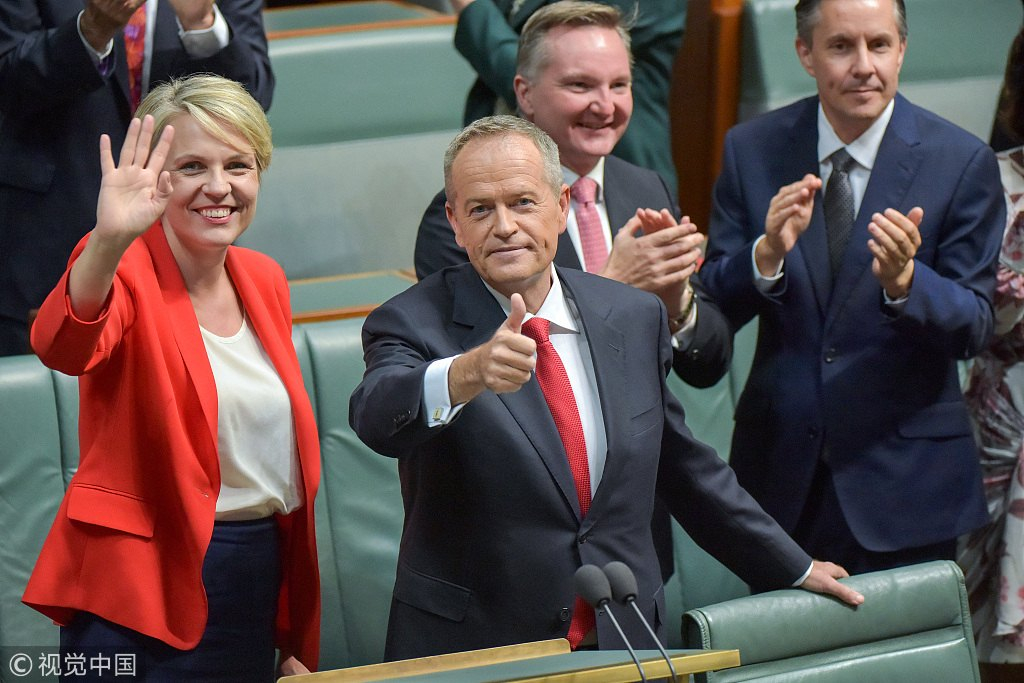
Bill Shorten (C), leader of Australia Labor Party, at the end of a budget reply speech in the House of Representatives at Parliament House in Canberra, Australian Capital Territory, Australia, April 4, 2019. /VCG Photo‍
These intentions are very worrying because the U.S. has already shown what it has in mind when it’s acted this way regarding what it perceives to be Russian and Iranian influence in Europe and the Mideast respectively. The modus operandi is usually to put different forms of pressure on targeted countries in a desperate bid to compel them to distance themselves from those two powers.
The end result is that the country in question is oftentimes forced to make a false choice between its partners, which makes the U.S. claims that its rivals are trying to establish their own “spheres of influence” a hypocritical self-fulfilling prophecy.
In reality and as proven through the U.S. modus operandi, it’s actually the U.S. that’s actively trying to do this and not others, all in pursuit of its zero-sum unipolar interests at Russia, Iran, and China’s collective multipolar expense.
While all countries have the right to have as many partners as they’d like, especially the South Pacific states which are in urgent need of developmental ones, it would be best if everyone cooperates with one another and coordinates their efforts instead of fiercely competing like the U.S. wants to have happened. Should that occur, then the South Pacific could become a zone of friendship among the U.S., China and Australia.
*
Note to readers: please click the share buttons above or below. Forward this article to your email lists. Crosspost on your blog site, internet forums. etc.
This article was originally published on CGTN.
Andrew Korybko is an American Moscow-based political analyst specializing in the relationship between the US strategy in Afro-Eurasia, China’s One Belt One Road global vision of New Silk Road connectivity, and Hybrid Warfare. He is a frequent contributor to Global Research.


https://www.globalresearch.ca/australias-suspicion-chinas-south-pacific-investments-zero-sum-game/5679090


JUST NEWS published this article following the Creative Commons rule. If you don't want your article to appear in this blog email me and I will remove it asap.