Showing posts with label Pakistan. Show all posts

Thursday, August 22, 2019

Russia’s UNSC Kashmir Stance Wasn’t Influenced by India or Pakistan, but by China


Global Research, August 22, 2019

Russia didn’t want the issue of Kashmir to be brought before the UNSC at all, though it allowed China to go forward with the meeting out of respect for their strategic partnership but then remained conspicuously silent about India’s threats against it in order to convey its disapproval towards Beijing.
***
Background Briefings
Russia’s UNSC stance towards Kashmir has generated a lot of discussion due to how differently it’s been interpreted, with some saying that Moscow sided with Islamabad by allowing the Beijing-initiated meeting to take place while others claim that it reaffirmed its support of New Delhi’s position by twice saying that it regards the issue as a bilateral one. The author takes the latter approach and extensively explained his views in the following analyses about the topic that were published within the last week:
Silence As A Statement
It’s the last one of the six aforementioned articles that’s the most revealing about what really influenced Russia’s position towards Kashmir. It wasn’t its relations with India or even Pakistan, but China, because Beijing brought the issue before the UNSC out of solidarity with Islamabad and due to its own national security stakes in the conflict even though Moscow would have preferred for this not to have been discussed at all in that format.
Russia allowed the meeting to go forward out of respect for its strategic partnership with China, but then remained deafeningly silent in response to India’s anti-Chinese threats, specifically the one made by Home Minister Amit Shah about how people “can die” over his country’s claims to Chinese-administered Aksai Chin and the overall concern that the Chinese Foreign Ministry officially expressed for its territorial sovereignty after India’s “Israeli”-like unilateral move in Kashmir earlier this month.
It’s very rare that the Russian Foreign Ministry misses an opportunity to opine about international matters, yet it chose not to make any comment whatsoever in response to a leading official in one of the world’s few nuclear-armed states threatening to kill people in its similarly nuclear-armed neighbor after his government made a move that infringed on their territorial sovereignty. This absence of action can be interpreted as an action in and of itself, namely one that conveyed the message that Russia is displeased with China.
The Limits Of The Russian-Chinese Strategic Partnership
At the very least, Russia is showing the world that it and China aren’t “allies” like many in the Mainstream and Alternative Media portray the two as being for their own separate reasons since it would have otherwise said something in Beijing’s defense had their relationship really been on that speculative level. Instead, Russia knew that saying the wrong word would ruin one of its two most important strategic partnerships, hence why it chose to stay silent and let India’s warmongering go unaddressed.
To be clear, it’s inconceivable that Russia endorses Shah’s statement or would in any way encourage Indian aggression against China’s territorial sovereignty so its silence shouldn’t be interpreted as support, the same way as its passive acceptance of China’s move to take Kashmir up with the UNSC shouldn’t be interpreted as support for the multilateralization of this issue either. Rather, Russia was forced into an unenviable strategic position due to events outside of its control and therefore sought to “balance” between all partners.
This, naturally, includes the global pivot state of Pakistan as well, with which Russia is currently engaged in a rapidly moving rapprochement that recently turned into a strategic partnership in its own right last year. That’s why Foreign Minister Lavrov accepted his counterpart’s invitation to talk about Kashmir last week and these two countries’ increasingly close military ties remain completely unaffected by Moscow’s UNSC stance towards the issue.
Triangulation
From the Russian perspective, each of the three states that are party to the Kashmir Conflict have their own roles in its grand strategy, which is why Moscow doesn’t want to offend any of them if it can help it. China is pioneering the Belt & Road Initiative(BRI) with which President Putin announced his plans to integrate the Eurasian Union, and it’s also a major customer for Russia’s resources. India, for its part, is a huge (but quickly declining) arms market, as well as a profitable partner when it comes to nuclear energy cooperation.
Meanwhile, Pakistan’s importance derives from Russia’s diplomatic and military-intelligence cooperation with it mostly stemming from their shared interests in bringing peace to Afghanistan, as well as the fact that Islamabad is Beijing’s top international partner. Nevertheless, Russia does attempt to “triangulate” between the three in order to promote the regional “balancing” act that it’s practicing through its “Return to South Asia“. For instance, China and Pakistan help Russia hedge against the implications of India’s pro-American pivot.
Likewise, the Russian-Indian Strategic Partnership could serve to “balance” China all across the Eastern Hemisphere if taken to its maximum extent in the long-term future and especially if Moscow clinches a “New Detente” with Washington that ends up indirectly involving the US in this relationship to that end. As for the Russian-Pakistani relations, Moscow can learn a lot from Islamabad’s experience being a key transit state for BRI via CPEC, which could in turn help it take better advantage of its role in the Eurasian Land Bridge.
Concluding Thoughts
Considering all of this, Russia would have preferred not to have been placed in a position where it’s forced to choose between its partners, but this was impossible after India’s “Israeli”-like unilateral move infringed on China’s territorial sovereignty and triggered Beijing into bringing up Kashmir at the UNSC, something that it didn’t necessarily have to do but did so anyway partly on behalf of its “iron brother” in Islamabad. The complicated strategic triangle of the Kashmir Conflict therefore put Russia in a very tricky position.
Unlike how it’s widely seen by both friends and foes alike (again, each for their own reasons), Russia wasn’t calling the shots at all this time, but merely reacting to them, and in a purely defensive way at that with the utmost care to avoid offending its three partners’ sensitivities through any unexpected moves that would contradict their expectations. Pakistan was unable to bring Kashmir up at the UNSC, nor was India able to prevent China from doing so, which is why Russia’s response was influenced by its relations with China.
Not wanting to actively disrespect China in front of the rest of the world, Russia passively allowed the meeting to take place, though it also remained passive in the face of India’s threats against its partner too in order to signal its disapproval of Beijing bringing Kashmir to the UNSC. If Russia had the choice, it would have rather that Kashmir not been discussed at the global body, but there’s no changing the fact that it was, though this means that Russia’s “balancing” act between China, India, and Pakistan just got all the more difficult because of it.
*
Note to readers: please click the share buttons above or below. Forward this article to your email lists. Crosspost on your blog site, internet forums. etc.
This article was originally published on Eurasia Future.
Andrew Korybko is an American Moscow-based political analyst specializing in the relationship between the US strategy in Afro-Eurasia, China’s One Belt One Road global vision of New Silk Road connectivity, and Hybrid Warfare. He is a frequent contributor to Global Research.


https://www.globalresearch.ca/russia-unsc-kashmir-stance-india-pakistan-china/5686831


JUST NEWS published this article following the Creative Commons rule. If you don't want your article to appear in this blog email me and I will remove it asap.

Indian Assault on Kashmir in Third Week, Thousands Arrested


Global Research, August 22, 2019

World Socialist Web Site 21 August 2019

The state of siege that India’s Hindu supremacist Bharatiya Janata Party (BJP) government has imposed on Indian-held Jammu and Kashmir (J&K) is now well into its third week.
Cell phone and internet access continue to be denied to many of the region’s 13 million residents; and tens of thousands of Indian Army troops and paramilitaries remain deployed in J&K’s cities, towns and villages to intimidate the population and brutally suppress any and all signs of opposition to New Delhi’s August 5 constitutional coup.
On that day, the BJP government illegally stripped India’s only Muslim-majority state of its unique, semi-autonomous constitutional status by executive fiat, bifurcated it and downgraded the severed parts into two Union Territories, thus placing them under permanent trusteeship of the central government.
Despite New Delhi’s efforts to black out what is happening in Kashmir and silence all government opponents, information is leaking out that points to both the scale of the state repression and the strength and resilience of popular opposition.
It is now known that the Indian government has arbitrarily detained at least 4,000 people under a draconian, anti-democratic law that allows the state to imprison people it deems a threat to “public security” for up to two years without charge.
The detainees include “potential stone-pelters,” i.e., students and other young people previously active in anti-government protests, academics, lawyers and journalists. They also include—in an implicit admission of the lack of any support for New Delhi’s actions in the Kashmir Valley and among the Muslim population of Jammu—the top leadership and numerous cadre of the pro-Indian parties formed or traditionally supported by J&K’s Muslim elite.
Indian authorities have refused to reveal the names of those who have been detained or tell their relatives where they are being held. State-owned All-India Radio said last week that government officials had placed the number of detained at around 500.
This has now been exposed as disinformation.
A J&K magistrate has determined that at least 4,000 people have been detained, with most sent by military aircraft to jails outside J&K, Agence France-Presse (AFP) reported Sunday. The magistrate had covertly collected information on the number of detainees from colleagues using a special cell phone that had been given him because of his senior government post. His account, said AFP, has been corroborated by other government sources, including a police official who said that upwards of 6,000 people have been arrested.
Since then there have been further arrests. Thirty youth who clashed with police overnight were seized and transported to jails elsewhere in India, reported Reuters Tuesday.
Reporters from the Kolkata-based daily Telegraph who visited three villages in south Kashmir, Shaar, Khrew, and Mandankpal, said residents told them that hundreds of security personnel had been deployed there and that they had rounded up dozens of “potential stone-throwers.” The report, which was published Monday under the headline “‘Iron fist’ in rural Kashmir,” said Indian forces had frequently held hostage the fathers and brothers of those targeted for detention so as to force them to surrender. This, it went on to note, is “an aspect of the crackdown that has passed largely under the radar thanks to the information blackout.”
A relative of one young man, Sameer Ahmad, who surrendered to authorities to secure the release of his father, told the Telegraph, “For six days, we had no information about him. Yesterday, we found him at the central jail, booked under the PSA (Public Security Act). He told us he was thrashed and that there were hundreds of prisoners in the jail.”
Another establishment publication, the Quint, noting that many of the detained Kashmiri youth have been transported to jails in BJP-administered Uttar Pradesh pointed to a sinister purpose. “That (criminal gangs) have immense influence in these jails is hidden from no one,” said the Quint. “People have been murdered and assaults are commonplace. This would mean that Kashmiris are likely to have a tough time in these jails. The government’s strategy (is) to instill this fear into the stone-pelters.”
A report published Monday by the Indian Express lists the names of the most high-profile of the scores of mainstream political leaders and officials who have been detained and are now being held incommunicado. On the list are three former J&K Chief Ministers—Farooq Abdullah and Omar Abdullah of the J&K National Conference, and People’s Democratic Party head Mehbooha Mufti; former J&K cabinet minister and People’s Conference head Sajad Lone; six other former J&K ministers; other legislators; and the mayor and deputy mayor of J&K’s largest city, Srinagar.
The Narendra Modi-led BJP, with the unabashed support of most of the corporate media, is trying to give the impression that normalcy is being gradually restored to J&K. But this is belied by its actions, which betray an enormous fear of popular opposition.
Since last Friday, the authorities have repeatedly announced that they were scaling back the blanket restrictions on people’s movements only to have to re-impose them after protests erupted.
Yesterday, Rohit Kansal, the principal spokesman for J&K’s New Delhi-imposed government, cited as proof that life is returning to “normalcy,” that “of 197 police stations across J&K, 136 stations have no daytime restrictions”—i.e., are not imposing daytime curfews. What he omitted to mention is that every inhabited part of the Kashmir Valley and much of Jammu are thick with security checkpoints, where residents must submit to questions and show identity papers, and that on a daily basis security forces are violently suppressing protests with tear gas, chili grenades and pellet-gun fire.
Some schools have been ordered reopened after a two-week government-imposed shutdown, but in Srinagar and much of J&K they are not functioning due to the absence of students. On Tuesday, Reuters correspondents visited three schools in Srinagar and found no students present. Nair Mir, an engineer in Srinagar told Al Jazeera,
“The government wants children in uniforms to be vidoegraphed for the media and sell it as normalcy in Kashmir.”
Safiya Tajamul also condemned the government’s actions.
“There is still 99 percent communications blockade in the region,” said the mother of two. “What if there are clashes” on children’s way to school? “Who will inform us and who will take responsibility for their safety?”
The BJP government’s assault on Kashmir—its illegal rewriting of the constitution and its imposition of an unprecedented security lockdown and information blackout on a region roughly equivalent in population to a mid-sized European country or a US state like Michigan—has huge domestic and geopolitical implications.
It is meant to initiate an all-out push to bring a quick and bloody end to the three-decade long, Pakistan-backed anti-Indian insurgency in J-K and force the Kashmiri population and elite to accept New Delhi’s unfettered domination. It is aimed at strengthening India’s hand against Pakistan and China, whose autonomous Tibet and Xinjiang regions border J&K to the east. Last but not least, it is aimed at shifting Indian politics sharply further to the right, by arrogating greater power for the Modi-led central government and whipping up bellicose nationalism and Hindu communalism.
Abrogation of J&K’s autonomy has been a key demand of the Hindu right since the early 1950s and is a key element of their agenda to transform India into a Hindu Rashtra, or state.
While India’s corporate media concedes the Modi government’s assault on Kashmir is a high-risk gamble that is further alienating the people of J&K and exacerbating tensions with Pakistan, it and the rest of India’s establishment have thrown their support behind it.
Twice last week, India’s Supreme Court curtly dismissed calls for it to at least curtail the security clampdown in J&K. On Friday, India’s highest court admonished the executive editor of the Kashmir Times and other complaints, saying they should have more confidence in the BJP government and security forces’ claims that the restrictions will ultimately be withdrawn.
Yesterday, India and Pakistan exchanged bellicose threats and artillery-fire across the Line of Control that divides Indian and Pakistan-held Kashmir, as they have every day since Aug. 5. As is the norm, the Indian and Pakistani militaries accused each other of initiating the artillery barrages and made conflicting casualty claims. New Delhi said one of its soldiers had been killed, but that in response it had inflicted “heavy” damage and casualties on Pakistan. Islamabad said three civilians had been killed by Indian fire, but that in a “befitting response” for India’s ceasefire violations it had killed six Indian soldiers.
Meanwhile, in what was clearly meant to be read as a threat, Indian Army Chief General Bipin Rawat boasted that he had informed the BJP government last February, when it was preparing an illegal military strike on Pakistan to “punish” it for a terrorist strike in J&K, that his forces were primed to repel any Pakistani counterattack “and take the battle into the enemy territory.”
India’s February 25 airstrike deep inside Pakistan prompted a Pakistani counterattack that resulted in a dogfight over disputed Kashmir and brought South Asia’s nuclear-armed rivals the closest to all-out war since the Indo-Pakistan war of December, 1971.
*
Note to readers: please click the share buttons above or below. Forward this article to your email lists. Crosspost on your blog site, internet forums. etc.
Featured image is from Cafe Dissensus Everyday blog


https://www.globalresearch.ca/indian-assault-kashmir-third-week-thousands-arrested/5686873

JUST NEWS published this article following the Creative Commons rule. If you don't want your article to appear in this blog email me and I will remove it asap.

Saturday, August 10, 2019

India’s Kashmir Crackdown Poses Risk of War


Global Research, August 10, 2019

Socialist Project

On August 5, India’s Hindu nationalist government unilaterally revoked the autonomy of the state of Jammu and Kashmir, while flooding the region with troops, imposing a curfew, and shutting down all communications.
The state is to be broken in two, with the eastern portion (Ladakh) under direct rule by New Delhi.
The government of Prime Minister Narendra Modi shut down Internet connections, mobile phone services, and land-line phones in the besieged region. The fragmentary news that has trickled out speaks of arrests of leading politicians and widespread fear among the region’s 12 million inhabitants.
Presenting the stunning news to India’s parliament, India’s Minister of the Interior, Amit Shah, statedthat these moves would bring “better government, a flood of outside investment, and peace.”
The government of mostly Muslim Pakistan has contested for influence in the region with mostly Hindu India. Pakistan now occupies the northern third of historic principality of Kashmir. Pakistan reacted to the August 5 measures with angry condemnation.
Modi heads a “fascist regime,” government minister Fawad Chaudhry told the Pakistani parliament on August 7. Another war over Kashmir was not off the table, he added. “Pakistan should not let Kashmir become another Palestine,” Chaudhry stated. “We have to choose between dishonor and war.”

70 Years of Rivalry

Pakistani-Indian rivalry in Kashmir goes back more than 70 years. In 1947, “British India” divided into two independent states: Pakistan and India. Jammu and Kashmir was the only state allocated to India with a majority Muslim population. Muslims made up only 15% of India’s post-independence population; their fellow believers in Kashmir felt isolated and vulnerable.
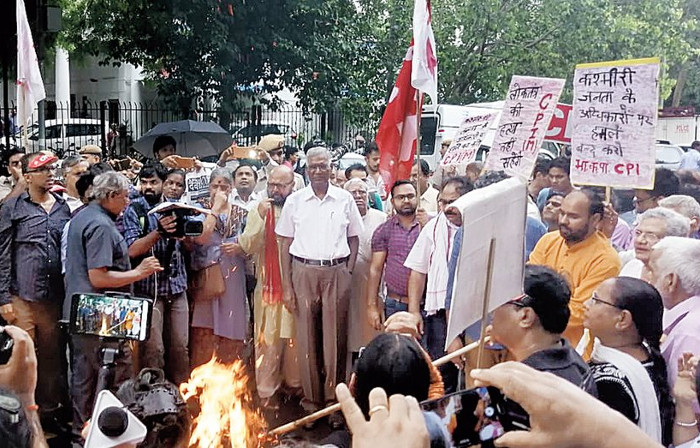
Leaders of Left parties burn an effigy of the Modi government in India.
Acknowledging strong support in Kashmir for self-determination, the United Nations provided for a referendum on the region’s status, but this never took place. Nonetheless, the terms for region’s incorporation into India did include addition of two clauses in the constitution, providing for wide-ranging autonomy for the state of Jammu and Kashmir (Article 370) and banning ownership of land by non-Kashmiris (Article 35A).
The Muslim population considered autonomy plus the land-ownership protection as essential to protect them from being swamped and sidelined by India’s Hindu majority. These measures stood as a barrier against the danger of a colonial settler invasion from outsiders that would convert the Muslims into a marginalized minority in their own land.
Both these safeguards were swept aside by the Indian government on August 5, 2019.

Palestinian Parallel

The Muslims’ present status, as the Pakistani government minister noted, has an uncanny resemblance to that in west-bank Palestine, where a hostile Israeli occupation has in fact turned into a colonial settler project to marginalize the indigenous Palestinian population in their own land.
Given that India has abolished the land-protection clause, the prediction of its Minister of the Interior, Amit Shah, that Kashmir will experience “a flood of outside investment” could well signify a plan for extensive colonialist dispossession of Kashmiri Muslims through land purchases by outsiders.

An Urgent Danger of Nuclear War

Even during the decades in which constitutional safeguards existed, Jammu and Kashmir have known little tranquility. Frictions with the central government have been frequent; New Delhi’s incursions into regional governance have provoked resistance. There have been armed clashes on the Pakistani border, and on two occasions the Pakistani and Indian armies fought brief wars. An armed resistance in the 1980s seeking Kashmiri self-determination met strong Indian military retaliation. Casualties were heavy, a low-level conflict has persisted, and security forces have often attacked unarmed popular protesters.
And now the armies of both India and Pakistan have nuclear weapons. Both countries possess more than 100 nuclear warheads, each one capable of causing incalculable slaughter of civilians on the other side.
In February this year, following on a bomb attack that killed 40 Indian security personnel, India and Pakistan each carried out an air raid against the other’s territory. Under these conditions, India’s crackdown in Kashmir could very possibly result in a military conflict escalating into nuclear war.

Voices of Opposition in India

Although many press reports speak of strong popular support in India for the government crackdown, opposition parties were quick to criticize these measures.
Speaking for the largest Indian opposition group, the Congress Party, Ghulam Nabi Azad stated that “the Bharatiya Janata Party has murdered the constitution. It has murdered democracy.”
Five left-wing parties issued a joint statement condemning Modi’s measures as “an assault on federalism, a fundamental feature of the Indian Constitution” and called a joint national protest for August 7.1
“It is universally acknowledged that the unity of India lies in its diversity,” the Communist Party of India (Marxist) stated August 5. “They are treating Jammu and Kashmir as an occupied territory.”

A Role for the United Nations?

Given that Kashmir’s disputed status was originally established recognized by the United Nations by calling for a referendum, the UN would seem to have some responsibility to assist in overcoming the present crisis. This point is strongly made in an August 7 appeal by the Kashmir Scholars Consultative and Action Networkto UN Secretary-General António Guterres. The UN should appoint a Special Rapporteur, the Kashmir scholars state, to work toward an end to violence against Kashmiri civilians and a restoration of human rights.
A year ago, on June 14, 2018, the UN High Commission on Human Rights (UNHCHR) submitted a reportcalling for an investigation of human rights violations in Kashmir.
The UNHCHR described credible reports of massacres, gang rapes, abductions, and “wilful blinding using pellet guns” by Indian security forces, which have not met with any official response.
The Indian government opposes UN mediation over Kashmir and refused to admit UNHCHR researchers into the region. It denounced the UNHCHR report as fallacious and prejudiced.

Canada’s Role in Kashmir

Zafar Bangash, director of the Toronto-based Institute of Contemporary Islamic Thought, has pointed outthat the UNHCHR decision to look into the Kashmir conflict resulted in part from a UK-based petition with strong backing from Canadians resulting in some 50,000 signatures worldwide. This is perhaps the only significant Canadian contribution to Kashmir peacemaking in recent years.
During the two-month Kashmir war between India and Pakistan that followed on their independence in 1947, Canada’s government played an active role in shaping the terms of armistice, and for a time a Canadian general, Andrew McNaughton, headed the armistice commission. Even today, that fact is remembered with gratitude by Kashmiri self-determination activists. But in recent years, Canada has abstained from such initiatives, and its government is now an obedient ally of both the US and Israel, both of whom are closely aligned with the Modi government. •
This article first published on the JohnRiddell.com website.

Endnotes

  1. The five parties are: Communist Party of India (Marxist), Revolutionary Socialist Party, All-India Forward Bloc, Communist Party of India, and the CPI(ML) Liberation.


https://www.globalresearch.ca/indias-kashmir-crackdown-poses-risk-of-war/5686066


JUST NEWS published this article following the Creative Commons rule. If you don't want your article to appear in this blog email me and I will remove it asap.
Thursday, August 8, 2019

If Crimea Matters, Russia Should Support Kashmir


Global Research, August 08, 2019


There are striking structural similarities between Kashmir and Crimea that should make Russian decision makers think twice before endorsing the unilateral actions of their decades-long Indian partners if they want to remain politically consistent.
Kashmir and Crimea share many structural similarities that most observers might have missed upon first glance or if they were earlier influenced by the anti-Pakistani and -Russian infowars waged by their geopolitical opponents, but both countries should be aware of them and use these commonalities to take their strategic partnership even further in the future. These two highly geostrategic regions were left out of those two Great Powers as part of the legacy of subjectively defined administrative borders carved out by political entities that no longer exists, which were the British Raj and the USSR respectively. Had Kashmir and Crimea’s people been able to vote on their political futures in 1947 and 1991, they’d have joined Pakistan and Russia, but both of them were denied their UN-enshrined rights to self-determination and instead found themselves unwilling parts of India and Ukraine.
They key difference, however, is that the UNSC mandated that a plebiscite be held in Kashmir, while the global body never issued such a recommendation when it came to Crimea. It’s already been seven decades and the Kashmiris still haven’t been able to vote on their future, yet the Crimeans were able to assemble a referendum in roughly seven days owing to the urgent threat of ethnic cleansing that they were facing in 2014 from the new fascist authorities of post-coup Ukraine. The Kashmiris are also facing a similar such threat nowadays too, as Pakistani Prime Minister Khan recently warned, yet they’re unable to hold their planned plebiscite owing to the much worse degree of Indian military occupation that they’re presently under when compared to the relatively weaker Ukrainian one that the Crimeans were subjugated to at the time.
It’s here where Russia has the chance to show the world that it’s politically consistent in supporting what structurally amounts to Pakistan’s Crimea of Kashmir by at the very least not openly endorsing the unilateral actions of its Indian partners earlier this week. New Delhi might nevertheless order its international perception managers to frame Moscow’s silence as tacit approval, though, which is why Russia should consider speaking out against India’s violation of international law and especially what The Times of India quoted Home Minister Amit Shah as saying on Tuesday. The Cabinet official also serves as the President of India’s ruling BJP religious extremists and was on record telling parliament that
“Kashmir is an integral part of India, there is no doubt over it. When I talk about Jammu and Kashmir, Pakistan occupied Kashmir and Aksai Chin are included in it and can die for it”.
Russia routinely criticizes Ukrainian officials whenever they claim that they’re willing to retake Crimea by force, so it should in the interests of political consistency also do the same when one of the most influential men in the nuclear-armed state of India threatens to kill people in the parts of Kashmir currently under Pakistan and China’s control, especially seeing as how both similarly nuclear-armed states are SCO members together with Russia and the second-mentioned one is a part of BRICS too. Moscow, however, might be wary of New Delhi weaponizing their military-industrial ties and more rapidly pivoting towards Western suppliers as punishment for Russia refusing to tow its narrative line or even outright rejecting it, which could contribute to the Eurasian Great Power possibly sacrificing its soft power for the sake of not disrupting its budgetary revenue in that scenario.
That said, Russia has earned the envied reputation among Western and non-Western audiences alike of solidly standing up for the rules-based international order as defined by the UN Charter, so it might not want to ruin this intangible strategic benefit no matter how high the financial costs are that India could impose on it. In fact, India might not even be able to use those current and future contracts as economic blackmail because its armed forces can’t rapidly transition away from Soviet- and Russian-provided equipment, so any fears that Moscow’s decision makers might have in this respect could turn out to be overblown fearmongering peddled by New Delhi’s “agents of influence” in their “deep state”. Russia’s “Return to South Asia” has seen it trying to carefully “balance” the region, but it could all be for naught if it takes a partisan approach by backing India’s illegal actions, which is why it should think twice before falling for the temptation to reactively do so.
*
Note to readers: please click the share buttons above or below. Forward this article to your email lists. Crosspost on your blog site, internet forums. etc.
This article was originally published on Eurasia Future.
Andrew Korybko is an American Moscow-based political analyst specializing in the relationship between the US strategy in Afro-Eurasia, China’s One Belt One Road global vision of New Silk Road connectivity, and Hybrid Warfare. He is a frequent contributor to Global Research.
Featured image is from Cafe Dissensus Everyday blog


https://www.globalresearch.ca/if-crimea-matters-russia-should-support-kashmir/5685871

UST NEWS published this article following the Creative Commons rule. If you don't want your article to appear in this blog email me and I will remove it asap.