Showing posts with label Military-industrial complex. Show all posts

Sunday, September 8, 2019

Strangelove Redux: US Experts Propose Having Artificial Intelligence (AI) Control Nuclear Weapons


Global Research, September 08, 2019


Hypersonic missiles, stealthy cruise missiles, and weaponized artificial intelligence have so reduced the amount of time that decision makers in the United States would theoretically have to respond to a nuclear attack that, two military experts say, it’s time for a new US nuclear command, control, and communications system. Their solution? Give artificial intelligence control over the launch button.
In an article in War on the Rocks titled, ominously, “America Needs a ‘Dead Hand,’” US deterrence experts Adam Lowther and Curtis McGiffin propose a nuclear command, control, and communications setup with some eerie similarities to the Soviet system referenced in the title to their piece. The Dead Hand was a semiautomated system developed to launch the Soviet Union’s nuclear arsenal under certain conditions, including, particularly, the loss of national leaders who could do so on their own. Given the increasing time pressure Lowther and McGiffin say US nuclear decision makers are under,
“[I]t may be necessary to develop a system based on artificial intelligence, with predetermined response decisions, that detects, decides, and directs strategic forces with such speed that the attack-time compression challenge does not place the United States in an impossible position.”
In case handing over the control of nuclear weapons to HAL 9000 sounds risky, the authors also put forward a few other solutions to the nuclear time-pressure problem: Bolster the United States’ ability to respond to a nuclear attack after the fact, that is, ensure a so-called second-strike capability; adopt a willingness to pre-emptively attack other countries based on warnings that they are preparing to attack the United States; or destabilize the country’s adversaries by fielding nukes near their borders, the idea here being that such a move would bring countries to the arms control negotiating table.
Still, the authors clearly appear to favor an artificial intelligence-based solution.
“Nuclear deterrence creates stability and depends on an adversary’s perception that it cannot destroy the United States with a surprise attack, prevent a guaranteed retaliatory strike, or prevent the United States from effectively commanding and controlling its nuclear forces,” they write. “That perception begins with an assured ability to detect, decide, and direct a second strike. In this area, the balance is shifting away from the United States.”
History is replete with instances in which it seems, in retrospect, that nuclear war could have started were it not for some flesh-and-blood human refusing to begin Armageddon. Perhaps the most famous such hero was Stanislav Petrov, a Soviet lieutenant colonel, who was the officer on duty in charge of the Soviet Union’s missile-launch detection system when it registered five inbound missiles on Sept. 26, 1983. Petrov decided the signal was in error and reported it as a false alarm. It was. Whether an artificial intelligence would have reached the same decision is, at the least, uncertain.
One of the risks of incorporating more artificial intelligence into the nuclear command, control, and communications system involves the phenomenon known as automation bias. Studies have shown that people will trust what an automated system is telling them. In one study, pilots who told researchers that they wouldn’t trust an automated system that reported an engine fire unless there was corroborating evidence nonetheless did just that in simulations. (Furthermore, they told experimenters that there had in fact been corroborating information, when there hadn’t.)
University of Pennsylvania political science professor and Bulletin columnist Michael Horowitz, who researches military innovation, counts automation bias as a strike against building an artificial intelligence-based nuclear command, control, and communications system.
“A risk in a world of automation bias is that the Petrov of the future doesn’t use his judgment,” he says, “or that there is no Petrov.”
The algorithms that power artificial intelligence-systems are usually trained on huge datasets which simply don’t exist when it comes to nuclear weapons launches.
“There have not been nuclear missile attacks, country against country. And so, training an algorithm for early warning means that you’re relying entirely on simulated data,” Horowitz says. “I would say, based on the state-of-the-art in the development of algorithms, that generates some risks.”
Mostly, Horowitz thinks the United States wouldn’t develop an artificial intelligence-based command, control, and communications system because, even if there may be less time to react to an attack in this era than in earlier decades, the government is confident in the military’s second-strike capability.
“As long as you have secure-second strike capabilities, you can probably absorb some of these variations in speed, because you always have the ability to retaliate,” he says.
Lowther and McGiffin point out that a second strike means there’s already been a first strike somewhere.
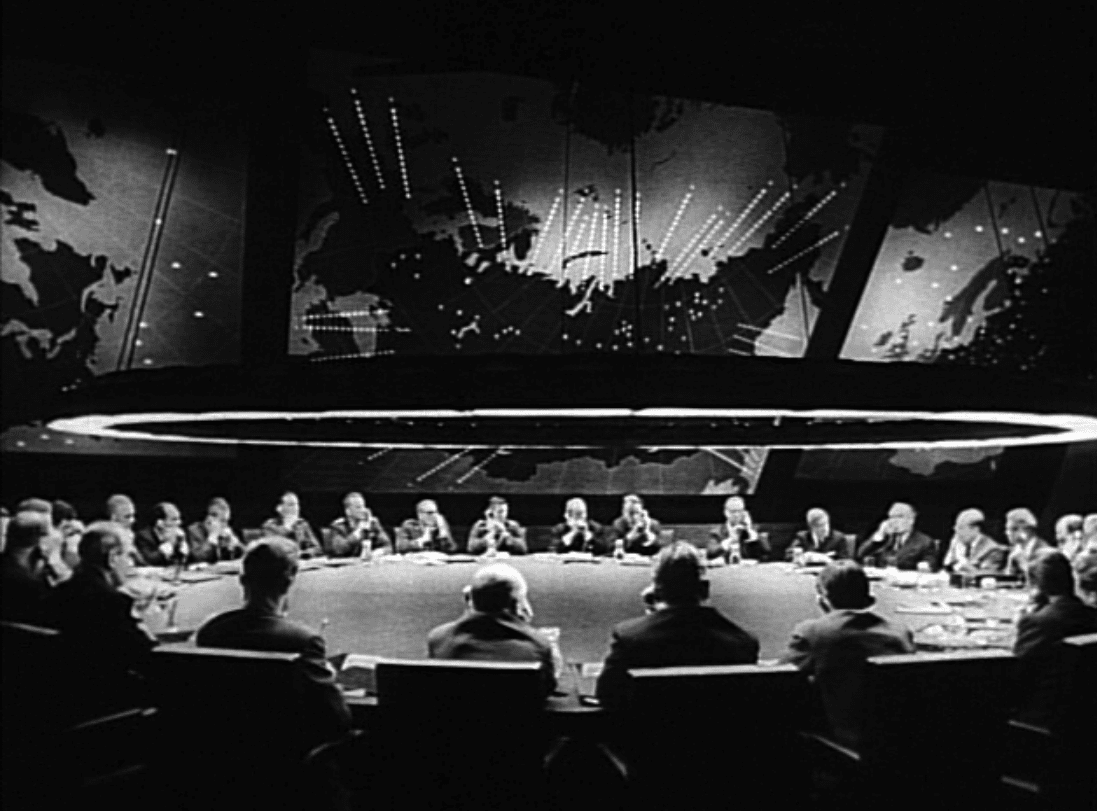
The "Doomsday Machine" in the movie Dr. Strangelove shares some similarities with a system the Soviet Union actually set up. Photo via Wikimedia Commons. Public Domain.
The “Doomsday Machine” in the movie Dr. Strangelove shares some similarities with a system the Soviet Union actually set up. Photo via Wikimedia Commons. Public Domain.
There is some precedent for the system proposed by the War on the Rocksauthors, who have served in government or in the military in nuclear-weapons-related capacities. In the fictional world of Hollywood, that precedent was established in Stanley Kubrick’s nuclear satire Dr. Strangelove and called the “Doomsday Machine,” which author Eric Schlosser described this way for The New Yorker:
“The device would trigger itself, automatically, if the Soviet Union were attacked with nuclear weapons. It was meant to be the ultimate deterrent, a threat to destroy the world in order to prevent an American nuclear strike. But the failure of the Soviets to tell the United States about the contraption defeats its purpose and, at the end of the film, inadvertently causes a nuclear Armageddon. ‘The whole point of the Doomsday Machine is lost,’ Dr. Strangelove, the President’s science adviser, explains to the Soviet Ambassador, ‘if you keep it a secret!’”
About two decades later, satire became closer to reality with the advent of the Soviet Union’s semiautomated Dead Hand system, formally known as Perimeter. When that system perceived that the Soviet military hierarchy no longer existed and detected signs of a nuclear explosion, three officers deep in a bunker were to launch small command rockets that would fly across the country initiating the launch of all of the Soviet Union’s remaining missiles, in a sort of revenge-from-the-grave move. The system was intended to enhance deterrence. Some reports suggest it is still in place.
The possibility that taking humans out of the loop might lead to an accidental launch and unintended nuclear war is a main element in US Naval War College Prof. Tom Nichols’ harsh characterization of the Dead Hand system in a 2014 article in The National Interest: “Turns out the Soviet high command, in its pathetic and paranoid last years, was just that crazy.”
But Lowther and McGiffin say a hypothetical US system would be different than Dead Hand because “the system itself would determine the response based on its own assessment of the inbound threat.“ That is to say, the US system would be better, because it wouldn’t necessarily wait for a nuclear detonation to launch a US attack.
*
Note to readers: please click the share buttons above or below. Forward this article to your email lists. Crosspost on your blog site, internet forums. etc.
Featured image: A US missile test. Photo via Wikimedia Commons. Public Domain.


https://www.globalresearch.ca/strangelove-redux-us-experts-propose-having-artificial-intelligence-ai-control-nuclear-weapons/5688448


JUST NEWS published this article following the Creative Commons rule. If you don't want your article to appear in this blog email me and I will remove it asap.

Saturday, August 17, 2019

The Military-Industrial Jobs Scam


More Money, Fewer Jobs - The Stubborn Truth About Employment and the Defense Industry

By Nia Harris, Cassandra Stimpson, Ben Freeman

August 16, 2019 "Information Clearing House" -  A Marilyn has once again seduced a president. This time, though, it's not a movie star; it's Marillyn Hewson, the head of Lockheed Martin, the nation's top defense contractor and the largest weapons producer in the world. In the last month, Donald Trump and Hewson have seemed inseparable. They "saved" jobs at a helicopter plant. They took the stage together at a Lockheed subsidiary in Milwaukee. The president vetoed three bills that would have blocked the arms sales of Lockheed (and other companies) to Saudi Arabia. Recently, the president's daughter Ivanka even toured a Lockheed space facility with Hewson.
On July 15th, the official White House Twitter account tweeted a video of the Lockheed CEO extolling the virtues of the company's THAAD missile defense system, claiming that it "supports 25,000 American workers." Not only was Hewson promoting her company's product, but she was making her pitch—with the weapon in the background—on the White House lawn. Twitter immediately burst with outrage over the White House posting an ad for a private company, with some calling it "unethical" and "likely unlawful."
None of this, however, was really out of the ordinary as the Trump administration has stopped at nothing to push the argument that job creation is justification enough for supporting weapons manufacturers to the hilt. Even before Donald Trump was sworn in as president, he was already insisting that military spending was a great jobs creator. He's only doubled down on this assertion during his presidency. Recently, overriding congressional objections, he even declared a national "emergency" to force through part of an arms sale to Saudi Arabia that he had once claimed would create more than a million jobs. While this claim has been thoroughly debunked, the most essential part of his argument—that more money flowing to defense contractors will create significant numbers of new jobs—is considered truth personified by many in the defense industry, especially Marillyn Hewson.
The facts tell a different story.
Lockheed Locks Down Taxpayer Dollars, While Cutting American Jobs
To test Trump's and Hewson's argument, we asked a simple question: When contractors receive more taxpayer money, do they generally create more jobs? To answer it, we analyzed the reports of major defense contractors filed annually with the U.S. Securities and Exchange Commission (SEC). Among other things, these reveal the total number of people employed by a firm and the salary of its chief executive officer. We then compared those figures to the federal tax dollars each company received, according to the Federal Procurement Data System, which measures the "dollars obligated," or funds, the government awards company by company.
We focused on the top five Pentagon defense contractors, the very heartland of the military-industrial complex, for the years 2012 to 2018. As it happened, 2012 was a pivotal year because the Budget Control Act (BCA) first went into effect then, establishing caps on how much money could be spent by Congress and mandating cuts to defense spending through 2021. Those caps were never fully adhered to. Ultimately, in fact, the Pentagon will receive significantly more money in the BCA decade than in the prior one, a period when the American wars in Afghanistan and Iraq were at their heights.
In 2012, concerned that those caps on defense spending would cut into their bottom lines, the five top contractors went on the political offensive, making future jobs their weapon of choice. After the Budget Control Act passed, the Aerospace Industries Association—the leading trade group of the weapons-makers—warned that more than one million jobs would be at risk if Pentagon spending were cut significantly. To emphasize the point, Lockheed sent layoff notices to 123,000 employees just before the BCA was implemented and only days before the 2012 election. Those layoffs never actually happened, but the fear of lost jobs would prove real indeed and would last.
Consider it mission accomplished, since Pentagon spending was actually higher in 2018 than in 2012 and Lockheed received a sizeable chunk of that cash infusion. From 2012 to 2018, among government contractors, that company would, in fact, be the top recipient of taxpayer dollars every single year, those funds reaching their zenith in 2017, as it raked in more than $50.6 billion federal dollars. By contrast, in 2012, when Lockheed was threatening its employees with mass layoffs, the firm received nearly $37 billion.
So what did Lockheed do with those additional $13 billion taxpayer dollars?  It would be reasonable to assume that it used some of that windfall (like those of previous years) to invest in growing its workforce. If you came to that conclusion, however, you would be sorely mistaken. From 2012 to 2018, overall employment at Lockheed actually fell from 120,000 to 105,000, according to the firm's filings with the SEC and the company itself reported a slightly larger reduction of 16,350 jobs in the U.S. In other words, in the last six years Lockheed dramatically reduced its U.S. workforce, even as it hired more employees abroad and received more taxpayer dollars.

In short, since 2012 the number of taxpayer dollars going to Lockheed has expanded by billions, the value of its stock has nearly quadrupled, and its CEO's salary went up 32%, even as it cut 14% of its American work force. Yet Lockheed continues to use job creation, as well as its employees' present jobs, as political pawns to get yet more taxpayer money. The president himself has bought into the ruse in his race to funnel ever more money to the Pentagon and promote arms deals to countries like Saudi Arabia, even over the nearly unified objections of an otherwise incredibly divided Congress.So where is all that additional taxpayer money actually going, if not job creation? At least part of the answer is contractor profits and soaring CEO salaries. In those six years, Lockheed's stock price rose from $82 at the beginning of 2012 to $305 at the end of 2018, a nearly four-fold increase. In 2018, the company also reported a 9% ($590 million) rise in its profits, the best in the industry. And in those same years, the salary of its CEO increased by $1.4 million, again according to its SEC filings.
Lockheed Is the Norm, Not the Exception
Despite being this country's and the world's top weapons maker, Lockheed isn't the exception but the norm. From 2012 to 2018, the unemployment rate in the U.S. plummeted from roughly 8% to 4%, with more than 13 million new jobs added to the economy. Yet, in those same years, three of the five top defense contractors slashed jobs. In 2018, the Pentagon committed approximately $118 billion in federal money to those firms, including Lockheed—nearly half of all the money it spent on contractors. This was almost $12 billion more than they had received in 2012. Yet, cumulatively, those companies lost jobs and now employ a total of 6,900 fewer employees than they did in 2012, according to their SEC filings.
In addition to the reductions at Lockheed, Boeing slashed 21,400 jobs and Raytheon cut 800 employees from its payroll. Only General Dynamics and Northrop Grumman added jobs—13,400 and 16,900 employees, respectively—making that total figure look modestly better. However, even those "gains" can't qualify as job creation in the normal sense, since they resulted almost entirely from the fact that each of those companies bought another Pentagon contractor and added its employees to its own payroll. CSRA, which General Dynamics acquired in 2018, had 18,500 employees before the merger, while Orbital ATK, which General Dynamics acquired last year, had 13,900 employees. Subtract these 32,400 jobs from the corporate totals and job losses at the firms become staggering.
In addition, those employment figures include all company employees, even those now working outside the U.S. Lockheed is the only top five Pentagon contractor that provides information on the percentage of its employees in the U.S., so if the other firms are shipping jobs overseas, as Lockheed has done and as Raytheon is planning to do, far more than 6,900 full-time jobs in the U.S. have been lost in the last six years.
Where, then, did all that job-creation money really go? Just as at Lockheed, at least part of the answer is that the money went to the bottom-line and to top executives. According to a report from PricewaterhouseCoopers, a consulting firm that provides annual analyses of the defense industry, "the aerospace and defense (A&D) sector scored record revenues and profits in 2018" with an "operating profit of $81 billion, surpassing the previous record set in 2017." According to the report, Pentagon contractors were at the forefront of these profit gains. For example, Lockheed's profit improvement was $590 million, followed closely by General Dynamics at $562 million. As employment shrank, CEO salaries at some of these firms only grew. In addition to compensation for Lockheed's CEO jumping from $4.2 million in 2012 to $5.6 million in 2018, compensation for the CEO of General Dynamics increased from $6.9 million in 2012 to a whopping $20.7 million in 2018.
Perpetuating the Same Old Story
This is hardly the first time that these companies have extolled their ability to create jobs while cutting them. As Ben Freeman previously documented for the Project On Government Oversight, these very same firms cut almost 10% of their workforce in the six years before the BCA came into effect, even as taxpayer dollars heading their way annually jumped by nearly 25% from $91 billion to $113 billion.
Just as then, the contractors and their advocates—and there are many of them, given that the weapons-making outfits spend more than $100 million on lobbying yearly, donate tens of millions of dollars to the campaigns of members of Congress every election season, and give millions to think tanks annually—will rush to defend such job losses. They will, for instance, note that defense spending leads to job growth among the subcontractors used by the major weapons firms. Yet research has repeatedly shown that, even with this supposed "multiplier effect," defense spending produces fewer jobs than just about anything else the government puts our money into. In fact, it's about 50% less effective at creating jobs than if taxpayers were simply allowed to keep their money and use it as they wished.
As Brown University's Costs of War project has reported, "$1 billion in military spending creates approximately 11,200 jobs, compared with 26,700 in education, 16,800 in clean energy, and 17,200 in health care." Military spending actually proved to be the worst job creator of any federal government spending option those researchers analyzed. Similarly, according to a report by Heidi Garrett-Peltier of the Political Economy Research Institute at the University of Massachusetts, Amherst, for every $1 million of spending on defense, 6.9 jobs are created both directly in defense industries and in the supply chain. Spending the same amount in the fields of wind or solar energy, she notes, leads to 8.4 or 9.5 jobs, respectively. As for the education sector, the same amount of money produced 19.2 jobs in primary and secondary education and 11.2 jobs in higher education. In other words, not only are the green energy and education areas vital to the future of the country, they are also genuine job-creating machines. Yet, the government gives more taxpayer dollars to the defense industry than all these other government functions combined.
You don't, however, have to turn to critics of defense spending to make the case. Reports from the industry's own trade association show that it has been shedding jobs. According to an Aerospace Industries Association analysis, it supported approximately 300,000 fewerjobs in 2018 than it had reported supporting just three years earlier.
If the nation's top defense contractor and the industry as a whole have been shedding jobs, how have they been able to consistently and effectively perpetuate the myth that they are engines of job creation? To explain this, add to their army of lobbyists, their treasure trove of campaign contributions, and those think tanks on the take, the famed revolving door that sends retired government officials into the world of the weapons makers and those working for them to Washington.
While there has always been a cozy relationship between the Pentagon and the defense industry, the lines between contractors and the government have blurred far more radically in the Trump years. Mark Esper, the newly minted secretary of defense, for example, previously worked as Raytheon's top lobbyist in Washington.  Spinning the other way, the present head of the Aerospace Industries Association, Eric Fanning, had been both secretary of the Army and acting secretary of the Air Force. In fact, since 2008, as the Project On Government Oversight's Mandy Smithberger found, "at least 380 high-ranking Department of Defense officials and military officers shifted into the private sector to become lobbyists, board members, executives, or consultants for defense contractors."
Whatever the spin, whether of that revolving door or of the defense industry's publicists, the bottom line couldn't be clearer: if job creation is your metric of choice, Pentagon contractors are a bad taxpayer investment. So whenever Marillyn Hewson or any other CEO in the military-industrial complex claims that spending yet more taxpayer dollars on defense contractors will give a jobs break to Americans, just remember their track record so far: ever more dollars invested means ever fewer Americans employed.
This article was originally published by "Tom Dispatch" - -

Note -  The image embedded in this article by ICH, did not appear in the original essay.

http://www.informationclearinghouse.info/52102.htm

JUST NEWS published this article following the Creative Commons rule. If you don't want your article to appear in this blog email me and I will remove it asap.

Monday, August 5, 2019

Cheering a New Arms Race: The End of the INF


Global Research, August 05, 2019

US President Donald Trump is a master of the withdrawal method.  That said, it is often forgotten that the United States remains that most fickle of creatures, joining, or abandoning international regimes that might be seen to jar with the national interest.  Initial preparations for such global arrangements tend to be initially optimistic, even rosy.  Eager to draft a suitable document, say, the Rome Statute establishing the International Criminal Court, diligent diplomats give the work a made-in-America feel. They are then told ratification will be impossible in the Senate.  Uncle Sam duly becomes a unilateralist jingo.
The difference from what has come before is that Trump is not troubled by any sense of enduring history.  There are no restraints, nor caveats.  Pre-Trump history had to be bad, if not altogether rotten.  This sort of attitude comes with doses of good and heavy draughts of bad.  Tariff wars result; states like Iran can be provoked.  Allies can be mocked.
On October 20, 2018, the US president announced that his country would be withdrawing from the Intermediate-Range Nuclear Forces Treaty.  Since then, the INF has been confined to an aged home, given modest palliative care, and not so respectfully expired.
The agreement came about because of a tiff in the nuclear family on certain weapons, notably ground-launched intermediate missiles.  The Soviet Union had moved SS-20 missiles into Europe in 1979.  The US balanced it with Pershing and cruise missiles in West Germany, Italy and the United Kingdom.  The prospect of turning Europe into a wasteland in futility presented itself with a certain glaringness.  Protests were held; politicians toyed with a fragile destiny.  The Kremlin and Washington stared at each other.
The result was the INF Treaty, described by President Ronald Reagan and the Soviet Union’s Mikhail Gorbachev as follows:
“This treaty is historic for its objective – the complete elimination of an entire class of US and Soviet nuclear arms – and for the innovative character and scope of its verification provisions.”
It mandated that both sides destroy and not deploy ground-based ballistic and cruise missiles with ranges of 500 to 5,500 kilometres, be they conventional or nuclear.
It took some time, but disgruntlement about observing the injunctions of the treaty were to come.  China, for instance, was not a member, leaving it to feed growing aspirations in deploying intermediate-range forces in East Asia.  And the military industrial complex is a cheeky old thing, bound to do its Promethean mischief in due course.  In 2014, the US took issue with Russia’s testing of the 9M729 ground-launched cruise missile.  Three years later, it was alleged that the weapon system had been deployed. By October 2018, Russia was deemed to be in full-blown violation of the treaty and given till February 2019 to right the ledger.  Not that the US never had its fair share of contingency designs in the system.
Now, Russia has also conceded to putting the 1987 document to bed.  Doing so provides greater latitude of missile deployment without the sense of being under a legal cloud, though few implications will be initially visible.
“In the short term, there’s no immediate physical change after Friday,” observes former US diplomat versed on non-proliferation issues.  “The United States and Russia are not going to begin on Saturday deploying hundreds of new missiles.”
Richard A. Clarke hazarded a guess on the implications.  Smug yet troubled, he reminded us that he had been a bricklayer in the original agreement, sad to see it lapse into history.
“As someone who helped designed the INF Treaty, only Russia benefits from the US withdrawal.  No European country will let us deploy new nukes and we don’t have any even under development.”
UN Secretary General Antonio Guterres has argued that,
“This will likely heighten, not reduce, the threat posed by ballistic missiles.”
At the heart of every arms control understanding is a studied hypocrisy.  By way of example, every power which has nuclear weapons wants to keep them.  Many powers without it want them but will be denied access to such technology by the family of hardnosed enforcers.  But within the nuclear cabal lies a range of inconsistent and, in some cases, contradictory factors.  Arms control might be seen as another form of controlled addiction, never case of abolition and true security.
Ending the INF is bound to cause some glumness, but the critics about its binary nature were growing in number, eager to see its revision or scuttling.  In 2014, Trump’s current national security advisor John Bolton was already making mutterings about a treaty obsolete before its violation.  It is easy to forget that the Reagan administration initially began with bellicosity, fearing that any sense of restraining the nuclear arms race was only coming at the expense of US hegemony.  Such arms control was not for them.  Yet it was Reagan, spurred on astrological guidance or otherwise, who finally found reassurance in the signing of the INF with his sparring counterpart.
There is bound to be an initial boost in expenditure and testing on weapons that would have otherwise been banned by the INF.  A mini-arms race is in the offing: to each his degree of deserving lunacy.  There will also be, if the views of NATO Secretary General Jason Stoltenberg are anything to go by, an increased emphasis on improving missile defences.  Once that dash is done, the parties may well find themselves at the negotiating table again, with a new cohort of arms inspectors ready for employment.  Till then, Trump is likely to set his wrecking ball to another arms control agreement.  Beware, negotiators of New START.
*
Note to readers: please click the share buttons above or below. Forward this article to your email lists. Crosspost on your blog site, internet forums. etc.
Dr. Binoy Kampmark was a Commonwealth Scholar at Selwyn College, Cambridge.  He lectures at RMIT University, Melbourne. He is a frequent contributor to Global Research and Asia-Pacific Research. Email: bkampmark@gmail.com
Featured image is from InfoRos


https://www.globalresearch.ca/new-arms-race-end-inf/5685627


JUST NEWS published this article following the Creative Commons rule. If you don't want your article to appear in this blog email me and I will remove it asap.

Thursday, July 18, 2019

The Military-Industrial Complex on Steroids


By William D. Hartung
July 18, 2019 "Information Clearing House" -  When, in his farewell address in 1961, President Dwight D. Eisenhower warned of the dangers of the “unwarranted influence” wielded by the “military-industrial complex,” he could never have dreamed of an arms-making corporation of the size and political clout of Lockheed Martin. In a good year, it now receives up to $50 billion in government contracts, a sum larger than the operating budget of the State Department. And now it’s about to have company.
Raytheon, already one of the top five U.S. defense contractors, is planning to merge with United Technologies. That company is a major contractor in its own right, producing, among other things, the engine for the F-35 combat aircraft, the most expensive Pentagon weapons program ever. The new firm will be second only to Lockheed Martin when it comes to consuming your tax dollars – and it may end up even more powerful politically, thanks to President Trump’s fondness for hiring arms industry executives to run the national security state.
Just as Boeing benefited from its former Senior Vice President Patrick Shanahan’s stint as acting secretary of defense, so Raytheon is likely to cash in on the nomination of its former top lobbyist, Mike Esper, as his successor. Esper’s elevation comes shortly after another former Raytheon lobbyist, Charles Faulkner, left the State Department amid charges that he had improperly influenced decisions to sell Raytheon-produced guided bombs to Saudi Arabia for its brutal air war in Yemen. John Rood, third-in-charge at the Pentagon, has worked for both Lockheed Martin and Raytheon, while Ryan McCarthy, Mike Esper’s replacement as secretary of the Army, worked for Lockheed on the F-35, which the Project on Government Oversight (POGO) has determined may never be ready for combat.
And so it goes. There was a time when Donald Trump was enamored of “his” generals – Secretary of Defense James Mattis (a former board memberof the weapons-maker General Dynamics), National Security Advisor H.R. McMaster, and White House Chief of Staff John Kelly. Now, he seems to have a crush on personnel from the industrial side of the military-industrial complex.
As POGO’s research has demonstrated, the infamous “revolving door” that deposits defense executives like Esper in top national security posts swings both ways. The group estimates that, in 2018 alone, 645 senior government officials – mostly from the Pentagon, the uniformed military, and Capitol Hill – went to work as executives, consultants, or board members of one of the top 20 defense contractors.
Fifty years ago, Wisconsin Senator William Proxmire identified the problem when he noted that:
“the movement of high ranking military officers into jobs with defense contractors and the reverse movement of top executives in major defense contractors into high Pentagon jobs is solid evidence of the military-industrial complex in operation. It is a real threat to the public interest because it increases the chances of abuse… How hard a bargain will officers involved in procurement planning or specifications drive when they are one or two years away from retirement and have the example to look at of over 2,000 fellow officers doing well on the outside after retirement?”
In other words, that revolving door and the problems that go with it are anything but new. Right now, however, it seems to be spinning faster than ever – and mergers like the Raytheon-United Technologies one are only likely to feed the phenomenon.

The merger of Raytheon and United Technologies should bring back memories of the merger boom of the 1990s, when Lockheed combined with Martin Marietta to form Lockheed Martin, Northrop and Grumman formed Northrop Grumman, and Boeing absorbed rival military aircraft manufacturer McDonnell Douglas. And it wasn’t just a matter of big firms pairing up either. Lockheed Martin itself was the product of mergers and acquisitions involving nearly two dozen companies – distinctly a tale of big fish chowing down on little fish. The consolidation of the arms industry in those years was strongly encouraged by Clinton administration Secretary of Defense William Perry, who held a dinner with defense executives that was later dubbed “the last supper.” There, he reportedly told the assembled corporate officials that a third of them would be out of business in five years if they didn’t merge with one of their cohorts.The Last Supper
The Clinton administration’s encouragement of defense industry mergers would prove anything but rhetorical. It would, for instance, provide tens of millions of dollars in merger subsidies to pay for the closing of plants, the moving of equipment, and other necessities. It even picked up part of the tab for the golden parachutes given defense executives and corporate board members ousted in those deals.
The most egregious case was surely that of Norman Augustine. The CEO of Martin Marietta, he would actually take over at the helm of the even more powerful newly created Lockheed Martin. In the process, he received $8.2 million in payments, technically for leaving his post as head of Martin Marietta. U.S. taxpayers would cover more than a third of his windfall. Then, a congressman who has only gained stature in recent years, Representative Bernie Sanders (I-VT), began to fight back against those merger subsidies. He dubbed them “payoffs for layoffs” because executives got government-funded bailouts, while an estimated 19,000 workers were laid off in the Lockheed Martin merger alone with no particular taxpayer support. Sanders was actually able to shepherd through legislation that clawed back some, but not all, of those merger subsidies.
According to one argument in favor of the merger binge then, by closing half-empty factories, the new firms could charge less overhead and taxpayers would benefit. Well, dream on. This never came near happening, because the newly merged industrial behemoths turned out to have even greater bargaining power over the Pentagon and Congress than the unmerged companies that preceded them.
Draw your own conclusions about what’s likely to happen in this next round of mergers, since cost overruns and lucrative contracts continue apace. Despite this dismal record, Raytheon CEO Thomas Kennedy claims that the new corporate pairing will – you guessed it! – save the taxpayers money. Don’t hold your breath.
Influence on Steroids
While Donald Trump briefly expressed reservations about the Raytheon-United Technologies merger and a few members of Congress struck notes ofcaution, it has been welcomed eagerly on Wall Street. Among the reasons given: the fact that the two companies generally make different products, so their union shouldn’t reduce competition in any specific sector of defense production. It has also been claimed that the new combo, to be known as Raytheon Technologies, will have more funds available for research and development on the weapons of the future.
But focusing on such concerns misses the big picture. Raytheon Technologies will have more money to make campaign contributions, more money to hire lobbyists, and more production sites that can be used as leverage over members of Congress loathe to oppose spending on weapons produced in their states or districts. The classic example of this phenomenon: the F-35 program, which Lockheed Martin claims produces 125,000 jobs spread over 46 states.
When I took a careful look at the company’s estimates, I found that they were claiming approximately twice as many jobs as that weapons system was actually creating. In fact, more than half of F-35-related employment was in just two states, California and Texas (though many other states did have modest numbers of F-35 jobs). Even if Lockheed Martin’s figures are exaggerated, however, there’s no question that spreading defense jobs around the country gives weapons manufacturers unparalleled influence over key members of Congress, much to their benefit when Pentagon budget time rolls around. In fact, it’s a commonplace for Congress to fund more F-35s, F-18s, and similar weapons systems than the Pentagon even asks for. So much for Congressional oversight.
Theoretically, incoming defense secretary Mike Esper will have to recuse himself from major decisions involving his former company. Among them, whether to continue selling Raytheon-produced precision-guided bombs to Saudi Arabia and the United Arab Emirates (UAE) for their devastating air war in Yemen that has killed remarkable numbers of civilians.
No worries. President Trump himself is the biggest booster in living memory of corporate arms sales and Saudi Arabia is far and away his favorite customer. The Senate recently voted down a package of “emergency” arms sales to the Saudis and the UAE that included thousands of RaytheonPaveway munitions, the weapon of choice in that Yemeni air campaign. A similar vote must now take place in the House, but even if it, too, passes, Congress will need to override a virtually guaranteed Trump veto of the bill.
The Raytheon-United Technologies merger will further implicate the new firm in Yemeni developments because the Pratt and Whitney division of United Technologies makes the engine for Saudi Arabia’s key F-15S combat aircraft, a mainstay of the air war there. Not only will Raytheon Technologies profit from such engine sales, but that company’s technicians are likely to help maintain the Saudi air force, thereby enabling it to fly yet more bombing missions more often.
When pressed, Raytheon officials argue that, in enabling mass slaughter, they are simply following U.S. government policy. This ignores the fact that Raytheon and other weapons contractors spend tens of millions of dollars a year on lobbyists, political contributions, and other forms of influence peddling trying to shape U.S. policies on arms exports and weapons procurement. They are, in other words, anything but passive recipients of edicts handed down from Washington.
As Raytheon chief financial officer Toby O’Brien put it in a call to investors that came after the murder of Washington Post columnist Jamal Khashoggi, “We continue to be aligned with the administration’s policies, and we intend to honor our commitments.” Lockheed Martin CEO Marillyn Hewson made a similar point, asserting that “most of these agreements that we have are government-to-government purchases, so anything that we do has to follow strictly the regulations of the U.S. government… Beyond that, we’ll just work with the U.S. government as they are continuing their relationship with [the Saudis].”
How Powerful Are the Military-Industrial Combines?
When it comes to lobbying the Pentagon and Congress, size matters. Major firms like Lockheed Martin, Boeing, and Raytheon can point to the jobs they and their subcontractors provide in dozens of states and scores of Congressional districts to keep members of Congress in line who might otherwise question or even oppose the tens of billions of dollars in government funding the companies receive annually.
Raytheon – its motto: “Customer Success Is Our Mission” – has primary operations in 16 states: Alabama, Arkansas, Arizona, California, Colorado, Florida, Indiana, Kentucky, Massachusetts, Michigan, Minnesota, New Mexico, Pennsylvania, Rhode Island, Texas, Utah, and Virginia. That translates into a lot of leverage over key members of Congress and it doesn’t even count states where the company has major subcontractors. The addition of United Technologies will reinforce the new company’s presence in a number of those states, while adding Connecticut, Iowa, New York, and North Carolina (in other words, at least 20 states in all).
Meanwhile, if the merger is approved, the future Raytheon Technologies will be greasing the wheels of its next arms contracts by relying on nearlyfour dozen former government officials the two separate companies hired as lobbyists, executives, and board members in 2018 alone. Add to that the $6.4 million in campaign contributions and $20 million in lobbying expenses Raytheon clocked during the last two election cycles and the outlines of its growing influence begin to become clearer. Then, add as well the $2.9 million in campaign contributions and $40 million in lobbying expensesracked up by its merger partner United Technologies and you have a lobbying powerhouse rivaled only by Lockheed Martin, the world’s largest defense conglomerate.
President Eisenhower’s proposed counterweight to the power of the military-industrial complex was to be “an alert and knowledgeable citizenry.” And there are signs that significant numbers of individuals and organizations are beginning to pay more attention to the machinations of the arms lobby. My own outfit, the Center for International Policy, has launched a Sustainable Defense Task Force composed of former military officers and Pentagon officials, White House and Congressional budget experts, and research staffers from progressive and good-government groups. It has already crafted a plan that would cut $1.2 trillion from the Pentagon budget over the next decade, while improving U.S. security by avoiding unnecessary wars, eliminating waste, and scaling back a Pentagon nuclear-weapons buildup slated to cost $1.5 trillion or more over the next three decades.
The Poor People’s Campaign, backed by research conducted by the National Priorities Project of the Institute for Policy Studies, is calling for a one-year $350 billion cut in Pentagon expenditures. And a new network called “Put People Over the Pentagon” has brought together more than 20progressive organizations to press presidential candidates to cut $200 billion annually from the Department of Defense’s bloated budget. Participants in the network include Public Citizen, Moveon.org, Indivisible, Win Without War, 350.org, Friends of the Earth, and United We Dream, many of them organizations that had not, in past years, made reducing the Pentagon budget a priority.
Raytheon and its arms industry allies won’t sit still in the face of such proposals, but at least the days of unquestioned and unchallenged corporate greed in the ever-merging (but also ever-expanding) arms industry may be coming to an end. The United States has paid an exorbitantly high price in blood and treasure (as have countries like Afghanistan and Iraq) for letting the military-industrial complex steer the American ship of state through this century so far. It’s long past time for a reckoning.
William D. Hartung, a TomDispatch regular, is the director of the Arms and Security Project at the Center for International Policy and the author ofProphets of War: Lockheed Martin and the Making of the Military-Industrial Complex.
Follow TomDispatch on Twitter and join us on Facebook. Check out the newest Dispatch Books, John Feffer’s new dystopian novel (the second in the Splinterlands series) Frostlands, Beverly Gologorsky’s novel Every Body Has a Story, and Tom Engelhardt’s A Nation Unmade by War, as well as Alfred McCoy’s In the Shadows of the American Century: The Rise and Decline of U.S. Global Power and John Dower’s The Violent American Century: War and Terror Since World War II.

Copyright 2019 William D. Hartung

http://www.informationclearinghouse.info/51925.htm

JUST NEWS published this article following the Creative Commons rule. If you don't want your article to appear in this blog email me and I will remove it asap.