Showing posts with label Nigeria. Show all posts

Thursday, July 18, 2019

African Free Trade Area Launched in Niger


55-nation bloc seeks to fuel economies around the continent


Global Research, July 18, 2019

On July 4 the 12th Extraordinary Summit of the African Union (AU) was held in Niamey, Niger to officially proclaim a project that is inherent within the notions of sovereignty and unity on the continent.
This African Continental Free Trade Area (AfCFTA) gathering took place in a nation in the western region which is endowed with uranium, one of the most strategic minerals in the world utilized for industrial, scientific and military purposes.
These contradictions within Niger related to its mineral wealth and the abject impoverishment of the masses of working class and rural people illustrates clearly the tremendous hurdles in which Africa must overcome to harness the economic and social potential of the AU member-states. The AfCFTA was announced at a previous AU Summit in Kigali, Rwanda on March 21, 2018.
Over the past 16 months some 27 governments have ratified the agreement while a total of 54 have signed the document mandating its establishment. The West African state of Ghana, once the fountainhead of Pan-Africanism during the 1950s and early to mid-1960s under the leadership of President Kwame Nkrumah, the foremost proponent of continental unification and socialism, was designated to host the secretariat for the AfCFTA.
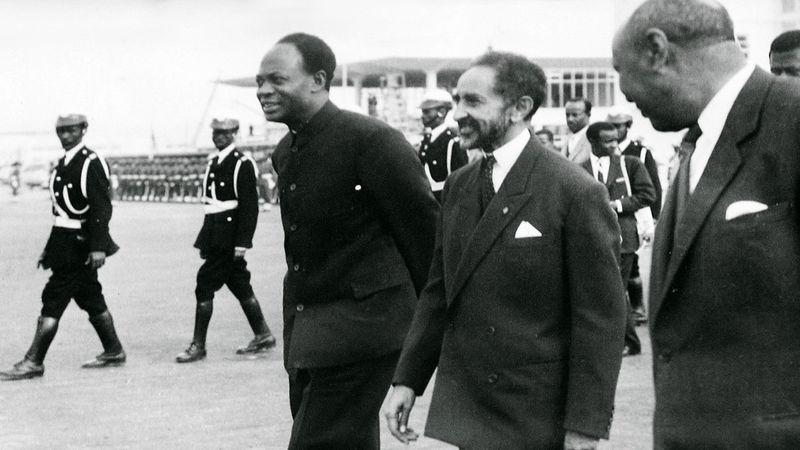
Kwame Nkrumah and Haile Selassie I in Ethiopia at the founding of the Organization of African Unity, May 1963
In a statement released by the AU on July 7, it says of the structure for the new continental body that:
“The AfCFTA will be governed by five operational instruments, i.e. the Rules of Origin; the online negotiating forum; the monitoring and elimination of non-tariff barriers; a digital payments system and the African Trade Observatory. Each one was launched by different Heads of State and Government that included President Cyril Ramaphosa of South Africa, President Abdel Fattah El Sisi of Egypt who is current Chairperson of the AU; Mr. Moussa Faki Makamat, the Chairperson of the African Union Commission; and President Mahamadou Issoufou of Niger, who is the Champion of the AfCFTA.”
Nevertheless, analysts have pointed to prospective barriers for the implementation of the AfCFTA emanating from the legacy of slavery and colonialism. Africa remains divided into 55 separate states where intra-regional and class differences are a source of the conflicts which exists inside many countries.
These impediments are also related to the lack of adequate transportation and telecommunications infrastructure. In addition, the reliance upon western foreign exchange currency in the arena of trade provides incentives for the maintenance of the status-quo.
The AU statement issued on July 7 spoke to the current 1.2 billion people in Africa and projected 2.5 billion by 2050 as a source of strength related to the realization of sustainable economic growth. Six years ago at the AU, the Agenda 2063 was affirmed aimed at economic integration and the adoption of a single currency on the continent.
Estimates indicate that with the actual operationalization of the AfCFTA program the region would become a $3.4 trillion economic zone. The breaking down of borders and the lifting of tariffs would in effect facilitate internal African trade.
At present only 17% of trade in Africa is conducted with AU states. This can be contrasted with Asia where intra-continental trade stands at 59% and in Europe where it is 69%.
Moreover, the uneven development among various states must be transcended considering that countries such as the Republic of South Africa, the Federal Republic of Nigeria and Egypt encompass a sizable portion of the continental Gross Domestic Product (GDP). South Africa is by far the most industrialized state on the continent while countries such as Nigeria, Angola, Libya and Sudan are leaders in the extraction and export of petroleum.
Overcoming Dependency as a Prerequisite for Development
An indisputable historical fact is that Africa has been subjected to enslavement, colonization and neo-colonialism through the rise and dominance of imperialism since the middle decades of the 15th century. This cannot be overlooked in making any honest assessment of the capacity for genuine growth and development.
There has been significant growth within African economies since the beginning of the 21st century. However, the reliance on export-based economic planning is objectively related to the stated mandate of the AfCFTA. Until the challenge of continental integration is seriously addressed the much desired substantial take off will not materialize.
Today’s neo-colonial existence is definitely a by-product of the post-independence era crises of continuing underdevelopment, imperialist exploitation as well as the ongoing military and intelligence interference in the internal affairs of all AU member-states. The nation of Niger has been a focal point of Pentagon and French military engagement.
Through the United States Africa Command (AFRICOM) and the Paris-engineered Operation Barkhane the imperialist governments not only have troops stationed on Nigerien soil. There is the presence of elaborate intelligence-gathering mechanisms including the positioning of highly-sophisticated reaper and predator drones in Niger.  All across Africa, the Pentagon is in evidence under the guise of anti-terrorism and national security. Ultimately, Africa is responsible for its own security against reactionary elements which have their origins within the imperialist centers.
The above-mentioned AU statement on the launch of the operational phase of the AfCTFA emphasizes the link between security and development by stating:
“The Chairperson (Moussa Faki Mahamat of Chad) also highlighted the importance of peace building and security on the continent, adding that ‘it would be a delusion to talk of trade and development without peace and security.’ He also stressed that, for the AfCFTA to be effective, there is [the] need to open borders to other Africans. In this light, host President Mr. Mahamadou Issoufou (Niger), said the free trade area will tear down borders inherited from Africa’s colonial past and ensure full continental integration.”
Nevertheless, the presence of western military forces within AU member-states represents the antithesis of the progressive and revolutionary currents of Pan-Africanism emanating from the First All-African Peoples Conference (AAPC) of December 1958 in Ghana right through to the armed resistance phase to colonialism, the founding of the Organization of African Unity (OAU), the predecessor to the AU, and the burgeoning class struggle against a comprador elite propped up by international finance capital. Under the present circumstances, the imperialists are firmly positioned to stifle any economic development planning which views the dominance of the world capitalist system as the major obstruction to Africa making a decisive turn in the direction of its rightful trajectory towards continental unification based upon the interests of the majority of its people.
The Political Essentials of Continental Integration
Consequently, a struggle must be opened up against the role of Washington and Brussels where the base of African underdevelopment strategies originate. As many historical materialist theorists have articulated over the decades, the development of North America and Western Europe was carried out through the underdevelopment of Africa.
Fundamentally the character of U.S., British and European Union (EU) foreign policy has not changed since the period of the Cold War. Wall Street, London and the Eurozone states have no intentions of relinquishing their profit-making capacity where the foundation of the exploitative system is situated. The Pentagon, NATO and its auxiliary units are in Africa and other regions of the world to police the maintenance of existing structures in the international division of labor and economic power.
Of course there are other states and regional blocs vying for Africa’s attention in the contemporary world situation such as the People’s Republic of China, the Russian Federation and socialist-oriented states in Latin America. The U.S. ruling class has intensified its economic and military wars against these countries which provide an alternative form of development strategies for Africa and its people.
The attacks by Washington and its allies against the Bolivarian Republic of Venezuela and the Republic of Cuba are a case point. These two states along with Bolivia are attempting to build their own societies where the well-being of the majority of its people remains primary. Consequently, there are consistent attempts at subversion, diplomatic isolation and economic destabilization by the current administration of President Donald Trump.
African Union 12th Extraordinary Summit to Launch the AfCFTA in Niger, July 4, 2019
As it relates to China and Russia, the twin political capitalist parties in the U.S. view the increasing influence of Beijing and Moscow as a threat to imperialist hegemony. The imposition of trade tariffs, sanctions and disinformation campaigns will undoubtedly lead to another world war. What will the AU member-states role going forward be in this escalating hostile geo-political situation which threatens a protracted international conflagration?
Capitalism and its global outgrowth of imperialism cannot provide any viable solutions for Africa’s development. The abolition of class society, the expulsion of western military interests from the continent and the broadening of trade policy inside and outside of Africa is the only way out of the foreseeable quagmire.
Socialism as an indispensable economic system to counter the imperialist states requires the organization and mobilization of the proletariat, farmers, youth and revolutionary intelligentsia centered on a program of immediate integration and unification. The rising problems associated with imperialist militarism, the potentially calamitous effects of climate change and its concomitant exigencies related to the acquisition of sustainable energy sources, clean water supplies, people-centered agricultural production, guaranteed healthcare and quality education requires the attention of all serious African organizations.
AfCFTA can only be realized when the full weight of the masses is thrown towards its enactment. There is no substitute for the creative genius of the people in their quest for total freedom and social justice.
*
Note to readers: please click the share buttons below. Forward this article to your email lists. Crosspost on your blog site, internet forums. etc.
Abayomi Azikiwe is the editor of Pan-African News Wire. He is a frequent contributor to Global Research. 
All images in this article are from the author


https://www.globalresearch.ca/african-free-trade-area-launched-niger/5683962

JUST NEWS published this article following the Creative Commons rule. If you don't want your article to appear in this blog email me and I will remove it asap.

Monday, December 31, 2018

Africa in Review 2018: Regional Instability and the Politics of Underdevelopment


Part II Dependency amid natural wealth absent of strategic influence


Global Research, December 31, 2018

Over the last twelve months events on the African continent have reinforced the centuries-long relationship with the imperialist nations through the process of economic exploitation of human and natural resources, fueling the profitability of the dominant forces within the world system. Although there are subtle and profound variations manifesting this reality in the 55 designated countries making up the African Union (AU), the similarities across the continent far outweigh the differences.
This second installment assessing events in the contemporary period can only be properly understood by placing the continuing crisis inside a historical context. Whilst these AU member-states are all nominally independent with the exception of the Western Sahara still under Moroccan occupation, almost every policy consideration taken by governments throughout the various geo-political regions cannot be enacted without a calculated reasoning related to the response of international financial institutions and the developed capitalist regimes of the West.
Instability in North Africa: The Cases of Egypt and Libya
The third largest-populated country of the AU is Egypt which has been undergoing profound political upheaval since 2011. The resignation of former President Hosni Mubarak after mass protests commonly characterized as the “Arab Spring” created the conditions for the ascendancy of the current military leader turned President Abdel-Fattah al-Sisi in 2013.
An elected Muslim Brotherhood administration in 2012 under the banner of the Freedom and Justice Party (FJP) only lasted for one year when the military retook power claiming it had a popular mandate to “restore order” and return the nation to “secularism.” Thousands of FPJ supporters were either killed or arrested in the aftermath of the coup.
Ousted President Mohamed Morsi remains imprisoned and during December appeared in the same courtroom with Mubarak in a trial that is seeking to place culpability on the FJP leader for unrest which struck Egypt in 2011-2012. Yet it was not the Muslim Brotherhood which initiated the mass demonstrations against Mubarak in February 2011. Instead it was broad discontent emanating from the subordinate position of the economy to imperialism facilitated by the funding of the Egyptian military and security apparatus as an adjunct to the strategic interests of Washington related to the continued existence of the State of Israel and its role throughout North Africa and West Asia.
A bomb attack on a tourist bus in Cairo near the thousands years-old pyramids killed three people from Vietnam. The following day it was announced by the Egyptian authorities that 40 “militants” had been eliminated in an anti-terrorist operation by the military.
These incidents of targeted retaliatory violence aimed at weakening and then fortifying the Egyptian economy and political system may appear to be law-enforcement issues. However, the origins of the quagmire are to be found in the legacy of British and French colonialism spanning from the 18th to the 20th centuries. Other factors in the Egyptian crisis stem from the encroachment of Tel Aviv and its backing by Washington which controls both pro-western outposts through economic and military means.
Egypt tourists bus bombing on Dec. 28, 2018
An Egyptian-born prolific and renowned scholar Dr. Samir Amin passed away on August 12 in a Paris hospital at the age of 86. Amin, the co-founding executive secretary of the Council for the Development of Social Research in Africa (CODESRIA) in 1973 was one of the most prominent Marxist researchers in the field of what became known in the 1970s as dependency theory.
Amin noted that Africa could not gain sustainable independence without “delinking” from world imperialism. This analysis is applicable to other states throughout the northern region of the continent.
The imperative of Amin’s thesis can best be illustrated as well in neighboring Libya where a Pentagon and NATO war of genocide was launched in early 2011 after being falsely labelled as a pro-democracy movement. Utilizing counter-revolutionary rebels on the ground, the seven month air campaign from March through October overthrew the Jamahiriya system under Col. Muammar Gaddafi, creating a vacuous situation which remains through the conclusion of 2018.
Despite several attempts to remake the post-Gaddafi Libya in the image of imperialism, factional violence and ongoing military interference from NATO states and its allies has left the country in perpetual disarray. Libya has gained a reputation in the last three years as a major hub for human trafficking where Africans are routinely abused and sold as cheap labor and sex slaves.
Almost daily hundreds if not thousands are being transported illegally across the Mediterranean Sea to southern Europe. Many are dying in and outside of rickety transport vessels while the debate over the level of migration has created the political basis for the rise of right-wing neo-fascist parties which have gained significant support across the European continent.
Balkanization in West Africa: The Fracturing of Nigeria and Cameroon
President Muhammadu Buhari of the Federal Republic of Nigeria has declared his candidacy on behalf of the All-Progressives Congress (APC) for reelection in 2019. When Buhari first came into office in 2015 he declared that the Boko Haram Islamist grouping would be defeated within six months.  Nonetheless, the violence in the northeast has continued throughout the tenure of his presidency. An anti-terrorism joint task force headquarters at Baga in Borno state was overrun by armed fighters in late December.
Even though Boko Haram has split into two identifiable factions where one is allied with the Islamic State of West Africa, the group’s capacity to use lethal force has remained a destabilizing factor in the northeast, one of the most underdeveloped regions within this oil-rich African state which has the largest population on the continent. The issue of internal security will be a major question raised by opposition parties seeking to defeat Buhari in the national elections.
The drastic decline in oil prices and the collapse of petroleum exports to the United States had a devastating impact on the national economy beginning in 2015. After the assumption of office by current President Donald Trump, relations between Abuja and Washington have improved where the resumption of the sales of military equipment to Nigeria has been done under the rationale of strengthening the country’s capacity to defeat Boko Haram.
What is often neglected on an international level is the repression against the Islamic Movement of Nigeria (IMN), a Shiite-based grouping. IMN leader Sheikh Ibrahim Zakzaky and his wife remain imprisoned in Nigeria despite a court order mandating their release. The IMN says that hundreds and perhaps thousands of its members have been killed and imprisoned by the Nigerian authorities. Demonstrations demanding the release of their leadership and followers are often met with gunfire and further arrests.
Nigeria is still largely dependent upon foreign exchange revenues generated through the sale of oil on the international market which has shifted in recent years to Asian nations such as China and India. Through the production of oil and natural gas there has been a growth in the trade union movement which is putting forward calls for the increase in minimum wage and better working conditions.
Unfortunately, Nigeria remains a capitalist state where the interests of workers, farmers and youth are not a priority for the national bourgeoisie. Women have made strides in the professional and business fields. Nevertheless, there is much to be desired in regard to creating a genuinely democratic society poised to take its rightful place in the efforts to transform Africa into an industrial power to be reckoned with internationally.
In neighboring Cameroon, the former German, British and French colony, is not only plagued by the insurgency of Boko Haram. The unresolved issues between French and English speaking regions have become politicized to the point of armed insurrection.
Cameroon demonstration in support of separation of Angolphone regions
An Anglophone guerrilla movement calling for the independence of Ambazonia, a carved out non-recognized nation in the southwest and northwest regions of the country (referred to as South Cameroon), has resulted in high profile attacks on civilians and the kidnapping of students. The reelection of longtime President Paul Biya has generated tensions since the urgency of a potential break-up of this oil-producing state is not being adequately addressed by the national leadership.
This type of divisions within Cameroon raises the specter of even deeper Pentagon and NATO intervention under the rubric of anti-terrorism and the purported stabilization of the West Africa region. The U.S. Africa Command (AFRICOM) is heavily involved in West Africa conducting annual military exercises in conjunction with members of the Economic Community of West African States (ECOWAS).
Legacies of Colonialism Must Be Overcome to Foster Regional Development
West Africa is a strategic geo-political area vital to the world economic system due to its vast energy resources, agricultural potential and close proximity to the Atlantic Ocean. As in North Africa, the U.S., Britain and other European Union (EU) governments are seeking to enhance their military and economic presence throughout the region.
The dependency on the West for its determination of commodity prices and preferences related to trade with African states poses a major impediment to the actual sovereignty and unification of the continent. Until these challenges are tackled on a continental basis there can be no real security against threats emerging from both internal and external elements.
There is no historical basis for the reliance upon AFRICOM and NATO in regard to the supplying of military hardware, troops training and the stationing of western soldiers in Africa. Examples abound through the recent experiences of Libya, Ivory Coast, Egypt and Somalia which refute any positive outcomes to imperialist militarism on the continent.
The creation of an All-African High Command of integrated national military forces and popular militias is the only solution to the crises of security which is inextricably linked to people-centered development paradigms. For such an armed Pan-African military to come into existence the AU member-states must break their dependency on capitalism and turn towards the resolving of internal contradictions which are a reflection of the ongoing exploitation and oppression engendered by the post-colonial construct only benefiting the ruling classes in Washington, New York, Paris, London, Brussels and other imperialist outposts.
*
Note to readers: please click the share buttons above. Forward this article to your email lists. Crosspost on your blog site, internet forums. etc.
Abayomi Azikiwe is the editor of Pan-African News Wire. He is a frequent contributor to Global Research.
All images in this article are from the author


https://www.globalresearch.ca/africa-in-review-2018-regional-instability-and-the-politics-of-underdevelopment/5664385

JUST NEWS published this article following the Creative Commons rule. If you don't want your article to appear in this blog email me and I will remove it asap.