Showing posts with label Middle East & North Africa. Show all posts

Tuesday, June 4, 2019

The Policy of Creative Chaos: America’s Project for a “Middle-East Holocaust”


By Mark Taliano

June 03, 2019 "Information Clearing House" - The Project for a New Middle East[1] is a Project for a New Holocaust.  It is happening now.  The policy of “Creative Chaos”[2] underpins the holocaust.  Empire willfully destroys the sovereignty and territorial integrity of prey nations such as Libya, Iraq, Syria, Ukraine, and beyond. Genocidal ethnic cleansing, mass murder and destruction are described benignly as “chaos” and as “creative”.
Empire deploys meticulously planned strategies to fabricate sectarian and ethnic divides, and to balkanize prey nations. The notion, as expressed by Condoleeza Rice, that the Middle East should be divided into a “Sunni Belt” and a “Shia Belt”[3] objectifies peoples, diminishes their humanity, turns them into fictional “stock characters” defined exclusively by perceived religious affiliations, and deliberately fabricates ethnic and religious tensions, all of which serve as preconditions for imperialists to create chaos and the disintegration of strong nation-states into fractious vassal states, devoid of self-determination and sovereignty.
Empire sees non-compliant, self-governing, secular, pluralist, multi-confessional, democratic states as enemies. Syria is all of the above, and therefore an “enemy”. Empire further destroys the “host” when it “opens the veins” of prey countries for resource plundering and criminal occupation. The oil-rich, strategically-located area East of the Euphrates is one such example.

 When Empire supports the SDF against ISIS, it is polishing its fake image by creating the perception that it opposes ISIS, even as it re-introduces “rebadged” ISIS into the same battle grounds. Alternatively, as in the case of Raqqa, Empire “rescues” and redeploys ISIS elsewhere. Both terrorists and civilians are expendable in these demonic operations.
Empire rounds civilians up in terrorist-controlled concentration camps[4]. It “weaponizes” them by deliberately creating conditions of desperation which lend themselves to recruiting opportunities for new terrorist proxies. Daesh will never disappear as long as Empire is in control or seeking control globally.
As long as Western war propaganda remains ascendant, and Western populations remain oblivious, Westerners will continue to believe that these wars are humanitarian or in their national interests. In fact, the wars are anti-humanitarian, and they only represent narrow “special interests.”
NATO’s strongest weapon is its apparatus of “Perception Management”.  Without it, NATO and the imperialists would be exposed as the Supreme International War Criminals that they are.
Mark Taliano is a Research Associate of the Centre for Research on Globalization (CRG) and the author of Voices from Syria, Global Research Publishers, 2017.
Notes
[1] Mahdi Darius Nazemroaya,“Plans for Redrawing the Middle East: The Project for a “New Middle East”.” Global Research, 18 November, 2006, 24 October, 2018. (https://www.globalresearch.ca/plans-for-redrawing-the-middle-east-the-project-for-a-new-middle-east/3882) Accessed 31 May, 2019.
[2] Mark Taliano, “ ‘Creative Chaos’ “ and the War Against Humanity. US-NATO Supports ISIS.” Global Research, 29 May, 2017.( https://www.marktaliano.net/creative-chaos-and-the-war-against-humanity-us-nato-supports-isis/?fbclid=IwAR1JZUi7SbjC6u6FI-kf3PgEvuERb7m02RAHZAarpJQNo_11m3hGtx-Lrm0) Accessed 31 May 2019.
[3] Prof. Tim Anderson, “U.S. ATTEMPTED TO CREATE SUNNI-SHIA RIFT IN THE MIDDLE EAST.” Shia Followers, 25 February, 2018. (https://shiafollowers.com/index.php/2018/02/25/u-s-attempted-create-sunni-shia-rift-middle-east-tim-anderson/?fbclid=IwAR0twDRc8GYrXJkRHuGosHwAeUa57PSXr-hVthZWRDWlW5RVLbkD5tSyhyk) Accessed 31 May, 2019.
[4] Arabi Souri, “US Forces in Syria Causing Catastrophic Effects on Civilians Held in Rukban Concentration Camp.” Syria News 30 May, 2019, Global Research, 31 May, 2019. (https://www.globalresearch.ca/us-forces-syria-causing-catastrophic-effects-civilians-rukban-concentration-camp/5679112) Accessed 31 May, 2019.

Order Mark Taliano’s Book “Voices from Syria” directly from Global Research.
This article was originally published by "Global Research"-

http://www.informationclearinghouse.info/51717.htm


JUST NEWS published this article following the Creative Commons rule. If you don't want your article to appear in this blog email me and I will remove it asap.

Sunday, April 21, 2019

US Defeat in Syria Transforms into Campaign of Spite. “ISIS Was a Creation of the West”


Global Research, April 21, 2019


The US-engineered proxy war against Syria, beginning in 2011 and the crescendo of the so-called “Arab Spring,” has ended in all but absolute defeat for Washington.
Its primary goal of overthrowing the Syrian government and/or rendering the nation divided and destroyed as it has done to Libya has not only failed – but triggered a robust Russian and Iranian response giving both nations an unprecedented foothold in Syria and unprecedented influence throughout the rest of the region.
Lamenting America’s defeat in Syria in the pages of Foreign Affairs is Brett McGurk – a career legal and diplomatic official in Washington whose most recent title was, “Special Presidential Envoy for the Global Coalition to Counter the Islamic State of Iraq and the Levant.” He resigned in protest over alleged plans for a US withdrawal from its illegal occupation of eastern Syria.
McGurk’s lengthy complaints are full of paragraph-to-paragraph contradictions – illustrating the lack of legitimate unified purpose underpinning US policy in Syria.
In his article titled, “Hard Truths in Syria: America Can’t Do More With Less, and It Shouldn’t Try,” McGurk would claim (emphasis added):
Over the last four years, I helped lead the global response to the rise of the Islamic State (ISIS)—an effort that succeeded in destroying an ISIS “caliphate” in the heart of the Middle East that had served as a magnet for foreign jihadists and a base for launching terrorist attacks around the world.
McGurk would also claim (emphasis added):
Following a phone call with his Turkish counterpart, Recep Tayyip Erdogan, Trump gave a surprise order to withdraw all U.S. troops from Syria, apparently without considering the consequences. Trump has since modified that order—his plan, as of the writing of this essay, is for approximately 200 U.S. troops to stay in northeastern Syria and for another 200 to remain at al-Tanf, an isolated base in the country’s southeast. (The administration also hopes, likely in vain, that other members of the coalition will replace the withdrawn U.S. forces with forces of their own.)
Yet if anything McGurk says is true, then ISIS is undoubtedly a threat not only to the United States, but to all of its coalition partners – mainly Western European nations. Why wouldn’t they eagerly commit troops to the coalition if ISIS truly represented a threat to their security back home? And why would the US withdraw any troops in the first place if this were true?
The answer is very simple – ISIS was a creation of the West – a tool explicitly designed to help “isolate” the Syrian government and carry out military and terrorist operations the US and its partners were unable to do openly.
It was in a leaked 2012 US Defense Intelligence Agency (DIA) memo (PDF) that revealed the US and its allies’ intent to create what it called a “Salafist principality” in eastern Syria. The memo would explicitly state that (emphasis added):
If the situation unravels there is the possibility of establishing a declared or undeclared Salafist principality in eastern Syria (Hasaka and Der Zor), and this is exactly what the supporting powers to the opposition want, in order to isolate the Syrian regime, which is considered the strategic depth of the Shia expansion (Iraq and Iran).
On clarifying who these supporting powers were, the DIA memo would clarify:
The West, Gulf countries, and Turkey support the opposition; while Russia, China, and Iran support the regime.
This “Salafist”[Islamic] “principality” [State] would show up on cue, placing additional pressure on an already besieged government in Damascus and eventually creating a pretext for direct Western military intervention in Syria.
Only through Russia’s own intervention in 2015 were US plans overturned and its overt war against Syria frozen in limbo.
McGurk and others throughout the Western establishment have attempted to compartmentalize what is essentially their own collective failures by linking them exclusively to both former-US President Barack Obama and current US President Donald Trump.
Whether President Trump maintains troops in eastern Syria or not, nothing will change or reverse the significant strategic and geopolitical defeat Washington has suffered.
Instead, troops levels and deployments in not only Syria, but also neighboring Iraq, serve to contribute to the next phase of US interference in the Middle East – spoiling reconciliation and reconstruction.
Washington’s War of Terror
This most recent episode of US military intervention in the Middle East – fighting terrorists it itself created and deliberately deployed specifically to serve as a pretext – is an example of US “slash and burn” foreign policy.
Just as farmers burn to the ground forest that serves them no purpose so that they can plant what they desire in its place – the US deliberately overturned an emerging political and economic order in the Middle East that served them no purpose in a bid to replace it with one that did.
McGurk all but admits this in his article, claiming – as he gave his version of ISIS’ defeat – that (emphasis added):
Over the next four years, ISIS lost nearly all the territory it once controlled. Most of its leaders were killed. In Iraq, four million civilians have returned to areas once held by ISIS, a rate of return unmatched after any other recent violent conflict. Last year, Iraq held national elections and inaugurated a new government led by capable, pro-Western leaders focused on further uniting the country. In Syria, the SDF fully cleared ISIS out of its territorial havens in the country’s northeast, and U.S.-led stabilization programs helped Syrians return to their homes.
He also claimed:
Iraqis and Syrians, not Americans, are doing most of the fighting. The coalition, not just Washington, is footing the bill. And unlike the United States’ 2003 invasion of Iraq, this campaign enjoys widespread domestic and international support.
In other words, it was a redesigned regime-change campaign spanning both Syria and Iraq, designed to attract domestic and international support by using an appalling – but artificially engineered – enemy to destroy both nations and allow the US and its “coalition partners” to rebuild the region as it desired.
And while McGurk enumerates the accomplishments of his US-led coalition – what he omits is the existence of a vastly more effective and powerful coalition in the region led by Russia and Iran.
While McGurk boasts of taking back empty desert in eastern Syria, it was the Syrian Arab Army and its Russian, Iranian, and Hezbollah allies who took back Syria’s most important, pivotal, and most populated cities.
In Iraq – Iranian sponsored Popular Mobilization Forces (PMF) carried out a large percentage of the fighting against ISIS there – and in the process have created a permanent nationwide network of militias that will better underwrite Iraqi security than compromising US defense partnerships and expensive US arms contracts, and the hordes of terrorists sponsored by the US itself to justify both.
McGurk eventually admits further into his article that the US presence in Syria has little to do with ISIS – and more to do with “great power diplomacy.”
He talks about the “US zone of influence” in Syria and brags about America’s ability to “enforce” it by killing Iranians and Russians who entered it in pursuit of terrorists the US was all but openly harboring.
McGurk also repeatedly decries “Iranian military entrenchment” in Syria, a geopolitical development made possible only by America’s many categorical failures amid its proxy war in Syria.
ISIS was eradicated first and foremost in areas under the control of the sovereign governments of Syria and Iraq in cooperation with Russia and Iran.
ISIS remnants have clung – without coincidence – to territory within the “US zone of influence.”
The US continues citing “ISIS” as its pretext to remain in Syria – while simultaneously admitting its presence in the region aims at reasserting Western domination over it and containing Russian and Iranian influence – Russia which was invited by Damascus to assist in counter-terrorism operations – and Iran – a nation that actually resides within the Middle East.
This incoherent, conflicting narrative contrasts with Russia and Iran’s clear-cut agenda of eliminating terrorists and preserving the territorial integrity of Syria, and their decisive, clear-cut actions to implement this agenda. Russia and Iran are also offering all shareholders in the region amble incentives to get behind this agenda – including the economic and political benefits that normally accompany national and regional peace and stability.
Washington’s War on Peace
Washington’s illogical and contradicting narratives undermine any notion of unified purpose in the Middle East. Even if its goal is regional hegemony, its multitude of failures and lack of incentives for allies undermine any chance of success.
In the absence of a sensible, unified purpose, attractive incentives, or a coherent strategic plan, the US has instead turned to spoiling reconciliation and reconstruction through attempts to divide the region along ethnic lines, preserve what few terrorists remain by shuffling them between Iraq and Syria through territory US forces occupy, and by targeting nations and their allies with sanctions to hinder reconstruction efforts.
Sanctions on Iran directly impact Tehran’s efforts to assist Syria and Iraq in reconstruction and the rehabilitation of their respective economies. So do US sanctions on Moscow.
The US is also targeting fuel shipments attempting to reach Syria – with Syria’s own oil production hamstrung by the ongoing illegal US occupation of Syria’s east where much of its oil resides.
AP in an article titled, “Syria fuel shortages, worsened by US sanctions, spark anger,” would report that:
Syrians in government-controlled areas who have survived eight years of war now face a new scourge: widespread fuel shortages that have brought life to a halt in major cities.
The article also reported that:
The shortages are largely the result of Western sanctions on Syria and renewed U.S. sanctions on Iran, a key ally. But they have sparked rare and widespread public criticism of President Bashar Assad’s government just as he has largely succeeded in quashing the eight-year rebellion against his rule.
The combination of sanctions and deliberate attempts to prolong the proxy war in Syria illustrate Washington’s true attitude toward any notion of “responsibility to protect.”
Fuel will still reach Syria’s government and military where it is needed most – but will cause extraordinary suffering among Syria’s civilian population – as Washington explicitly intends.
Washington is not attempting to remove the government in Damascus to alleviate the suffering of the Syrian people – it is causing immense suffering among the Syrian people to remove the government in Damascus.
While Washington has lost its war against Syria, it continues its war on peace. It will spoil attempts by Syria to move forward – and by doing so – and more than anything else – illustrating to the world that its own malign interests and agenda wrecked the region – not “ISIS” and not “Iranians” or “Russians.”
The US campaign of spite will continue onward both in Syria and across the rest of the region until an alternative regional and global order can be established that allows nations to sufficiently defend against US aggression and interference and enables the world to move on without those special interests on Wall Street and in Washington driving America’s current battle for hegemony.
*
Note to readers: please click the share buttons below. Forward this article to your email lists. Crosspost on your blog site, internet forums. etc.
Tony Cartalucci is Bangkok-based geopolitical researcher and writer, especially for the online magazine “New Eastern Outlook” where this article was originally published. He is a frequent contributor to Global Research.
Featured image is from NEO


https://www.globalresearch.ca/us-defeat-in-syria-transforms-into-campaign-of-spite-isis-was-a-creation-of-the-west/5675099


JUST NEWS published this article following the Creative Commons rule. If you don't want your article to appear in this blog email me and I will remove it asap.

Tuesday, March 12, 2019

Rubio’s “Full Gangster” Comments Hinder U.S.-Saudi Relations


Global Research, March 12, 2019

OilPrice.com 7 March 2019


It didn’t take long for Florida Senator Marco Rubio’s comments that Saudi Crown Prince Mohammed bin Salman had “gone full gangster”to make the news rounds all the way from the U.S. to the Middle East, across the globe and back again. The Republican senator made his controversial comments during Retired Gen. John Abizaid‘s nomination hearing Wednesday in Washington to be the Trump administration’s first ambassador to Saudi Arabia. Despite increasing tensions between the two long-time allies, the U.S. has not had an ambassador to Saudi Arabia since Trump became president in January 2017. Abizaid is a retired four-star Army general who led U.S. Central Command during the Iraq war under the Bush and Obama administrations.
During the hearing, both Republican and Democrats pressed Abizaid over what they said were Saudi domestic repression, including lashings, electrocutions, beatings, whippings, sexual abuse, raids, the alleged detention and torture of activists and royal family members, the likely killing of Saudi dissident journalist, and U.S. resident, Jamal Khashoggi in the Saudi consulate in Turkey last October, as well as the recent alleged torture of a U.S. citizen.
Ruthless and reckless
Republican Sen. Jim Risch, the committee chairman, joined in, stating that “Saudi Arabia has engaged in acts that are simply not acceptable.” Another Republican, Sen. Ron Johnson reiterated Rubio’s “full gangster” remarks. Rubio added that
“He [bin Salman] is reckless, he’s ruthless, he has a penchant for escalation, for taking high risks, confrontational in his foreign policy approach and I think increasingly willing to test the limits of what he can get away with the United States.”
Senators also condemned Saudi Arabia’s conduct in the ongoing war in Yemen, which the Crown Prince has been instrumental in. Abizaid, for his part, paid his part skillfully, which should help ease concerns among senators whether he is fit or not for the high-profile diplomatic post. Though defending the relationship between the U.S. and Saudi Arabia as strategically important, he also called for accountability for the murder of Khashoggi, and support for human rights.
“In the long run, we need a strong and mature partnership with Saudi Arabia,” Abizaid told the Senate Foreign Relations Committee. “It is in our interests to make sure that the relationship is sound.”
Part of the unbridled criticism over recent alleged Saudi misbehavior comes from frustrated American lawmakers that want to see the Trump administration take a harder line over Saudi Arabia, while both the House and Senate have passed resolutions to that would end U.S. support for the Saudi-led coalition in Yemen. However, Trump has resisted such resolutions. Abizaid said that continued U.S. support “bolsters the self-defense capabilities of our partners and reduces the risk of harm to civilians.”
Significant take-aways
At the end of the day, several issues have to be examined. First, though lawmakers have the right to make such assertions at the hearing, the actions of Saudi Arabia are still the actions of a sovereign power beyond the scope of U.S. control. A comparison could even be made over human rights abuse claims, torture and other disconcerting claims in China, particularly in Tibet, where hundreds of thousands of citizens, mostly men, are detained for extended periods of time and endure what Beijing calls re-education. Yet, the U.S. relationship with China operates under different imperatives that the U.S.-Saudi relationship, so pressure over these alleged abuses isn’t being promulgated on the same scale.
The second take away from remarks made at Wednesday’s hearing centers on what can be called reality-geopolitics. The more than 70-year alliance between Washington and Riyadh that has survived World War II, being on the same side against Soviet expansion during the Cold War, surviving the fallout from both the 1967 and 1973 Arab oil embargo, managing Saudi angst at continued U.S. support of Israel, as well as now working together trying to reign in Iranian regional hegemony and support of terrorism – this fragile alliance has to be viewed through a different lens than other alliances.
Economic necessity
The U.S.-Saudi alliance is one born of necessity, mostly economic (global oil markets) as well as one of wrestling with middle eastern security. The two nations don’t share common values, like the U.S. does with the U.K. or with much of Western Europe, doesn’t share a similar history, whose values are derived from extremely a different religious history and perspective. The U.S. is the largest democracy in the world, while Saudi Arabia is a top-down authoritarian monarchy influenced in large part by its strict Wahhabi interpretation of Islam.
Just the fact that two radically different nations can exist as allies for so long has to appreciate. Nonetheless, Senator Bob Menendez, the committee’s ranking Democrat, acknowledged the strategic importance of Saudi ties, amid threats from Iran. “But we cannot let these interests blind us to our values or to our long-term interests in stability,” he added.
However, another point to consider is growing U.S. energy independence, particularly as the country recent recently passed the 12 million barrels per day oil production mark, with that production amount projected to increase going forward to next year and beyond. Though U.S. crude is mostly light, sweet as opposed to heavier, sour crude mostly produced and imported from Saudi Arabia by U.S. refineries, growing U.S. global market share, reduced Saudi oil imports, could indeed lead to fracturing on the U.S.-Saudi alliance. It’s oil first and middle eastern security second, which often goes hand in hand, that is the glue that keeps this fragile alliance from falling apart.
*
Note to readers: please click the share buttons below. Forward this article to your email lists. Crosspost on your blog site, internet forums. etc.
Tim Daiss is an oil markets analyst, journalist and author that has been working out of the Asia-Pacific region for 12 years.
Featured image is from OilPrice.com


https://www.globalresearch.ca/rubios-full-gangster-comments-hinder-u-s-saudi-relations/5671155


JUST NEWS published this article following the Creative Commons rule. If you don't want your article to appear in this blog email me and I will remove it asap.

Thursday, January 31, 2019

When 'Former' Spies Run Wild, Bad Things Happen


By Moon Of Alabama

January 31, 2019 "Information Clearing House" -    A number of related stories describe nefarious activities by 'former' NSA, 'former' CIA, 'former' military officers who joined private businesses which harm other people. They demonstrate that there is a structural problem when those trained to be weapons are allowed to run in the wild.

Reuters just published a two part story about 'former' NSA staff, more than twenty in total, who since 2013 built a snooping center for the United Arab Emirates.

Inside the UAE’s secret hacking team of American mercenaries
Ex-NSA operatives reveal how they helped spy on targets for the Arab monarchy — dissidents, rival leaders and journalists.

The 'former' NSA staff did not mind to spy on local dissidents or 16 year old kids on Twitter for the dictatorial Gulf State. Only some of them jumped ship when they found out that their shop was also used to spy on Americans. The 'private' company they worked for is named Dark Matter. It claims to do only cyber-security work, but is a known snooping shop directly connected to the UAE's digital intelligence service NESU. It even resides in the same building.

In October 2016 Jenna McLaughlin reported on Dark Matter for the Intercept:
In December 2017 she followed up with an piece in Foreign Policy:
Deep Pockets, Deep Cover
The UAE Is paying Ex-CIA officers to build a spy empire in the Gulf
McLaughlin reports that Dark Matter is under FBI investigation.
The UAE hires not only 'former' NSA and 'former' CIA spies but also 'former' U.S. special operations soldiers:
The second Reuters story published today describes the technical side of the UAE's cyber-spy shop:
The ex-Raven operatives described Karma as a tool that could remotely grant access to iPhones simply by uploading phone numbers or email accounts into an automated targeting system.
Reuters does not say so, but from the description of the spy tools it seem clear that the Karma tool was bought from the notorious Israeli spy shop NSO Group. The tool's original marketing name is Pegasus. The quoted 'former' NSA spy in the Reuters piece makes some curious claims like 'the tool could not record phone calls'. But that claim makes no sense. Once a decent spy software is on the phone everything is accessible. The claim is obviously made to divert from NSO/Pegasus. Sales of the NSO Group tools to the UAE were confirmed in earlier reports. From August 2018:
The government of the United Arab Emirates used Israeli phone-hacking technology to spy on political and regional rivals as well as members of the media, with the Israeli company itself participating in the cyber attacks, The New York Times reported Friday.The Herzliya-based NSO Group uses its controversial Pegasus spyware program to turn smartphones into listening devices.
...
In 2016, Israel’s Yedioth Ahronoth daily first reported that the Defense Ministry had given the NSO Group permission to sell the software to an Arab company, which went on to target a prominent UAE rights activist.
The NYT original:
The U.A.E.’s use of the NSO Group’s spyware was first reported in 2016. Ahmed Mansoor, an Emirati human rights advocate, noticed suspicious text messages and exposed an attempt to hack his Apple iPhone. The U.A.E. arrested him on apparently unrelated charges the next year and he remains in jail.After Mr. Mansoor’s disclosures, Apple said it had released an update that patched the vulnerabilities exploited by the NSO Group. The NSO Group pledged to investigate and said in a statement that “the company has no knowledge of and cannot confirm the specific cases.”
But other leaked documents filed with the lawsuits indicate that the U.A.E. continued to license and use the Pegasus software well after Apple announced its fix and the NSO Group pledged to investigate.
NSO Group was founded by two 'former' Israeli army spies:
But founder Omri Lavie keeps a remarkably tight ship. ... Co-founder Shalev Hulio had not responded to messages. Both are believed to be alumni of Israel's famous Unit 8200 signals intelligence arm, as are many of the country's security entrepreneurs.
The NSO Group tools were also used by the government of Mexico under the former president Nieto to spy on journalists and its opposition.
It was the Toronto University Citizen Lab that in 2016 uncovered the UAE attacks on human rights activists and found NSO to be behind it. It has since published a number of pieces about the NSO Group. Last year Citizen Lab alleged that the NSO tools were used by Saudi Arabia to spy on Jamal Khashoggi, a 'former' Saudi intelligence asset, Muslim Brotherhood activist and Washington Post columnist, who the Saudis slaughtered inside their consulate in Istanbul.

Last month two leading members of Citizen Lab were approached by a shady figure who purported to offer investment money. The Citizen Lab folks became suspicious. They recorded their talks with the man, photographed him and invited some journalists. AP reported on January 26:
APNewsBreak: Undercover agents target cybersecurity watchdog
The researchers who reported that Israeli software was used to spy on Washington Post journalist Jamal Khashoggi’s inner circle before his gruesome death are being targeted in turn by international undercover operatives, The Associated Press has found.
Two days later the NYT found that the spy shop which sent the man was the Israeli company Black Cube.
Black Cube denied that it had played any role in approaching Citizen Lab employees, but the same undercover agent turned up in an earlier case in Canada with a Black Cube connection.
...
The New York Times, in collaboration with Uvda, an investigative television show on Israel’s Channel 12, has confirmed that the mysterious visitor was Aharon Almog-Assoulin, a retired Israeli security official who until recently served on the town council in a suburb of Tel Aviv.
Black Cube also spied on some people who supported Obama's Iran deal.
Black Cube is run by a number of 'former' military officers and 'former' Mossad agents.
Internal Black Cube documents obtained by NBC News and interviews of sources with direct knowledge of Black Cube’s operations reveal a business intelligence company with governmental contracts and a special department for politically motivated work.
...
The firm was founded by former Israeli military officers in 2011. It retains close ties to the Israeli intelligence community, and many of its recruits are former Mossad agents.

The UAE hires 'ex-CIA', 'former NSA' and 'ex-soldiers' to spy on dissidents, friends and enemies. It uses tools produced by the NGO Group which is run by 'alumni of Israel's famous Unit 8200 signals intelligence arm'. When Canadian researchers dig too deep into NGO Group's business they get visits by 'retired Israeli security official' from a company founded by 'former Israeli military officers' who recruit many 'former Mossad agents'.

There is also the 'former MI6 agent' Christopher Steele who created the Dirty Dossier about Donald Trump for the Clinton campaign. Parts of the dossier were likely written by the 'former MI6/GRU double agent' Sergei Skripal who the Brits novichoked and vanished in Salisbury. The international media reaction to that incident was of special interest to the secret military intelligence shop Integrity Initiative which is run by Nigel Donnelly, a 'former British military intelligence official'. The Initiative is financed by the British government.

When I read pieces like those linked above I always presume that the 'former' CIA/NSA/FBI/MI6/8200/Mossad/military folks are not 'former' at all, but active agents on a mission for their original service. Some stories only make sense when one reads them under that premise.
But many of the 'former' people above may really have quit their service. They then get hired for a lot of money by shady states or businesses. This is dangerous not only for human rights advocate in the Emirates or some Jamal Khashoggi. These people could be directed to attack anyone.

There was a time when people entered public jobs when they were young and stayed with their service until they were old and retired. For the services it made sense to keep the expensively trained people within the house and their knowledge away from potentially hostile competition. The public services offered good perks and paid sufficient pensions to make the long stay attractive. They were competitive employers.
That is no longer the case. One of the 'former' NSA spies in the Reuters story above is Lori Straud:
She spent a decade at the NSA, first as a military service member from 2003 to 2009 and later as a contractor in the agency for the giant technology consultant Booz Allen Hamilton from 2009 to 2014. ... Marc Baier, a former colleague at NSA Hawaii, offered her the chance to work for a contractor in Abu Dhabi called CyberPoint. ... Many analysts, like Stroud, were paid more than $200,000 a year, and some managers received salaries and compensation above $400,000.
It is crazy that the NSA trains people who then leave and get hired by a contractor for more money only to do the very same work at the NSA while costing the taxpayer much more than they originally received. That's a racket and not a sensible policy.
(Years ago I managed the IT division of an international company. I made it policy to never ever hire a contractor who was earlier employed in my shop. Thereafter the termination rates decreased significantly.)
'Former' NSA, CIA, military etc have special knowledge and abilities that can be very dangerous. They should be handled like controlled substances. To allow these people to get hired by foreign spy shops is ridiculous.
The above reports of 'former' agents in the wild only scratch the surface of what has become a big business, but is unhealthy for our societies. It is bad enough that state actors spy on us. It will get worse when private businesses do the same.
There will come a day when a crew of former NSA analysts will help some foreign power to defend against NSA analysts who spy on it or will even counterspy on the NSA. There will come a day when former U.S. special operation forces hired by someone will get into a fight with U.S. special operation forces. The outcry will be great. Decent public service pay and sensible regulation could probably prevent the situation.
This article was originally published by "Moon Of Alabama " -

==See Also==


http://www.informationclearinghouse.info/51011.htm


JUST NEWS published this article following the Creative Commons rule. If you don't want your article to appear in this blog email me and I will remove it asap.

Sunday, December 23, 2018

Cyprus – UK Air Force Bases against Middle East, Propaganda and Tourism


Global Research, December 23, 2018


Believe it or not, but not long ago, Cyprus used to be the only country in the European Union that was governed by a Communist Party. And it was not really too long ago – between 2008 and 2013.
Also, relatively recently, unification of the Republic of Cyprus and the Turkish administered northern part of the island, appeared to be achievable.
And when Cyprus, like Greece, almost collapsed financially, it was Russia which offered to bail it out (before the EU did all it could to prevent this from happening).
Now it all seems like ancient history.
The city of Nicosia is still divided, with the Greek Cypriot and the Turkish immigration check-points located right in the middle of an old town. Graffiti painted in ‘no man’s land’ demand an immediate end to the conflict: ‘One country; one nation solution’.
The crossing is busy. And to make it all somehow more colorful, perhaps, there is a huge white Pitbull, phlegmatically hanging around the border area. It does not bark; it is just there. Nobody knows whether he belongs to the Turkish or the Greek side, but it appears that he spends more time with the Turks, as, I suppose, they feed him better.
The Greek-speaking side of Nicosia looks like a slightly run-down EU provincial town. On their flank, Turks are smoking shisha (traditional Middle Eastern waterpipe), and their cafes appear to be more traditional, and the old architecture more elegant. In the southern part, freshly brewed coffee is called ‘Greek’, while a few meters north, you have to order ‘Turkish’, or at least ‘Arabic coffee’. Needless to say, you get the same stuff on both sides.
Otherwise, it is one island, one history and one sad and unnecessary partition.
The division of the nation is not the only madness here. Before you get used to the idea, you may go mental, finding out that there are two British administered territories still engraved into the island.
If you drive around, you will never notice that you are actually leaving Cyprus, and entering the U.K. Some car license plates are different to those regular Cypriot ones, but that’s about it.
You cross an invisible line, and you are in the UK; historically the most aggressive (militarily and ideologically) nation on the face of the earth.
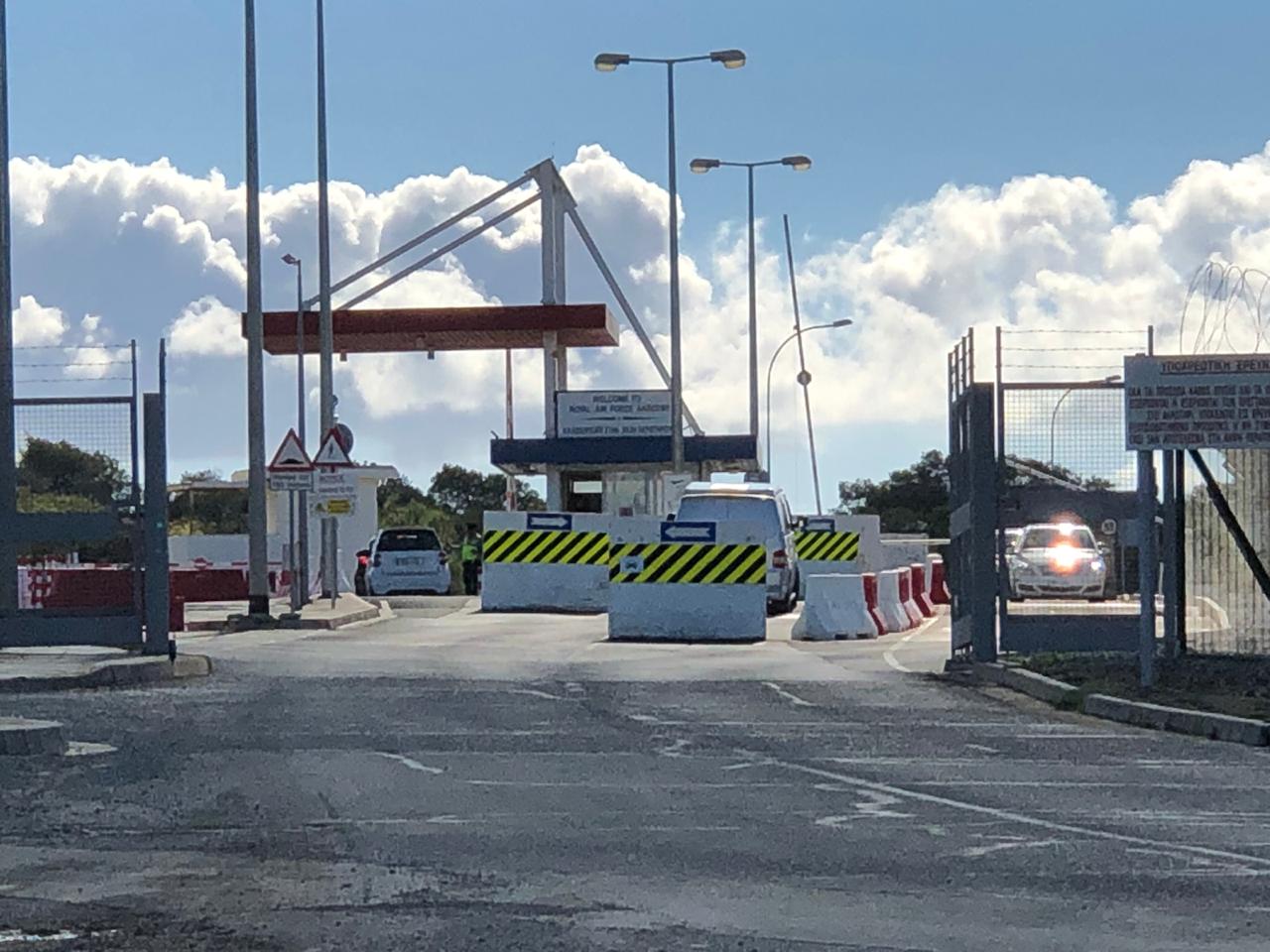
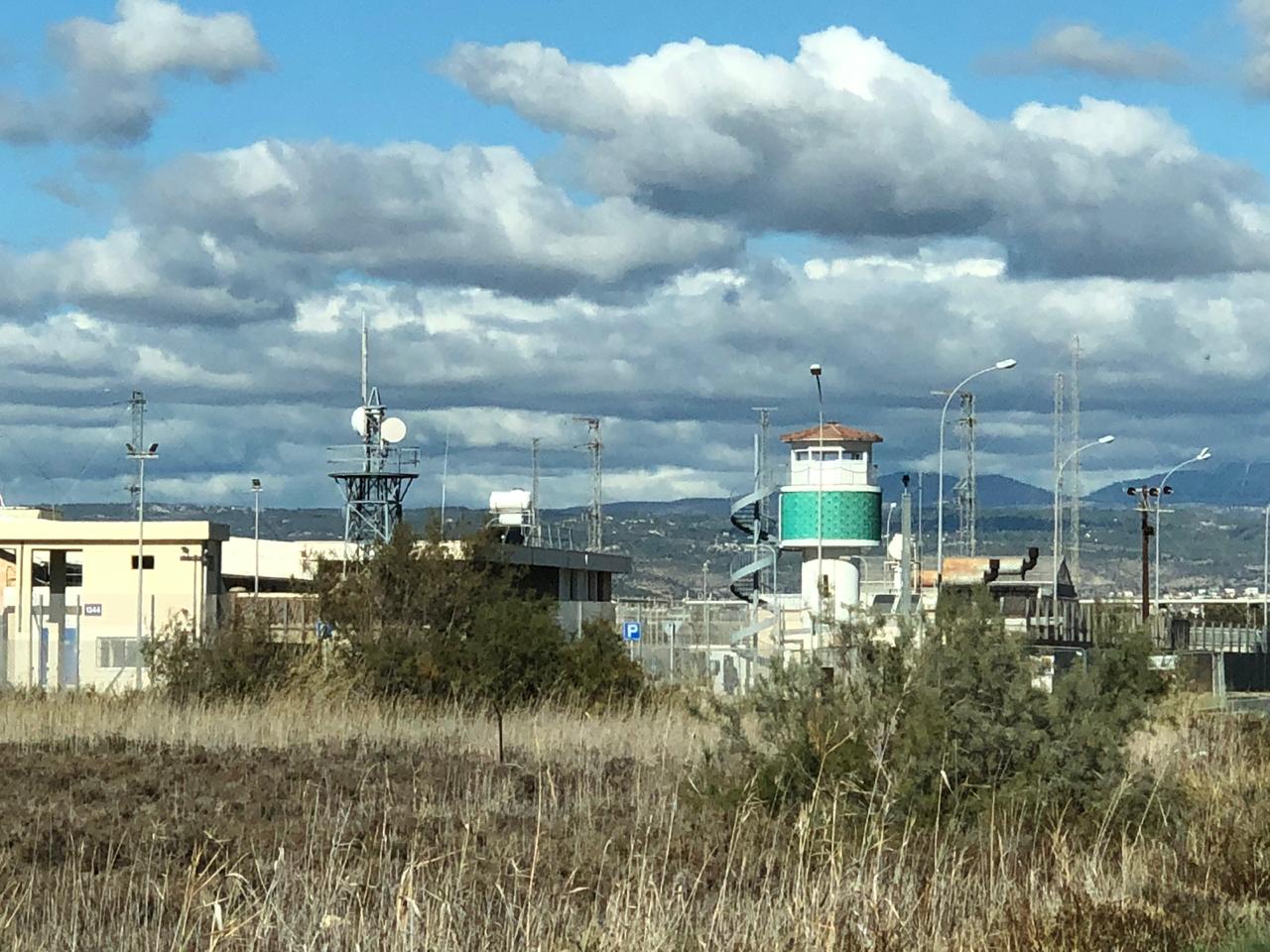
You drive through some agricultural fields, but soon you see something very eerie all around the road: a few kilometers after passing the historic Crusader’s Kolossi Castle, there is an ocean of masts of different heights and shapes, as well as concrete, fortified military installations. The masts are ‘decorated’ with strange looking wires. It all looks like some old Sci-Fi movie.
Of course, if you come ‘prepared’, you know what you are facing: tremendous installations of the BBC propaganda apparatus aimed at destabilizing and indoctrinating the Middle East. But that is not all. This entire enclave – ‘Sovereign Base Areas of Akrotiri’ (as well as Dhekelia a few dozens of miles to the east) – is here mostly in order to spy on the ‘neighborhood’ of the Middle East. While London is some 4 hours flight away, Syria is just a short distance across the water, and so is Lebanon.
Further south, after you leave the propaganda and spy installations behind, is a small village of Akrotiri; a typical picturesque Cypriot charming settlement, with an old church, narrow streets and humble local cafes. It sits on top of the hill. But you are, actually, inside the U.K. From here, you can see the blue sea, a salt lake and the city of Limassol; but you are on British turf. How come? Simple: after Cyprus achieved independence from the British Empire, in 1960, the Brits ‘were concerned’ that they could lose control over their military bases in Cyprus, and at least partially, influence over the Middle East. As this being unimaginable to the British imperialist mind, the U.K. arm-twisted the Cypriots into this bizarre arrangement which holds to this day.
One more kilometer further south, and you hit the wall and a gate, decorated with threatening warnings. You are at the perimeter of the RAF Akrotiri base. From here, since December 2015, the RAF is carrying out illegal (according to international law) airstrikes against the sovereign Syrian Arab Republic.
According to Jeffrey Richelson & Desmond Ball, The Ties the Bind: Intelligence Cooperation between the UKUSA Countries, (Unwin Hyman, Boston/London and others, 1990, p.194 note 145):
“As of 2010, around 3,000 troops of British Forces Cyprus are based at Akrotiri and Dhekelia. Ayios Nikolaos Station, in the ESBA, is an ELINT (electronic intelligence) listening station of the UKUSA Agreement intelligence network.”
That was then, but now things are getting even deadlier. Practically, the U.K. is at war with Syria. Many in Cyprus are deeply concerned that Syria could retaliate, sending missiles against the RAF bases, from which it is being bombed (legally, independent Syria has the full right to defend itself against the attacks from abroad). Such retaliation could endanger the lives of the inhabitants of Cyprus.
There have been protests and demands for the British forces to return to Cyprus both of the ‘sovereign bases’, but the U.K. shows no interest in ceding what it controls.
As early as in 2008, former left-wing President Demetris Christofias (who was also the General Secretary of AKEL, the Communist Party of Cyprus) tried to remove all British forces from the island, calling them a “colonial bloodstain”. However, he did not succeed, and in 2013 he decided to step down and not to seek re-election.
Dhekelia Base is carved into the eastern part of Cyprus, bizarrely encircling both Turkish-controlled and Greek-speaking villages.
In the past, the Cypriots fought against the British presence. Nowadays, in the era of omnipresent surveillance, sabotages and resistance had been replaced by toothless protests. Still, hundreds of local people have been detained, demanding the departure of British troops from the island.
Cyprus is still divided, although reunification talks began, once again, in 2015. Now it is possible to walk between the Republic of Cyprus and Northern Cyprus (controlled by Turkey).
It was not always this way. As Papadakis Yiannis wrote:
“On 15 July 1974, the Greek military junta under Dimitrios Ioannides carried out a coup d’état in Cyprus, to unite the island with Greece.”
Thousands of Turkish residents were displaced, many killed. Turkey invaded and the island got divided. But inter-cultural violence dated even further back than 1974. The history can be felt on every corner of Nicosia, and in many villages of the island. Northern Cyprus was never recognized by any other country except Turkey, but the division is still there. There are still entire de-populated towns that used to belong to the displaced Turkish and Greek inhabitants.
One of the eeriest is Kofinou, in the south of the island, which suffered on at least two occasions, unprecedented ethnic violence, which could be defined as ‘cleansing’. Once inhabited mainly by the Turkish Cypriots, Kofinou is now a ghost town, dotted with collapsed houses and agricultural structures, with foreign guest workers and farm animals living in appalling conditions.
*
Cyprus has two faces. It is proud to be one of the famous European tourist destinations. It is an EU member.
Simultaneously, it is a symbol of division.
Border fences between the Republic of Cyprus and Northern Cyprus are scarring its beautiful countryside. Deadly British military installations, the air force bases, as well as propaganda warfare and disinformation campaigns are brutalizing, physically and morally, almost the entire Middle East.
Here, in Cyprus, European and Russian tourists coexist, uneasily. The ideological war between the West and the rest of the planet is clearly felt in Pathos and other historic areas of the island.
Some British residents (around 50,000 of them), as well as countless British tourists, often behave insultingly towards the generally humble Russian visitors. Here, the British Empire still appears to be ‘in charge’.
In the port of Pathos, I passed by an elderly Russian couple, who seemed to be simply admiring an old water castle. A British couple was passing by, then looked back and forged sarcastic, rude grimaces: “Those Russians,” uttered the man. This was not the only instance when I witnessed this sort of behavior.
In Cyprus, I drove exactly 750 kilometers, all around the island, trying to understand and define its present position, and its role in the ‘area’ and in the world.
I hoped to find reminiscences of at least some revolutionary spirit of the Communist (AKEL) government. But I almost exclusively found pragmatism, so typical for basically all European Union countries. Only questions like this were common: ‘Would Brexit be good or bad for Cyprus?’ Or: ‘Would the bombing of Syria be dangerous for the citizens of Cyprus?’
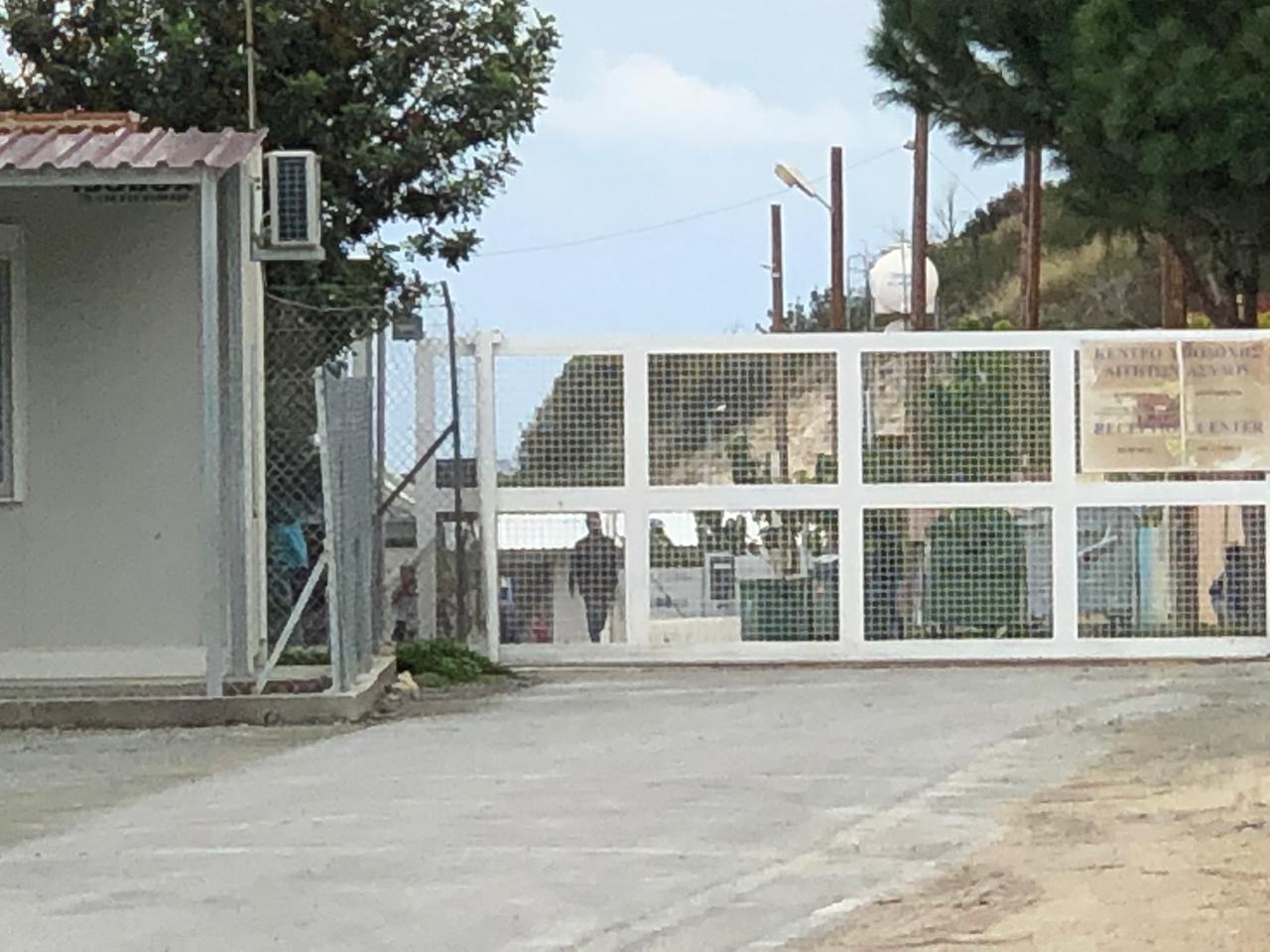
Symbolically, near the village of Kofinou, destroyed by the inter-cultural violence several decades ago, I found a tough-looking refugee camp, built mainly for the immigrants coming from the destabilized Middle East. It looks like a concentration camp. Locals call it, realistically, a ‘prison’. Most likely, it is.
As I was driving around the area, I spotted, just a few kilometers from the camp, in front of an eerie and semi-abandoned farm, a huge goat. It was on its side; dying, in agony, in the middle of the road.
Cyprus has become a divided island with some hedonistic resorts, but also with terribly marginalized communities, located all over its territory.
One could easily conclude: this former British colony is still allowing, for a fee, the tremendous presence of the British/NATO military forces, as well as various spy facilities and propaganda outlets. RAF Tornado jetfighters are presently flying their ‘missions’ against Syria. Missiles are being fired from Akrotiri. People fleeing from the destroyed countries of the Middle East, are then detained in Cyprus, like criminals, behind barbed wire.
In the meantime, the people of Cyprus are calculating, whether all this is truly feasible, or not; whether to be an outpost of the empire is a good business, for as long as it pays, they will do very little to change the situation. Despite of its complex past and present, as well as its proximity to the Middle East, Cyprus is, after all, an integral part of Europe, and therefore of the Western empire.
*
[Originally published by NEO – New Eastern Outlook]
Andre Vltchek is a philosopher, novelist, filmmaker and investigative journalist. He has covered wars and conflicts in dozens of countries. Three of his latest books are Revolutionary Optimism, Western Nihilism, a revolutionary novel “Aurora” and a bestselling work of political non-fiction: “Exposing Lies Of The Empire”. View his other books here. Watch Rwanda Gambit, his groundbreaking documentary about Rwanda and DRCongo and his film/dialogue with Noam Chomsky “On Western Terrorism”. Vltchek presently resides in East Asia and the Middle East, and continues to work around the world. He can be reached through his website and his Twitter.


https://www.globalresearch.ca/cyprus-uk-air-force-bases-against-middle-east-propaganda-and-tourism/5663724


JUST NEWS published this article following the Creative Commons rule. If you don't want your article to appear in this blog email me and I will remove it asap.