Global Research, April 15, 2019

Abshir’s
Just over a week ago Abshir, from Somalia, was transferred from Samos to a mainland refugee camp at Nea Kavala in northern Greece. He was part of around 350 refugees taken that day from Samos as part of the Government’s attempt to ease pressure on the massively overcrowded camp in Vathi. All of them left on the ferry to Athens and in Abshir’s case with some others, he was bussed north. In all a journey of nearly 24 hours. No food or drink provided.
Abshir was very nervous about this move. He did not want to leave Samos. After 5 months this shy gay young man from Somalia was at last feeling more comfortable. UNHCR had recognised that it was not safe for Abshir, on account of his sexuality, to stay in the camp which led to the Greek NGO, Arsis, funded by the UNHCR, to provide him with a single room in a modern shared apartment. It was not five star but it was a million times better than the tent he had in the jungle around the camp. He had access to a shower, washing machine, kitchen, wi fi; he had his room and he was warm and dry. As he grew in confidence he made some close friends and started Greek language classes, again funded by UNHCR. He was also making plans to create a small business.
If Abshir refused to move he would lose his monthly UNCHR allowance and his accommodation. Without any family support or other sources of regular income he felt he had no choice. So his focus shifted to finding out what he could expect when he got to Nea Kavala and to ensure that his case papers were transferred. Basically he was told that he need have no worry and that he would continue to receive the appropriate care although he would be need to be patient as they had many people arriving in Nea Kavala, especially from the frontier islands of Kos, Lesvos and Samos.
Since arriving in Nea Kavala Abshir has been living in a tent. He has one blanket. Most nights he is cold. He sleeps on the floor.
Image on the right: Abshir’s Tent

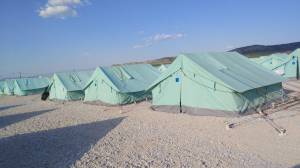
The tent sits on stones so the floor is uncomfortable. It has no electricity, no furniture, no wi fi access, no cooking facilities. The meals are basic and he can’t eat them as they give him a bad stomach pain. Hours are spent in lines – for food, for the showers, for the toilet. The water is heated by solar panels so in the early mornings the water is cold. This is when Abshir showers as there is no line. The laundry is overwhelmed and gives priority to established residents. He tells me that even if could find a way to wash his clothes he would have to sit and watch them. There is so much hardship in the camp that nothing is secure. Already he has had milk and bread and some money taken from his tent. Many people are very hungry he said. The only consolation is that he is alone in the tent, but he has been told that this could change at any time as new refugees arrive.
The camp which is home to over 700 refugees is isolated. The few facilities on offer are provided by a Danish NGO which is UNHCR funded. UNHCR and the Asylum Service have no permanent presence in the camp. Neither do any lawyers. So when they make their twice weekly visits they are overwhelmed. Absher has met with the lawyers who told him that he would have to wait. They did tell him however, that his papers had not yet arrived.
There is a supermarket around 20 minutes walk from the camp and the nearest town 45 minutes on foot.
Image below: Nea Kavala Camp
Abshir is not alone in finding the camp a bad place to be. On April 10th an asylum lawyer came to meet all those who were recently transferred with Abshir from Samos and to give them some sense of what they could expect with respect to the asylum process. They were told that they would need to be patient as their papers had not yet arrived from Samos. This came as no surprise to Abshir but what was more noticeable was that of the 350 who came together from Samos less than a 100 were at the meeting. According to Abshir, there was so much anger and disgust at the conditions in the camp – sleeping in tents, cold, terrible food, no electricity, its isolation and more – that those who could were leaving.
Heading for the border, or to Athens, or to Thessaloniki, leaving behind those such as families who could not move so easily. And this is what they told the asylum lawyer when he asked why there were so few of them at the meeting. There was much anger in particular over the cutting of their UNHCR allowances from 140 to 90 euros a month on account that they were now being fed in the camp and no longer were responsible for their own food. The lawyer’s response was that he had nothing to say about the conditions they were complaining of as he was only responsible for the asylum process. But he urged them to be patient and not to demonstrate because if they did the police would certainly come in and jail them.
One can only wonder how many of these 350 would have boarded the ferry in Vathi at the beginning of April if they knew what was waiting for them?
A little over a week ago Abshir had his own room in the town centre of Vathi……..
Saad’s
Image on the right: Saad’s Living Room
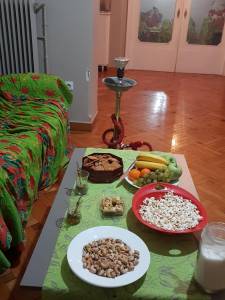
At the same time as Abshir was being moved from Samos, Saad was moved from his apartment in Athens. In both instances they were given no choice. In Saad’s case he was moved by Praksis, a Greek NGO funded by UNHCR to provide housing for vulnerable refugees.
Alongside Saad there were two other refugees each with their own room. Most importantly, the apartment had a decent sized sitting room where Saad’s friends would meet to talk, to smoke shisha and to pass the time. There was also a balcony and all the bedrooms were furnished with wardrobes and cupboards. And over 18 months they had made the place into a comfortable home adding rugs, chairs, couches (most of them from the street) and pictures and photos on the walls.
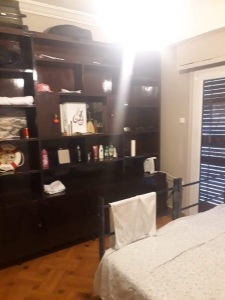
Now Saad and his co tenants are in an apartment with just 2 rooms, no sitting area, no balcony, and no furniture. It is in poor condition.One of them has created a tent in the lobby and now sleeps there so Saad has his own room. Currently he has a bed and 12 boxes and bags with his belongings. Nothing else. Praksis told him that they can give them nothing more and that they should be happy not to be living out on the streets.
Saad and his co-tenants are furious with Praksis both with respect to what they have done and how they have done it. They say they can do nothing but Saad refuses to accept this and plans to appeal directly to UNHCR. As he said, at the end of the day he may get nowhere but he is determined that they should at least realise what they have done is inhumane, cruel and unacceptable.
Image below: Saad’s bedroom
Saad has been with Praksis long enough to know how to contact them. This is not a common experience for refugees as most of the agencies involved in the lives of refugees have developed a range of practices and mechanisms which make direct contact with someone who might know something about your case almost impossible. This was why Abshir was so concerned to ensure that information about his case should be transferred to Nea Kavala as he knew that once away from Samos, all the contacts he had made there would no longer be available to him and he would have to start afresh in the new camp. He has no named contact person and there is no continuity in his case management. This is the most common experience for all the refugees here.
Neither Saad or Abshir were given any clear reason for why they had to move. Neither were asked about how they felt and above all no choice. In Saad’s case the Praksis workers knew that the 3 refugees hated what they were given and that all are very angry. But no alternative is offered nor is there any attempt to work together to find a better place. It’s Praksis or nothing. As it stands at the time of writing, Praksis has now agreed to look for a more suitable apartment for the three of them but none of them is expecting much.
Living Space and Survival
Many issues are highlighted in these two stories.
Firstly, the powerlessness of the refugees over where and how they live. Their needs and voices are simply ignored. Refugees are given little or no notice whether it is moving house or moving off an island. Abshir and Saad had 5 days notice. As I write, the minster for migration is on Samos for a few days and he has just announced that when he leaves at the end of the week he will be taking hundreds of refugees with him on a Greek navy boat. I wonder if the refugees affected have been told yet? ( 494 refugees, all classed as vulnerable, were taken by a Navy ship to Athens on April 13th.) The casual way in which the agencies act in moving refugees without any negotiation or discussion; a complete disregard of their needs and circumstances reveals (once more) the fundamental lack of solidarity and respect for refugees.
Secondly, there is no sign that the authorities grasp or understand the critical importance of place (home, locality,) for refugees as they wait for the asylum system to process their applications. In Saad’s case, he has been in Greece since October 2016 and in Athens for over 2 years waiting for his final interview in June this year. As with thousands of other refugees his ability to survive these months where his life is virtually stopped has been down to his friends. In Saad’s case his apartment became part of a network of places where friends could meet and in many cases find a bed in an emergency. His home has been crucial to his well-being. This has now been taken away from him.
Abshir has his asylum interview scheduled for January 2021. As far as he knows he could be in Nea Kavala camp for 2 years.
Thirdly, these stories challenge the widely held view that refugees are better off being moved to the mainland from the camps on the frontier islands. It would seem that many assume that the conditions there would [must] be better than Samos.
There are simply no reservations to the mantra of de-congest the frontier islands of refugees. It is a mantra shared across the political spectrum and voiced by virtually every refugee agency/NGO in Greece. Here on Samos no questions are asked about where and what happens to the refugees who are moved. Of course no one asks the refugees what they think.
But there is no innocence to de-congestion. The authorities and the NGOs know very well that what awaits many of the refugees on the mainland will mark no improvement in their lives and may very well be worse than what they have left behind on the islands. But they say nothing to those leaving and do what they can to stop people from refusing to leave.
There is also a madness to de-congestion. In the week Abshir left with 350 refugees for Athens – heralded on Samos for relieving the pressure on the camp – a similar number of new refugees arrived. It is like watching a child trying to empty a bath whilst the water continues to pour in.
The camp in Vathi is an outrage. No argument. But then you are drinking tea with a 34 year old refugee from Gaza who has beautifully painted and fitted out the recently opened Banana House, a new refugee space, in Vathi. In the process of drinking tea he shows the photos of his tent in the jungle around the camp. It is amazing. From the outside it looks as desperate as all the other tents and shelters clustered amongst the olive trees. But! Inside his home made cabin under the trees he has created a place of wonder and comfort. It has a floor, carpets, store cupboards on the wall, a fire place, and a small kitchen area. He lives there with his wife and daughter. The man is a genius. There are many others maybe not as talented but who have created some comfort in such extreme conditions. They and not the authorities have done this. It is theirs. For many, their resilience as refugees rests on these kinds of activities and the spaces they create for living, meeting and talking; passing time as best they can as they wait. All these factors make arbitrary removals highly disruptive and damaging.
Without doubt after being detained on Samos being moved to the mainland carries more than the scent of a new freedom. For some their detention on Samos has been for up to 2 years and all have been on Samos for months. So it is with some hope they leave the island for the mainland.
But the way in which these movements of refugees – big and small- are managed makes them problematic and flawed. When it suits, major NGOs amongst others will draw attention to the trauma of refugees and in particular the psychological damage to refugees from being corralled in disgusting camps as on Samos. But what of their compliance in the cruelties such as moving people from their homes without notice or discussion. Silence. Where in this one part of the refugee experience in Greece does one get a clear sense that refugees are human beings with all our individual and paradoxical dimensions? Nowhere. Watching the refugees who are being moved off on the ferries is like watching sheep being herded. It is dehumanising.
Sometimes small individual stories take us to much bigger issues and in so doing reveal much especially illustrating the impact of macro policy and ideology on lived daily experiences. Abshir and Saad’s stories are such examples. For as they share their experiences we see just how pernicious and damaging is the European insistence of placing deterrence at the very centre of its refugee practices at least with respect to the kinds of refugees that come to islands like Samos. (It does not apply to those with wealth and who are offered ‘golden’ visas and the like.) As we see every day on Samos, deterrence allows no space for humanity; for dignity and respect. Deterrence does not allow for compassion and care. It is the very opposite of solidarity. And for the refugees the consequences are lethal at worst and distress at best.
(With thanks to Abshir and Saad. Your photos are great too!)
*
Note to readers: please click the share buttons below. Forward this article to your email lists. Crosspost on your blog site, internet forums. etc.
This article was originally published on Samos Chronicles.
The original source of this article is Global Research
Copyright © Chris Jones, Global Research, 2019
https://www.globalresearch.ca/moving-stories-from-poverty-to-despair-refugees-moved-from-greeces-samos-island-to-the-mainland/5674487
JUST NEWS published this article following the Creative Commons rule. If you don't want your article to appear in this blog email me and I will remove it asap.


