JUST NEWS

Posting Against the Matrix Information Lies

Showing posts with label War economy. Show all posts

Wednesday, June 26, 2019

Arms Dealers and Lobbyists Get Rich as Yemen Burns


By Barbara Boland
Global Research, June 26, 2019

The American Conservative 25 June 2019


Chronic human rights violator Saudi Arabia is using American-made weapons against civilians in the fifth-poorest nation in the world, Yemen. And make no mistake: U.S. defense contractors and their lobbyists and supporters in government are getting rich in the process.
“Our role is not to make policy, our role is to comply with it,”John Harris, CEO of defense contractor Raytheon International, said to CNBC in February.
But his statement vastly understates the role that defense contractors and lobbyists play in Washington’s halls of power, where their influence on policy directly impacts their bottom lines.
Since 2015, Saudi Arabia and the United Arab Emirates have waged war against Yemen, killing and injuring thousands of Yemeni civilians. An estimated 90,000 people have been killed, according to one international tracker. By December 2017, the number of cholera cases in Yemen had surged past one million, the largest such outbreak in modern history. An estimated 113,000 children have died since April 2018 from war-related starvation and disease. The United Nations calls the situation in Yemen the largest humanitarian crisis on earth, as over 14 million face starvation.
The majority of the 6,872 Yemeni civilians killed and 10,768 wounded have been victims of Saudi-led coalition airstrikes, according to the Office of the United Nations High Commissioner for Human Rights (OHCHR). Nearly 90 coalition airstrikes have hit homes, schools, markets, hospitals, and mosques since 2015, according to Human Rights Watch. In 2018, the coalition bombed a wedding, killing 22 people, including eight children. Another strike hit a bus, killing at least 26 children.
American-origin munitions produced by companies like Lockheed Martin, Boeing, General Dynamics, and Raytheon were identified at the site of over two dozen attacks throughout Yemen. Indeed, the United States is the single largest arms supplier to the Middle East and has been for decades, according to a report by the Congressional Research Service.
From 2014 to 2018, the United States supplied 68 percent of Saudi Arabia’s arms imports, 64 percent of the UAE’s imports, and 65 percent of Qatar’s imports. Some of this weaponry was subsequently stolen or sold to al-Qaeda linked groups in the Arabian Peninsula, where they could be used against the U.S. military, according to reports.
The Saudi use of U.S.-made jets, bombs, and missiles against Yemeni civilian centers constitutes a war crime. It was an American laser-guided MK-82 bomb that killed the children on the bus; Raytheon’s technology killed the 22 people attending the wedding in 2018 as well as a family traveling in their car; and another American-made MK-82 bomb ended the lives of at least 80 men, women, and children in a Yemeni marketplace in March 2016.
Yet American defense contractors continue to spend millions of dollars to lobby Washington to maintain the flow of arms to these countries. 
“Companies like Lockheed Martin, Raytheon, Boeing, and other defense contractors see countries like Saudi Arabia and the UAE as huge potential markets,” Stephen Miles, director of Win Without War, told TAC. “They see them as massive opportunities to make a lot of money; that’s why they’re investing billions and billions of dollars. This is a huge revenue stream to these companies.”
Boeing, Raytheon, and General Dynamics have all highlighted business with Saudi Arabia in their shareholder reports.
“Operations and maintenance have become a very profitable niche market for U.S. corporations,” said Richard Aboulafia, a vice president at Teal Group.
He added that defense contractors can make as much as 150 percent more profit off of operations and maintenance than from the original arms sale. U.S. weapons supply 57 percent of the military aircraft used by the Royal Saudi Air Force, and mechanics and technicians hired by American companies repair and maintain their fighter jets and helicopters.
In 2018 alone, the United States made $4.5 billion worth of arms deals to Saudi Arabia and $1.2 billion to the United Arab Emirates, a report by William Hartung and Christina Arabia found.
From the report:
“Lockheed Martin…was involved in deals worth $25 billion; Boeing, $7.1 billion in deals; Raytheon, $5.5 billion in deals; Northrop Grumman had one deal worth $2.5 billion; and BAE systems…had a $1.3 billion deal.”
“Because of the nature of U.S. arms control law, most of these sales have to get government approval, and we’ve absolutely seen lobbyists weighing in heavily on this,” Miles said. “The last time I saw the numbers, the arms industry had nearly 1,000 registered lobbyists. They’re not on the Hill lobbying Congress about how many schools we should open next year. They’re lobbying for defense contractors. The past 18 years of endless wars have been incredibly lucrative for the arms industry, and they have a vested industry in seeing these wars continue, and not curtailing the cash cow that…has been for them.”
The defense industry spent $125 million on lobbying in 2018. Of that, Boeing spent $15 million on lobbyists, Lockheed Martin spent $13.2 million, General Dynamics $11.9 million, and Raytheon $4.4 million, according to the Lobbying Disclosure Act website.
Writes Ben Freeman:
According to a new report…firms registered under the Foreign Agents Registration Act have reported receiving more than $40 million from Saudi Arabia in 2017 and 2018. Saudi lobbyists and public relations professionals have contacted Congress, the executive branch, media outlets and think tanks more than 4,000 times. Much of this work has been focused on ensuring that sales of U.S. arms to Saudi Arabia continue unabated and blocking congressional actions that would end U.S. support for the Saudi-led coalition in Yemen. …
Lobbyists, lawyers and public relations firms working for the Saudis have also reported doling out more than $4.5 million in campaign contributions in the past two years, including at least $6,000 to Trump. In many cases, these contributions have gone to members of Congress they’ve contacted regarding the Yemen war. In fact, some contributions have gone to members of Congress on the exact same day they were contacted by Saudi lobbyists, and some were made to key members just before, and even on the day of, important Yemen votes.
Over a dozen lobbying firms employed by defense contractors have also been working on behalf of the Saudi or Emiratis, efficiently lobbying for both the arms buyers and sellers in one fell swoop. One of these lobbying firms, the McKeon Group, led by former Republican congressman and chairman of the House Armed Services Committee Howard McKeon, represents both Saudi Arabia and the American defense contractors Lockheed Martin, Northrop Grumman, Orbital ATK, MBDA, and L3 Technologies. Lockheed Martin and Northrup Grumman are the biggest suppliers of arms to Saudi Arabia. In 2018, the McKeon Group took $1,697,000 from 10 defense contractors “to, among other objectives, continue the flow of arms to Saudi Arabia,” reports National Memo.
Freeman details multiple examples where lobbyists working on behalf of the Saudis met with a senator’s staff and then made a substantial contribution to that senator’s campaign within days of a key vote to keep the United States in the Yemen war.
American Defense International (ADI) represents the United Arab Emirates, Saudi Arabia’s coalition partner in the war against Yemen, as well as several American defense contractors, including General Dynamics, Northrup Grumman, Raytheon, L3 Technologies, and General Atomics.
Not to be outdone by the McKeon Group, ADI’s lobbyists have also aggressively pursued possible swing votes in the U.S. Senate for the hefty sum of $45,000 a month, paid for by the UAE. ADI lobbyists discussed the “situation in Yemen” and the “Paveway sale to the UAE,” the same bomb used in the deadly wedding strike, with the office of Senator Martin Heinrich, a member of the Armed Services Committee, according to FARA reports. ADI’s lobbyists also met with Congressman Steve Scalise’s legislative director to advise his office to vote against the congressional resolution on Yemen. For their lobbying, Raytheon paid ADI $120,000 in 2018.
In addition to the overt influence exercised by lobbyists for the defense industry, many former arms industry executives are embedded in influential posts throughout the Trump administration: from former Airbus, Huntington Ingalls, and Raytheon lobbyist Charles Faulkner at the State Department, who pushed Mike Pompeo to support arms sales in the Yemen war; to former Boeing executive and erstwhile head of the Department of Defense Patrick Shanahan; to his interim replacement Mark Esper, secretary of the Army and another former lobbyist for Raytheon.
The war in Yemen has been good for American defense contractors’ bottom lines. Since the conflict began, General Dynamics’ stock price has risen from about $135 to $169 per share, Raytheon’s from about $108 to more than $180, and Boeing’s from about $150 to $360, according to In These Times. Their analysis found that those four companies have had at least $30.1 billion in Saudi military contracts approved by the State Department over the last 10 years.
In April, President Donald Trump vetoed a resolution that would have ended American support for the Saudi-UAE coalition war against Yemen. Such efforts have failed to meet the 60-vote veto-proof threshold needed in the Senate.
There are a few senators who didn’t vote for the War Powers resolution “that will probably vote for the Raytheon sales,” Brittany Benowitz, a lawyer and former adviser to a member of the Senate Foreign Relations Committee, told TAC. “I think you’ll continue to see horrific bombings and as the famine rages on, people will start to ask, ‘Why are we a part of this war?’ Unfortunately, I don’t think that will start to happen anytime soon.”
*
Note to readers: please click the share buttons above or below. Forward this article to your email lists. Crosspost on your blog site, internet forums. etc.
Barbara Boland is TAC’s foreign policy and national security reporter. Follow her on Twitter @BBatDC
Featured image: 360b/Shutterstock By Fabian Res /Flickr; F-16 drops MK82 bombs (USAF photo); Child victim of attack in which MK82 bomb built by Lockheed Martin was dropped on his school bus Aug. 9, 2018. (VOA/Screengrab)
US Bomb Pieces Found at Yemen Bus Strike Site as Pentagon Says ‘We May Never Know’ Who Supplied It

The original source of this article is The American Conservative
Copyright © Barbara Boland, The American Conservative, 2019

https://www.globalresearch.ca/arms-dealers-lobbyists-get-rich-yemen-burns/5681821


JUST NEWS published this article following the Creative Commons rule. If you don't want your article to appear in this blog email me and I will remove it asap.
Follow @counter_info
By Jaime C. at June 26, 2019 No comments:
Email ThisBlogThis!Share to XShare to FacebookShare to Pinterest
Tags U.K., U.S., War economy, Yemen

Tuesday, June 25, 2019

The Geopolitics of World War III


By StormCloudsGathering
The U.S. dollar is a unique currency for many reasons, though the reasons that matter most are not necessarily widely known.
Posted June 24, 2019

Prior to 1971, the U.S. dollar was bound to the gold standard - or at least that is what the world operated under the belief of. The filmmakers highlight that the International Monetary Fund reports that in 1966, foreign central banks and governments held 14 billion U.S. dollars. While the United States did have $13.2 billion in gold reserves, most of that was needed to cover domestic holdings and only $3.2 billion of it was available for foreign holdings. What that means is the U.S. was printing more money than it could cover, and inflation naturally ensued. To quell the fire, the Richard Nixon presidential administration took the dollar off the gold standard and made it a debt-based currency.

Through various political arrangements, the filmmakers suggest that the U.S. then tied the dollar to oil trade to keep its demand up, a system that remained in place at America's convenience until the year 2000 - right before 9/11, mind you - when Iraqi leader Saddam Hussein declared he was shifting their oil trade from the dollar to the euro. This is said to be the catalyst behind all the post-9/11 military action, not anti-terrorism efforts, and that these dollar-undermining decisions by foreign governments continue to shape the U.S. military agendatoday in regards to policy against Russia and Syria.

http://www.informationclearinghouse.info/51823.htm

JUST NEWS published this article following the Creative Commons rule. If you don't want your article to appear in this blog email me and I will remove it asap.
Follow @counter_info
By Jaime C. at June 25, 2019 No comments:
Email ThisBlogThis!Share to XShare to FacebookShare to Pinterest
Tags U.S., War economy

Thursday, June 20, 2019

Sanctions Are “Genocidal”, and They Are America’s “Favorite Weapon”


By Justin Podur
Global Research, June 20, 2019

podur.org 12 June 2019

After withdrawing from the nuclear deal with Iran last year and resuming sanctions last November, the White House in April announced that its goal was to “drive Iranian exports to zero.” To make this drive happen, the White House stopped allowing (my emphasis) countries like India, China, Japan, Turkey, and South Korea to import Iranian oil: dictating to sovereign countries whom they can trade with.
The dictating doesn’t stop there. Last December the United States had Canadian authorities detain and imprison a Chinese executive, the chief financial officer of telecom company Huawei. Meng Wanzhou is currently on trial in Canada, on the allegation that her company violated U.S. sanctions against Iran. Not content with having told China that it cannot trade with Iran, the United States has gotten a third country, Canada, to take a Chinese corporate executive captive in what Trump suggested was leverage for a trade deal:
“If I think it’s good for what will be certainly the largest trade deal ever made, which is a very important thing—what’s good for national security—I would certainly intervene, if I thought it was necessary,” he told Reuters in December.
The trade deal with China didn’t come through, and a “trade war” has begun. Meng Wanzhou is still stuck in Canada. And the blockade against Iran is still tightening. Economist Mark Weisbrot assessed some of the damage to the Iranian economy in a recent segment on the Real News Network, noting that when sanctions were imposed in 2012, oil production dropped by 832,000 barrels per day and GDP by 7.7 percent; when they were lifted in 2016 in the nuclear deal, production increased by 972,000 barrels per day and GDP increased by 12 percent that year. In 2018 when sanctions were imposed, oil production fell dramatically again and inflation rose by 51 percent; shortages of dozens of essential medicines, according to a study at the University of California, have followed.
Some basic economics are in order here. A country that does not need to import or export is called an autarky, and in today’s global economy there are no autarkies. All national economies depend on trade: they export, earn foreign currency, and use that to import what they cannot produce. Driving a country’s exports to zero means destroying the country’s economy, and depriving the country’s people of necessities.
Sometimes billed as an alternative to war, sanctions are in fact a weapon of war. Far from precision-guided munitions, sanctions are weapons of starvation, which target the most vulnerable civilians for slow and painful death by deprivation of food and medicine. They are an alternative to war in the sense that unlike the invasion of ground troops or even the dropping of bombs, they pose little risk to the aggressor. This is their appeal to someone like Trump, who revealed the genocidal intent behind the Iran sanctions when he threatened (on Twitter) “the official end of Iran.”
U.S. Sanctions: Economic Sabotage that Is Deadly, Illegal and Ineffective
In the 1990s, one focus of the antiwar movement was the impact of the genocidal sanctions against Iraq, which killed 500,000 children (a “price” that Madeleine Albright famously said was “worth it”). Antiwar activists feared that the sanctions were part of a military strategy that would end in even more devastating shooting war. Those fears proved true. Today’s sanctions seem to draw from the same playbook.
International law recognizes that sanctions are a form of warfare, and places the use of the sanctions weapon in the hands of the United Nations Security Council. And so it happened that between the 1990 and 2003 U.S. wars on Iraq, the UN played the shameful role of administering the Iraq sanctions. But today’s unilateral sanctions imposed by the U.S. circumvent any UN legalities. In the same Real News segment, UN Special Rapporteur on Unilateral Coercive Measures Idriss Jazairy noted that about one-quarter of the world’s population is under some form of unilateral sanctions. Iran, Venezuela, Syria, Cuba, Sudan and others are under various U.S. sanctions regimes. Yemen is fully blockaded by the U.S., UK, and Saudi Arabia; Gaza and the West Bank are completely sealed in by Israel; Qatar is blockaded by Saudi Arabia and the UAE, and the list goes on.
U.S. sanctions against Venezuela have already killed 40,000 people between 2017 and 2018, according to a report by Mark Weisbrot and Columbia University’s Jeffrey Sachs. The more intense sanctions imposed in 2019 will kill still more. Venezuela’s electrical grid is damaged, most likely because of sabotage. Maintenance of potable water pumps has become impossible without imported spare parts, leaving millions without water. A Venezuelan professor of economics, Pasqualina Curcio, told a delegation of the End Venezuela Sanctions coalition that sanctions have cost the country $114 billion, “which is nearly equal to one year’s worth of Venezuelan GDP at a typical oil price, or 26 years’ worth of medical imports.”
One of the tactical arguments anti-sanctions campaigners sometimes make is that sanctions “don’t work.” And for their declared purpose of “regime change,” indeed they do not. But when a policy is so widespread, such a first resort, perhaps the declared purpose is not the real purpose. If the purpose is to destroy economies, isolate countries, coerce allies, keep tensions near boiling and maintain a constant threat of war, sanctions are successful. It has been shown time and again that torture “doesn’t work” for obtaining information. But torture is not a technique for obtaining information. It is a technique for breaking a person and, when practiced on a mass scale by an apartheid state or dictatorship, for breaking a society. Sanctions are similar: the point is to break the society, not “regime change.”
Sanctions are Trump’s favorite weapon, but good Democrats are no different. Obama oversaw the destruction of Syria, Clinton laughed about the murder of Gaddafi and the destruction of Libya, and Albright said that 500,000 Iraqi children’s deaths were “worth it.” For the empire, genocide, like aggression, is a normal part of politics. Nuclear planners plan how to commit it. Sanctions officials administer it. And for the most part, human rights organizations take no position on it.
It is possible that at some point sanctions could become self-limiting. If enough countries are sanctioned, they might of course decide to trade with one another. In attempting to isolate so many big countries, the United States could isolate itself, creating a kind of “coalition of the sanctioned.” But from the U.S. perspective, with Brazil, India, and Egypt (the biggest countries in Latin America, South Asia, and the Arab world) all utterly subservient, perhaps this looks like a good moment to try to pressure China, Russia, Iran, Venezuela and Cuba. Trump’s planners can rest assured that it is not them, but millions of innocents in those countries who will pay for their power plays.
*
This article was produced by Globetrotter, a project of the Independent Media Institute.
Note to readers: please click the share buttons above or below. Forward this article to your email lists. Crosspost on your blog site, internet forums. etc.
Justin Podur is Associate Professor at York University’s Faculty of Environmental Studies. He is the author of Haiti’s New Dictatorship (Pluto, Between the Lines, and Palgrave-Macmillan 2012). His writings can be found at podur.org.
Featured image is from podur.org

The original source of this article is podur.org
Copyright © Justin Podur, podur.org, 2019


https://www.globalresearch.ca/sanctions-genocidal-they-us-favorite-weapon/5681236

JUST NEWS published this article following the Creative Commons rule. If you don't want your article to appear in this blog email me and I will remove it asap.
Follow @counter_info
By Jaime C. at June 20, 2019 No comments:
Email ThisBlogThis!Share to XShare to FacebookShare to Pinterest
Tags U.S., War economy

Tuesday, June 18, 2019

U.S. Sanctions: Economic Sabotage that Is Deadly, Illegal and Ineffective


By Medea Benjamin and Nicolas J. S. Davies
Global Research, June 18, 2019

While the mystery of who is responsible for sabotaging the two tankers in the Gulf of Oman remains unsolved, it is clear that the Trump administration has been sabotaging Iranian oil shipments since May 2, when it announced its intention to “bring Iran’s oil exports to zero, denying the regime its principal source of revenue.” The move was aimed at China, India, Japan, South Korea and Turkey, all nations that purchase Iranian oil and now face U.S. threats if they continue to do so. The U.S. military might not have physically blown up tankers carrying Iranian crude, but its actions have the same effect and should be considered acts of economic terrorism.
And this isn’t the only place suffering from US economic terrorism. The Trump administration is also committing a massive oil heist by seizing $7 billion in Venezuela’s oil assets — keeping the Maduro government from getting access to its own money. According to John Bolton, the sanctions on Venezuela will affect $11 billion worth of oil exports in 2019. The Trump administration also threatens shipping companies that carry Venezuelan oil. Two companies–one based in Liberia and the other in Greece–have already been slapped with penalties for shipping Venezuelan oil to Cuba. No gaping holes in their ships, but economic sabotage nonetheless.
Whether in Iran, Venezuela, Cuba, North Korea or one of the 20 countries under the boot of U.S. sanctions, the Trump administration is using its economic weight to try to exact regime change or major policy changes in countries around the globe.
Deadly
The U.S. sanctions against Iran are particularly brutal. While they have utterly failed to advance U.S. regime change goals, they have provoked growing tensions with U.S. trading partners across the world and inflicted terrible pain on the ordinary people of Iran.  Although food and medicines are technically exempt from sanctions, U.S. sanctions against Iranian banks like Parsian Bank, Iran’s largest non-state-owned bank, make it nearly impossible to process payments for imported goods, and that includes food and medicine. The resulting shortage of medicines is sure to cause thousands of preventable deaths in Iran, and the victims will be ordinary working people, not Ayatollahs or government ministers.
U.S. corporate media have been complicit in the pretense that U.S. sanctions are a non-violent tool to inflict pressure on targeted governments in order to force some kind of democratic regime change. U.S. reports rarely mention their deadly impact on ordinary people, instead blaming the resulting economic crisis solely on the governments being targeted.
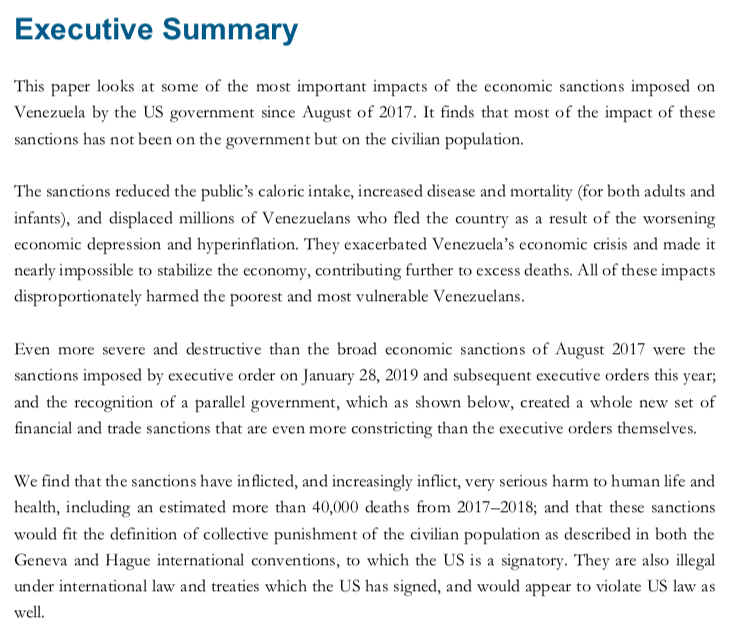
The deadly impact of sanctions is all too clear in Venezuela, where crippling economic sanctions have decimated an economy already reeling from the drop in oil prices, opposition sabotage, corruption and bad government policies. A joint annual report on mortality in Venezuela in 2018 by three Venezuelan universities found that U.S. sanctions were largely responsible for at least 40,000 additional deaths that year.  The Venezuela Pharmaceutical Association reported an 85% shortage of essential medicines in 2018.
Source: CEPR
Absent U.S. sanctions, the rebound in global oil prices in 2018 should have led to at least a small rebound in Venezuela’s economy and more adequate imports of food and medicine. Instead, U.S. financial sanctions prevented Venezuela from rolling over its debts and deprived the oil industry of cash for parts, repairs and new investment, leading to an even more dramatic fall in oil production than in the previous years of low oil prices and economic depression. The oil industry provides 95% of Venezuela’s foreign earnings, so by strangling its oil industry and cutting Venezuela off from international borrowing, the sanctions have predictably – and intentionally – trapped the people of Venezuela in a deadly economic downward spiral.
A study by Jeffrey Sachs and Mark Weisbrot for the Center for Economic and Policy Research, titled“Sanctions as Collective Punishment: the Case of Venezuela,” reported that the combined effects of 2017 and 2019 U.S. sanctions are projected to lead to an astounding 37.4% decline in Venezuela’s real GDP in 2019, on the heels of a 16.7% decline in 2018 and the over 60% drop in oil prices between 2012 and 2016.
Venezuela: The U.S.’s 68th Regime Change Disaster
In North Korea, many decades of sanctions, coupled with extended periods of drought, have left millions of the nation’s 25 million people malnourished and impoverished. Rural areas in particular lack medicine and clean water. Even more stringent sanctions imposed in 2018 banned most of the country’s exports, reducing the government’s ability to pay for imported food to alleviate the shortages.
Illegal
One of the most egregious elements of U.S. sanctions is their extraterritorial reach. The U.S. slaps third-country businesses with penalties for “violating” U.S. sanctions. When the U.S. unilaterally left the nuclear deal and imposed sanctions, the U.S. Treasury Department bragged that in just one day, November 5, 2018, it sanctioned more than 700 individuals, entities, aircraft, and vessels doing business with Iran. Regarding Venezuela, Reuters reported that in March 2019 the State Department had “instructed oil trading houses and refiners around the world to further cut dealings with Venezuela or face sanctions themselves, even if the trades made are not prohibited by published U.S. sanctions.”
An oil industry source complained to Reuters, “This is how the United States operates these days. They have written rules, and then they call you to explain that there are also unwritten rules that they want you to follow.”
U.S. officials say that sanctions will benefit the people of Venezuela and Iran by pushing them to rise up and overthrow their governments. Since the use of military force, coups and covert operations to overthrow foreign governments have proven catastrophic in Afghanistan, Iraq, Haiti, Somalia, Honduras, Libya, Syria, Ukraine and Yemen, the idea of using the dominant position of the U.S. and the dollar in international financial markets as a form of “soft power” to achieve “regime change” may strike U.S. policymakers as an easier form of coercion to sell to a war-weary U.S. public and uneasy allies.
But shifting from the “shock and awe” of aerial bombardment and military occupation to the silent killers of preventable diseases, malnutrition and extreme poverty is far from a humanitarian option, and no more legitimate than the use of military force under international humanitarian law.
Denis Halliday was a UN Assistant Secretary General who served as Humanitarian Coordinator in Iraq and resigned from the UN in protest at the brutal sanctions on Iraq in 1998.
“Comprehensive sanctions, when imposed by the UN Security Council or by a State on a sovereign country, are a form of warfare, a blunt weapon that inevitably punishes innocent citizens,” Denis Halliday told us. “If they are deliberately extended when their deadly consequences are known, sanctions can be deemed genocide. When U.S. Ambassador Madeleine Albright said on CBS ‘Sixty Minutes’ in 1996 that killing 500,000 Iraqi children to try to bring down Saddam Hussein was ‘worth it,’ the continuation of UN sanctions against Iraq met the definition of genocide.”
Today, two UN Special Rapporteurs appointed by the UN Human Rights Council are serious independent authorities on the impact and illegality of U.S. sanctions on Venezuela, and their general conclusions apply equally to Iran. Alfred De Zayas visited Venezuela soon after the imposition of U.S. financial sanctions in 2017 and wrote an extensive report on what he found there. He found significant impacts due to Venezuela’s long-term dependence on oil, poor governance and corruption, but he also strongly condemned U.S. sanctions and “economic warfare.”
“Modern-day economic sanctions and blockades are comparable with medieval sieges of towns,” De Zayas wrote. “Twenty-first century sanctions attempt to bring not just a town, but sovereign countries to their knees.”  De Zayas’s report recommended that the International Criminal Court should investigate U.S. sanctions against Venezuela as a crime against humanity.
A second UN Special Rapporteur, Idriss Jazairy, issued a forceful statement in response to the failed U.S-backed coup in Venezuela in January.  He condemned “coercion” by outside powers as a “violation of all norms of international law.”  “Sanctions which can lead to starvation and medical shortages are not the answer to the crisis in Venezuela,” Jazairy said, “…precipitating an economic and humanitarian crisis…is not a foundation for the peaceful settlement of disputes.”
Sanctions also violate Article 19 of the Charter of the Organization of American States, which explicitly prohibits intervention “for any reason whatever, in the internal or external affairs of any other State.”  It adds that it “prohibits not only armed force but also any other form of interference or attempted threat against the personality of the State or against its political, economic, and cultural elements.”
Article 20 of the OAS Charter is equally pertinent: “No State may use or encourage the use of coercive measures of an economic or political character in order to force the sovereign will of another State and obtain from it advantages of any kind.”
In terms of U.S. law, both the 2017 and 2019 sanctions on Venezuela are based on unsubstantiated presidential declarations that the situation in Venezuela has created a so-called “national emergency” in the United States. If U.S. federal courts were not so afraid to hold the executive branch accountable on matters of foreign policy, this could be challenged and very likely dismissed by a federal court even more quickly and easily than the similar case of a “national emergency” on the Mexican border, which is at least geographically connected to the United States.
Ineffective
There is one more critical reason for sparing the people of Iran, Venezuela and other targeted countries from the deadly and illegal impacts of U.S. economic sanctions: they don’t work.
Twenty years ago, as economic sanctions slashed Iraq’s GDP by 48% over 5 years and serious studies documented their genocidal human cost, they still failed to remove the government of Saddam Hussein from power. Two UN Assistant Secretaries General, Denis Halliday and Hans Von Sponeck, resigned in protest from senior positions at the UN rather than enforce these murderous sanctions.
In 1997, Robert Pape, then a professor at Dartmouth College, tried to resolve the most basic questions about the use of economic sanctions to achieve political change in other countries by collecting and analyzing the historical data on 115 cases where this was tried between 1914 and 1990.  In his study, titled “Why Economic Sanctions Do Not Work,” he concluded that sanctions had only been successful in 5 out of 115 cases.
Pape also posed an important and provocative question: “If economic sanctions are rarely effective, why do states keep using them?”
He suggested three possible answers:
  • “Decision makers who impose sanctions systematically overestimate the prospects of coercive success of sanctions.”
  • “Leaders contemplating ultimate resort to force often expect that imposing sanctions first will enhance the credibility of subsequent military threats.”
  • “Imposing sanctions usually yields leaders greater domestic political benefits than does refusing calls for sanctions or resorting to force.”
We think that the answer is probably a combination of “all of the above.”  But we firmly believe that no combination of these or any other rationale can ever justify the genocidal human cost of economic sanctions in Iraq, North Korea, Iran, Venezuela or anywhere else.
While the world condemns the recent attacks on the oil tankers in the Gulf of Oman and tries to identify the culprit, global condemnation should also focus on the country responsible for the deadly, illegal and ineffective economic warfare at the heart of this crisis: the United States.
*
Note to readers: please click the share buttons below. Forward this article to your email lists. Crosspost on your blog site, internet forums. etc.
Medea Benjamin, co-founder of Global Exchange and CODEPINK: Women for Peace, is the author of the new book, Inside Iran: The Real History and Politics of the Islamic Republic of Iran. Her previous books include: Kingdom of the Unjust: Behind the U.S.-Saudi Connection; Drone Warfare: Killing by Remote Control; Don’t Be Afraid Gringo: A Honduran Woman Speaks from the Heart, and (with Jodie Evans) Stop the Next War Now (Inner Ocean Action Guide). Follow her on Twitter: @medeabenjamin
Nicolas J S Davies is the author of Blood On Our Hands: the American Invasion and Destruction of Iraq and of the chapter on “Obama At War” in Grading the 44th President: A Report Card on Barack Obama’s First Term as a Progressive Leader.
Featured image is from iStock
The original source of this article is Global Research
Copyright © Medea Benjamin and Nicolas J. S. Davies, Global Research, 2019

https://www.globalresearch.ca/u-s-sanctions-economic-sabotage-deadly-illegal-ineffective/5680928

JUST NEWS published this article following the Creative Commons rule. If you don't want your article to appear in this blog email me and I will remove it asap.
Follow @counter_info
By Jaime C. at June 18, 2019 No comments:
Email ThisBlogThis!Share to XShare to FacebookShare to Pinterest
Tags U.S., War economy, Warmonger
Older Posts Home
Subscribe to: Posts (Atom)

Socialize

  • facebook count=3.5k;
  • twitter count=1.7k;
  • gplus count=735;
  • youtube count=2.8k;
  • pinterest count=524;
  • instagram count=849;

Recent Posts

Recent Posts Widget

Technology

The CIA Takeover of America in the 1960s Is the Story of Our Times. The Killing of the Kennedys...

The CIA Takeover of America in the 1960s Is the Story of Our Times. The Killing of the Kennedys...

The US Desperately Needs a New Secretary of State

The US Desperately Needs a New Secretary of State
Paul Graig Roberts

recent posts

911 False Flag

911 False Flag

Social Media Icons

  • facebook
  • twitter
  • gplus
  • pinterest
  • bloglovin
  • dribbble
  • rss
  • behance
  • instagram
  • delicious

Main Menu

  • Home
  • About
  • Contact

Menu

  • Seo Services
  • DropDown
  • _DropDown 1
  • _DropDown 2
  • _DropDown 3
  • __DropDown 3.1
  • __DropDown 3.2
  • __DropDown 3.3
  • __DropDown 3.4
  • _DropDown 4
  • _DropDown 5
  • Post Formats
  • _Typography
  • _SiteMap
  • _Full Post
  • _Left Sidebar
  • _Right Sidebar
  • Documentation
  • Download

Breaking

U.K.

Featured

China

Mexico

Russia

France

Technology

Videos

Germany

Italy

Post Top Ad

Post Bottom Ad

Posting Against the matrix information lies

Author Details

Top Menu

Libya

Venezuela

Archive

France

My Blog List

  • Ted Rall's Rallblog
    Wanted: More Luigis | DMZ America Podcast | Ep 253 - LIVE 11 am Eastern Fridays, and then streaming whenever you wanna hear/watch it: In a surprise turn, Luigi Mangione pleaded guilty to the shooting death ...
    1 day ago
  • Postcards from the End of [the] America[n Empire]
    - [image: Old white man in wheelchair, younger white man in floral shirt and younger Vietnamese woman, on 8-15-26--Vung Tau copy]
    2 days ago
  • Land Destroyer
    China’ Long March 10B Rocket Closes Gap on Space Launch Capabilities - *July 21, 2026* (NEO - Brian Berletic) - On July 10, 2026 China successfully launched a payload to orbit and recovered the first stage booster of its Long ...
    1 week ago
  • Counter Information
    Agenda to Depopulate the Planet Through COVID Vaccination. Revealed by Government Reports and Pfizer Documents - By The Expose Global Research, October 24, 2024 The Expose 3 October 2023 [First published on October 5, 2023] If an experimental vaccine were to damage th...
    1 year ago

Yemen

Japan

Connect With us

Over 600,000+ Readers Get fresh content from FastBlog

Box

U.K.

Brazil

Australia

Iran

Total Pageviews

Argentina

Climate Change

Contact Form

Name

Email *

Message *

Palestine

Julian Assange

Africa

Canada

Ukraine

Disclaimer

Publication of this blog is non-profit, the images are downloaded from the internet search platforms, if you see an image of your property , Please email me and I will remove it ASAP.

CC

Creative Commons License
JUST NEWS by Jaime Castro is licensed under a Creative Commons Attribution-NonCommercial-NoDerivatives 4.0 International License.

Pages

  • Home

Social Media Icons

  • facebook
  • twitter
  • gplus
  • pinterest
  • instagram
  • rss
  • behance
  • instagram
  • delicious

Popular

  • Victoria Nuland, US midwife to Maidan-2014, denied visa to Russia
    FILE PHOTO: Victoria Nuland.  ©   Reuters / Valentyn Ogirenko Former US diplomat Victoria Nuland, best known for distributing c...
  • Honest Government Ad | The Economy
    JUST NEWS published this article following the Creative Commons rule. If you don't want your article to appear in this blog ema...
  • Artificial Intelligence and “Voice AI”: Dawn of the Reduction of Human Thinking
    By  Makia Freeman Global Research, July 23, 2019 Voice AI  is becoming a normal part of life for many people. Whether it’s a...
  • The Globalization of War, America’s “Long War” against Humanity by Michel Chossudovsky
    By  Prof Michel Chossudovsky Global Research, September 12, 2019 The Globalization of War  is undoubtedly one of the most import...
  • Jeffrey Epstein Accuser Names Powerful Men in Alleged Sex Ring
    In newly unsealed documents, Virginia Giuffre claims that Jeffrey Epstein and Ghislaine Maxwell trafficked her to politicians, ...
  • US Empire: The Reality of the “Greater United States”
    By  Makia Freeman Global Research, August 09, 2019 The US Empire  is not a term you will commonly hear when people refer to ...
  • Video: Hezbollah Warns Israel: ‘If You Dare Attack, You Will Regret it’
    Despite the August 2006 ceasefire, Lebanon and Israel remain in a state of war. By  Sayed Hasan Global Research, December...
  • The CIA Takeover of America in the 1960s Is the Story of Our Times. The Killing of the Kennedys and Today’s New Cold War
    A Quasi-Review of A Lie Too Big To Fail: The Real History of the Assassination of Robert F. Kennedy by Lisa Pease By  Edward ...
  • Hold the Teddy Bears and Candles
    By James Howard Kunstler August 08, 2019 " Information Clearing House " -      In a nation afflicted by fads, cr...
  • Tanks on Maidan, president’s gold bath & more outrageous Ukraine fakes by disgraced Spiegel reporter
    ©   Reuters / Kham ;  Global Look Press / Lefort Zentaro;  Reuters / Gleb Garanich One wonders just how outrageous ‘fake news’ ...

Labels

5G 911 Afghanistan Africa AIPAC Al-Qaeda Albania Algeria Alternative Journalism Amnesty International Antarctica Antiwar Argentina Arrogance Asia Australia Bee Extinction Belarus Belgium Big Pharma Biotechnology and GMO Boko Haram Book Review Bosnia Brazil Brexit BRICS Bullying Cambridge Analytica Canada Canadians for Justice and Peace in the Middle East Capitalism Censorship Central America Chelsea Manning Chemical Weapons Chemtrails Child Labour Chile China Chris Hedges CIA Civil Rights Climate change CNN Colombia Conservatives Conspiracy Theories Conspiracy Theory Corruption Crimea Crimes against Humanity Croatia Cuba Cyberwarfare Cyprus Daesh Death Penalty Deep State Domestic Violence Drone War Drug trafficking Earth Economy Ecuador Edward Snowden Egypt El Salvador Empire Environment Espionage Act Europa Europe Facebook Fake News False flag Fascism FBI Finland Fracking France Free Speech Fukushima G20 G7 gallery Gandhi Georgia Germany Global Economy Global Research GMO Gold Google Greece Green Party Gun Control Haiti Hands Off Venezuela Hezbollah Hillary Clinton History Honduras Hong Kong Huawei Human Rights Humor Hungary ICC ICJ Imperialism India Insurance Industry Intelligence Internet Irak Iran Iraq Ireland ISIS islammophobia Israel Israel occupation Italy Jamaica Jamal Khashoggi James Petras Japan JFK John Bolton John Pilger Judicial Watch Julian Assange kashmir Kosovo Kuwait Laos Latin America & Caribbean Law And Justice Lebanon Libya Lies Madagascar Mainstream Media Malaysia Marta Harnecker Media Disinformation Mercenaries Mexico Michel Chossudovsky Middle East Middle East & North Africa Migration Militarization Militarization and WMD Military-industrial complex Mind Control MLK Monsanto Morocco Music NAFTA 2.0 NATO NATO-EXIT Nepal New Zealand Nicaragua Nigeria Noam Chomsky North America North Korea Norway Nuclear War Nuclear Weapons NYT Oceania Oil and Energy Oliver Stone OPCW Opinion Pakistan Palestine Paul Craig Roberts Peace Peace Movement Pentagon Pepe Escobar Philippines PKK Poland Police State Poverty & Social Inequality Puerto Rico Qatar Racism Recession Redacted Tonight Refugee crisis Regime Change Religion Resistance Robert Mueller Rogue State Russia Russiagate Russophobia Rwanda Saudi Arabia Science and Medicine Science and Technology Scotland Selected Articles Serbia Smear Campaign Somalia South Africa South East Asia South Korea South Korea. South Sudan Space Spain Sri Lanka Stephen F. Cohen Stephen Lendman Sub-Saharan Africa Sudan Sweden Syria Taiwan Terrorism Thailand Thanksgiving The Balkans The Maldives Thieves Torture Troika of Evil TSA Turkey U.K. U.S. U.S. against the world U.S. Coup d'état U.S. Empire U.S. Prisons UAE UE Ukraine UN US Foreign Policy USA vaccines Vassals Vatican City Venezuela Veterans for Peace Videos Vienna Convention Vietnam Vladimir Putin war War Agenda War crimes War criminals War economy War Propaganda Warmonger Warmongers White Helmets Wikileaks William Blum WMD Women’s Day Women's Rights World WW1 WW2 WW3 Yemen Yugoslavia Zionism

Comments

Picture Window theme. Powered by Blogger.