Showing posts with label Militarization. Show all posts

Thursday, May 30, 2019

The US Army Asked Twitter How Service Has Impacted People. The Answers Were Gut-Wrenching


By Caitlin Johnstone
May 30, 2019 "Information Clearing House" -  After posting a video of a young recruit talking to the camera about how service allows him to better himself “as a man and a warrior”, the US Army tweeted, “How has serving impacted you?”
As of this writing, the post has over 5,300 responses. Most of them are heartbreaking.
“My daughter was raped while in the army,” said one responder. “They took her to the hospital where an all male staff tried to convince her to give the guy a break because it would ruin his life. She persisted. Wouldn’t back down. Did a tour in Iraq. Now suffers from PTSD.”
“I’ve had the same nightmare almost every night for the past 15 years,” said another.
Tweet after tweet after tweet, people used the opportunity that the Army had inadvertently given them to describe how they or their loved one had been chewed up and spit out by a war machine that never cared about them. This article exists solely to document a few of the things that have been posted in that space, partly to help spread public awareness and partly in case the thread gets deleted in the interests of “national security”. Here’s a sampling in no particular order:
“Someone I loved joined right out of high school even though I begged him not to. Few months after his deployment ended, we reconnected. One night, he told me he loved me and then shot himself in the head. If you’re gonna prey on kids for imperialism, at least treat their PTSD.”
~
“After I came back from overseas I couldn’t go into large crowds without a few beers in me. I have nerve damage in my right ear that since I didn’t want to look weak after I came back I lied to the VA rep. My dad was exposed to agent orange which destroyed his lungs, heart, liver and pancreas and eventually killing him five years ago. He was 49, exposed at a post not Vietnam, and will never meet my daughter my nephew. I still drink to much and I crowds are ok most days but I have to grocery shop at night and can’t work days because there is to many ppl.”
~
“The dad of my best friend when I was in high school had served in the army. He struggled with untreated PTSD & severe depression for 30 years, never told his family. Christmas eve of 2010, he went to their shed to grab the presents & shot himself in the head. That was the first funeral I attended where I was actually told the cause of death & the reasons surrounding it. I went home from the service, did some asking around, & found that most of the funerals I’ve attended before have been caused by untreated health issues from serving.”
~
“My dad was drafted into war and was exposed to agent orange. I was born w multiple physical/neurological disabilities that are linked back to that chemical. And my dad became an alcoholic with ptsd and a side of bipolar disorder.”
~
“i met this guy named christian who served in iraq. he was cool, had his own place with a pole in the living room. always had lit parties. my best friend at the time started dating him so we spent a weekend at his crib. after a party, 6am, he took out his laptop. he started showing us some pics of his time in the army. pics with a bunch of dudes. smiling, laughing. it was cool. i was drunk and didn’t care. he started showing us pics of some little kids. after a while, his eyes went completely fucking dark. i was like man, dude’s high af. he very calmly explained to us that all of those kids were dead ‘but that’s what war was. dead kids and nothing to show for it but a military discount’. christian killed himself 2 months later.”
~
“I didn’t serve but my dad did. In Vietnam. It eventually killed him, slowly, over a couple of decades. When the doctors were trying to put in a pacemaker to maybe extend his life a couple of years, his organs were so fucked from the Agent Orange, they disintegrated to the touch. He died when I was ten. He never saw me graduate high school. He never saw me get my first job or buy my first car. He wasn’t there. But hey! Y’all finally paid out 30k after another vet took the VA to the Supreme Court, so. You know. It was cool for him.”
~
“Chronic pain with a 0% disability rating (despite medical discharge) so no benefits, and anger issues that I cope with by picking fistfights with strangers.”
~
“My parents both served in the US Army and what they got was PTSD for both of them along with anxiety issues. Whenever we go out in public and sit down somewhere my dad has to have his back up against the wall just to feel a measure of comfort that no one is going to sneak up on him and kill him and and walking up behind either of them without announcing that you’re there is most likely going to either get you punch in the face or choked out.”
~
“Many of my friends served. All are on heavy antidepressant/anxiety meds, can’t make it through 4th of July or NYE, and have all dealt with heavy substance abuse problems before and after discharge. And that’s on top of one crippled left hand, crushed vertebra, and GSWs.”

~“Left my talented and young brother a broken and disabled man who barely leaves the house. Left my mother hypervigilant & terrified due to the amount of sexual assault & rape covered up and looked over by COs. Friend joined right out if HS, bullet left him paralyzed neck down.”
“My cousin went to war twice and came back with a drug addiction that killed him. My other cousin could never get paid on time and when he left they tried to withhold his pay.”
~
“It’s given me a fractured spine, TBI, combat PTSD, burn pit exposure, and a broken body with no hope of getting better. Not even medically retired for a fractured spine. WTF.”
~
“Y’all killed my father by failing to provide proper treatments after multiple tours.”
~
“Everyone I know got free PTSD and chemical exposure and a long engagement in their efforts to have the US pay up for college tuition. Several lives ruined. No one came out better. Thank god my recruiter got a DUI on his way to get me or I would be dead or worse right now.”
~
“I have ptsd and still wake up crying at night. Also have a messed up leg that I probably will have to deal with the rest of my life. Depression. Anger issues.”
~
“My grandfather came back from Vietnam with severe PTSD, tried to drown it in alcohol, beat my father so badly and so often he still flinches when touched 50 years later. And I grew up with an emotionally scarred father with PTSD issues of his own because of it. Good times.”
~
“Hmmm. Let’s see. I lost friends, have 38 inches of scars, PTSD and a janky arm and hand that don’t work.”
~
“my grandpa served in vietnam from when he was 18-25. he’s 70 now and every night he still has nightmares where he stands up tugging at the curtains or banging on the walls screaming at the top of his lungs for someone to help him. he refuses to talk about his time and when you mention anything about the war to him his face goes white and he has a panic attack. he cries almost every day and night and had to spend 10 years in a psychiatric facility for suicidal ideations from what he saw there.”
~
“My best friend joined the Army straight out of high school because his family was poor & he wanted a college education. He served his time & then some. Just as he was ready to retire he was sent to Iraq. You guys sent him back in a box. It destroyed his children.”
~
“Well, my father got deployed to Iraq and came back a completely different person. Couldn’t even work the same job he had been working 20 years before that because of his anxiety and PTSD. He had nightmares, got easily violent and has terrible depression. But the army just handed him pills, now he is 100% disabled and is on a shit ton of medication. He has nightmares every night, paces the house barely sleeping, checking every room just to make sure everyone’s safe. He’s had multiple friends commit suicide.”
~
“Father’s a disabled Vietnam veteran who came home with severe PTSD and raging alcoholism. VA has continuously ignored him throughout the years and his medical needs and he receives very little compensation for all he’s gone through. Thanks so much!!”
~
“I was #USNavy, my husband was #USArmy, he served in Bosnia and Iraq and that nice, shy, funny guy was gone, replaced with a withdrawn, angry man…he committed suicide a few years later…when I’m thanked for my service, I just nod.”
~
“I’m permanently disabled because I trained through severe pain after being rejected from the clinic for ‘malingering.’ Turns out my pelvis was cracked and I ended up having to have hip surgery when I was 20 years old.”
~
“My brother went into the Army a fairly normal person, became a Ranger (Ft. Ord) & came out a sociopath. He spent the 1st 3 wks home in his room in the dark, only coming out at night when he thought we were asleep. He started doing crazy stuff. Haven’t seen him since 1993.”
~
“Recently attended the funeral for a west point grad with a 4yr old and a 7yr old daughter because he blew his face off to escape his ptsd but thats nothing new.”
~
“I don’t know anyone in my family who doesn’t suffer from ptsd due to serving. One is signed off sick due to it & thinks violence is ok. Another (navy) turned into a psycho & thought domestic violence was the answer to his wife disobeying his orders.”
~
“My dad served during vietnam, but after losing close friends and witnessing the killing of innocents by the U.S., he refused to redeploy. He has suffered from PTSD ever since. The bravest thing he did in the army was refuse to fight any longer, and I’m so proud of him for that.”
~
“My best friend from high school was denied his mental health treatment and forced to return to a third tour in Iraq, despite having such deep trauma that he could barely function. He took a handful of sleeping pills and shot himself in the head two weeks before deploying.”
~
“Bad back, hips, and knees. Lack of trust, especially when coming forward about sexual harassment. Detachment, out of fear of losing friends. Missed birthdays, weddings, graduations, and funerals. I get a special license plate tho.”
~
“My son died 10 months ago. He did 3 overseas tours. He came back with severe mental illness.”
~
“I’m still in and I’m in constant pain and they recommended a spinal fusion when I was 19. Y’all also won’t update my ERB so I can’t use the education benefits I messed myself up for.”
~
“My dad served two tours in middle east and his personality changes have affected my family forever. VA ‘counseling’ has a session limit and doesn’t send you to actual psychologists. Military service creates a mental health epidemic it is then woefully unequipped to deal with.”
~
“My best childhood friend lost his mind after his time in the marines and now he lives in a closet in his mons house and can barely hold a conversation with anyone. He only smokes weed and drinks cough syrup that he steals since he can’t hold a job.”
~
“After coming back from Afghanistan…..Matter fact I don’t even want to talk about it. Just knw that my PTSD, bad back, headaches, chronic pain, knee pain, and other things wishes I would have NEVER signed that contract. It was NOT worth the pain I’ll endure for the rest of life.”
~
“My cousin served and came back only to be diagnosed with schizophrenia and ptsd. There were nights that he would lock himself in the bathroom and stay in the corner because he saw bodies in the bathtub. While driving down the highway, he had another episode and drove himself into a cement barrier, engulfing his Jeep in flames and burning alive. My father served as well and would never once speak of what he witnessed and had to do. He said it’s not something that any one person should ever be proud of.”
~
“I was sexually assaulted by a service member at 17 when I visited my sister on her base, then again at 18. My friend got hooked on k2 and died after the va turned him away for mental health help. Another friend serving was exploited sexually by her co and she was blamed for it.”
~
“I spent ten years in the military. I worked 15 hour days to make sure my troops were taken care of. In return for my hard work I was rewarded with three military members raping me. I was never promoted to a rank that made a difference. And I have an attempt at suicide. Fuck you!”
~
“I actually didn’t get around to serving because I was sexually assaulted by three of my classmates during a military academy prep program. They went to the academies and are still active duty officers. I flamed out of the program and have PTSD.”
~
“My father’s successful military career taught him that he’s allowed to use violence to make people do what he wants because America gave him that power.”
~
“While I was busy framing ‘soliders and families first’ (lol) propaganda posters, my best friend went to ‘Iraqistan’ but he didn’t come back. He returned alive, to be sure, but he was no longer the fun, carefree, upbeat person he’d previously been.”
~
“My husband is a paraplegic and can’t control 3/4 of his body now. Me, I’ve got PTSD, an anxiety disorder, two messed up knees, depression, a bad back, tinnitus, and chronic insomnia. I wish both had never served.”
~
“This is one of the most heartbreaking threads I’ve ever read.”
~
“I am so sorry. The way we fail our service members hurts my heart. My grandfather served in the Korean War and had nightmares until his death at 91 years old. We must do better.”
~
“My Army story is that when I was in high school, recruiters were there ALL the time- at lunch, clubs, etc.- targeting the poor kids at school. I didn’t understand it until now. You chew people who have nothing at home up and spit them out.”
~
“I was thinking about enlisting until I saw this thread. Hard pass.”
~
“I hope to god that the Army has enough guts to read these and realize how badly our servicepeople are being treated. Thank you and god bless you to all of you in this thread, and your loved ones who are suffering too.”
~
There are many, many more.
This is a poem I wrote a while back called “Naughty Little Boys”:
That little boy’s mum is going to be so upset.
He hasn’t combed his hair,
and his clothes are filthy.
And what’s he gone and done with his legs?
Where are your legs, little boy?
Better go and find them before your mum sees you.
Those legs are very important to her.
They sent the little boys up into the sky
and over the ocean to go play soldiers.
They gave them toy guns
full of toy bullets,
and they screamed toy screams,
and bled toy blood,
and cried toy tears,
and had toy nightmares,
and called out for their mums
in the desert.
The man on the TV keeps calling them heroes.
Don’t call them that, TV man,
you’ll only encourage them.
These are little boys,
and they’re being very naughty.
They are worrying their mums sick
and it’s time for them to go home.
Find your legs, little boy,
and go be with your mum.
Find your hands and your face too;
she’ll miss those as well.
Find your mind and bring it back
from that dark, scary place.
You’re not there anymore.
You are home.
Stop screaming toy screams
and crying toy tears
and go tell your mum that you’ve had
a bad dream.
Caitlin's articles are entirely reader-supported, so if you enjoyed this piece please consider sharing it around, liking her on Facebook, following her antics on Twitter, checking out her podcast, throwing some money into her hat on Patreon orPaypalor buying her book Woke: A Field Guide for Utopia Preppershttps://caitlinjohnstone.com


JUST NEWS published this article following the Creative Commons rule. If you don't want your article to appear in this blog email me and I will remove it asap.

Monday, May 27, 2019

Mike Pence Tells West Point Graduates They Will Be In Combat: ‘It Will Happen’


“Some of you will join the fight on the Korean Peninsula ... where North Korea continues to threaten the peace,” the vice president said.
By Mary Papenfuss
May 27, 2019 "
Information Clearing House" - Vice President Mike Pence warned West Point graduates on Saturday to expect combat at some point during their service in a “dangerous” world.

In a commencement speech, he said grads might have to fight against forces aligned with North Korea or China, or in Afghanistan or Iraq, as well as possibly face an unidentified foe in “this hemisphere.”“It is a virtual certainty that you will fight on a battlefield for America at some point in your life. You will lead soldiers in combat. It will happen,” Pence said.
“Some of you will join the fight against radical Islamic terrorists in Afghanistan and Iraq. Some of you will join the fight on the Korean Peninsula and in the Indo-Pacific where North Korea continues to threaten the peace, and an increasingly militarized China challenges our presence in the region.”
He warned: “Some of you may even be called upon to serve in this hemisphere ... When that day comes, I know you will move to the sound of the guns.” 

Pence’s words were particularly ominous amid rising tensions in U.S. relations with some other nations. President Donald Trump has vowed to back a coup in Venezuela. He has adopted a more bellicose tone toward Iran and announced the deployment of an additional 1,500 troops to the Mideast. Ignoring objections from some lawmakers, he’s also bypassing congressional review and allowing the sale of billions of dollars of arms to Saudi Arabia.
The U.S. military remains in Afghanistan in the longest war in U.S. history, and 4,400 troops are now stationed at the border with Mexico.
Trump has tried to broker a nuclear disarmament deal with North Korea ― bending over backward to praise that nation’s brutal dictator, Kim Jing Un ― but so far the president has little to show for his efforts.
 
Pence in his speech touted increases in defense spending under Trump and aid the U.S. “is once again embracing our role as the leader of the free world.”
He also called Trump the “best friend the men and women of our armed forces will ever have.” That praise came as the president has been slammed in recent days by former top military leaders for reportedly planning to pardon several service members accused of war crimes.
The 980 cadets who became second lieutenants upon their graduation included 223 women, of whom 34 are black ― both all-time highs for the once all-male academy. The number of black men and women in the class totaled 110 ― double the number from as recently as 2013, according to The Guardian.
Pence ― like Trump ― did not serve in the military. But in his speech the vice president paid tribute to his father, Edward J. Pence, who served in the Korean War.This article was originally published by "HP"-

==See Also==

War is War on Mother Earth: There is the close relationship between war and climate change that can be seen in a cycle of feedback loops creating the interlocking crisis.
http://www.informationclearinghouse.info/51666.htm


JUST NEWS published this article following the Creative Commons rule. If you don't want your article to appear in this blog email me and I will remove it asap.

Sunday, May 19, 2019

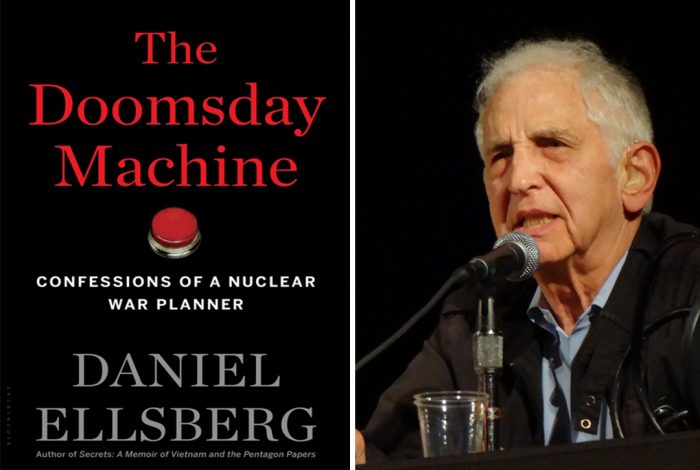
The Truth-Teller: From the Pentagon Papers to the Doomsday Machine


Global Research, May 19, 2019


The growth of the military-industrial complex poses an existential threat to humanity. Daniel Ellsberg, peace activist and Vietnam War whistleblower discusses with Tellus Senior Fellow Allen White the continuing existential threat posed by the military-industrial complex—and what needs to be done about it.
***
Allen White: You became a pivotal figure in the anti-Vietnam War movement when you released the Pentagon Papers, a large batch of classified documents that revealed a quarter century of official deception and aggression. What inspired you to take such a risky action?
Daniel Ellsberg: After graduating from Harvard with an economics degree and completing service in the US Marines, I worked as a military analyst at the RAND Corporation. In 1961, in that role, I went to Vietnam as part of a Department of Defense task force and saw that our prospects there were extremely dim. It was clear to me that military intervention was a losing proposition.
Three years later, I moved from RAND to the Department of Defense. On my first day, I was assigned to a team tasked with devising a response to the alleged attack on the US naval warship USS Maddoxin the Gulf of Tonkin by the North Vietnamese. This completely fabricated incident became the excuse for bombing North Vietnam, which the Joint Chiefs of Staff (JCS) and Secretary of Defense Robert McNamara had wanted to do for some months.
That night, I saw President Lyndon Johnson and my boss, Secretary McNamara, knowingly lie to the public that North Vietnam had without provocation attacked the US ship. In fact, the US had covertly attacked North Vietnam the night before and on previous nights. Johnson and McNamara’s claim that the US did not seek to widen the war was the exact opposite of reality. In short, the Gulf of Tonkin crisis was based on lies. I was not yet moved to leave government, though I had come to view US military action as ineffective, illegitimate, and deadly, without rationale or endgame.
By 1969, as the war progressed under Richard Nixon, I saw such evil in government deceit that I asked myself, “What can I do to shorten a war that I know from an insider’s vantage point is going to continue and expand?” When the Pentagon Papers were released in 1971, the extent of government lies shocked the public. The retaliatory crimes Nixon committed against me out of fear that I would expose his own continuing threats––including nuclear threats—ultimately helped to bring him down and shorten the Vietnam War. This outcome had seemed impossible after his landslide reelection in 1972.
Today, similar revelations do not occasion equal shock because in the current administration in Washington, lying is routine rather than exceptional. Whether we are headed for a turning point toward bringing liars to justice will become clear when the investigations of President Donald Trump’s administration are concluded.
Allen White: Since then, you have been a vocal critic of both US military interventions and the continued embrace of nuclear weapons, an issue with which you had first-hand familiarity through your work at RAND and the Pentagon. How did your experience with nuclear policy contribute to your disillusionment with US foreign policy writ large?
Daniel Ellsberg: At RAND, Cold War presuppositions dominated all our work. We were certain that the US was behind in the arms race and that the Soviet Union, in pursuit of world domination, would exploit its lead by achieving a capacity to disarm the United States entirely of its nuclear retaliatory force. We were convinced that we were facing a Hitler with nuclear weapons.
However, in 1961, I learned about a highly classified new estimate of Soviet weapons: four intercontinental ballistic missiles (ICBMs). At the time, the US had forty ICBMs, as well as thousands of intermediate-range ballistic missiles in Italy, Britain, and Turkey (compared to the Soviet Union’s total of zero). General Thomas Power, head of the Strategic Air Command (SAC), believed that the Russians had 1000 ICBMs. He was wrong by a factor of 250. This early mistaken belief signaled to me that something was very wrong with our perception of the world and, more specifically, with how we perceived the threat posed by the nation viewed as our most formidable adversary.
At the time, I regarded the erroneous “missile gap” as a misunderstanding or cognitive error of some kind. But, in fact, it was very much a motivated error—motivated in particular by the desires of the Air Force and SAC to justify their budget requests for huge increases in the numbers of US bombers and missiles. But why did we at RAND uncritically accept the wildly inflated Air Force Intelligence estimates, rather than the contrary estimates by Army and Navy Intelligence that the Soviets had produced only “a few” ICBMs? Again, a motivated error. Through self-deception, we viewed ourselves as independent thinkers focused exclusively on national security, assuming that our role as contractors on the Air Force payroll had no influence on our analysis.
In retrospect, it is clear that our focus and our recommendations would have been very different had we been working for the Navy. As Upton Sinclair said, “It is difficult to get a man to understand something when his salary depends on his not understanding it.” It was very important to us not to understand that our work was above all serving to justify the exaggerated budget demands by the Air Force.
My distrust of the wisdom of Pentagon planners was also aroused by JCS estimates of the death toll resulting from deployment of our nuclear weapons. I had heard that the JCS avoided calculating this figure because they didn’t want to know how many people they would be killing. To confront them, I drafted a question that appeared in a letter from the White House Deputy for National Security, Robert Komer, transmitted in the name of President Kennedy: “If your war plans were carried out as written and were successful, how many people would be killed in the Soviet Union and China?”
Within a week, I held in my hand a top secret, eyes-only-for-the-president document with an estimate of 325 million fatalities in the first six months. A week later, a second communication added an estimated 100 million deaths in Eastern Europe and another 100 million in our allied nations of Western Europe, depending upon the wind patterns in the aftermath of the strike. Additional deaths in Japan, India, Afghanistan, and other countries brought the total to 600 million.
That killings of this magnitude—100 times the toll of Jewish victims of the Holocaust—were willingly contemplated by our military transcended prevailing notions of crimes against humanity. We had no words—indeed, there are no words—for such devastation. These data confronted me with not only the question of whom I was working with and for, but also the fundamental question of how such human depravity was possible.
Allen White: Your recent book, The Doomsday Machine, describes “a very expensive system of men, machines, electronics, communications, institutions, plans, training, discipline, practices and doctrine designed to obliterate the Soviet Union under various circumstances, with most of the rest of humanity as collateral damage.” How did this system come about?
Daniel Ellsberg: World War II created a highly profitable aerospace sector upon which the US military relied for strategic bombing of cities, thereby setting the stage for the idea of bombers as a delivery mechanism for nuclear weapons. As orders precipitously declined by the end of the war, the industry was in dire financial straits, facing bankruptcy within a year or two. Accustomed to the guaranteed profits of the war years, they found themselves unable to compete with corporations experienced in building non-military products for the market, and demand for civilian aircraft on the part of commercial airlines was insufficient to replace the wartime military business.
The Air Force grew concerned that the industry would be unable to survive on a scale adequate to deliver military superiority in future conflicts. In the eyes of the government—and industry lobbyists—the only solution was a large peacetime (Cold War) Air Force with wartime-level sales to keep the industry afloat.
Thus emerged the military-industrial complex. Mobilization to confront a Hitler-like external enemy—a role filled by the Soviet Union—was viewed as indispensable to national security. Government military planning followed, essentially socialism for the whole armaments industry, including but not limited to aircraft production. With the benefit of hindsight, I now see the Cold War as, in part, a marketing campaign for the continual, massive subsidies to the aerospace industry. That’s what it became after the war, and that’s what we are seeing again today. The contemporary analog is the idea of China as an existential enemy, which, I believe, is the dream and expectation of the US Defense Department.
Allen White: The threat of nuclear conflict persists as a near-term existential threat yet remains muted in political discourse and largely absent in public consciousness. How do you explain this glaring inconsistency?
Daniel Ellsberg: Contemporary US media focuses on contradictions and conflicts between the two major parties. On the issue of nuclear weapons, little difference exists between them. They support the same programs and both receive donations from Boeing, General Dynamics, and Raytheon, among others. They both favor more aircraft than the Pentagon requests, itself an amazing situation given the existing level of spending. Right now, the F35, the largest military project in history, may end up costing $1.5 trillion (an incredible sum even by historical standards of lavish Pentagon spending), yet still unable to achieve the promised performance. This kind of massive pork program is used by senators and representatives to secure political advantage—a “jobs” program that often is a euphemism for a “profits” program.
Allen White: Nuclear weapons and climate change are two quintessential planetary threats requiring a coordinated global response. Do you see potential for alignment and cooperation between the anti-nuclear movement and the climate justice movement?
Daniel Ellsberg: We, as a society, are conscious of the risk of the devastating impacts that could come from climate disruption. In contrast to the absence of public discourse around nuclear conflict since the end of the Cold War, climate has been a subject of intense public debate. Although the danger of the nuclear threat remains undiminished, the proposed $1.7 trillion nuclear modernization program in the US is not a matter of serious debate.
It is difficult to compare climate and nuclear threats. The climate catastrophe toward which we are moving, while uncertain in terms of timing and outcomes, is indisputable. We have survived the nuclear danger for seventy years, although we have come close to conflict more frequently than the public realizes. I am not talking about just the Cuban Missile Crisis; in 1983, for example, we were also at the brink of a nuclear exchange, and there have been other instances. The risk of conflagration remains continuous and potentially catastrophic.
It is true that climate change may totally disrupt civilization as we know it, but how many lives would it cost? Whatever the number, some form of civilization would probably survive. By contrast, a nuclear winter, which has a non-zero possibility of occurring, would occasion near extinction.
That being said, both climate and nuclear threats are existential in nature, even as the degree and type of destruction differ. And both share another critical feature: the role of corporate interests and influence in sustaining the threat. As we speak, a pristine Arctic snowfield is under threat of oil drilling. Will Exxon and the other corporations be content to leave their known oil reserves in the ground, as needs to be done? I think that’s as unlikely as Boeing eschewing military contracts.
To the question of alignment of the nuclear and climate movements, in my view, we cannot deal with the climate problem, globally or nationally, without massive government spending to speed up the production and lower the cost of renewables, and thereby accelerate the transition from a fossil-fuel economy to a renewable energy one. This will also require subsidies to the underdeveloped countries to ease their transitions. In short, we need a new super-sized Marshall Plan combined with government regulation to constrain the most damaging impulses of the fossil-based market economy embraced by Reagan, Thatcher, and other market fundamentalists. We need a national mobilization akin to that achieved during World War II. We confronted Hitler then as a civilizational threat. Climate disruption demands an equivalent response.
And here’s where the climate-nuclear nexus comes into play again. We cannot afford the wasteful and dangerous development of new nuclear weapons that “modernize” the Doomsday Machine at the same time that we need to apply vast sums to reduce the threat of climate disruption. In the face of imminent climate catastrophe, the $700-plus-billion military budget is both untenable and irresponsible. We must convert the military economy to a climate economy. We cannot have both. To do so, we must recognize that the risks posed by the military-industrial complex far exceed those posed by Russia.
Allen White: The Great Transition envisions a fundamental shift in societal values and norms. To what extent does eliminating the nuclear threat ultimately depend on such a shift?
Daniel Ellsberg: Few would disagree that to activate plans for deployment of nuclear weapons leading to a nuclear winter—and thereby killing nearly everyone on Earth—is immoral to a degree that words cannot convey. It is a crime that transcends any human conception or language. But what about the threat of deployment? For many, propagating the threat of an immoral act is itself immoral. But in the nuclear era, the nuclear states have not accepted that as a norm. Our entire nuclear posture, and that of our NATO allies, is based on deterrence of a nuclear war and, if it occurs, responding with our nuclear arsenal.
Revisiting this norm is very difficult. It is deeply embedded in the mindset of the US, Russia, and other nuclear-armed states and reinforced by the interests of powerful corporations. When Reagan and Gorbachev agreed that nuclear war cannot be won and must not be fought, they did not say that it cannot be threatened or risked. Both nations continued such preparations and do so to this day. We have been taught that nuclear weapons are a necessary evil. Without a shift in norms and values, this situation will not change.
Allen White: The Great Transition depicts a hopeful future rooted in solidarity, well-being, and ecological resilience. Given the dystopian scenarios you outline in The Doomsday Machine and your other work, where do you see the basis for hope?
Daniel Ellsberg: My intention in addressing the threat of nuclear annihilation is that it will at least open up the possibility of change. While such a shift in values and norms would be almost miraculous, miracles can happen, and have happened in my lifetime. In 1985, the falling of the Berlin wall a mere four years later would have seemed improbable, if not impossible, given decades of nuclear tensions and near conflicts. But then it happened. And Nelson Mandela coming to power in South Africa, without a violent revolution, was impossible. But it happened.
So, unpredictable changes like these can happen, and their possibility inspires my commitment to continue my peace activities against long odds. My activity is based on the belief that small probabilities can be enlarged and that, however remote success may be, it is worthwhile pursuing because so much is at stake.
My experience with the Pentagon Papers showed that an act of truth-telling, of exposing the realities about which the public had been misled, can indeed help end an unnecessary, deadly conflict. This example is a lesson applicable to both the nuclear and climate crises we face. When everything is at stake, it is worth risking one’s life or sacrificing one’s freedom in order to help bring about radical change.
*
Note to readers: please click the share buttons below. Forward this article to your email lists. Crosspost on your blog site, internet forums. etc.
Daniel Ellsberg is a writer, peace activist, former military analyst, and whistleblower known for his release of the Pentagon Papers in 1971. He is the author of The Doomsday Machine: Confessions of a Nuclear War Planner, Secrets: A Memoir of Vietnam and the Pentagon Papers, and Risk, Ambiguity and Decision.


https://www.globalresearch.ca/pentagon-papers-doomsday-machine/5677848


JUST NEWS published this article following the Creative Commons rule. If you don't want your article to appear in this blog email me and I will remove it asap.
Tuesday, May 14, 2019

Putin Just Pulled a Bush on “Missile Defense Shield”. Russia’s Dominance in Hypersonic Missiles


Global Research, May 14, 2019

Despite almost two decades of criticizing the Bush-era missile defense shield plans for threatening to disrupt the sensitive strategic balance between the US and Russia, Putin now wants his country to be the world leader in hypersonic missile defense technology in order to retain its global dominance in this field, essentially embodying the exact same principle that he previously railed against for years.
Putin tried to pull a fast one on the world earlier this week when he thought that nobody would notice the hypocrisy of him calling for Russia to deploy a hypersonic missile defense shield before its rivals catch up to it and develop hypersonic armaments too. RT quoted the Russian President as saying that
“we also have a perfect understanding that the world’s leading nations will develop such weapons sooner or later(, therefore) we must obtain the means of protection against such systems, before hypersonic weapons are put in service by the [foreign] militaries.”
In other words, Russia wants to retain its global dominance in the field of hypersonic missiles by being the first state to deploy both offensive and defensive systems related to this technology, the first of which provides it with a credible nuclear second-strike capability that can pierce through the US’ missile defense shield while the second ensures that it can thwart others’ efforts to do the same against it.
It shouldn’t be forgotten that the Bush-era missile defense shield plans have been fiercely criticized by almost all of Russia’s state representatives over nearly the past two decades since they were announced, with none other than President Putin regularly railing against them for disrupting the sensitive strategic balance between the US and his country. His government was entirely right in pointing out that the US aimed to undercut Russia’s nuclear second-strike capabilities in order to eventually place it in a position of nuclear blackmail, ergo why Moscow made the decision to urgently prioritize the research and development of hypersonic missile technology in the first place. Now that it’s the world leader in this field, it doesn’t want to risk losing its position by being unprepared for the eventual deployment of these armaments by its rivals and unable to defend itself from them in the same way that the US isn’t able to do at this moment.
In other words, the Neo-Realist theory of International Relations is especially apt in explaining what’s happening here because Russia and its rivals seem to be trapped in the so-called “security dilemma” whereby outwardly defensive moves by one state (such as Russia’s development of hypersonic missiles and shields) are interpreted by others as offensive ones because they’re seen as occurring at the zero-sum expense of their own security since they don’t trust that the leading state won’t abuse its dominant position. Interestingly, this is very similar to what happened back during the Bush Administration when the US originally sought to roll out conventional missile defense technology all across the world in order to preserve its dominant position in that sphere, which in turn provoked Russia into making rapid advancements in hypersonic missile technology to offset the expected disadvantages that the success of the US’ plans would have for its security.
Therefore, in terms of the Neo-Realist theory of International Relations, there’s no difference between the US and Russia in this respect, unless one incorporates the Constructivist theory of (changing) perceptions and begins to differentiate the grand strategic intent being pursued by both Great Powers.
Whether objectively the case or only subjectively so, there’s a prevailing notion that the US wanted to deploy its conventional missile defense shield for aggressive reasons related to preserving its unipolar hegemony across the world, while Russia is doing this in the hypersonic sense in order to maintain the strategic balance that it restored through this technology. In any case, there’s no avoiding the uncomfortable optics that Putin just pulled a Bush on missile defense, so Russia should launch a supportive information campaign in parallel with the development of its hypersonic missile defense shield in order to explain to the world how its intentions differ from the US’.
*
Note to readers: please click the share buttons below. Forward this article to your email lists. Crosspost on your blog site, internet forums. etc.
This article was originally published on Eurasia Future.
Andrew Korybko is an American Moscow-based political analyst specializing in the relationship between the US strategy in Afro-Eurasia, China’s One Belt One Road global vision of New Silk Road connectivity, and Hybrid Warfare. He is a frequent contributor to Global Research.


https://www.globalresearch.ca/putin-pulled-bush-missile-defense/5677436


JUST NEWS published this article following the Creative Commons rule. If you don't want your article to appear in this blog email me and I will remove it asap.

Monday, April 22, 2019

Nuclear Weapons Ruined My Life, and I Wouldn’t Have It Any Other Way


Global Research, April 22, 2019

Waging Nonviolence 4 April 2019


As someone deeply embedded in a life of anti-nuclear resistance, I know the only way to get rid of these weapons is to never stop thinking about them.
***
I want to offer you something different than the barrage of facts and figures around nuclear weapons. But let’s establish the basics. There are nine countries that possess them: France, China, the United Kingdom, India, Pakistan, Israel, North Korea and — of course — Russia and the United States. Together these nine countries possess a total of 14,575 nuclear weapons, with the United States and Russia accounting for 92 percent of them.
Then there’s the outlandish nuclear weapons budgets and U.S. plans to modernize and upgrade current nuclear weapons stockpiles at egregious expense. According to a new government estimateplans for modernizing and maintainingthe nuclear arsenal will cost $494 billion over the next decade — an average of just under $50 billion per year.
All of this is happening with Donald Trump in the White House. With his recklessness and overriding need to win — or appear to win — at all costs, he is more dangerous than his predecessors. And that’s despite the fact that every president of the nuclear age played a part in extending the nuclear nightmare and increasing the threat of global annihilation.
Again, these are just the basics — things you already knew or aren’t terribly surprised to learn. That’s why I want to tell you a different story about nuclear weapons: My own.
It comes through the lens of the nuclear fire and my relationships to the people who serve as a sort of bucket-brigade — offering sense, responsibility and sacrifice in an effort to douse the inferno.
April 1, 1974
I am born. It’s a home birth to a nun and a priest — in the basement of a tall three-story row house full of anti-nuclear activists. On the day of my birth, the Bulletin of the Atomic Scientists’ Doomsday Clock stands at 12 minutes to nuclear midnight, moved back from 10 minutes in 1972 after the Strategic Arms Limitation Talks between the United States and Soviet Union developed a road map for reducing nuclear arsenals.
A few months after I am born, the scientists move the clock forward again — this time to 9 minutes to nuclear midnight, “In recognition that our hopes for an awakening of sanity were premature and that the danger of nuclear doomsday is measurably greater today than it was in 1972.”
Richard Nixon is president. He’s a nuclear hothead who perfects the “madman” strategy of nuclear diplomacy. He tells a meeting of congressmen, “I can go in my office and pick up a telephone, and in 25 minutes, millions of people will be dead.”
I am blissfully unaware. A healthy baby — the first of three — born to parents, Elizabeth McAllister and Philip Berrigan, who had set themselves on a course that maybe should have precluded children: a course of robust, muscular, creative, risky anti-nuclear resistance.
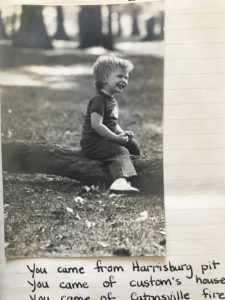
Image below: Frida Berrigan next to a poem by her uncle, Danial Berrigan. (WNV / Berrigan family)
My uncle, Daniel Berrigan, the Jesuit priest and poet, writes a series of poems to welcome me into the world. One goes like this:
You came from Harrisburg pit
You came from Custom’s House blood
You came from Catonsville Fire
You came from jail
You came in spite of Judge Mace’s death’s head
Shaking “no” in its socket.
You came without regard to writs, torts, barbed wire
You came up from the least known
Phiz, China and beyond
Down from Dante’s crystalline
Paradise– a round eyed
Round trip freeloader.
You came from a nun
You came from a priest
You came from a vow
Yes and No and the Great Tao
That creeps. A vine
Claiming like two arms
The world’s rack for its own dismembering and flowering.
March 28, 1979
Three days before my fifth birthday, the Three Mile Island Nuclear Power Plant suffers a partial meltdown. It is decades before I learn what that term really means, but the terror is real. Three Mile Island is less than 90 miles from our house and radiation is headed our way. My parents take my little brother and I to West Virginia — as far away as they could figure — for the better part of two weeks.
We return to a changed diet: miso in hot water for breakfast every morning. My mother read that healthcare workers in Hiroshima drank the fermented soybean paste in water after the U.S. atomic bombing in 1945. They strengthened their immune systems and cleansed radiation out of their bodies with this ancient traditional Japanese food.
Miso is brown, salty and is disgusting to the 5-year-old palate. But we drink it every morning for years.
My parents start to look more deeply at the connections between nuclear weapons and nuclear power. There are nearly 100 nuclear power reactors across the United States, and they provide roughly one-fifth of the electricity produced in the country. Nuclear power is one of the dirtiest, most dangerous and most expensive sources of energy. Nuclear reactors in the United States and around the globe are plagued by accidents, leaks, extended outages, delayed construction and skyrocketing costs. Nuclear reactors produce highly radioactive waste that continues to threaten the environment and public health for thousands of years and for which no safe disposal exists.
There is a large scale movement to end the production of nuclear weapons and our dependence on nuclear power as well. Our father shouts at us every time we leave a light on: “Okay, now we are supporting Calvert Cliffs — our local nuclear power plant.”
September 9, 1980
I am 6 years old and my brother is 5 when our father and seven others gain access to General Electric’s Nuclear Missile Reentry Division plant in King of Prussia, Pennsylvania.
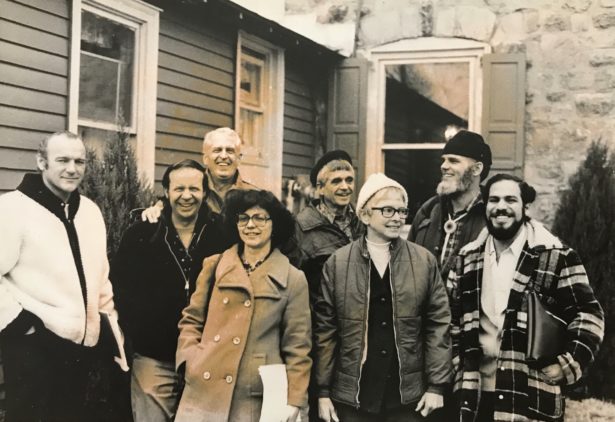
The Plowshares Eight, from left to right: Carl Kabat, Elmer Maas, Phil Berrigan, Molly Rush, Dan Berrigan, Anne Montgomery, John Schuchardt, Dean Hammer. (WNV / Berrigan family)
A few months earlier the Doomsday Clock had been moved from 9 to 7 minutes to nuclear midnightbecause the United States and Soviet Union are behaving like “nucleoholics — drunks who continue to insist that the drink being consumed is positively ‘the last one,’ but who can always find a good excuse for ‘just one more round.’”
Our dad and his friends hammer on two nose cones, pour blood and read from this statement:
We commit civil disobedience at General Electric because this genocidal entity is the fifth leading producer of weaponry in the United States. To maintain this position, GE drains $3 million a day from the public treasury, an enormous larceny against the poor. We wish also to challenge the lethal lie spun by GE through its motto, ‘we bring good things to life.’ As manufacturers of the Mark 12A reentry vehicle, GE actually prepares to bring good things to death. Through the Mark 12A, the threat of first strike nuclear war grows more imminent. This GE advances the possible destruction of millions of innocent lives.
This is a new kind of action, in the tradition of the Catonsville Nine (which two of the eight participated in) and the Hebrew prophets who enjoined peacemakers to beat swords into plowshares.
Our dad writes:
We love our children and all children — that is why we are in resistance; that is why we are in jail. We cannot abandon the children; cannot render them to caesar for our immunity and comfort. And that love for them, and for the God who blessed us with them, will enrich their lives. So runs our hope.
Fall 1980 finds us in school for the first time, at sea in a swirl of six-year-old politics that we do not understand. We are objects of fascination and derision to our mostly African-American classmates and regarded with pity by most of our teachers. They have been told what our father has done and — even though they know the details of the action and that he is a good person — they have less context for what he has done than we do.
Our father spends that Christmas in jail. Just before the holiday, we go and visit him and my brother Jerry says: “We want to thank you, Dad. You’ve given us the greatest Christmas gift anyone could.”
“What’s that, Jer?” our Dad asks. There were no presents from the Montgomery County Jail in rural Pennsylvania.
“Your action. You were making peace, just as Jesus was in coming to us at Christmas.”
This becomes an oft-told story in our household, used at various times to celebrate my brother’s thoughtfulness and sincerity or, at other times, to highlight our long downward spiral since that glorious apex of insight and righteousness.
Our dad faces years in jail. In a February 1981 jury trial, he is convicted of burglary, conspiracy and criminal mischief and sentenced to 5-10 years in jail. It isn’t until April 1990 (when I am 16) that the Plowshares 8 wins some overturning of charges on a hard fought (and almost forgotten) appeal.
Somewhere between action, trial and conviction, my sister Kate is conceived. My mom comes home from the doctor’s appointment — after finding out she was pregnant — and slugs a shot of scotch.
Liz McAlister turns 42 just two weeks after my sister is born on Nov. 5, 1981. The Doomsday Clock is at 4 minutes to nuclear midnight, moved in January in response to “the flat unwillingness of either the United States or the Soviet Union to reject publicly, and in all circumstances, the threat of striking the other first. Both sides willfully delude themselves that a nuclear war can remain limited or even be won. In 1980 both sides officially declared nuclear war ‘thinkable.’”
November 20, 1983
Image below: Frida Berrigan with her brother Jerry Berrigan. (WNV / Berrigan family)
I am 9 and my brother is 8. Our sister has just turned 2. As a general rule, we are not permitted to watch television, except for the nightly news. But on this random Sunday before Thanksgiving, we Berrigan children get a special treat. We watch a television movie with our parents. It is called “The Day After.”
More than 35 years later, before consulting Google, the details of the film were vague, but the outline is clear. The film imagines a nuclear attack on the United States and the lives of the people who survive its aftermath.
After the film, we sat with our parents while our mom told us that she was going to do an action soon that would try and keep what the film depicted from happening.
She later wrote about that conversation:
Our children have grown up with these [nuclear] realities as part of the air they breathe. They have seen many people in the community in which we live, including their mom and dad, imprisoned for resistance to nuclear annihilation. But to have mom do something like this and to face her possible absence from their day to day lives for an indefinite amount of time — this was a large step.
They were willing to accept the personal sacrifice of my absence as their part in trying to stop nuclear war from happening, as their part in trying to avoid the suffering that the movie displayed… They committed themselves to assuming more responsibility around the house, especially to be helpful dealing with the questions and fears of their little sister, who was not able to understand it as they were.
It was a moment of extreme closeness for the four of us — a moment of accepting together whatever might come, and we concluded our conversation with prayer and big big hugs.
Thirty-five years later, reconsidering this story as a parent myself, it strikes me as a very calculated move: a mom power play. But there we were.
President Ronald Reagan watched the film a few weeks before it hit TV screens and wrote in his diarythat the film was “very effective and left me greatly depressed.” Nearly 100 million people watched “The Day After” on its first broadcast, a record audience for a made-for-TV movie. But very few followed it up with an action like our mom’s.
November 24, 1983
Mom is one of seven who enter the Griffiss Air Force Base in upstate New York in the early hours of the morning to hammer and pour blood on a B-52 Bomber.
We are in Syracuse with my dad’s brother and his family when it happens. It takes hours for the base security to learn of the breach and arrest them. They are initially charged with sabotage, conspiracy and destruction of government property — and face 25 years in jail. We are, as I said, 9, 8 and 2.
They are eventually tried in a federal court in Syracuse. Their trial is a strange mix of freedom and scrutiny for my brother, sister and me. Our mom and dad are caught up in the trial, and we are left to play and grapple largely unsupervised. But we are also in the media eye. People magazine calls us “troupers to the extreme” when it covered mom’s sentencing in July 1984.
Our dad tells the reporter, “They don’t cry. They’ve been raised in a resistance community, and they’ve seen their mother and father repeatedly brought to jail for nonviolent civil disobedience.”
Image below: Liz McAllister holding Kate Berrigan outside the Syracuse federal jail. (WNV / Berrigan family)
We did cry. Our mom serves 26 months in Alderson Federal prison in West Virginia. We fall into a rhythm of traveling there once a month for a long weekend. The powers that be conspire to make those weekends fall on every school field trip or fun excursion planned by our teachers. Our dad writes us long “please excuse my children from school” letters reminding our teachers every month that our mom is in jail for her anti-nuclear action. He sees it as an opportunity for education. We bypass this impulse and figure out a way to relate exclusively with the school secretary for early dismissals on these fraught Fridays. We are not the only kids with moms in jail, but we are the only ones whose dad writes polemics about it every month. We endure.
April 3, 1988
It’s Easter Sunday. I am 14, and it is two days after my birthday. My dad is one of four activists who board the battleship Iowa in Norfolk, Virginia as part of a public tour greeting the vessel on its return from service in the Persian Gulf. The four disarmed two armored box launchers for the Tomahawk Cruise Missile, hammering and pouring blood, and unfurled two banners: “Seek the Disarmed Christ” and “Tomahawks Into Plowshares.” It becomes known as the Nuclear Navy Plowshares action.
My dad is sentenced to six months in prison.
March 31, 1991
Another Easter Sunday. The day before I am to turn 17, and this time my father is in Bath, Maine, aboard the U.S.S. Gettysburg, taking part in the Aegis Plowshares action. The state declines to prosecute and charges are dismissed the day before the trial was scheduled to start.
December 7, 1993
While not close to any birthdays or special holidays, it is the anniversary of Pearl Harbor Day. I am 19, in my second year at Hampshire College. The activists wade through marshes and over rough terrain to gain access to the tarmac at Seymour Johnson Air Force base in Goldsboro, North Carolina. There they hammer on an F-15 fighter plane before being surrounded by hundreds of armed soldiers who were engaged in war game exercises at the time. They call themselves the Pax Christi-Spirit of Life Plowshares.
The trial the next February was notable to some people because the judge enforced a gag order and refused any mention of the political or moral justification for their actions. It was notable to me because my college boyfriend was able to attend. I was trying to integrate the various pieces of my life and not just slip the letter to the school secretary any more.
Visiting him at the county jail in the midst of the trial, my dad says, “Was that Him in the courtroom?” I nod, nervous and proud at the same time. “Seems a bit of a hippie, doesn’t he?” my dad observes. And that was that.
February 12, 1997
My dad is one of 6 who boards the U.S.S. Sullivans, a nuclear-capable Aegis destroyer at Bath Iron Works in Maine. They hammer and pour blood on different parts of the battleship. As they read their action statement and unfurl a banner, armed military security forcibly push them to the deck and place them under arrest.
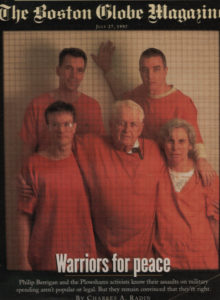
Image below: Cover of the Boston Globe Magazine from 1997 featuring (back row, from left to right) Steve Kelly and Mark Colville and (front row, left to right) Steve Baggerly, Phil Berrigan and Susan Crane.
They call themselves the Prince of Peace Plowshares, and they are tried in May and sentenced in October. My dad is sentenced to two years in jail and told not to associate with any other felons except for his wife. He pays this no mind. He is 74 years old at the time.
I had finished college the month before and moved home. In that brief time before his action, we spent our time building a composting toilet to collect our “humanure.” I help him out on less controversial projects around the house, while looking for a job. He doesn’t understand why I want a job.
“I have student loans, Dad.”
He is flabbergasted. His daughter is in debt?
“Yep, I owe $14,000 bucks, Dad.”
I went to the most expensive college in the country (with a great financial aid package) and nobody had any money to put down at the beginning.
I managed to get into college with encouragement from people outside of my nuclear family. Mom and Dad were not much help. It was hard to explain — to a man who went to college on the G.I. Bill after World War II and then graduated school as a Josephite priest — the real cost of a college education.
Awaiting trial after the action, Dad is in a county jail in Maine. Every time I go visit him, I upset the routine of local activists who visit him every week, and I feel awkward as they give me “private” time with my dad, grizzled and rumpled in his orange suit.
I walk with my class at Hampshire College in May 1997 on a frigid day. We go straight from the graduation ceremony up to Maine to see Dad in jail. My brother graduates a few weeks later. Our sister graduates from high school the next year. He misses it all.
I recently poured through my high school and college journals — thick, precious times that show how much time I had to process my experiences before social media or small children. I looked for hard evidence of the bereavement I tend to lay atop my parents’ absences. But it wasn’t there, or it was so between-the-lines that my 44-year-old eyes couldn’t see it.
Nowhere did I write: “I am distraught because my father is missing my graduation.”
Looking back now, forced to confront the patina of angst I’ve spread over all these memories, it occurs to me that we were deeply embedded in this life. It was who we were and what we did. We did not question it. And while we missed our dad (mostly) and our mom (earlier), we included them in everything. We recounted it all in letters and visits. We saved the best parts for them. In some sense, our experiences weren’t entirely real until we shared them with our dad or mom (whoever wasn’t physically there).
December 19, 1999
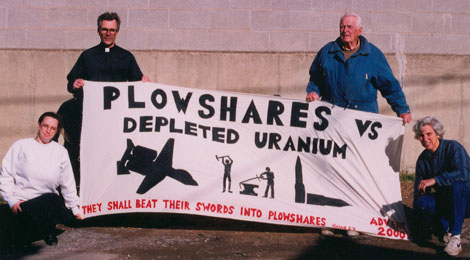
The group cuts through a fence at the Air National Guard Base in Essex, Maryland and pours blood, hangs a rosary and a banner, and hammers on two A-10 Warthog bombers. All were charged with malicious destruction of property and conspiracy. They call the action “Plowshares vs. Depleted Uranium.”
From left to right: Elizabeth Walz, Steve Kelly, Phil Berrigan and Susan Crane. (WNV / Berrigan family)
By this point, I am living in New York City. I have an apartment in Brooklyn and a boyfriend who is not a hippy. In fact, he has gained my dad’s grudging regard. I also have a job at the New School for Social Research, where I work for an arms analyst and public intellectual named William Hartung. At college, my friends and I had joked about becoming public intellectuals like Edward Said or Eqbal Ahmed, and now here I am earning money to pay attention to the military industrial complex. I feel incredibly lucky and very uncomfortable with my good fortune.
I know all about depleted uranium — the radioactive byproduct that is used as a covering on munitions to give them armor-busting capabilities. Some of my favorite times with my dad are trading bad news story for bad news story. He is reading (and enjoying) the many articles I am writing and publishing. He occasionally enjoins me to not have such a secular voice and to end my articles for In These Times or The Progressive with a Jesus quote. I demure.
I knew this action was coming, and I asked him to sit this one out. I did not offer to take his place.
He wrote in a statement before the action:
I am 76 years old, a married Catholic priest, with 35 years of resistance to the empire’s wars, nine years of imprisonment, numberless arrests, surveillance and ‘dirty tricks’ from the FBI… Enter my friends, sometimes brusquely: ‘Hey Dads!! Give it up to the young pups. It’s rocking chair time…’ But, but, but… I cannot forget the dying children of Iraq, and the two million Iraqis dead from our war, sanctions and depleted uranium… I cannot forget my country’s war psychosis — its obsession with better tools for killing, its mammoth war chest, its think tanks and war labs.
My dad is sentenced to 30 months in jail. “They were prepared for the worst,” my mom says outside the courthouse afterward, “and they got it.”
He serves some of his sentence in a youth facility in rural Maryland. My brother, sister and I visit him there often. (There is an outlet mall nearby). He is the only white person in the visiting room — save for some of the corrections officers. The visiting room was designed for discomfort. It has this chest-level barrier between the inmates and the visitors, and you can’t lean on it to be closer to your family member. It is brutally loud. The boys all call him Pops and show him concern and respect. At some point, he was moved to a jail in Ohio that is more age appropriate, where we visit as often as we can.
He is released right before Christmas 2001. Friends welcome him back to “minimum security.” He dies less than a year later, on Dec. 6, 2002.
The Bulletin of the Atomics Scientists’ Doomsday Clock stood at 7 minutes to nuclear midnight, the same time as when it was created in 1947. In the wake of September 11, 2001, the scientists wrote: “Moving the clock’s hands at this time reflects our growing concern that the international community has hit the ‘snooze’ button rather than respond to the alarm… More than 31,000 nuclear weapons are still maintained by the eight known nuclear powers, a decrease of only 3,000 since 1998. Ninety-five percent of these weapons are in the United States and Russia, and more than 16,000 are operationally deployed.”
Over most of the next decade and a half, our mom continues to live in the community she formed with my dad and others and continues to bear witness at the Pentagon, the White House and other sites of power. She keeps animals — goats, llamas, donkeys, even sheep for a while, and starts painting again. She is arrested repeatedly, but not for any big actions. I leave New York City for a small town in eastern Connecticut, get married and have three kids.
My brother and sister settle down too. My brother has three kids, lives in a Catholic Worker community in Michigan that he founded with his wife and another couple. My sister studies to be a physical therapist, becomes a doctor, falls in love with a doctor of English and lives in Grand Rapids. We are all arrested occasionally, but not for any big action. We march, we organize, we speak. We try.
As our mother approaches and passes 70, we — like many people our age — start encouraging her to take it easy, give up the rigors of community life and resistance, the constant hosting and demonstrating. We envision and invite her to live a life with her grandchildren, stories, bedtimes, sporting events and art projects. We have room, we all say.
She goes in the exact opposite direction. With others taking the reins at Jonah House, she feels free for the first time since our father’s death to be a Plowshares activist again, to conspire with her friends and to plan for a rigorous and daring action.
We don’t know the specifics, but as all her answers about the future muddle into a very specific kind of vagueness, we know exactly what is going on.
“Please don’t,” we say.
“You are too old,” we say.
“Think of your grandkids,” we say.
“I will. I’m not. I am. This is what I have to give.”
April 4, 2018
It was just three days after my 44th birthday, which was also Easter — again. We received word of a new plowshares action. Seven Catholic activists entered Kings Bay Naval Submarine Base in St. Mary’s, Georgia. They went to make real the prophet Isaiah’s command to “beat swords into plowshares.” The seven chose to act on the 50th anniversary of the assassination of Martin Luther King, Jr., who devoted his life to addressing what he called the “triple evils of militarism, racism and materialism.” Carrying hammers and baby bottles of their own blood, the seven attempted to convert weapons of mass destruction. They hoped to call attention to the ways in which nuclear weapons kill every day, just by their mere existence and maintenance. They are charged with three federal felonies and one misdemeanor for their actions. They could face 25 years in prison if convicted on all counts.
And there they still are. Three — my mom, Father Steve Kelly and Mark Colville — remain in county jail almost a year later. They still do not have a trial date. The other four are out on bond, wearing ankle monitors and are required to check in with their minders at regular intervals.
The Kings Bay Naval Station is home to at least six nuclear ballistic missile submarines. Each carries 20 Trident II D 5 MIRV thermonuclear weapons. Each of these individual Trident thermonuclear weapons contains four or more individual nuclear weapons ranging in destructive power from a 100 kilotons to 475 kilotons. To understand the massive destructive power of these weapons remember that the nuclear bomb dropped on Hiroshima was a 15 kiloton bomb.
My mother feels very useful in jail — generous, empathetic and calm in a place that encourages none of those qualities.
The wheels of justice grind very slowly in Georgia particularly because the activists are mounting a creative legal defense. They seek to portray their actions as protected under the freedom of religion, using the Religious Freedom Restoration Act, which allowed the homophobic cake makers to not make a cake for a gay couple. They are seeking to demonstrate their “deeply held religious beliefs” and how the practice of their religion has been burdened by the government’s response to their actions. The Religious Freedom Restoration Act requires the government to take claims of sincere religious exercise seriously.
Please keep them in thought and prayer.
Just a few months before they acted, the Bulletin of the Atomic Scientistsmoved the clock again — this time to 2 minutes to nuclear midnight, saying, “This is a dangerous time, but the danger is of our own making. Humankind has invented the implements of apocalypse; so can it invent the methods of controlling and eventually eliminating them.”
The clock has never been closer to nuclear midnight in my lifetime. All the work, all this sacrifice, and the clock keeps moving closer to midnight.
My mom’s action and extended incarceration pre-trial come as nuclear conflagration seems more likely. Nuclear weapons do not even rate in the list of top 10 fears that Americans are questioned about every year.
Putin and Trump have shredded the imperfect and imbalanced but nevertheless important fabric of nuclear arms control treaties. Putin claims that Russia is developing a new class of “invincible” nuclear weapons, including a cruise missile that can reach anywhere in the world.
The Pentagon signaled recently that the United States would begin tests on a couple of types of missiles. And just to make things truly terrifying, Anthony Cordesman of the Center for Strategic and International Studies says that in response to U.S. and Russian actions, China is improving its own nuclear arsenal.
Searching for signs of hope to counter as a bulwark against these mounting fears, I hold close the work of the International Campaign to Abolish Nuclear Weapons, or ICAN. It developed the Treaty on the Prohibition of Nuclear Weapons and is now building a global civil society coalition to promote adherence to and full implementation of the nuclear weapons ban. ICAN received the 2017 Nobel Peace Prize “for its work to draw attention to the catastrophic humanitarian consequences of any use of nuclear weapons and for its ground-breaking efforts to achieve a treaty-based prohibition of such weapons.” I draw hope from that movement.
Nuclear weapons ruined my life.
I am never not thinking about them. Nuclear weapons are present in my most mundane tasks. Nuclear weapons are present in all my major relationships. Every goodbye and hello is freighted with uncertainty.
They have shaped how I think about time. Nuclear weapons have caused me to honor and treasure the present. They have made the future provisional, muted, not taken for granted. I try to be present to the present and hold the future loosely, but with hope.
Nuclear weapons ruined my life. And I wouldn’t have it any other way. In fact, I hope they are ruining your life too. Because that is the only way we are going to get rid of them.
*
Note to readers: please click the share buttons below. Forward this article to your email lists. Crosspost on your blog site, internet forums. etc.
Frida Berrigan is a columnist for Waging Nonviolence and the author of “It Runs in the Family: On Being Raised by Radicals and Growing into Rebellious Motherhood.” She lives in New London, Conn. with her husband Patrick and their three children.


https://www.globalresearch.ca/nuclear-weapons-ruined-my-life-and-i-wouldnt-have-it-any-other-way/5675273

JUST NEWS published this article following the Creative Commons rule. If you don't want your article to appear in this blog email me and I will remove it asap.