Global Research, June 08, 2019
Unilateral sanctions are being imposed by the United States on Cuba. “On 2 May 2019, the Trump administration implemented Title III of the 1996 Helms Burton Act. In doing so, it unleashed the most severe economic sanctions against Cuba since the blockade was first introduced by President Kennedy in 1962.”
In the light of recent developments, Global Research is reposting this article focussing on the contradictory role of Cuban intellectuals (involved in the foreign policy debate). The article was originally published on March 6, 2017.
To the People of Cuba,
The Cuban Revolution constitutes a fundamental landmark in the history of humanity, which challenges the legitimacy of global capitalism. In all major regions of the World, the Cuban revolution has been a source of inspiration in the relentless struggle against neo-colonial domination and US imperialism.
The World is at a critical crossroads. At this juncture of our history, most “real” progressive movements towards socialism have been destroyed and defeated through US-NATO led wars, military interventions, destabilization campaigns, regime change, coups d’etat, “soft coups”.
Progressive movements as well as “The Left” in Western Europe and the U.S. have largely been coopted, often financed by elite corporate foundations.
The socialist project in Cuba nonetheless prevails despite the US economic blockade, CIA intelligence ops and dirty politics.
While the legacy of Fidel Castro lives, let us be under no illusions, Washington’s intent not only consists in destroying the Cuban Revolution, it also seeks to erase the history of socialism.
Washington’s Diabolical Design
There are indications that a “regime change” in Cuba is currently contemplated by Washington policy makers. The Trump administration has been categorical in this regard. The repercussions will be felt throughout Latin America.
During the election campaign “he committed himself to reversing Obama’s Presidential Policy Directive titled “United States-Cuba Normalization,”(a 12-page directive—referred to officially as “PPD-43”). (
The Nation, October 2017). No subsequent statement following Trump’s inauguration has as yet been forthcoming.
Of significance is Trump’s appointment of
Dr. Judy Shelton to head the National Endowment for Democracy (NED), a think tank and funding agency geared towards regime change. As a former Vice-President of the NED,
Shelton was “directly involved in lending legitimacy to US-backed subversion in Cuba as part of a decades-long attempt to overthrow the government in Havana and expand US hegemony over the Caribbean.”
Whatever US- Cuba “normalization” is contemplated by the Trump Administration, it would be geared towards the restoration of capitalism through acts of sedition, infiltration, etc. combined with the imposition of neoliberal economic reforms, including the IMF’s “strong economic medicine”. The fundamental question is how Cuba and the Cuban people will, in the current context, respond to these ongoing threats.
How does Washington plan to carry out this plan. Fundamentally through:
1) Measures which contribute to destabilizing the Cuban economy and its monetary system.
2) Procedures which are conducive to the eventual integration of the Cuban economy into the nexus of the IMF-World Bank-WTO, including the imposition of policy conditionalities geared towards dismantling Cuba’s social programs, its rationing of essential consumer goods, etc.
3) To reach their objectives, Washington and its European allies have over the years devised various covert mechanisms of infiltration and cooptation with a view to influencing government policy makers, managers of public sector enterprises as well as intellectuals. In this regard Washington has also relied on its European partners which have established bilateral relations with Cuba.
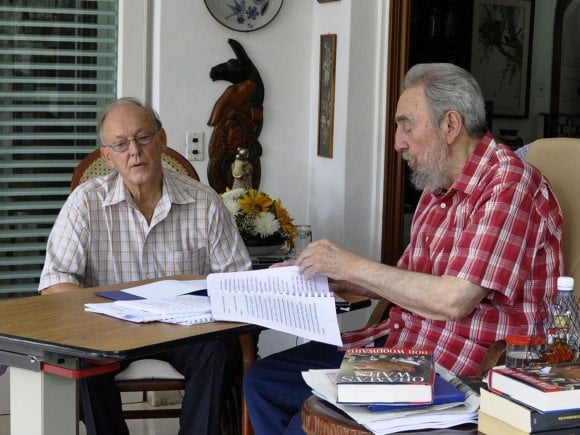
Fidel Castro Ruz and Michel Chossudovsky, October 2010
This article will largely concentrate on the activities of right wing European foundations involved in funding Cuban think tanks and research centers.
The objective is the cooptation of researchers, scholars and intellectuals. The purpose is to build a “new normal” which will pave the way towards the insertion of Cuban socialism into the logic of World capitalism. While retaining the socialist narrative, this process is ultimately intended to undermine the Cuban revolution, opening the door to economic deregulation, foreign investment and privatization. The “acceptance” by Cuban intellectuals of this “new normal” is essential to reaching the goal of capitalist restoration.
Background: US Interventionism
In recent years, the modalities of US interventionism have changed dramatically: The thrust of U.S. foreign policy largely consists in destabilizing sovereign countries through a process of “regime change” (color revolution). The latter consists in destabilizing the national economy, manipulating national elections, co-opting leftist intellectuals, bribing politicians, financing opposition parties, engineering violence and protest movements.
In Latin America, pro-US military dictatorships have largely been replaced by pro-US (fake) “democracies”. In turn, neoliberal economic reforms under the guidance of the IMF-World Bank have served to impoverish the population, thereby creating conditions which favor protest as well as social and political strife.
The rigging of elections in Latin America is coupled with engineered protests and the co-optation of Left intellectuals funded both by US and European foundations and NGOs, with links to US intelligence.
The National Endowment for Democracy (NED) created in 1983 alongside a number of other US based foundations has taken the lead. The NED’s mandate is to promote democracy and human rights in developing countries.
The NED is an unofficial arm of the CIA. According to former NED president Carl Gershman:
“It would be terrible for democratic groups around the world to be seen as subsidized by the C.I.A. … We have not had the capability of doing this, and that’s why the endowment was created.”
In the words of the NED’s first president Alan Weinstein: ” A lot of what we do today was done covertly 25 years ago by the CIA” (Washington Post, September 22, 1991).
The NED Project in Cuba. Entry through the “Back Door”
While the NED is banned in Cuba, it nonetheless finances indirectly –through partner foundations and proxy NGOs based in Florida — a large number of so-called “democracy projects”. Many of these partner (US based) organizations –including the Cuban Democratic Directorate (Directorio), the Instituto Cubano por la Libertad de Expresion y Prensa, the Observatorio Cubano de Derechos Humanos– have links to US intelligence. Historically, the NED has functioned through partners in the European Union which have formal bilateral links with Cuba.
With regard to Germany, the Friedrich Ebert Stiftung (linked to the Social Democratic Party), the Hans Böll Stiftung (Green Party) and the Hanns Seidel Stiftung (linked to the right wing Bavarian Christian Democratic Party (CSU)) have agreements with Cuba.
America’s Proxy: The Hanns Seidel Foundation, Instrument of the Right Wing CSU Party of Bavaria
In this essay I will focus primarily on the role of the Hanns Seidel Foundation, with specific reference to its role in Cuba and Venezuela.
The Hanns Seidel Stiftung (HSS), via the right wing Bavaria CSU, has a direct relationship to the government of Angela Merkel, who, in many regards is considered a US proxy Historically, the activities of the HSS have been supportive of right wing political interventionism.
Many of HSS’ activities in developing countries as well as in Eastern Europe are carried out in partnership with US foundations including the NED and, the Open Society Foundation. HSS also has links with various think tanks including Chatham House (Royal Institute of International Affairs) and the American Enterprise Institute. It hosts speaking events as well as training programs in collaboration with NATO, the EU and the German government.
The Hanns Seidel Stiftung (NSS) has intervened in many countries, often in liaison with the NED and the US State Department. In the early 1990s it was involved in the so-called “Orange Revolution” in Ukraine, which resulted in mass poverty and the destabilization of the Ukrainian economy.
More recently, Hanns Seidel (HSS) has maintained links with the current Kiev regime, largely with a view to confronting Moscow and destabilizing Donbass.
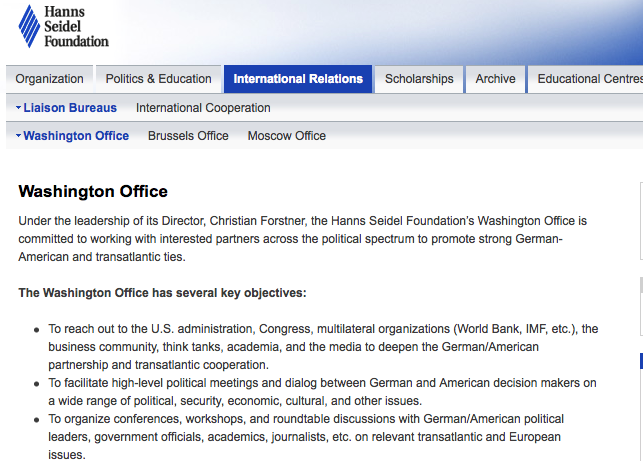
HSS through its Washington office has routine consultations with the US government, Congress, think tanks, including major partner foundations.
HSS is also in liaison with US based foundations including the NED, the Ford Foundation, the Open Society Foundation.
HSS continues to maintain close ties to the Kiev regime which is integrated by two Neo-Nazi parties. The CSU and the HSS have informal ties to German intelligence, the Bundes Nachrichtendienst (BND).
One of the main activities of the Hanns Seidel Foundation has been the co-optation of Leftist intellectuals and scholars. This has been carried out by financing key policy-oriented think tanks and research institutes.
Hanns Seidel in Venezuela
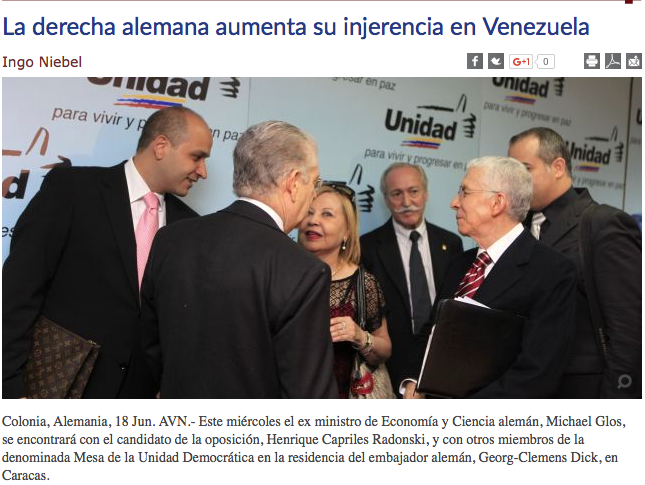
Of significance, the Hanns Seidel Foundation (HSS) was actively involved in financing the opposition candidate Henrique Capriles Radonski in Venezuela in the 2012 elections. Its activities extended far beyond its endorsement of Capriles’ candidacy. In its quarterly report, the HSS openly acknowledges its dislike of the Bolivarian process. In this regard, the HSS was involved in organizing a number of anti-government conferences, largely with a view to upholding free market capitalism (neoliberalism) and smearing the Chavez government. The HSS was also used to create links with right wing parties including Copei and Primera Justicia.
It is worth noting that more than forty years ago, the CDU and CSU parties (to which the Hanns Seidel foundation is affiliated) were involved in providing financial support to the protagonists of the military coup against president Salvador Allende. And in the wake of the coup, they provided economic aid to the military government of Augusto Pinochet.
HSS is still involved in Venezuela, financing a number of projects. Their unspoken objective is the destabilization of the Bolivarian government.
Hanns Seidel representing the CSU of Bavaria is also involved in the politics of several Latin American countries including Ecuador, Colombia, Argentina and Bolivia. In Ecuador the CSU through Hanns Seidel is cooperating with the Corporación Autogobierno y Democracia, Fundación Acción y Desarrollo Comunitario (ACDECOM) and various other organizations.
The Hanns Seidel Foundation in Cuba
Now let me turn my attention to Cuba, focussing on a specific activity of the Hanns Seidel Foundation in which I was personally involved.
In October 2015, I was invited to participate in an international venue of the Centro de Investigaciones de Politica Internacional (CIPI), a research centre and think tank affiliated to the Ministry of Foreign Affairs. The theme of the conference was to analyze the process of geopolitical transition opened up by the resumption of diplomatic relations between Cuba and the US.
Transicion geopolitica del poder global: entre la cooperacion y el conflicto
The event was funded by the Hanns Seidel Stiftung. Scholars were invited from Western Europe, Latin America, Africa, the US and Canada.
A few weeks following my acceptance to participate in the venue addressed to CIPI, I received a message from the Hanns Seidel Stiftung informing me that the event was supported by them and that the HSS would be funding all my expenses including an honorarium. The message stated that they would be in contact with me regarding issues pertaining to a contract. They also requested that I submit a so-called “propuesta de servicios” (offer of services).
I was fully aware of the track record of the HSS, specifically on how they had intervened in the Venezuelan 2012 presidential elections in support of Capriles Radonski, with a view to ultimately undermining Hugo Chavez.
I was shocked by the fact that CIPI had requested funding from HSS. The intent of HSS (acting on behalf of Bavaria’s CSU, a right wing party) in liaison with its partner organizations in Washington was to undermine socialism in Cuba. It also consisted in co-opting Cuban scholars and intellectuals in anticipation of a broad process of political change.
I responded to the HSS invitation indicating both to them and to the CIPI organizers that I would be funding my travel and accommodation expenses and did not see the need to receive funding from the HSS. This decision created confusion in the processing of my participation in the conference.
The October 2015 Conference
What happened: some very good contributions by prominent Cuban and Latin American scholars and scientists on a variety of important topics. But there were several black holes in the program no doubt related to the fact that the HSS linked to Bavaria’s CSU was funding the venue and had imposed its conditions.
1. A key session of the conference was on Venezuela, focussing on the future of the Bolivarian government and its historical relationship to Cuba.
Not a single participant from Venezuela had been invited to the Conference, thereby foreclosing a dialogue and discussion between Cuban and Venezuelan intellectuals.
All the presentations on Venezuela were by Cuban scholars.
No doubt the HSS had blocked the invitation of progressive Venezuelan intellectuals aligned with the Bolivarian revolution. The topic of the conference (i.e. transition and normalization with the US) is of crucial significance to both Cuba and Venezuela.
It should be understood that in the present context, the future of Cuban socialism largely hinges upon maintaining and building Cuba-Venezuela relations within the context of the Bolivarian revolution. The HSS was intent upon denying a political dialogue and debate between Cuban and Venezuelan intellectuals. The objective of the HSS was to undermine and weaken the longstanding relationship between Cuba and the Bolivarian government of Venezuela. Ironically, nobody among the Cuban organizers and participants was aware of Hanns Seidel’s dirty politics in Venezuela.
In contrast, the session on Mexico included four distinguished scholars from Mexico. There was a large delegation of Mexicans as well as from other Latin American countries. Not a single Venezuelan was invited.
2. A session on US Foreign Policy included Israeli academic Yossi Mekelberg associated with Chatham House, Royal Institute of International Affairs (UK), an arch-reactionary British think tank, with links to the Washington based Council on Foreign Relations.
The presentation by the Israeli academic provided a biased interpretation of what was happening in Syria and Palestine. The US led terrorist insurgency in Syria was casually described as a “civil war”, Palestinians were tagged as terrorists, and President Bashar al Assad was accused of killing his own people, much in the same way as the US-UK corporate media.
According to Mekelberg, quoted by
Newsweek, the ISIS “emulates” the Palestinians:
http://europe.newsweek.com/netanyahu-ramming-atttacks-isis-palestinians-inspired-541097?rm=eu
The Cuban scholars who were participating in this event did not take the trouble to react or express their disdain.
The question is why would such an individual (affiliated to Chatham House, supportive of the Zionist regime in Tel Aviv) be invited to socialist Cuba by a research centre associated with Cuba’s Ministry of Foreign Affairs?
Cuba has historically expressed solidarity with Palestine as well as with the struggle of the people of Syria and Iraq, who are currently the object of acts of military aggression by US-NATO.
Why did they not invite a committed socialist scholar from Palestine to debate US foreign policy? Was it a condition set by the Right Wing CSU of Bavaria via the Hanns Seidel Foundation (HSS)?
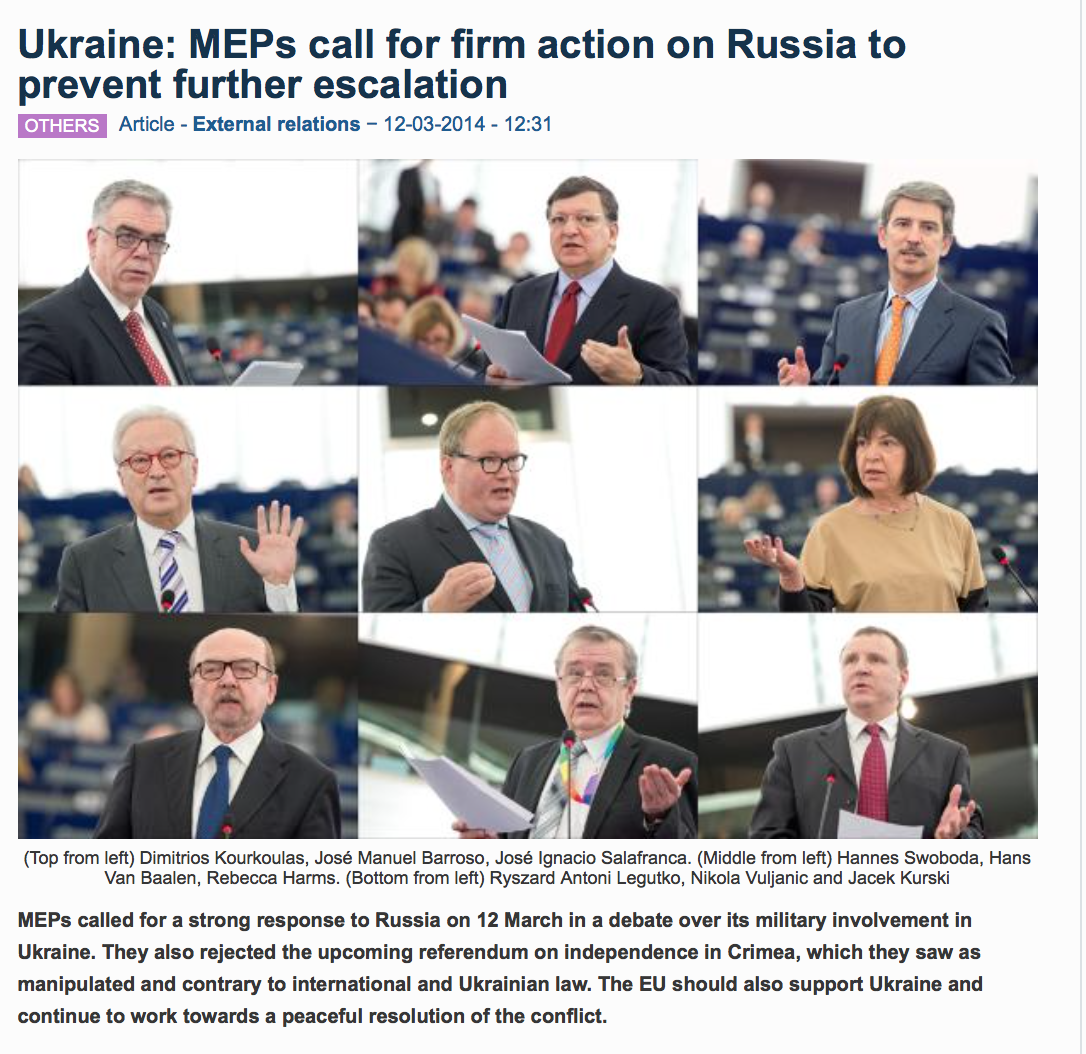
3. Another session focussed on Ukraine. Among the participants was the President of the Vienna based International Institute for Peace Prof. Hannes Swoboda, who is a (former) member of the European Parliament. Swoboda outlined his support for US-NATO in Eastern Europe directed against Russia as well as his endorsement of Ukraine’s Maidan Kiev regime (which is integrated by two Neo-Nazi parties). No reaction by the Cuban intellectuals participating in this venue was forthcoming.
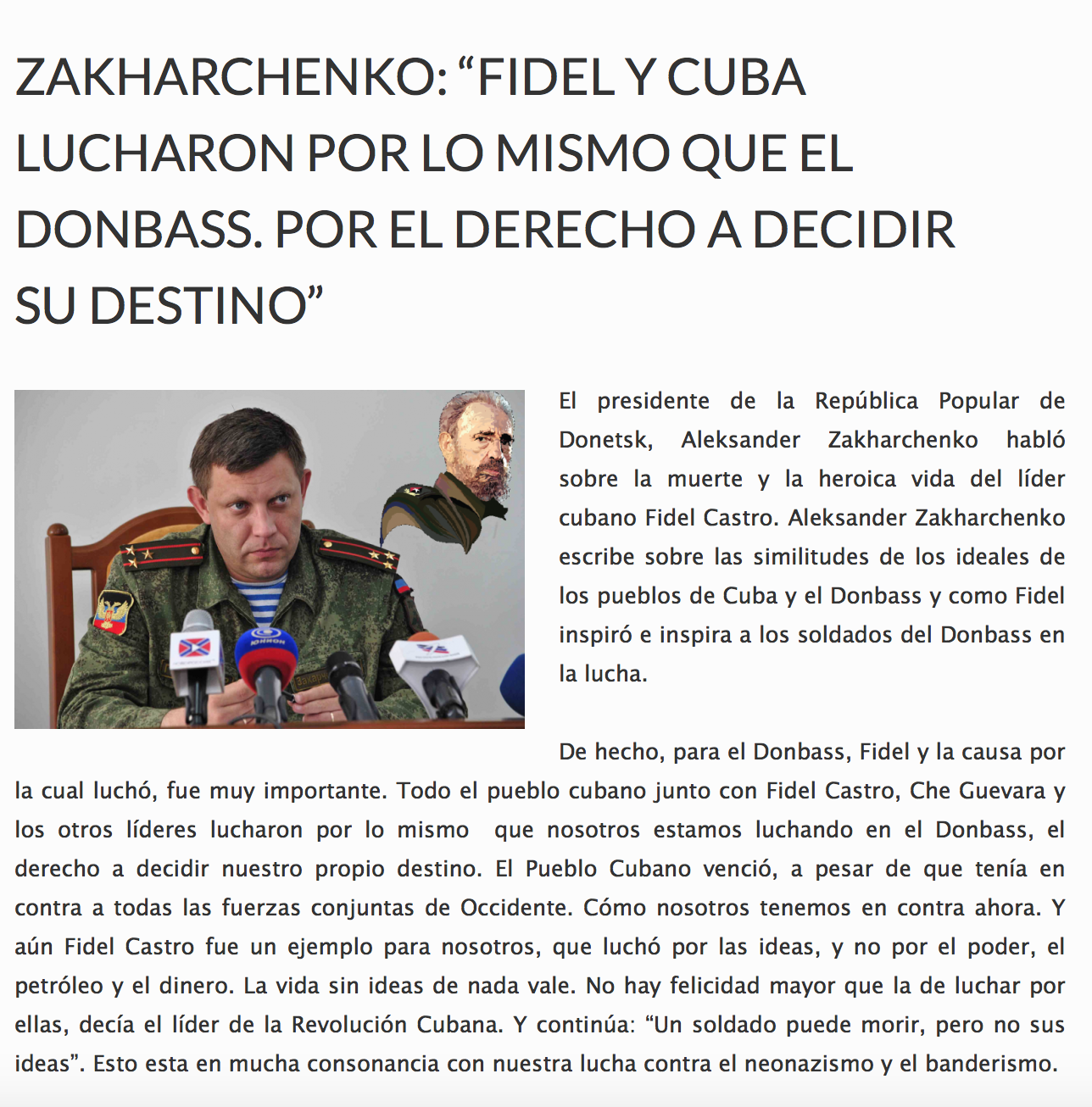
Lest we forget, the Cuban government has expressed its solidarity with the people of Donbass and Crimea. In turn, the people of Donbass acknowledged their solidarity with Cuba and the teachings of Fidel Castro (see below). But this was not an issue of debate at the CIPI Conference.
In the words of Fidel Castro:
Cuba, which has always stood in solidarity with the Ukrainian people, and in the difficult days of the Chernobyl tragedy provided medical care to the many children affected by the accident’s harmful radiation, and is always willing to continue doing so, cannot refrain from expressing our repudiation of the action of the anti-Russian, anti-Ukrainian and pro-imperialist [Kiev] government. (July 14, 2014)
Hannes Swoboda invited to Cuba by CIPI (to quote Fidel Castro) was “anti-Russian, anti-Ukrainian and pro-imperialist”. As MEP, he initiated (together with several other MEPs) the anti-Russian pro-NATO procedure at the European parliament, calling for support of the illegitimate Kiev regime, integrated by two Neo-Nazi parties. (see below)
Concluding Remarks, The Legacy of Fidel Castro
It is my sincere hope that what I have presented in this article will be the object of debate and discussion in Cuba.
The Cuban government is committed to protecting the achievements of the Cuban revolution. In the current context, this is no easy task. As outlined in the Introduction, Washington is intent not only upon destroying the Cuban Revolution, it also seeks to erase the history of socialism.
The intent of Western foundations –operating directly or indirectly on behalf of Washington– is to trigger divisions within Cuban society, through infiltration and co-optation, the ultimate objective of which isthe restoration of capitalism.
These mechanisms of co-optation are also facilitated by the dual currency system in Cuba, which has allowed Hanns Seidel and other European foundations to make payments to Cuban think tanks and research institutes in convertible currency (CUC).
Increased “dollarization” of retail consumer prices (expressed in CUC) is conducive to impoverishment and social inequalities.
Cubans are well aware of this evolving crisis: people who earn income in CUC convertible pesos have acquired purchasing power. In contrast, those whose earnings are largely in nonconvertible Cuban pesos are excluded from the CUC consumer economy.
Washington’s broader intent is to implement measures which contribute to destabilizing the Cuban economy and its monetary system, namely to reintegrate Cuba into a dollarized World economy.
Procedures are also envisaged by Washington to eventually reintegrate the Cuban economy into the nexus of the IMF-World Bank-WTO, including the imposition of policy conditionalities geared towards dismantling Cuba’s social programs, its rationing of essential consumer goods, etc.
It is essential to block these initiatives. Debate and discussion on the mechanics of “capitalist normalization” are crucial, both within Cuba and internationally.
A revolutionary narrative per se will not sustain Fidel’s legacy, unless it is backed by concrete actions and carefully designed policies.
The mechanics of capitalist restoration and the various modes of political interference and social engineering must be forcefully addressed.
The battle against war and neoliberalism prevails.
For the concurrent demise of neoliberalism and militarization which destroy people’s lives,
For the outright criminalization of America’s imperial wars,
For a World of Social Justice with a true “responsibility to protect” our fellow human beings,
Long Live Fidel Castro Ruz
The original source of this article is Global Research
https://www.globalresearch.ca/to-the-people-of-cuba-the-co-optation-of-cuban-intellectuals-is-washington-preparing-a-soft-coup/5557714
JUST NEWS published this article following the Creative Commons rule. If you don't want your article to appear in this blog email me and I will remove it asap.

 This aspect of thinking is known in Cuba. It is why its independence traditions, centuries-long, are so interesting, philosophically, although it’s largely unrecognized. In 1999 in Caracus, Fidel Castro said,
 It beats “smart weapons” because it’s about truth. Che Guevara told medical students in 1960: